![]()
The View from Youngstown
THE IDEA OF REBUILDING THE LABOR MOVEMENT FROM BElow is, at first glance, overwhelming.
How do we deal with the fact that in a time when most of us are taking the merest first steps toward a new kind of labor movement, are necessarily working at a local level and in a very preliminary manner, are barely scratching the surface of the huge collective task of rethinking the assumptions on which the labor movement of the United States has proceeded at least since the 1930s, and in some respects since the 1880s—that just at this moment, when our work is properly so tentative and decentralized, capital has reorganized itself on a scale ever more far-flung and international? Doesn’t the scope and power of capital’s reorganization make our work, by contrast, almost grotesquely irrelevant? In suggesting that our work might be of some historical significance, who do we think we are kidding?
Like each of you, in approaching these questions I can only draw on my own experience. Let me quickly sketch the constituencies with whom I have worked, and how each of them views the future of the labor movement.
First, there are workers in non-union shops. Many of them worked in steel mills before the Youngstown mills shut down in 1977–1980. Others are Blacks and women trying to get a foothold in the labor force. Wages are typically very little above state and federal minimum requirements of seven to eight dollars an hour. Safety and health conditions are atrocious. Yet these workers, who it would seem have every reason to belong to unions, have been disillusioned by the performance of big existing unions as they have experienced it, or been told about it. Some have worked for a series of companies that shut down or went bankrupt, while unions stood by helpless. After one too many bankruptcy, plant closing, or concession contract, the non-union workforce in the Mahoning Valley is looking for something different than joining the Steelworkers, or the Teamsters, or the autoworkers.
Secondly, there are persons who belong to existing unions. In some cases the union headquarters is an hour and a half away in Cleveland and meetings are never held in Youngstown. In others the members do not even know the name of the union to which they belong. The largest unionized work force in the area is at General Motors Lordstown. Workers there do know the name of their union. In 1990, they also knew the name of the chairman of the board, Roger Smith. That year GM gave each Lordstown worker a profit-sharing check in the amount of fifty dollars. Workers at Ford and Chrysler received thousands of dollars. Lordstown workers responded by circulating, first, a picture of three fifty-dollar bills with Roger Smith’s face in the middle (instead of the picture of U.S. Grant), and second, a leaflet ending with the words: “when … you really feel you’d like to quit, don’t come to me, I don’t give a shit. ROGER SMITH.”
Lordstown management then posted an Information Bulletin to the effect that Shop Rule #29 had been modified to cover “the making or publishing of malicious statements concerning any employee, the company or its products.” The UAW locals have done nothing to challenge this shop rule, just as they did nothing to challenge the previous management practice of requiring employees to get leaflets approved by GM Labor Relations before passing them out in the plant parking lot.1 The prevailing atmosphere is cynicism. The strongest single emotion is fear that the plant will close.
Finally, there are former members of unions who are retired or disabled. They may be the most alienated of all. For example, in 1990 LTV Steel had (nationwide) 13,800 active workers and 46,000 hourly retirees. Such retirees are no longer union members, do not vote for union officers, and have no voice in the negotiation or ratification of changes in their pension and medical benefits. In the 1990 LTV Steel contract, ratified by active workers alone, the average active worker received $7.25 in contract improvements for every $1 received by the average retiree. There was a company-wide retiree protest movement. Among its demands were that retirees should have the right to vote on contract provisions changing their benefits.
All in all, the Youngstown scene is a bleak one. But the people just described have created some interesting organizations.
THE WORKERS’ SOLIDARITY CLUB
The Workers’ Solidarity Club can best be described as a parallel central labor union, to which rank-and-file workers, unemployed persons, and retirees could come when they needed help in their various struggles. Several members wrote this about the Club:
We wanted a place where rank-and-file workers could go to get strike support without a lot of hassle and delay. We were disillusioned with big national unions that encourage their members to “pay your dues and leave the rest to us.”
We were called “rebels” and “dissidents” but we believed in solidarity, and we wanted a way to see each other regularly, share experiences, laugh at each other’s jokes, and dream up plans to change the world.
The Workers’ Solidarity Club grew out of classes at the hall of Utility Workers Local 118, where the Club met. Local 118 had been through a long strike a couple of years earlier. There was a core of members who were eager to give tangible strike support to other workers on strike. In the fall of 1981, we held a series of discussions at the hall on the topic, What has gone wrong with the labor movement? We talked about all kinds of things, for instance the new encyclical by the Pope called “On Human Labor.” As the discussions drew to a close, we realized we didn’t want to disband. We gave ourselves a name and started to meet monthly.
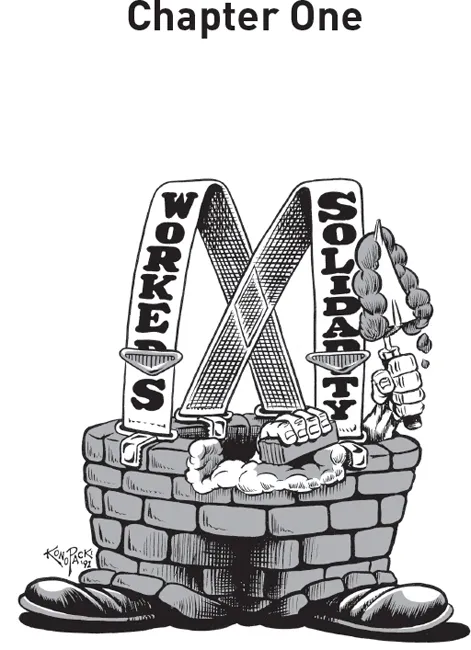
From the beginning, the Club was extremely informal. There were no officers except a treasurer. Two members got out a monthly notice describing what was expected to happen at the next meeting. Individuals volunteered (or were volunteered at the last moment) to chair particular meetings. If there was a speaker at a particular meeting, the person who invited the speaker was likely to become chairperson. There were no dues, but by passing the hat we raised hundreds of dollars for legal defense, publications, and travel expenses. We also raised money by selling bright red suspenders with the words “Workers’ Solidarity” silk-screened in black. Beer at the end of every meeting, and annual picnics and Christmas parties, kept us cheerful.
Lots of Unions
The Workers’ Solidarity Club was like a Wobbly “mixed local,” or a local branch of Polish Solidarity, in that its members came from many different trades and unions. A typical leaflet was signed by twenty-five people. Of these, seventeen were current employees; they worked for Ohio Edison, Schwebel Baking Company, LTV Steel, and other enterprises. Six of the seventeen were stewards or local union officers. The remaining signers were retired or unemployed. The signers included current or past members of the Utility Workers, the Laborers, the Steelworkers, the Bakery Workers, the Teamsters, the Mineworkers, the Ohio Education Association, and the Amalgamated Clothing Workers.
Our first big action came in the summer of 1982. Service and maintenance workers at Trumbull Memorial Hospital in Warren, Ohio, organized in an AFSCME local, went on strike. Two members of the Club visited the picket line. The Club put out a series of leaflets. The leaflets appealed to strike-breakers not to cross the picket line. The first leaflet began: “THINK before you cross a picket line. Think before you take your neighbor’s job.”
The leaflet also invited members of other unions to rally every Wednesday afternoon in front of the hospital. The rallies grew larger and larger. People brought homemade banners and signs, and chanted slogans like: “Warren is a union town, we won’t let you tear it down.”
On October 13, 1982, there was a confrontation with the Warren police. Thirteen demonstrators were arrested, including three members of the Club: Ed Mann, retired president of a steelworkers’ local; Greg Yarwick, a member of Local 118; and Ken Porter, laid off from a local cement company. The other arrestees entered agreed-on pleas for lesser offenses and paid a fine. Ed, Greg, and Ken pled not guilty, and were convicted of conspiracy to riot and resisting arrest. With the help of the ACLU they appealed to the Court of Appeals and Supreme Court of Ohio. In the end, not only were they acquitted, but the Club recovered $1,000 in court costs from the City of Warren.
As a result of all this mass activity, the AFSCME local survived the strike. After the strike, the Club conducted classes for sixty to eighty members of the AFSCME local at the hall of USWA Local 1375.
Other club activities included weekly picketing at the Bessemer Cement Company, which closed and cut off benefits only to reopen non-union under a different owner, and strike support for the Food and Commercial Workers. [After this article was written, the Club played a key role in supporting striking members of the Machinists at a Buick sales and service shop. Forbidden by a judge to engage in mass picketing, members of the Club invented the “honkathon”: trade unionists from all over the Valley drove slowly down the main street that passed in front of the Buick facility, honking loudly, and displaying colorful signs.]
Although there are three lawyers in the Club, we all agree that legal activity should reinforce mass activity, not the other way around. A local bakery became notorious for its many discharges. Club members were involved in picketing, NLRB charges, and a lawsuit, and the number of discharges decreased dramatically. Executives of one of the very few businesses to move to Youngstown since the steel mills closed, Avanti Motors, told the media that if a union were organized they might leave town. The Workers’ Solidarity Club filed a charge with the NLRB. Avanti Motors was obliged to post a notice promising not to threaten a shutdown, and the UAW proceeded to organize at the plant.
OUR OWN UNION ORGANIZING
In evaluating the Trumbull strike, many Club members felt that our role had been essentially reactive. Union leaders made decisions about strategy. Rank-and-file union members and strike supporters had to live with these decisions whether or not they agreed with them. The sentiment was expressed that the Club should seek ways to do its own organizing.
This was a long process. Club members were involved in three attempts to organize unions. One was successful. A small group of visiting nurses and home health aides formed an independent union for which they (not we!) chose the name Visiting Nurses Solidarity. Two other organizing drives, at medium-size metal fabricators, failed.
STARTING YOUR OWN CLUB
There are a couple of things we would like to share with others who might want to try something similar.
First, from the very first meeting a majority of those present were rank-and-file workers, or retirees. Rather than fast-speaking professionals or academics setting the tone, it was the other way around. While lawyers and academics (including the director of labor studies at the local university) took part, they were minority voices.
Second, we discouraged lecturing, and rarely made long written presentations. We think that a broader consciousness grew naturally from the experience of talking and acting together. Having lived through the way big corporations trampled on people’s lives in Youngstown, we found it easy to relate to Native Americans in the Southwest, or to Nicaragua. In 1988 four members of the Club went to Nicaragua and worked there for two weeks. One of them, an electric lineman, returned with a fellow worker to help bring electric power to small towns in northern Nicaragua.
Third, we didn’t feel the need to come to a group decision about the correctness of a proposed action before a member did something. Instead the member said, “I’m planning to do so-and-so. I need help. Anyone who wants to give me a hand, meet me” at such-and-such a time and place. Acting in this way gave us a chance to try things out in practice. It was like the experimental method in science. We were able to draw conclusions from what worked and what didn’t.2
SOLIDARITY USA
During and after World War II, management and organized labor in the United States undertook to provide through collective bargaining the “fringe benefits” that in other industrialized nations are financed by taxes and provided through the government. The pattern in communities like Youngstown was for people to work all their lives in one plant so as to become entitled to the pensions and medical insurance that such long service made possible. Workers took less in benefits because of the promise of benefits at retirement. They viewed pensions and medical insurance as deferred compensation, which they had fully earned by their labor at the time they retired.
This is the bargain that has collapsed under pressure from overseas competition. Corporations cannot now fulfill their promises to unions with respect to both pensions and medical benefits. A shrinking workforce in industries like steel cannot generate the cash flow needed to pay for the benefits of a much larger number of retirees.
The fringe benefit crisis came home to the Youngstown area when LTV Steel declared bankruptcy in July 1986. At the same time that it filed its bankruptcy petition, LTV Steel, a self-insured employer, directed the insurance companies that administered its benefit programs to stop paying medical and life insurance claims to retirees, about eleven thousand of them in or near Youngstown. The results were catastrophic. One retiree, Roy St. Clair, did not seek hospitalization for a heart attack because he did not know how he could pay the bill. He died a few hours later. Another retiree, Louis Lipka, blew his brains out in his bedroom because, according to his wife, he was worried about the family’s benefits.
Delores Hrycyk, wife of a retiree with thirty-six years at Republic Steel (one of the companies merged to form LTV Steel), telephoned radio talk shows and called a rally in downtown Youngstown. A thousand people attended. Soon after they formed an organization with the name Solidarity USA. Between August 1986 and March 1987 the group took busloads of retirees to the bankruptcy court in New York City, to Washington, DC, to sympathetic city councils in Pittsburgh and Cleveland, and to Aliquippa, Pa., where on several occasions retirees sat down in the street leading to the mill gate. Thanks to such efforts medical insurance was restored, and as of September 1990, when LTV Steel came out of bankruptcy, LTV Steel reti...