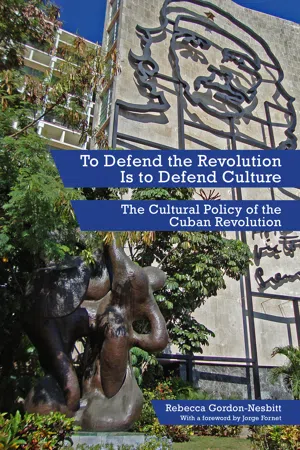
To Defend the Revolution Is to Defend Culture
The Cultural Policy of the Cuban Revolution
- 448 pages
- English
- ePUB (mobile friendly)
- Available on iOS & Android
To Defend the Revolution Is to Defend Culture
The Cultural Policy of the Cuban Revolution
About this book
Grounded in painstaking research, To Defend the Revolution Is to Defend Culture revisits the circumstances which led to the arts being embraced at the heart of the Cuban Revolution. Introducing the main protagonists to the debate, this previously untold story follows the polemical twists and turns that ensued in the volatile atmosphere of the 1960s and '70s. The picture that emerges is of a struggle for dominance between Soviet-derived approaches and a uniquely Cuban response to the arts under socialism. The latter tendency, which eventually won out, was based on the principles of Marxist humanism. As such, this book foregrounds emancipatory understandings of culture.
To Defend the Revolution Is to Defend Culture takes its title from a slogan – devised by artists and writers at a meeting in October 1960 and adopted by the First National Congress of Writers and Artists the following August – which sought to highlight the intrinsic importance of culture to the Revolution. Departing from popular top-down conceptions of Cuban policy-formation, this book establishes the close involvement of the Cuban people in cultural processes and the contribution of Cuba's artists and writers to the policy and praxis of the Revolution. Ample space is dedicated to discussions that remain hugely pertinent to those working in the cultural field, such as the relationship between art and ideology, engagement and autonomy, form and content. As the capitalist world struggles to articulate the value of the arts in anything other than economic terms, this book provides us with an entirely different way of thinking about culture and the policies underlying it.
Frequently asked questions
- Essential is ideal for learners and professionals who enjoy exploring a wide range of subjects. Access the Essential Library with 800,000+ trusted titles and best-sellers across business, personal growth, and the humanities. Includes unlimited reading time and Standard Read Aloud voice.
- Complete: Perfect for advanced learners and researchers needing full, unrestricted access. Unlock 1.4M+ books across hundreds of subjects, including academic and specialized titles. The Complete Plan also includes advanced features like Premium Read Aloud and Research Assistant.
Please note we cannot support devices running on iOS 13 and Android 7 or earlier. Learn more about using the app.
Information
Table of contents
- Cover
- Praise for To Defend the Revolution Is to Defend Culture
- Title Page
- Copyright
- Dedication
- Contents
- Acknowledgements
- List of Illustrations
- Key to Institutions and Abbreviations
- Foreword: Jorge Fornet
- Preamble: Cuba as an Antidote to Neoliberalism
- One: Conceptualising Cultural Policy in Cuba
- Two: Revolutionary Rebuilding
- Three: The Emancipatory Potential of Culture under Socialism
- Four: The Early Cultural Climate
- Five: Cultural Policy 1961–7
- Six: The Cultural Congress of Havana (5–12 January 1968)
- Seven: Cultural Policy of the Revolution 1968–76
- Eight: Towards a Marxist-Humanist Cultural Policy
- Bibliography
- Appendix A: Towards a National Culture Serving the Revolution
- Appendix B: Timeline of Events Significant to Cultural Development in Cuba
- About the Authors
- Index