eBook - ePub
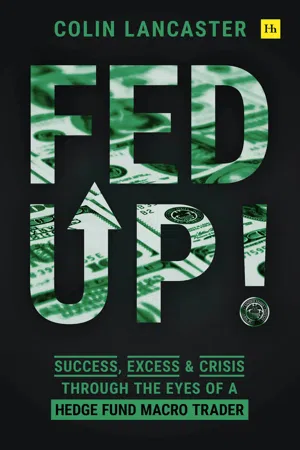
Fed Up!
Success, Excess and Crisis Through the Eyes of a Hedge Fund Macro Trader
- English
- ePUB (mobile friendly)
- Available on iOS & Android
eBook - ePub
About this book
Fed Up! tells the story of a global macro trader working amidst the greatest market panic we have seen since the Great Depression. As the COVID-19 pandemic spreads across the world, readers are taken through the late-stage decadence of an exuberant market bubble to the depths of the market crash and into the early innings of a recovery. It provides readers with a front row seat on trading activity, allowing them to experience the heartbeat of the markets.
It's also about money and opportunity. It's about the moral dilemma of a man who is struggling as he reaches his own peak. Readers will experience the frenetic pace of life as a trader and will connect with the protagonist, experiencing his struggle to balance his personal values with the compromised values of the world around him. It shines a light on the largest policy issues confronting the U.S., while offering an entertaining and humorous look at the guys and gals who are the new market operators.
This riveting account of the 2020 market crash from inside the mind of a global macro trader will serve as an exciting, nail-biting record of current times. It is about making fortunes while the world slips into misfortune.
Will he beat the markets or will the markets beat him?
Information
Part 1: The Late Stages of a Bubble
Chapter 1
Sushi, Sake and a Breakdown in the repo markets
October 2019
10/1/2019—Fed continues to pump liquidity via repo market; will continue at least until Oct. 10; balance sheet expanding, “not QE” QE.
10/4/19—Payrolls +136K for Sept. Unemployment rate drops to 3.5%, lowest since 1969.
10/11/19—President Trump announces US/China have reached an outline of a deal for phase 1 of trade negotiations.
10/11/19—Fed announces plans to buy $60B in T-bills each month. New actions are “purely technical.”
10/28/19—EC President Donald Tusk and UK Prime Minister Boris Johnson agree to “flextension”: Brexit deadline pushed from month-end to Jan. 31, 2020.
10/30/19—Fed cuts rates by 25 bps (1.5–1.75%), third cut in four months. Powell wants to pause unless the growth outlook deteriorates.
Month-end: UST 10s at 1.69%; S&P +2.2%; Nasdaq +3.7%.
I couldn’t take it anymore. The world had $17 trillion of negative yielding debt, global growth was at stall speed, and wealth inequality was out of control. Greed was back in vogue. And outside, it was turning to fall. The days were growing colder, and it had rained solid for the past eight days. Even for London, it sucked.
And then this. A tweet from the President of the United States of America:
As I have stated strongly before, and just to reiterate, if Turkey does anything that I, in my great and unmatched wisdom, consider to be off limits, I will totally destroy and obliterate the Economy of Turkey (I’ve done that before!).
Most of the world, me included, had become numb to this type of tweet. But this one, well, it broke my back.
It wasn’t about the politics, or the fact that we had taken a long position in the Turkish lira, which was about to get jammed down our throats. The Big D, the leader of the free world, in his “great and unmatched wisdom,” had openly threatened another world power in a mere 140 characters. How could the US president post this to social media? Was this all a dream, some sort of parallel universe? A big mistake?
But fuck it. We’re in a ten-year bull market and are starting to make money again. A lot of money. It’s been a while since we had a month like this. It’s time to celebrate. Even the recent yield curve inversions, such as the three-month/ten-year Treasury spread, are back to positive.1 These positives might just be a nail in the coffin in terms of the predicted upcoming recession. After all, they say the market is the best predictor of recessions, and yield curve inversions like this don’t lie. They’re never wrong. But not today. The Federal Reserve—the world’s biggest central bank—is pivoting. Jerome (Jay) Powell, the head of the Fed, is making a mid-cycle adjustment that will drive stocks higher. And there’s no way he can stop now. He has to cut rates again at the end of the month. Markets are going up.
As global macro traders we are paid to get these calls right. We are paid to understand what is going on in the world and to turn these views into cash. Think George Soros and Stan Druckenmiller, some of the best ever.
*
What is global macro, anyway?
When people say “macro,” a lot of people have visions of George Soros when he was “breaking the Bank of England” or Paul Tudor Jones when he predicted the ‘87 crash. These make or break trades helped to propel macro as an investment approach. But you have to remember that these guys are a lot more than one big trade. Their reputations were earned over decades of employing a disciplined, analytical investment process. I’m talking years and years of long hours and hard work, trying to make money in both bull and bear markets. It’s a hard thing to do.
The strategy’s broad mandate permits portfolio managers to invest in virtually any instrument, anywhere in the world. This makes it unique. It also makes macro managers great at cocktail parties since they can talk about almost anything. The origins of many high-profile global macro traders can be traced back to investment-bank proprietary trading businesses, and to places such as Commodities Corporation, and, of course, Soros Fund Management. These macro pioneers created platforms within their firms that trained a new generation of portfolio managers, a next wave of great macro investors, who started their careers at those earlier shops and went on to launch firms such as Duquesne Capital, Tudor Investment Corporation, Moore Capital, Caxton Associates, and Brevan Howard. Some started from a different lineage, launching their own firms, such as Ray Dalio at Bridgewater. More recently, firms such as Element Capital and Rokos Capital have risen in prominence. Many of the large multi-strategy hedge funds also have great internal macro teams working for them.
At its simplest, global macro investing can be boiled down to investing in assets on the basis of changes in the fundamental landscape: the ups and downs in growth and inflation and interest rates. It’s understanding business cycles and how government spending and central bank policies will impact those cycles. As George Soros pointed out in his book The Alchemy of Finance, monetary policy and normal business cycles impact each other. Furthermore, variables such as credit, housing, employment, inflation, and consumption all flow into this analysis. Equity experts will do a tremendous amount of work in understanding how a company operates. A macro expert tends to do the same, but on countries, not companies. The Holy Grail of macro is finding an imbalance. Maybe it’s related to growth, or interest rates, or a central bank’s reaction function, and then profiting from the moves in that country’s interest rates, or foreign exchange, or equity, or credit markets.
Investments are often made in a number of markets around the world and across different asset classes so that the various investments are, theoretically, noncorrelated. This can be both a blessing and a curse to macro investors. For any core view you have, there are many, many ways to express that view, should it be in equities, in fixed income, or in FX. One of the most frustrating moments for macro investors is when they get a view correct but have on the wrong expression and end up with zero profit and loss (PnL).
You end up with style points, but no one gets paid on style points.
Needless to say, the manager’s world view has to be constantly under review, and investments have to be made nimbly and flexibly. The best macro managers tend to change their minds a lot. When they do, they need to know they can get out of what they have.
Macro investors tend to be a pessimistic lot. Maybe this is because we know our own investors expect us to have our best years when the shit’s hitting the fan. They usually consider macro to be a diversifier against a broader portfolio of equities and other strategies that will be more correlated to overall market activity. We tend to look for the problem rather than the exciting new growth story.
In any event, the strategy’s modern roots really began after the Great Depression and WWII, when the international monetary system first left the gold standard, creating more trading variables in the fixed income and currency markets. In 1944, the Bretton Woods Conference addressed the financial order following WW2 to identify a replacement to the gold standard. This all resulted in a new system of exchange rates backed by the US dollar as its reserve currency. This new system all blew up in the early ‘70s. President Nixon killed the Bretton Woods Agreement and then a guy named Paul Volcker had to clean up the mess. The net result was that all major currencies began to float against each other. This really opened things up for the global macro guys. Overnight, you had an amazing number of new products to trade.
The strategy has changed since the Global Financial Crisis (GFC). Information is more readily available to virtually anyone, central banks have changed the markets, and the markets themselves have continued to evolve. Systematic strategies and the rise of the quants have made the markets more difficult. To help combat some of these factors, many firms started to embrace other, higher Sharpe-ratio strategies in lieu of the more traditional macro investing. In some ways, the classic macro approach has been a dying breed these past ten years. But still, there’s a lot of smart guys trying to earn a living doing this stuff and a crazy cast of characters of brokers and researchers who support their efforts.
*
The environment of 2019 has been tough. Up to this point in the year, it has been a big yo-yo. Stocks are up small, year-to-date, but over a twelve-month period, they’ve flatlined. Bonds rally as the data weakens and then sputter. Stocks go up on trade optimism and then fall. And as usual, we are always watching out for the flash crashes. They appear with no warning, like black ice on a frozen highway. You’re long $750,000 per basis point in some EM curve steepener, and all of a sudden, it’s moving massively against you with zero liquidity.2 The car hits the ice, and you end up in a wreck.
At the end of the day, we macro traders have unique jobs. We are not paid to do anything productive for society. We are paid to turn a pile of money into a bigger pile of money. We are paid to compound wealth, generate alpha, deliver absolute returns, and make money in all market environments. We definitely have a lot to think about.
Particularly since I’ve been in a slump. It has been a couple of years since I outperformed the market, back when I was the top dog. But I’m no longer in the Bigs playing shortstop for the Yankees. Now, I’m a family office guy. But screw all that. We are making money again and t’s time to party.
I take the team to our favorite sushi spot near St. James’s. The waitress knows our order.
- spicy edamame
- three orders of yellowtail jalapeño
- two orders of salmon tartar
- three orders of sashimi salad
- Kobe beef sliced thin with ponzu sauce
- two orders of rock shrimp and king crab tempura
- three orders of black cod
- and some sushi: eel, toro, shrimp, yellowtail, and softshell crab rolls.
“Oh yeah, and bring me two ishobins of sake,” I tell the waitress as she walks away. “I want the Hokusetsu Onigoroshi.” They call it Devil Killer and ishobins are the biggest bottles of sake they carry. 1.8L bottles of liquid love. Everyone needs some Devil Killer these days, something to dampen the noise.
That’s one of the bigger changes over the last twenty years: the amount of noise, tweets, talking-head commentators, and a news cycle that spews it all out nonstop. It’s everywhere. You have to find a way to drown it out and focus on what matters. If you don’t, it will make you crazy. Just wait until next year, a US election year. The noise will be deafening.
When she brings the sake, I ask the waitress why they don’t have anything bigger than an ishobin. She smiles, shakes her head, and leaves our sake at the table, because she knows I like to pour it out myself. All the team members nudge their little matte-black sake cups toward me. There are five of us.
Elias is our trader. He executes our orders. Elias knows where to find liquidity. He’s smooth but always has an agenda. Talking faster than anyone I’ve ever met, he still manages to have a seriousness about him, since he knows that things in this business can change in an instant. He communicates with hundreds of people every day. A French Lebanese, with a great sense of humor, he has dating apps in three different languages in six different cities. He has an AMEX black card and gladly picks up bar tabs for the opportunity to flash it. We all know that he was sherpa’ed to the summit of credit-card Everest on the back of business expenses that were later reimbursed by the firm. But, for his targeted female demographic, the black card gets the job done. He has never saved a dime, but he has a rap, the mojo. Women love him.
Jerry builds our models. A blue-collar kid from a working family in Florida—I like that—ruddy complexion, educated as an economist, and eager to please, he was trained at one of our competitors, and I poached him away. Smart and hard working, he busts his ass around the clock, writing his own code and building economic models, but he’s naive and maybe a little too eager. He wants to make it in this business—to be rich, really rich—but he has no idea about the sacrifices he needs to make. To succeed, he must live this business. It must be his top priority. Not just the long hours he needs to work, but the sacrifices he needs to make to his values, his personal code. He needs to change. And who knows if he could handle the additional opportunities that come with that extra dough—not just business opportunities. I’m talking about a different kind of deal flow: blondes, brunettes, redheads, and all the other extras that find their way to you when you succeed.
Jerry likes to wear the skinniest of suits, but he’s starting to gain weight due to the long hours. And his name really isn’t Jerry. It’s a nickname from a movie.
Then there’s the Rabbi, heavy set with high blood pressure and an ornery edge. He’s our analyst. He went to a state school in the USA. Paranoid beyond all belief, he knows a bit about everything. He’s a permabear, the Eeyore of the markets, negative on everything all the time. But this is because he has seen people make mistakes, big mistakes, that cost them millions, even their lives. Back before the ‘08 crisis, before the tide went out, he made some of the greatest calls possible.
One time, we were shown a deal from a guy in Los Angeles. It looked like a sure thing. A three-Sharpe-ratio business looking to grow. The returns were literally too good to be true. It originated in Minneapolis with the Petters scams.3 A guy was pitching one of the funds as an investment opportunity. But the Rabbi was on it and told us to stay away. When the tide went out, it was left lying on the beach. It was exposed as a total fraud, a Ponzi scheme. Everything went to zero. This Los Angeles guy had put all of his friends and family into it, for a small finder’s fee of course. He went into a great depression. He never understood why the promoters had paid him so much money to raise capital when they had such great returns. He never recovered. Two months later, his wife found him hanging in his garage.
The Rabbi can sniff out these bad deals like a hunting dog. He has seen every bullshit sales pitch and has heard every story. There is no one better to bounce ideas off to figure out what you’re missing, where you’re wrong. He’s a human lifeline. In fact, he would probably be one of the best game show contestants of all time. He’s part James Holzhauer, part Cliff Clavin. Suspicious of his own mother. Twenty IQ points lower, and he might be sitting in his underground bunker in a tinfoil hat listening to the police scanner. He can also make a jukebox pop. I’ve seen him light up a dive bar better than Calvin Harris at Omnia.
Lifecoach is part lawyer, part CFA, part fixer, a daughter of immigrants, and one of the few people I know who still pulls all-nighters at work on a regular basis. She grew up in the suburbs and was taken back to her village for an arranged marriage, which she later blew up because she was too independent. That took guts. Basically, she has the same background as Christine LaGarde, but not political. She’s too blunt and loyal as hell. I trust her. She can also recite a standard ISDA agreement4 from memory, negotiate a complex derivatives transaction, and locate and lock up cheap leverage better than anyone. It cracks me up to watch her negotiate, because she has these big eyes and looks sweet and meek, and then she opens her mouth…
And me. I grew up in the ‘80s, the old guy now. I’m part of the wave that’s being replaced by computers, machines—Death of a Salesman, macro style. This is a young man’s game. I was a blue-collar kid, a hockey player. I wear the battle scars on my body like the old seal at the zoo. Not quite Keith Richards—he has us all beat—but you get the idea. Away from my team, I don’t trust many people. That’s what twenty-five years on Wall Street does to you. You don’t see the good in people as you used to. That bright-eyed, bushy-tailed stuff wears off fast in this business. You just assume everyone is trying to pick you off. I’m from Detroit. That’s probably all you need to know. That and I’m going grey. My kids tell me I’m starting to look like Beethoven.
Everyone is wearing the team uniform, except Lifecoach. Dress pants, button-down shirt and fleece vests. Walk around Mayfair or watch Billions. You’ll get it. Lifecoach prefers Hermès. Just look for the scarf.
We are sitting at our normal table in the restaurant, waiting for the food to arrive. A headline has just hit on WeWork, and all of us are checking our phones. WeWork is run by a guy named Adam Neumann, and its largest shareholder is a company called SoftBank, run by Masayoshi Son.5 SoftBank has been pouring money into fast-growing tech companies. Masa Son famously lost $70 billion, the most money lost in stock market history, during the dotcom bust. He’s back at it again and swinging for the fences. WeWork is his new crown jewel and is considered one of the unicorns.
Unicorns are high-flying growth companies with valuations in excess of $1 billion, companies that don’t actually make any money. No shit. They have no earnings. You see stuff like that in a ten-year bull market. But WeWork is a special case. They got greedy. They tried to monetize too quickly and wanted to do an IPO and go public. This forced them to provide transparency in their business records and their problems, all for the world to see, in massive footnotes in tiny font. Unfortunately for WeWork, when a company wants to go public, there are analysts whose sole focus and pay depends on doing a deep dive into these records and reading and re-reading the footnotes to unearth the dead bodies. It’s now a shit show.
Jerry has been obsessed with Neumann. He stalks the guy over the Internet. “Hey, Boss, you think Masa Son is going to bail out WeWork?” Jerry doesn’t understand how a company raises $14 billion over nine years and rents more office space in Manhattan than anyone else, but still considers itself a disruptive tech company. But there is more to it than that. There’s missed opportunity regret as well. For people like Jerry, who got into the business postcrisis, it has been a stunted decade, particularly for macro. It has not brought the spoils of past decades.
He often rants to me about what could have been. “You know, when I graduated and decided to go to Wall Street, we were supposed to be the next masters of the universe. These tech guys cramped in their parent’s basements not getting laid, while we were working eighty-hour weeks, shuttling around in black cars, client dinners at Nobu and Peter Luger’s, tables at the best clubs. We were busting our asses while they designed new photo filters and poop emojis. All nonsense. Except it wasn’t. They all got really rich.”
I ignore his rant—I’ve heard it before—and answer his question. “Yeah, Jerry, for Neumann, it’s another free option. There are always guys like Neumann.”
The Rabbi jumps in. “Neumann has SoftBank so exposed they can’t afford to stop now. They’ll have to throw more money at it.” He’s pouring out a round of sake. I hadn’t realized the sake cups were empty, because I was too distracted by my phone.
“It’s a shitty business model. They’ve never made money.”
He’s right on this. WeWork lost ninety million bucks in Q1 of 2016 and has continued to lose money ever since. When the Rabbi is talking, everyone is pin-drop silent.
“But Neumann will get paid. He owes everyone else too much money—the landlords, Masa Son, everyone. You know the saying. If you owe a bank a dollar, that’s your problem. If you owe a bank a billion dollars, that’s their problem, and you own them. Same old story. I like companies I can understand, where the founder is not doing deals from his hot tub.”
Jerry looks up at me. “Will the market crack on this?”
“Jerry, what did you learn from Liar’s Poker?”
“To watch the two-year, Boss.”
“What happens if you don’t watch the two-year?”
“If you don’t pay attention to the two-year, you get your fuckin’ face ripped off.”6
“Thank you, Jerry. And what is the two-year doing?”
“It’s stable.”
“That answers your question. The Fed will keep going. Markets are okay.”
“You know, Oyo is next,” the Rabbi says. “It’s the next one to tank in SoftBank’s book. I hate that company. I don’t care how many hotels they have these days or how well positioned they’re in the hospitality market. They’re totally overleveraged.”
At some point in the conversation, the waitress has put the food down. Jerry has already finished an entire serving of salmon tartar and dropped some spicy mayo on his shirt.
Elias puts his chopsticks down on their rest. He tells me he wants more computer monitors. He always wants more screens. Trading desks are no longer like the ones in the movie Wall Street. They’re not two old IBM box sets and a bunch of phones. Trading desks have evolved. The best execution guys now want their own sports books, something Derek Stevens would be proud of. They want walls of computer screens so high they block access and draw attention from fire marshals. Elias currently has a bank of nine screens in stacks that are three screens wide. He wants more. It’s all a big dick measuring contest. I know guys who have given their set-ups nicknames such as Death Star or Millennium Falcon.
Our conversation goes on until plates are clean and the sake is gone. I need to go home to get some sleep. In the old days, I wouldn’t miss a chance to go out. But I’ve felt tired lately and am leaving for New York in the morning. I head home to Knightsbridge. The rest of them are off to Mahiki.
My wife, Caroline, is already sleeping by the time I get home. My side of the bed is still made, but she has neatly tucked herself under the duvet on her side. She’s a light sleeper, so I know she has heard me come in, but she doesn’t say anything. I quietly slip in and go to sleep.
*
I land in New York. Back to reality. I turn on my phone to an announcement that Jay Powell delivered, as promised, and the Big D tweeted on a “very good” trade deal with the Chinese. The statement from the Fed said their adjustment was “purely technical,” but such a triviality will be lost on the market, as will the reason for needing to do this. All that matters is that the Fed’s printing. Let the good times roll. Stay long. We need to buy more Nikkei and Eurostoxx, and the euro should have upside from here. Bonds should sell off and the curves will steepen. And of course, more FANG stocks. People can’t get enough of Facebook, Amazon, Netflix, and Google’s parent company, Alphabet. Risk on! Our book, our portfolio of investments and trades, is set up for this.
It’s all kind of crazy. We are long risk in about a dozen different ways, but I’m about as negative as I have ever been on the world. Brexit, slow growth, trade wars, muddled-up foreign policy, a lack of investment, impeachment, and central bank balance sheets are back near all-time highs. And that doesn’t even factor in the more foreboding signs, such as the inverted yield curves that tell us that we are headed toward something darker.
JFK airport is a dump. The highway into the city looks like a war zone, and the car I’m in feels as if it has no shocks or suspension. Shit. I can barely hold my phone to my ear there are so many bumps, and my AirPods are in my luggage. An hour and a half later, I’m finally downtown. It’s such a pain in the ass to get downtown. Now it’s almost 4 p.m., so no point checking into the hotel. I head to Goldman Sachs.
All of these market events are on my mind, and I’m in New York to try to get a fresh perspective. But the negatives are tough to shake, and the Goldman guys I meet with all agree. There are a lot of problems. But everyone seems convinced of one thing: that stocks are going higher because of the Fed.
I should feel better than I do. The markets are up. Shit. Since the last financial crisis, the markets are up huge, close to 500%. But I’ve got this nagging feeling that this is all bad in the long run. I guess experience has taught me that too much of a good thing isn’t really a good thing at all. It’s all sitting on a knife’s edge. If it weren’t for the central banks the markets would crash hard. And it all feels like such a game.
Maybe that’s the point. Maybe I just need to play the game better and shake myself out of my funk. If central banks keep supporting the markets, who really cares about those other issues? The markets will go higher.
*
I wake up early in New York to do a video conference with Jerry in London. Every couple of weeks I like to sit down with him to try to be a good mentor. He reminds me of me when I was young. I want the blue-collar kid to make it. During the sessions, we talk about something I have learned over the course of my career. I usually like to do these in my local pub, my comfort zone, but not today with the travel.
I sign in for the video call and am a bit surprised to see that he’s at home. There are boxes stacked in piles behind him, and the sound of a vacuum drones. The place looks a mess. His wife has recently come to London from the USA, with their new baby. I know they’re moving flats, but it always annoys me when people decide to work from home if they know I’m on the road. My annoyance comes through in my tone.
I’m going to need to keep this a bit shorter than usual due to my meeting schedule.
Today’s topic is the GFC. The crisis was ten years ago, when Jerry was still in school. I tell him that the GFC was my third crisis. My first was Long-Term Capital Management (LTCM) and the Asian crisis in ‘98. My second was the tech meltdown in 2000. But I can’t look at the markets now without thinking about 2008. It was a game changer. It was all about greed, capitalism run amok. It ended with massive bailouts and something called quantitative easing (QE). We will get to QE. That’s the biggest thing going.
The bubble all started in the late 1980s but really ramped in the 2000s, when the world moved away from rational thinking, away from Markowitz and modern portfolio theory to Pets.com. Alan Greenspan, the top guy at the Fed in those days, was there to drive the bubble even bigger. That’s when the central banks changed.
At the time, it looked innocent enough. Greenspan gave us low interest rates. They dubbed it “lower for longer.” But this was really just lighter fluid on a fire. It told people to get greedy. I’m not talking about everyday risk taking and speculation, normal human greed. I’m not even talking about Gordon Gekko in the ‘80s. This is much more than “greed is good.” I’m talking about steal as much as you can, and if you’re wrong, we’ll bail you out. I’m talking about too big to fail and moral hazard. I’m talking about Rihanna playing to a bunch of hustlers at a mortgage convention boondoggle.
“Does that mean that Greenspan caused it?” Jerry asks. I don’t think it’s the best question he could have asked. He has been doing this for seven or eight years now and should know this, but that’s what happens. People get caught up in what they’re doing and miss the big picture. I keep going.
“Look, it was not him alone. But he was a big fucking contributor.”
“But didn’t he try to hike?”
“He did, but he made it too easy, too predictable. Twenty-five basis points per meeting, like clockwork. He didn’t want to upset the status quo despite the signs of overheating and irrational exuberance. The market never had to guess, never had to price any uncertainty. He allowed everyone to take too much risk.”
I go on. “His policies helped build the bubble in the real-estate market. But then we saw lots of bad decision making. You know, stuff like ‘I can’t afford it, but I’m going to buy it anyway and will lie about my income in order to get it.’ This allowed the bubble to expand. And then everyone was on board: underwriters, appraisers, lenders, rating agencies. And finally, Wall Street took it to a new level. They built and sold the weapons of mass destruction: subprime mortgages, and all of their derivative by-products that exploded on the scene and took in and funded these real estate loans. They invented collateralized debt obligations (CDOs) and added an unimaginable degree of leverage.” I tell Jerry to go watch The Big Short. “Watch the bathtub scene and learn about these things,” I say.
“Then, in the summer of 2007, the subprime mortgage market began to fall apart. In September 2008, Lehman filed for bankruptcy. It was a disaster, good old-fashioned runs on the banks, total crisis of confidence. The financial system was on the verge of collapse. That’s when the Fed had to take rates to zero and start with QE. The bank had to take things to a whole new level. And that, my friend, has become the new normal.”
“Did they try anything else besides QE?” he asks.
“Yeah, they tried about everything. It was a combination of economic incentives, bailouts, and just finding ways to prop up the markets. Programs like Cash for Clunkers, TARP, TALF—you name it.7 The biggest of the programs allowed them to purchase all of the crap that the banks had bought, all of the illiquid, difficult-to-value crap. You know, stuff like the CDOs.”
I go on. “You should go read Andrew Ross Sorkin’s book Too Big to Fail. He describes it step by step.”
“Why did QE stick? Why is it still here?”
“It’s one of those cases where we were never able to get off the juice. QE was supposed to improve the real economy, but it never did that. The economy never got enough traction. All it did was to drive the prices of financial assets higher. You know, stocks and bonds.”
“I understand how it helps the rich ‘cause it pushes up prices,” he says. “But how does it hurt everyone else?”
“This is the age-old debate of wages versus capital. The rich folks live off their capital, which is invested in the markets. Everyone else lives off wages. The problem is that the economy never really improves. It just hovers at stall speed, and this causes wages to either stagnate or go down. So, if you’re living off your wages, you end up fucked. You’re taking a step backward. Plus, any savings you do have doesn’t earn interest, so you end up using them to maintain your lifestyle.”
“Oh, I see,” he says.
“Rich folks don’t have that problem since the markets keep hitting new all-time highs every ten minutes because they’re being propped up. They just keep getting richer.”
“What would happen if interest rates went up?” he asks.
“If they did, most governments would need to default. They couldn’t repay their debts. That’s why interest rates will never be allowed to normalize. They simply can’t. If they did, we are all insolvent, all bankrupt. We can’t service our debt. Okay, enough for now. I have to get to the rest of my meetings.”
I can see Jerry’s wife walking behind him on the video screen. I say a quick hello to be polite and end our session on FaceTime.
*
As I hop in my cab outside the Soho Grand Hotel, I say hello to the bellhop. He has been here for years and always remembers my name. Talking to Jerry gets me thinking, and as I get in the cab, my mind is focused on how capitalism is different now. Despite all the rhetoric of free markets, competition, deregulation, blah blah blah, the central banks and the governments increasingly pick the winners and the losers.
And they call it the superstar economy. This isn’t like past bull markets. This is not the ‘80s of your father. Back then, a lot more people got a piece of it, a rising tide lifted more ships. You could be a fat guy on the desk at Drexel from some middle-class family and make a fortune. But not now. Fewer and fewer take more and more. Most people are taking a step backward. They try to create the illusion that it’s not happening, that they’re actually moving forward, sort of like a Michael Jackson moonwalk. But the facts don’t lie.
And the guys at the top are all trained assassins. No more time to be all coked up at Studio 54. They have trainers, psychologists, meditation coaches, anything to increase their edge. And they all have another trait in common. They’re paranoid about failure, paranoid it will all go away, and they don’t have enough. No matter how much they have, they don’t think it’s enough to pay their bills.
I guess it just means that we broke capitalism and now we’re stuck with this bastardized version of it. We turbocharged it. We never fixed the problems of 2008. We just reshuffled the deck. We just took on more debt and made the problems even bigger.
I have a busy day. I’m meeting with all of our key trading partners, firms such as JP Morgan, Morgan Stanley, UBS, Citibank, Deutsche Bank, and CSFB. My meetings touch on the issues that have been on my mind. I want to dig deeper into the negatives and understand these banking experts’ views on what could pop the bubble. It’s a whirlwind tour of the largest risk takers and top economists at each of these firms.
Each of the meetings takes place in a grand conference room. They have drinks and snacks sitting on trays, but no one really touches them. I tend to like the scruffy little rooms right off the trading floors. But I’m getting the red-carpet treatment since I’m in from London. These are the big rooms on the executive floors. They seem too fancy for a bunch of traders, more suited for the bankers. I like the ones that don’t have artwork but papers and research reports thrown all over the place, and math equations written on the walls. But the ones on the nice floors always have great views: from Goldman, a great view of the Hudson River over to Jersey City; from JP Morgan, a great view of Midtown all the way to Central Park.
The meetings don’t make me feel much better. Each of the conversations seems to drift to the fact that we’re living on borrowed time. If we go back to the last couple of bubbles, we know that the seeds of the problem are artificially low interest rates. Low interest rates are like the first two drinks, when the buzz settles in. This magnifies the greed factor. The last two bubbles are good examples. You had the tech bubble and then the housing and credit bubble.
But the current one is an entirely different animal. It’s way bigger. This is the everything bubble. Leading up to 2008, the consumer was leveraging up. But since 2010, businesses and governments have been leveraging up. We have low rates, cheap credit, buybacks, unicorns—you name it. Reinhard and Rogoff feel like eons ago.8 That’s what we’re looking at, something on a much greater scale than anything we’ve seen before.
Weird stuff starts to happen in a bubble. For fuck’s sake, as I’m meeting with the team from UBS, I’m told that Greece just borrowed money with a negative yield. The lenders paid Greece to borrow the money, not the other way around. Look, I love Mykonos, but Greece is a bankrupt country. Truckloads of money shouldn’t be dumped in its backyard, and lenders okay with receiving less than they loaned. This is not supposed to be possible. It defies all logic.
As a last stop for the day, I grab a drink with one of my real-estate developer friends. I tell him about my concerns, and he says he’s ready for the next recession. He tells me his portfolio is bulletproof. This makes me laugh.
Let me tell you. When a market crash like the one in 2008 happens, there’s no way to prepare. If you’re long risk assets, you get slammed. Nothing is bulletproof. There’s no way to describe how bad it feels. There is no way to react. It’s all too late. Your book, the stuff you own, all goes against you every fucking day. You want to vomit. The risk guys tell you to sell stuff. But you can’t. There’s no liquidity. Everyone is selling, and no one wants to buy. You’re forced to hedge, to expand your balance sheet when all you really want is to get to flat, to get to safety. But that never happens. You’re along for the ride. You know, “Buy the ticket, take the ride.”9 I finish my drink and head to the airport. I’m on the overnight flight back to London.
As I settle into my seat, I keep thinking about the markets and the policies that are creating these problems. I used to love this stuff. In fact, that’s why I started doing it. Macro guys are different from other investors. We really get to think about the world and how government policies impact business cycles and real people. I used to love all of that learning. I’m not sure what changed, why I became so sour. As these thoughts are going through my head, I drift off to sleep.
*
I land in London early Saturday morning. I meet my driver and hop in the car. The radio is on and I hear “Orrrrrderrrrrrr. Orrrrrdeerrrrrr. I have listened carefully to the application from the right honorable gentleman, and I’m satisfied that the matter raised by him is proper to be discussed under Standing Order Number …”
It’s Brexit vote day. Boris Johnson is trying to ram his deal through. The currency has already popped 7% in the last week in the hope that this gets done, and we’ve been adding to our position the entire way up. It’s eight o’clock in the morning and BBC News is already in full gear. This will definitely be more entertaining than the Arsenal match later today.
Listening to the radio reminds me that the British Parliament does not usually meet on Saturdays. In fact, this is the first time since the Falklands War. That was back when the UK could still win an away match. But now they have Prince Andrew and Brexit. Speaking of the Falklands, Argentina, with an abundance of natural resources and a highly educated population, has also blown a great opportunity. Besides winning a World Cup, they haven’t done much, except, of course, default on their debt. The Argentines make WeWork look prudent. They’re defaulting machines, eight fucking times in total, almost nine. It’s really bad when you’re defaulting in a ten-year bull market.
I arrive at my house and turn on the television. Boris didn’t get his deal done, another delay. Bollocks to Brexit.
No sense in going anywhere. It’s still raining. Even my dog won’t go outside.
The markets are continuing to head higher, and I’m glad we added to our winners yesterday: our long equity exposure, our steepeners, and selling more volatility. I hate selling vol, but it’s one of the things this market forces you to do.
*
I only have one more night back in London, so Caroline and I decide to walk over to our favorite Chinese place on Brompton Road. We sit on our usual stools at the bar and order Beijing hot and sour soup, some dim sum, and a bottle of Pinot Grigio.
“So,” Caroline says, swirling her wine as she holds the glass stem between two fingers. “You’re leaving again tomorrow.”
“I don’t have any control over these things. You know how it goes.” I pass her my bowl of soup. “Plus, New Orleans is a dump. You don’t want to come anyways.”
“You moved us all the way over here. If you’re always in the US …”
“You know it’s the nature of the beast.”
I guess I should take it as a compliment that Caroline doesn’t want me to go again. Caroline and I met in college. She has been with me through it all. She’s one of those people who truly sees the good in everyone. She can make friends with a chair.
“I think I’m going to go back to school,” she says. She finishes the rest of her wine.
I nearly choke on my dumpling. “School?”
“Well now that the kids are off, and you’re gone all the time. I think it’s about time I do something for myself.”
*
It’s Tuesday, and I’m heading back to the USA with the Rabbi for an annual conference where top investors meet to discuss the markets. Traveling with him is like traveling with Led Zeppelin. Every flight starts with a trip to the British Airways executive club. The Rabbi is afraid to fly. He spends the time staring at his iPad, dissecting weather patterns and predicting turbulence during the flight. As I finish up my call with Lifecoach, who is updating me on the status of our financing, I notice the Rabbi popping two Ambien pills. He offers to share his pills with his neighbors at the bar, as if they were Tic Tacs. He has downed his third G&T when they announce that the flight is two hours delayed. Jesus, I’m going to have to carry him to the fucking gate.
We land in New Orleans, Louisiana (NOLA). The Rabbi and I walk down Bourbon Street. It’s depressing, poverty. It smells like urine. Everyone here has lost to the new rules. They haven’t gotten a raise since Hurricane Katrina. And it will get worse for them. But the people are friendly, nice. They’re different from people in London or New York. They smile more.
And I’m a sucker for a good Mac Rebennack song. Mac, known as Dr. John, combined jazz, blues, pop, and some amazing piano. He created a new sound. It moves me. We could all use more boogie-woogie, some voodoo influence in our lives. “If I don’t do it, somebody else will …” I can hear him singing it. Maybe that should be our new slogan. Put it on our flags. Let people know what we all stand for. We should promote this new era of moral hazard. God rest his soul.
The conference is focused on the toxins flowing through the markets. This is the stuff beneath the surface, not the shit that gets reported on the nightly news. Curve flattening, German yields negative out to thirty years, and EM volatility. No one likes to talk about this stuff; they don’t like to wreck the mood of a ten-year bull market.
The first panel is focused on the fixed income markets. They’re talking about the massive yield curve flattening we’ve witnessed over the past two months. This is not normal, they explain:
A normal yield curve should have a nice positive upward slope. Longer-term yields should be higher than shorter-term yields. A nice positive upward slope means that you’re paying a higher rate to borrow money for a longer period of time than for a shorter period of time. A sign of a healthy market. Simply put, a flat yield curve means that you pay the same to borrow money for one year as you do for ten or thirty years.
One of the panelists offers an explanation:
An upward sloping yield curve means that folks expect growth to continue into the future, a sign of optimism and a healthy economy. The banking system lies at the center of the economy, and an upward sloping curve helps them fulfill their role as lenders: they pay you to borrow your deposits and then lend at higher rates further out the curve.
A flattening yield curve indicates that the yield spread between long-term and short-term bonds is decreasing. Flat (or even worse, inverted) yield curves mean the economy is slowing and the central banks need to cut rates. They predict the next recession. This is the market voting with its money. The markets drive the shape of the yield curve, saying things are bad, they need to be fixed. Today, the front end of the Treasury curve is flat as a pancake; it has never been flatter. It’s telling us we are heading into a recession.
I’m at a group lunch with the Rabbi. He has just caused an awkward scene. We arrive at our a...
Table of contents
- Contents
- Part 1: The Late Stages of a Bubble
- Chapter 1
- Sushi, Sake and a Breakdown in the repo markets
- Chapter 2
- Viva Las Vegas
- Chapter 3
- The Star Tavern and Life in Knightsbridge
- Part 2: The Crash
- Chapter 4
- The Virus Spreads
- Chapter 5
- Risk Management and an Inflection Point
- Chapter 6
- Market Crash
- Part 3: The Aftermath
- Chapter 7
- QE Dreaming
- Chapter 8
- Economic Data Worse than the Great Depression
- Chapter 9
- Lessons from the Gilded Age; Back to Market Highs
- About the author
- Acknowledgments
- Publishing Details
Trusted by 375,005 students
Access to over 1.5 million titles for a fair monthly price.
Study more efficiently using our study tools.
Frequently asked questions
Yes, you can cancel anytime from the Subscription tab in your account settings on the Perlego website. Your subscription will stay active until the end of your current billing period. Learn how to cancel your subscription
No, books cannot be downloaded as external files, such as PDFs, for use outside of Perlego. However, you can download books within the Perlego app for offline reading on mobile or tablet. Learn how to download books offline
Perlego offers two plans: Essential and Complete
- Essential is ideal for learners and professionals who enjoy exploring a wide range of subjects. Access the Essential Library with 800,000+ trusted titles and best-sellers across business, personal growth, and the humanities. Includes unlimited reading time and Standard Read Aloud voice.
- Complete: Perfect for advanced learners and researchers needing full, unrestricted access. Unlock 1.5M+ books across hundreds of subjects, including academic and specialized titles. The Complete Plan also includes advanced features like Premium Read Aloud and Research Assistant.
We are an online textbook subscription service, where you can get access to an entire online library for less than the price of a single book per month. With over 1.5 million books across 990+ topics, we’ve got you covered! Learn about our mission
Look out for the read-aloud symbol on your next book to see if you can listen to it. The read-aloud tool reads text aloud for you, highlighting the text as it is being read. You can pause it, speed it up and slow it down. Learn more about Read Aloud
Yes! You can use the Perlego app on both iOS and Android devices to read anytime, anywhere — even offline. Perfect for commutes or when you’re on the go.
Please note we cannot support devices running on iOS 13 and Android 7 or earlier. Learn more about using the app
Please note we cannot support devices running on iOS 13 and Android 7 or earlier. Learn more about using the app
Yes, you can access Fed Up! by Colin Lancaster in PDF and/or ePUB format, as well as other popular books in Business & Trading. We have over 1.5 million books available in our catalogue for you to explore.