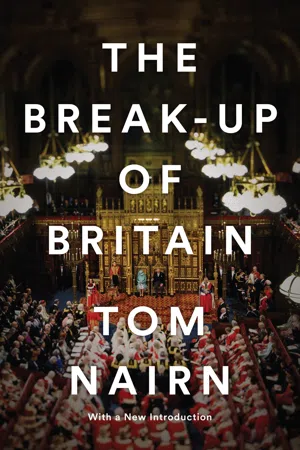
In this classic text, first published in 1977, Tom Nairn memorably depicts the 'slow foundering' of the United Kingdom on the rocks of imperial decline, constitutional anachronism and the gathering force of civic nationalism.
Rich in comparisons between the nationalisms of the British Isles and those of the wider world, thoughtful in its treatment of the interaction between nationality and social class, The Break-Up of Britain concludes with a bravura essay on the Janus-faced nature of national identity. Postscripts from the Thatcher and Blair years trace the political strategies whose upshot accelerated the demise of a British state they were intended to serve.
As a second Scottish independence referendum beckons, a new Introduction by Anthony Barnett underlines the book's enduring relevance.
- 464 pages
- English
- ePUB (mobile friendly)
- Available on iOS & Android
eBook - ePub
About this book
Information
1. The Twilight of the
British State
‘External conflicts between states form the shape of the state. I am assuming this “shape” to mean – by contrast with internal social development – the external configuration, the size of a state, its contiguity (whether strict or loose), and even its ethnic composition … We must stress that in the life of peoples external events and conditions exercise a decisive influence upon the internal constitution.’
Otto Hintze, The Formation of States and
Constitutional Development (1902).
Constitutional Development (1902).
Only a few years ago, the break-up of Britain was almost inconceivable. Southern, catholic Ireland had broken away from the United Kingdom in 1922; but there seemed little reason to believe that the protestants of Northern Ireland or the other minor nationalities of Wales and Scotland would follow their example.
Conditions were different in these other cases. Southern Ireland had been conquered country, displaying most of those features which in this century have come to be called ‘under-development’. Upon that basis, and mobilizing the deep-laid cultural differences provided by Catholicism, a largely peasant society had produced the classical nationalist reaction against alien rule which ended in 1922. As the century’s history of anti-imperialist struggle unfolded this seemed more and more a typical episode of it. Although unusually close geographically to the metropolitan centre, Southern Ireland had in fact been separated from it by a great socio-political gulf, by that great divide which was to dominate so much of the epoch: the ‘development gap’.
For this very reason, it appeared improbable that other regions of the British Isles would follow Eire’s example. There were episodes of conquest in the histories of Northern Ireland, Wales, and Scotland, true enough. But these had been followed or accompanied by episodes of assimilation and voluntary integration – and until the 1960s it looked as if the latter tendencies had triumphed. All three societies had, at least in part, crossed over the main divide of the development process. Unlike Eire, they had become significantly industrialized in the course of the 19th century. All three had turned into important sub-centres of the Victorian capitalist economy, and around their great urban centres – Belfast, Cardiff and Glasgow – had evolved middle and working classes who, consciously and indisputably, gave their primary political allegiance to the imperial state.
Through this allegiance they became subjects of one of the great unitary states of history. Absorption, not federation, had always been the principle of its development. From the period of Norman feudalism onwards, the English state had expanded its hold over these outlying areas and peoples. Until in 1800 – as one constitutional authority puts it – ‘there existed the United Kingdom of Great Britain and Ireland, and in the process of its development there was not the smallest element of federation’. None of the constituent countries of this multi-national state ‘retained even a modified sovereignty: that of each was melted in the general mass’.1
Such is the theory of the British state, and the notion of the British parliament’s total sovereignty still praised and defended in current debate. To understand it as more than that would be misleading. The ‘general mass’ has not, on the whole, been taken to mean civil society. The ‘unitary state’ in this form was compatible with civil variety in the different countries composing it: it did not necessarily seek to impose a uniform culture, language, or way of life. There have been examples of forced levelling, for instance in Wales or the Scottish Highlands; yet in the main ‘Anglicization’ was left to the slower, more natural-seeming pressures of one large central nationality upon the smaller peripheric areas.
In spite of the pressure, a lot of latitude was left by the system to the personality of the smaller nations. 19th and early 20th century British imperialism even encouraged such circumscribed patriotisms. A conservative pride in local colour and traditions went well with the grand design. Hence, until the secession of southern Ireland in 1922, a general formula of ‘Home Rule’ for all three countries was widely discussed and approved of. While the centre remained strong, such an approach did not appear too threatening. On the other hand, for the same reason – the strong, magnetic pull the metropolis had over its fringe lands – pressure for genuine self-government was not very great. Apart from the exception, Catholic Ireland, it remained weak until the 1960s.
Since then, in only a decade, it has swelled into the major political issue of the 1970s. It is worth underlining how quite unexpected and puzzling this change has been. Vague expectations about a possible transformation, or even collapse, of the British system after the defeat of its empire had been commonplace not for years but for several generations. Worried prognostications of this order go back to the 1890s or even earlier. It never took much political imagination to grasp that: (i) Great Britain was quite unusually and structurally dependent upon external relations tied up with its empire; (ii) Britain was due for demotion or outright defeat at the hands of the bigger, more dynamic capitalist states that expanded from the late 19th century onwards. Hence the loss of its critical overseas wealth and connections was bound to promote internal readjustments – or perhaps, as left-wing observers imagined with relish, a real social revolution. There was something suitable about this: the most inveterate and successful exploiters ought to suffer the most sensational punishment.
There is no doubt that the old British state is going down. But, so far at least, it has been a slow foundering rather than the Titanic-type disaster so often predicted. And in the 1970s it has begun to assume a form which practically no one foresaw.
Prophets of doom always focused, quite understandably, upon social and economic factors. Blatant, deliberately preserved inequities of class were the striking feature of the English social order. Here was the original proletariat of the world’s industrial revolution, still concentrated in huge depressed urban areas, still conscious of being a class – capable of being moved to revolutionary action, surely, when the economic crisis got bad enough. As for the economic slide itself, nothing seemed more certain. A constantly weakening industrial base, a dominant financial sector oriented towards foreign investment rather than the re-structuring of British industries, a non-technocratic state quite unable to bring about the ‘revolution from above’ needed to redress this balance: everything conspired to cause an inexorable spiral of decline. The slide would end in break-down, sooner rather than later.
Clearly the prophecies were out of focus, in spite of the strong elements of truth in them. The way things have actually gone poses two related questions. Firstly, why has the old British state-system lasted so long, in the face of such continuous decline and adversity? Secondly, why has the break-down begun to occur in the form of territorial disintegration rather than as the long-awaited social revolution – why has the threat of secession apparently eclipsed that of the class-struggle, in the 1970s?
In my view the answer to both of these questions depends mainly upon one central factor, unfortunately neglected in the majority of discussions on the crisis. This central issue is the historical character of the British state itself.
The Logic of Priority
The most important single aspect of the United Kingdom state is its developmental priority. It was the first state-form of an industrialized nation. From this position in the general process of modern development come most of the underlying characteristics of the system. A specific historical location furnished those ‘external conditions’, in Hintze’s sense, that ‘exercised a decisive influence upon the internal constitution’.
Critical analysis of the state-form has been retarded by two interrelated factors. The conservative account which has always insisted on the system’s uniqueness is in reality a mythology, and has been an important ideological arm of the state itself. But critical rejection of these mystifications, above all by marxists, has normally reverted into complete abstraction. Thus, a pious bourgeois cult of British priority and excellence has been countered by insistence that there is ‘in reality’ nothing special about the British state: like all others, it represents the dominance of a capitalist class.2
In developmental terms, it represented the dominance of the first national capitalist class which emancipated itself from city or city-state mercantilism and created the foundations of industrialization. From its example, much of the original meaning of ‘development’ was derived. For this reason the English – subsequently ‘British’ – political system was, and still remains ‘unique’ in a non-mystifying sense. These are peculiarities that owe nothing to the inherent political virtues of the British, and everything to the conditions and temporality of capitalist development in the British Isles. The multinational state-form that has ruled there from 1688 to the present time could not be ‘typical’ of general modern development simply because it initiated so much of that development.
This initiation goes back to the revolutionary era of English history, between 1640 and 1688. It is not necessary here to discuss the various accounts which have been given of the causes or unfolding of the upheaval.3 But few critics would dispute that it signalled the end of absolutism in the British Isles. By the beginning of the next century only the Celtic areas in the north and west retained a basis for restoring the absolute monarchy; and this attempt failed finally in 1746. Thus, the late-feudal state had effectively disappeared by the end of the 17th century, and the way had been opened – at least – for the development of a bourgeois society.4
To the conditions of that society there corresponded a new type of political state, first theorized by Thomas Hobbes and John Locke. ‘In the aftermath of the crisis … it became clear that despite differences in emphasis there was a strong converging tendency so that by the early 18th century the search for sovereignty was moving almost all the European countries towards the concept of the impersonal state’, writes one historian of the idea of the state.5 This common tendency, in time, produced the modern constitutional state of the 19th century. In 1843 Marx delineated the latter’s emergence as follows. The political revolution which had destroyed feudalism ‘raised state affairs to become affairs of the people, (and) constituted the political state as a matter of general concern, that is, as a real state, necessarily smashed all estates, corporations, guilds and privileges, since these were all manifestations of the separation of the people from the community…’. It posited a collection of abstract individuals – ‘citizens’ – whose collective will was supposedly represented by the abstract authority of the new state. The real life of these individuals, as property-owners, religious believers, workers, family men and women, etc., was consigned to the realm of ‘civil society’.6
This relationship between society and state was – as Marx indicates in the same place – first completely formulated by Rousseau, and realized in practice by the French Revolution. This second revolutionary era, from the American revolt of 1776 up to 1815, marked the definitive establishment of modern constitutionalism. Absolutism had been far stronger over most of the European continent than in England. Hence – ‘On the Continent, the full development of constitutionalism was delayed until the 19th century, and … it took a series of revolutions to achieve it’.7 It was these revolutions which formed the typical modern idea and practice of the state, imitated and reduplicated on an ever-increasing scale up to the present day. ‘With the exception of those of Great Britain and the United States,’ points out the same author, ‘no existing constitution is older than the 19th century, and most of those which existed in the first half of that century have since either entirely disappeared … or been so fundamentally amended and revised as to be in effect new.’8 But of course the association of the English and American systems is misleading here: the American was the firstborn of the moderns, and only the English represents a genuine survival.
Alone, it represented ‘a slow, conventional growth, not, like the others, the product of deliberate invention, resulting from a theory’. Arriving later, those others ‘attempted to sum up at a stroke the fruits of the experience of the state which had evolved its constitutionalism through several centuries’.9 But in doing so (as panegyrists of Westminster have always said) they could not help betraying that experience, which remained (in a sense far less flattering than the panegyrists believe) inimitable. Because it was first, the English – later British – experience remained distinct. Because they came second, into a world where the English Revolution had already succeeded and expanded, later bourgeois societies could not repeat this early development. Their study and imitation engendered something substantially different: the truly modern doctrine of the abstract or ‘impersonal’ state which, because of its abstract nature, could be imitated in subsequent history.
This may of course be seen as the ordinary logic of developmental processes. It was an early specimen of what was later dignified with such titles as ‘the law of uneven and combined development’. Actual repetition and imitation are scarcely ever possible, whether politically, economically, socially or technologically, because the universe is already too much altered by the first cause one is copying. But this example of the rule had one interesting consequence it is important to underline in the present context.
Most theory about the modern state and representative democracy has been, inevitably, based upon the second era of bourgeois political revolution. This is because that era saw what Marx called ‘the completion of the idealism of the state’, and the definition of modern constitutionalism. It established and universalized what is still meant by the ‘state’, and the relationship of the political state to society. Hegelian-based idealism and marxism were both founded upon study of ‘The classic period of political intellect … the French Revolution’ and its derivatives.10 As such, they naturally – even legitimately – neglected the preceding evolution of the English state. Far less defined and universalizable, this process embodied, and retained, certain original characteristics that in the later perspectives seemed ‘anomalous’, or even inexplicable.11 These traits have remained the preserve of worshippers within, and puzzled comment without. It is for this reason that the present political crisis in Britain raises such far-ranging and theoretical problems. While comparable to other problem-situations in Western Europe in a number of ways – e.g. Italy, as regards its economic dimensions, or Spain and France as regards its neo-nationalism – there is something important and sui generis about the British case. It is, in effect, the extremely long-delayed crisis of the original bourgeois state-form – of the grandfather of the contemporary political world. The passing of this ancestor calls for more than superficial commentary.
An Imperial State
The non-typical features of the British state order can be described by calling it ‘transitional’. More than any other society it established the transition from the conditions of later feudalism to those of modernity. More than its predecessor, the Dutch Republic, it gave impetus and direction to the whole of later social development. Yet for this very reason it could not itself be ‘modern’. Neither feudal nor modern, it remained obstinately and successfully intermediate: the midwife of modern constitutionalism, perhaps, as much as a direct ancestor.
Internally, this system presents a number of ‘peculiarities’ related to its historical location. It replaced late-feudal monarchy by a rule which was – as it remains today – patrician as well as representative. Because in this original case a spontaneously emergent bourgeois ‘civil society’ created the state, pragmatically, civil society retained an unusual dominance over the state. The only comparable examples were to be in social formations directly hived from England, like the white colonies or North America. Elsewhere the armature of the state itself was of incomparably greater significance in development: all the progeny of the ‘classic period of political intellect’ were to be relatively state-dominated formations, reflecting the harder circumstances of historical evolution in the 19th and 20th centuries. In turn, this original English civil hegemony had certain implications for the nature of civil society itself, to which I will return below.
But for the moment it is essential to stress something else. From the outset, all these internal conditions were interwoven with, and in reality dependent on, external conditions. As well as England’s place in developmental sequence, one must bear in mind its place in the history of overseas exploitation. As Marx indicated in Capital, success on this front was bound up with the primitive accumulation of capital in England itself.12 The new English state’s ascendancy over its competitors in colonization accompanied the crystallization of its internal forms.
Hence, a double priority was in fact involved: the temporality of England’s new capitalist social system was in symbiosis with the country’s maritime and conquering adventures. The latter remained a central feature of world history until the Second World War – that is, until long after English industrial capitalism had lost its pre-eminence, and indeed become a somewhat backward economy by many well-known indices.
It was the extraordinary external successes of the transitional English state that permitted it to survive so long. Otherwise, it would certainly have gone down in the wave of new, state-ordered, nationalist capitalisms which developed in the course of the 19th century. It too would have been compelled to suffer a second, modernizing revolution and the logical reorganization of its constitution and state: precisely that second political upheaval whose absence has been the constant enigma and despair of modern Britain.
But in fact the advantages gained through developmental priority were for long decisive. As the ‘industrial revolution’ waned from the mid-19th century onwards the more conscious and systematic exploitation of these advantages compensated for domestic backwardness. A ‘New Imperialism’ took over from the old, with the establishment of a financial control of the world market as its core. This mutation accorded supremely well with the character of the patrician state. It safeguarded the latter for another half-century, at the cost of ever-greater external dependency and ever more pronounced sacrifice of the domestic economy. As will be suggested in more detail below, this pattern has reproduced itself without fail not only into the last years, but into the last months and days of the present crisis: a slow, cumulative collapse determined not by the failure of ‘British capitalism’ alone, but by the specific underlying structures of an archaic state and the civil class-system it protects.
‘Imperialism’, in the sense pertinent to this prolonged trajectory, is somewhat different from the definitions now customarily given to the term.13 As with constitutionalism, theory has naturally been preoccupied in the main by later and more systematic developments: in this case the formation of modern European empires between 1880 and 1945, and the nature of the informal U.S. system which followed them. However, England’s pattern of foreign exploitation and dependency has lasted from the 16th century to the present, uninterruptedly. Like the state-form it made possible, it preceded and conditioned the rise of later rivals and – even while adapting to this new world, as in ‘New Imperialism’ – remained itself of a somewhat different nature.
This nature...
Table of contents
- Cover Page
- Title Page
- Copyright Page
- Dedication
- Contents
- Introduction: ‘Tom Nairn Is the One’
- 1. The Twilight of the British State
- 2. Scotland and Europe
- 3. Old and New Scottish Nationalism
- 4. Culture and Politics in Wales
- 5. Northern Ireland: Relic or Portent?
- 6. English Nationalism: the Case of Enoch Powell
- 7. The English Enigma
- 8. Supra-Nationalism and Europe
- 9. The Modern Janus
- Postscript 1981: Into Political Emergency
- Postscript 2003: 21st-Century Hindsight
- Acknowledgements
- Notes
- Index
Trusted by 375,005 students
Access to over 1.5 million titles for a fair monthly price.
Study more efficiently using our study tools.
Frequently asked questions
Yes, you can cancel anytime from the Subscription tab in your account settings on the Perlego website. Your subscription will stay active until the end of your current billing period. Learn how to cancel your subscription
No, books cannot be downloaded as external files, such as PDFs, for use outside of Perlego. However, you can download books within the Perlego app for offline reading on mobile or tablet. Learn how to download books offline
Perlego offers two plans: Essential and Complete
- Essential is ideal for learners and professionals who enjoy exploring a wide range of subjects. Access the Essential Library with 800,000+ trusted titles and best-sellers across business, personal growth, and the humanities. Includes unlimited reading time and Standard Read Aloud voice.
- Complete: Perfect for advanced learners and researchers needing full, unrestricted access. Unlock 1.5M+ books across hundreds of subjects, including academic and specialized titles. The Complete Plan also includes advanced features like Premium Read Aloud and Research Assistant.
We are an online textbook subscription service, where you can get access to an entire online library for less than the price of a single book per month. With over 1.5 million books across 990+ topics, we’ve got you covered! Learn about our mission
Look out for the read-aloud symbol on your next book to see if you can listen to it. The read-aloud tool reads text aloud for you, highlighting the text as it is being read. You can pause it, speed it up and slow it down. Learn more about Read Aloud
Yes! You can use the Perlego app on both iOS and Android devices to read anytime, anywhere — even offline. Perfect for commutes or when you’re on the go.
Please note we cannot support devices running on iOS 13 and Android 7 or earlier. Learn more about using the app
Please note we cannot support devices running on iOS 13 and Android 7 or earlier. Learn more about using the app
Yes, you can access The Break-Up of Britain by Tom Nairn in PDF and/or ePUB format, as well as other popular books in History & British History. We have over 1.5 million books available in our catalogue for you to explore.