
- 336 pages
- English
- ePUB (mobile friendly)
- Available on iOS & Android
eBook - ePub
About this book
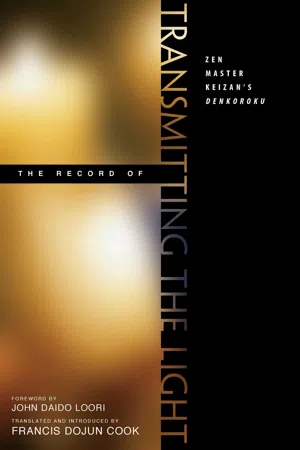
The Record of Transmitting the Light traces the inheritance of the Buddha's enlightenment through successive Buddhist masters. Written by a seminal figure in the Japanese Zen tradition, its significance as an historical and religious document is unquestionable. And ultimately, The Record of Transmitting the Light serves as a testament to our own capacity to awaken to a life of freedom, wisdom, and compassion. Readers of Zen will also find the introduction and translation by Francis Dojun Cook, the scholar whose insights brought Zen Master Dogen to life in How to Raise an Ox, of great value.
Frequently asked questions
Yes, you can cancel anytime from the Subscription tab in your account settings on the Perlego website. Your subscription will stay active until the end of your current billing period. Learn how to cancel your subscription.
At the moment all of our mobile-responsive ePub books are available to download via the app. Most of our PDFs are also available to download and we're working on making the final remaining ones downloadable now. Learn more here.
Perlego offers two plans: Essential and Complete
- Essential is ideal for learners and professionals who enjoy exploring a wide range of subjects. Access the Essential Library with 800,000+ trusted titles and best-sellers across business, personal growth, and the humanities. Includes unlimited reading time and Standard Read Aloud voice.
- Complete: Perfect for advanced learners and researchers needing full, unrestricted access. Unlock 1.4M+ books across hundreds of subjects, including academic and specialized titles. The Complete Plan also includes advanced features like Premium Read Aloud and Research Assistant.
We are an online textbook subscription service, where you can get access to an entire online library for less than the price of a single book per month. With over 1 million books across 1000+ topics, weâve got you covered! Learn more here.
Look out for the read-aloud symbol on your next book to see if you can listen to it. The read-aloud tool reads text aloud for you, highlighting the text as it is being read. You can pause it, speed it up and slow it down. Learn more here.
Yes! You can use the Perlego app on both iOS or Android devices to read anytime, anywhere â even offline. Perfect for commutes or when youâre on the go.
Please note we cannot support devices running on iOS 13 and Android 7 or earlier. Learn more about using the app.
Yes, you can access The Record of Transmitting the Light by Francis Dojun Cook in PDF and/or ePUB format, as well as other popular books in Theology & Religion & Religious Biographies. We have over one million books available in our catalogue for you to explore.
Information
THE RECORD OF
TRANSMITTING
THE LIGHT

SHAKYAMUNI
Case
Shakyamuni Buddha saw the morning star and was enlightened, and he said, âI and the great earth and beings simultaneously achieve the Way.â
Circumstances
Shakyamuni Buddha was of the Sun Race in India.1 At the age of nineteen he leaped over the palace walls in the dead of night, and at Mount Dantaloka, he cut off his hair. Subsequently, he practiced austerities for six years. Later, he sat on the Adamantine Seat, where spiders spun webs in his eyebrows and magpies built a nest on top of his head. Reeds grew up between his legs as he sat tranquilly and erect without movement for six years. At the age of thirty, on the eighth day of the twelfth month, as the morning star appeared, he was suddenly enlightened. These words [in the above case] are his very first lionâs roar.
From that time on, for forty-nine years, he did not spend a day alone but preached the Dharma for the assembly constantly. He was never without a robe and begging bowl. During that time, he preached to the assembly more than three hundred sixty times. Later, he transmitted the Treasury of the Eye of the True Dharma to Mahakashyapa, and it has been passed down from Mahakashyapa through generation after generation to the present. Truly, it has been transmitted through India, China, and Japan, where the practice of the True Dharma is based on it.
The practices of his lifetime are the standard for his descendants. Even though he possessed the thirty-two marks and eighty minor marks,2 he certainly looked like an ordinary old monk and was no different from other people. Therefore, after his appearance in the world, throughout the three times of the True Dharma, Counterfeit Dharma, and the present Collapsed Dharma,3 those who emulate his teaching and conduct model themselves on his deportment, use what he used, and each moment, while walking about, standing in place, sitting, or lying down, do as the Buddha did. Buddha after Buddha, and patriarch after patriarch have simply transmitted this so that the True Dharma is not extinguished, and this event clearly indicates this. Even though the method of expressionâvarious stories, figures of speech, and wordsâwas different on the more than three hundred sixty occasions during the forty-nine years, they are nothing more than the expression of this principle.
Teisho
The so-called I [in the main case] is not Shakyamuni Buddha, and Shakyamuni Buddha also comes from this âI.â Not only does Shakyamuni come from it but the great earth and beings also come from it. Just as when a large net is taken up and all the many openings of the net are also taken up, when Shakyamuni Buddha was enlightened, the great earth and all beings were enlightened. Not just the great earth and beings but all the Buddhas of the past, future, and present were also enlightened.
Since this is so, do not think that it was just Shakyamuni Buddha who was enlightened. You must not see any Shakyamuni Buddha apart from the great earth and beings. Even though mountains, rivers, and their myriad forms flourish in great abundance, none are left out of the pupil of Gotamaâs eye. All of you here are also established in the pupil of Gotamaâs eye. Not only are you established in it but, rather, it is enfolded within you. Also, the pupil of Gotamaâs eye becomes the fleshly body; it becomes the whole body of each person, standing like an eighty-thousand-foot precipice in each. Therefore, do not think that from the past to the present there was an eyeâs bright pupil and distinct people. You are the pupil of Gotamaâs eye; Gotama is the entirety of each of you.
If this is the way it is, what do you call this principle of enlightenment? Let me ask you, monks, does Gotama become enlightened with you, or do you become enlightened with Gotama?4 If you say that you become enlightened with Gotama, or that Gotama becomes enlightened with you, this is not Gotamaâs enlightenment. Therefore, this is not the principle of enlightenment.
If you want an intimate understanding of enlightenment, you should get rid of âyouâ and âGotamaâ at once and quickly understand this matter of âI.â âIâ is the great earth and beings as âand.â âAndâ is not âIâ as the old fellow Gotama. Examine carefully, deliberate carefully, and clarify this âIâ and this âand.â Even if you clarify the meaning of âI,â but you fail to clarify âand,â you lose the discerning eye.
This being so, âIâ and âandâ are neither identical nor different. Truthfully, your skin, flesh, bones, and marrow are totally âand.â The âLord of the Houseâ is âI.â It has nothing to do with skin, flesh, bones, and marrow, nor has it anything to do with the four elements or the five aggregates. Ultimately, if you wish to know the âUndying Person in the Hermitage,â how could it be something separate from this present skin bag? Thus, do not think of it as the great earth and beings.
Although the seasons change and the mountains, rivers, and great earth are different over time, you should realize that because this is the old fellow Gotama raising his eyebrows and blinking his eyes, all this is that body standing independently and openly within the myriad things. It brushes aside the myriad things and does not brush aside the myriad things. [Zen Master] Fayan said, âYou cannot say whether it brushes aside or does not brush aside.â5 [Zen Master] Dizang said, âWhat do you mean by âmyriad thingsâ?â6
Therefore, practice fully and sufficiently, develop full mastery, and clarify both Gotamaâs enlightenment and your own as well. You should figure it out by inspecting this case in detail. Let the answer flow from your heart without borrowing the words of former Buddhas or contemporaries. On the next day set aside for explanations, I want you to present your understanding with a decisive word.
Verse
This mountain monk would like to say a few humble words about this case. Would you like to listen?
A splendid branch issues from the old plum tree;
At the same time, obstructing thorns flourish everywhere.

MAHAKASHYAPA
Case
The first patriarch was Mahakashyapa. Once, the World-honored One held up a flower and blinked. Kashyapa smiled. The World-honored One said, âI have the Treasury of the Eye of the True Dharma and Wondrous Mind of Nirvana, and I transmit it to Mahakashyapa.â7
Circumstances
The Venerable Mahakashyapaâs family was Brahmin.8 In India, he was called âKashyapa,â which in our country means âMost Venerable Light Drinker.â When the Venerable One was born, a golden light filled the room and all of it entered his mouth. Therefore, he was called âLight Drinker.â His body had a golden color, as well as thirty marks, lacking only the protuberance on top of his head and the tuft of white hairs between his eyebrows.9
He met the World-honored One in front of the Stupa of Many Children. When the World-honored One said, âWelcome, mendicant,â his hair fell off as a result, he shed his earthly body, and he was [miraculously] clothed in the robes of a monk. Also, he was entrusted with the Treasury of the Eye of the True Dharma [by the Buddha]. He practiced the twelve austerities and never vainly wasted his time during the night or day. Seeing his emaciated body and uncouth clothing, the whole community of monks was struck with wonder. As a result, when the Buddha preached the Dharma, he shared his seat at each assembly with Kashyapa. From then on Kashyapa was the senior among the monks. Not only was he the senior monk at the assemblies of Shakyamuni but he was also the nonregressing senior monk among the assemblies of all past Buddhas.10 You should know that he was an old Buddha and not think that he was simply one of the Buddhaâs ordinary disciples.
Also, before an assembly of eighty thousand monks on Mount Grdhrakuta, the World-honored One held up a flower and blinked. None of the assembly understood his mind, and they remained silent. Mahakashyapa alone smiled. The World-honored One said, âI have the Treasury of the Eye of the True Dharma and Wondrous Mind of Nirvana, the Complete Pure Markless Teaching, and I transmit it completely to Mahakashyapa.â
Teisho
The so-called holding up a flower of that time has been intimately transmitted from patriarch to patriarch. It has not been indiscriminately transmitted to outsiders. Therefore, it has not been understood by teachers of the scriptures and treatises or even by many meditation teachers. In truth, they did not understand its true meaning. Be that as it may, this koan is not the koan of the assembly at Mount Grdhrakuta but rather the words transmitted at the Stupa of Many Children. It is not a matter of what was said on Mount Grdhrakuta, as claimed by the Chuan Deng Lu,11 the Bu Deng Lu, and others. When the Buddhadharma was transmitted the very first time [to Mahakashyapa] there was this kind of etiquette.
If you are not a patriarchal teacher who transmits the seal of Buddha Mind, you do not understand the occasion of his holding up the flower, nor do you understand [the spirit of] his holding up the flower. You must meticulously study and carefully experience it. Understand that Kashyapa is Kashyapa and clarify that Shakyamuni is Shakyamuni, and separately transmit the perfectly pure Way.
Put aside for a while the holding up of the flower and clarify the blinking. There is not a hairâs breadth of difference between your ordinary lifting your eyebrows and blinking, and Gotamaâs holding up of the flower. There is not a hairâs breadth of difference between your speaking and smiling and Mahakashyapaâs breaking into a smile. However, if you do not know who it was who raised his eyebrows and blinked, then Shakyamuni and Mahakashyapa are in India, and skin, flesh, bones, and marrow are within you. So many flowers in your eyes, so much floating dust! You have not yet been liberated for countless eons, and for eons to come you will be ruined.
If only once you thoroughly know the Lord,12 then Mahakashyapa will be able to move his toes in your sandals. Donât you know that Gotama completely vanished when he raised his eyebrows and blinked, and that Kashyapa was enlightened when he smiled? Isnât it our own, then? The Treasury of the Eye of the True Dharma has been completely transmitted to yourselves. Therefore, it cannot be called Kashyapa or Shakyamuni.
Never presenting this Dharma to others, never receiving the Dharma from anotherâthis is called the True Law. In order to indicate that, [the Buddha] held up a flower and showed that it was unchanging. [Kashyapa] smiled to show that it was eternal. In this way, Shakyamuni and Mahakashyapa became acquainted and their life pulses intermingled. Perfectly pure complete understanding is not involved with the ordinary discriminating mind, so [Mahakashyapa] sat in meditation and cut out the root of thought. He entered Mount Kukkutapada, where he awaits the future appearance of Maitreya. Even now, Mahakashyapa has not entered nirvana.
Monks, if you intimately study the Way and investigate carefully, not only is Mahakashyapa not extinct but Shakyamuni abides eternally. Therefore, [the Wondrous Mind of Nirvana], which has been directly indicated and intimately transmitted before you were born, has burgeoned and spread everywhere from antiquity to the present. Monks, do not yearn for the antiquity of two thousand years ago. If you just urgently practice the Way today, Kashyapa has not yet entered Mount Kukkutapada but can appear in Japan, Shakyamuniâs fleshly body will be warm right now, and Kashyapaâs smile will be new again.
If you can reach this place, then you will be a successor to Kashyapa, and Kashyapa will receive [the True Law] from you. Not only does it come down to you from the seven [past] Buddhas, but you will be able to be the patriarchal teacher of the seven Buddhas. Beginningless and endless, annihilating past and present, here is the abiding place of the entrusting of the Treasury of the Eye of the True Dharma.
For this reason, Shakyamuni also received the transmission from Kashyapa, who dwells now in the Heaven of the Satisfied,13 and you also abide in the assembly of Mount Grdhrakuta unchanging. Are you not familiar with the expression [by Shakyamuni, in the Lotus Sutra], âI always abide on Mount Grdhrakuta and other places, and at the time of the great conflagration [at the end of the world], my land is peaceful and calm, filled with celestials and humansâ?14 Mount Grdhrakuta is not the only abode [of the Dharma]. How could India, China, and Japan be excluded? The Tathagataâs True Dharma is transmitted and not so much as a hair of it is lost.
If this is so, this assembly [here] must be the assembly of Mount Grdhrakuta, and Mount Grdhrakuta must be this assembly. On the basis of your diligence or lack of diligence, the Buddha either appears or does not appear. Today, also, if you practice the Way incessantly and master it in detail, the Venerable Shakyamuni will instantly appear. It is only because you have not clarified the self that the Venerable Shakyamuni entered nirvana in ancient times. Since you are children of the Buddha...
Table of contents
- Cover Page
- Title Page
- Dedication
- Table of Contents
- Foreword by John Daido Loori
- Acknowledgments
- Notes on Translation
- Introduction
- The Record of Transmitting the Light
- Guide to the Pronunciation of Pinyin Transliterations
- Alternative Transliterations and Pronunciations
- A Note about the Names of Chinese Buddhist Priests
- Notes
- Bibliography
- Copyright