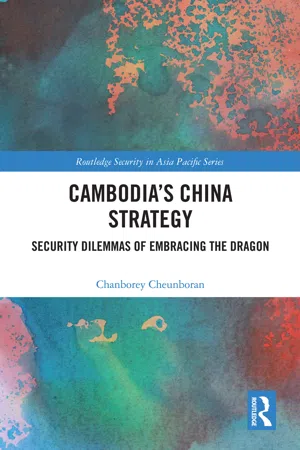
This book explores the tensions within Cambodia's foreign policy between a tight alignment with China, on the one hand, and Cambodia's commitment to the Association of the Southeast Asian Nations (ASEAN) as well as its delicate foreign policy diversification towards other major powers, on the other hand. It traces the long history of Cambodia's quest for survival from its bigger and historically antagonistic neighbours – the Thai and the Vietnamese – and its struggle for security and independence from the two neighbours and external major powers, particularly the United States and China. It discusses Cambodia's geopolitical predicaments deriving from its location of being sandwiched between powerful neighbours and limited strategic options available for the Kingdom. The book also assesses recent developments in Cambodia's relations with its neighbours and their implications for Cambodia's increasingly tight alignment with China in recent years. It considers the extent to which the ruling regime in Cambodia depends on strong relations with China for its legitimacy and survival and argues that there are risks and danger for Cambodia in moving towards an increasingly tight alignment with China.
- 236 pages
- English
- ePUB (mobile friendly)
- Available on iOS & Android
eBook - ePub
About this book
Information
1
Conceptual frameworks
Small states and strategic options
The international system has experienced fundamental changes in the last half century, with strong implications for small states. Jean Hey confidently asserts that small states today enjoy more international prestige and visibility than at any time in history.1 The study of small states has, therefore, attracted an increasing attention from academics and students of IR. The end of the Cold War, to some extent, has ensured that small states in the developing world are less likely to be pawns in the global competition of the great powers. Undeniably, small states are playing an increasingly important role in the international system. The former Secretary-General of the UN Ban Ki-moon suggests that “small states – which are more than half of the UN’s members – routinely drive substantive and structural issues at the UN, as they strive to uphold and develop international principles.”2 Nevertheless, threats and security challenges facing small states remain looming. Thus, foreign policymakers of small states must not lose sight of the security risks and vulnerabilities due to the fact that the survival of small states remains fragile and that international institutions are often ineffective and unresponsive to address their security concerns. The security threats and vulnerabilities that small states face have been manifested countless times throughout human history. Through his observation of the Peloponnesian War (431–404 BC), Thucydides came to the powerful conclusion that has influenced IR over the past millennium: “the strong do what they have the power to do and the weak suffer what they must.”3
This chapter, therefore, attempts to review and fill a gap in the existing literature on small state foreign policy. It deals with the key characteristics of small states as well as the security challenges that they face in the international system. Most importantly, this chapter seeks to highlight strategic options available for small states to address their security challenges as well as the strengths and weaknesses of each option. The literature reviews on small state strategic options are crucially relevant to understand Cambodia’s foreign policy behaviour. However, the author claims that the existing literature on small state strategic options is not conceptually nuanced and empirically precise enough to explain the foreign policy behaviour of some small states like Cambodia. In this regard, building upon the existing body of knowledge, the author proposes two conceptions – tight and loose alignment – to be discussed in detail in the following sections.
Key characteristics of small states
There is no scholarly consensus on the meaning of small states. Small states are often misunderstood as weak states, which are generally referred to as states that are weak or ineffective in their core domestic functions of providing security and basic public goods and services, and experience limited or contested legitimacy with their people. Attempts to define small states include various attributes such as geographical location, population size, psychological and material capability, the perception of leaders, and the degree of influence of the small state in question on the international system. David Vital says small states are those that have a population between 10 and 15 million for economically advanced countries and 20–30 million for undeveloped countries.4 Barston, on the other hand, adopts a population upper limit of 10–15 million as the benchmark to define small states.5 The threshold is significantly lowered in a joint study between the Commonwealth Secretariat and the World Bank in 2000, as a small state is defined as the one whose population is 1.5 million or less.6 Clearly, the size of the population is one of the necessary dimensions of small states. However, population-based definitions of small states fail to provide a comprehensive understanding of smallness and its dynamics. In fact, the population size is just one of the factors determining the influence and status of a state in the international system. Roderick Pace notices that the European Union (EU) will very soon be dominated by states with a population of less than 10 million.7 However, it is obvious that the EU member states – individually and collectively – have a strong influence on the world thanks to their financial, military, and normative contributions to the international community.
Robert Rothstein further develops the definition of small states by emphasising the psychological and material dimensions. He postulates that “a small power is a state which recognizes that it cannot obtain security primarily by using its own capabilities, and that it must rely fundamentally on the aid of other states, institutions, processes, or development to do so.”8 He also points out three unique aspects of a small state: (1) outside help is required; (2) the state has a narrow margin of safety, with little time for correcting mistakes; and (3) the state’s leaders see its weakness as essentially unalterable.
Although Rothstein’s conception captures the nuance of vulnerabilities of smallness and weakness, it reveals a clear shortcoming due to the fact that only a very few countries in the contemporary world are excluded from the category. Tellingly, even Japan and South Korea still require outside assistance, particularly from the United States (US), to address their security threats from North Korea and, to larger extent, China. Robert Keohane recommends that pundits in the field should focus on the systemic role that leaders see their countries playing. He, hence, suggests three distinct categories of states in the international system as follows:
A great power is a state whose leaders consider that it can alone exercise a large, perhaps decisive, impact on the international system; a middle power is a state whose leaders consider that it cannot act alone effectively but may be able to have a systematic impact in a small group or through an international institution; and a small power is a state whose leaders consider that it can never, acting alone or in a small group, make a significant impact on the system.9
A significant drawback of Keohane’s definition is that small states do not always endeavour to make an impact on the international system but, most of the time, promote their national interests, primarily the preservation of their survival and the pursuit of prosperity. Certainly, only great powers can have the interest and power to shape and influence the international system. In a recent study, Steinmetz and Wivel apply relative capability to conceptualise small states in Europe by defining a small state as “the weak part in an asymmetric relationship.”10 More over, there are attempts to explain the nature of small states by looking at their common characteristics and foreign policy behaviour. For instance, the Commonwealth Consultative Group considers small states to have “inherent vulnerability,” defined as the “susceptibility to the risk of harm.”11 Similarly, Hans Morgenthau aptly captured the political vulnerabilities by articulating the view that small states “have always owed their independence either to the balance of power … or to the preponderance of protecting power, or to their lack of attractiveness for imperialistic aspirations.”12 Although his last point is difficult to prove one way or the other, there have been numerous cases of small states that have been victims of the ambitious military policies of their larger neighbours. The US attack against Grenada in 1982 and its invasion and occupation of Haiti from 1994 to 1995, the Iraqi invasion and occupation of Kuwait in 1990, and the Russian invasion of Georgia in 2008 clearly illustrate the vulnerability of small states. Therefore, it becomes the conventional wisdom that a key difference between big and small states is that the latter cannot take their own survival for granted.
As far as foreign policy behaviour is concerned, in the absence of a potent military capability, small states tend to give more salience to diplomacy as a strategy to cope with their political vulnerabilities by “developing positive techniques of diplomacy to compensate for their limitations, including occasional judicious use of bold initiatives.”13 Similarly, Hey argues that a global ‘class structure’ deprives small states of the option of using force in the way that larger states could and that there was general agreement that small states would seek out multilateral organisations and alliances to ensure their security and achieve foreign policy goals.14 Keohane, Nye, Persaud, and Ikenberry, among others, share the similar view that weak states see international institutions as opportunities to build coalitions and strengthen ties with other weak states through the “bastions of rules, norms, and principles” and therefore increase their “bargaining position within the international system.”15
Hey summarises the most commonly cited behaviours of small states: they tend to (a) exhibit a low level of participation in world affairs; (b) address a narrow scope of foreign policy issues; (c) limit their behaviour to their immediate geographic arena; (d) employ diplomatic and economic foreign policy instruments, as opposed to military instruments; (e) emphasise internationalist principles, international law, and other morally minded ideals; (f) secure multinational agreements and join multinational institutions whenever possible; (g) choose neutral positions; (h) rely on superpowers for protection, partnerships, and resources; (i) aim to cooperate and to avoid conflict with others; and (j) spend a disproportionate amount of foreign policy resources on ensuring physical and political security and survival.16 Hey’s long list contains some self-contradicting features of small states, and those features are not unique to small states. This can vividly suggest that the definitions of small states are complex and dependent on whether scholars can identify the conditions under which small states choose among courses of action available to them. Therefore, it is difficult to define small states solely based on their foreign policy behaviour, as small states must try all approaches, exhaust all means to ensure their survival, obtain material wealth, and exert influence on the international system. In this study, nevertheless, a small state is defined relatively based on its relations with the rest of the world, with three characteristics, namely (1) a relatively small size population between 5 and 10 million people for economically advanced countries and from 10 to 20 million for developing countries; (2) a weaker side in an asymmetric relationship that has to confront with more risks and vulnerabilities compared to the stronger party; and (3) unlike the stronger side of the relationship, survival is the primary concern in its relations with the rest of the international community. The rationale for the inclusion of the three characteristics is that the smallness of a state is determined not only by material capability but also by its relations to others, as well as the psychological attributes that leaders of the state inherit. Although population size is not the only sufficient criterion to define a small state, it is an important element of smallness as population is associated with economic potential and military mobilisation of the small state in question. It also shapes the psychological orientation of the ruling eli...
Table of contents
- Cover
- Half Title
- Series Page
- Title Page
- Copyright Page
- Dedication Page
- Contents
- List of acronyms
- Acknowledgements
- Introduction
- 1 Conceptual frameworks: small states and strategic options
- 2 History of Cambodia’s search for survival, 1431–1997
- 3 Cambodia-China ties, 1997–2008: hedging against risks
- 4 Revived threats from bigger neighbours: Cambodia’s increasing alignment with China since 2008
- 5 China’s growing influence in Southeast Asia: implications for Cambodia’s strategic direction
- 6 Cambodia and major powers: limited strategic options
- 7 China and the legitimacy of the Cambodian ruling party
- 8 Potential risks and costs of Cambodia’s alignment with China
- 9 Overall assessments and policy recommendations
- Conclusion
- Index
Trusted by 375,005 students
Access to over 1.5 million titles for a fair monthly price.
Study more efficiently using our study tools.
Frequently asked questions
Yes, you can cancel anytime from the Subscription tab in your account settings on the Perlego website. Your subscription will stay active until the end of your current billing period. Learn how to cancel your subscription
No, books cannot be downloaded as external files, such as PDFs, for use outside of Perlego. However, you can download books within the Perlego app for offline reading on mobile or tablet. Learn how to download books offline
Perlego offers two plans: Essential and Complete
- Essential is ideal for learners and professionals who enjoy exploring a wide range of subjects. Access the Essential Library with 800,000+ trusted titles and best-sellers across business, personal growth, and the humanities. Includes unlimited reading time and Standard Read Aloud voice.
- Complete: Perfect for advanced learners and researchers needing full, unrestricted access. Unlock 1.5M+ books across hundreds of subjects, including academic and specialized titles. The Complete Plan also includes advanced features like Premium Read Aloud and Research Assistant.
We are an online textbook subscription service, where you can get access to an entire online library for less than the price of a single book per month. With over 1.5 million books across 990+ topics, we’ve got you covered! Learn about our mission
Look out for the read-aloud symbol on your next book to see if you can listen to it. The read-aloud tool reads text aloud for you, highlighting the text as it is being read. You can pause it, speed it up and slow it down. Learn more about Read Aloud
Yes! You can use the Perlego app on both iOS and Android devices to read anytime, anywhere — even offline. Perfect for commutes or when you’re on the go.
Please note we cannot support devices running on iOS 13 and Android 7 or earlier. Learn more about using the app
Please note we cannot support devices running on iOS 13 and Android 7 or earlier. Learn more about using the app
Yes, you can access Cambodia’s China Strategy by Chanborey Cheunboran in PDF and/or ePUB format, as well as other popular books in Politics & International Relations & Diplomacy & Treaties. We have over 1.5 million books available in our catalogue for you to explore.