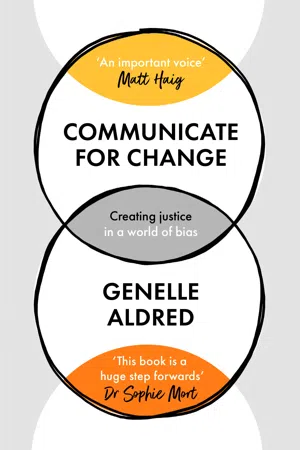
How do we advocate for justice effectively in a world deeply divided by racial, gender and class inequalities? If we want to make a positive difference, we have to know how to recognise our own biases and blind spots - only then can we understand how to be part of the solution and start having meaningful conversations.
In Communicate for Change, journalist and communication consultant Genelle Aldred offers suggestions and guidance to help us be better listeners, readers, watchers and talkers. With insight drawn from years of experience, she breaks down the barriers to effective conversation so we can communicate in a more nuanced, thoughtful way and understand our part in bringing about a more just society.
You'll soon be noticing how singular narratives drive behaviour and conversation and how language helps to shape our views, understanding how fake news magnifies your own biases and blind spots, and reflecting on how to be a better ally; in a way that is not just performative but that creates meaningful, effective and lasting change.
Communicate for Change is a book for anyone interested in the conversations about race that have been happening in the UK and around the world, and anyone wanting to play their part in bringing about class, gender and racial equity. Thought-provoking and stimulating, it lays out how we can take that next step from learning and talking about anti-racism and unconscious bias to putting it into practice and actively shaping an environment in which justice can thrive.
- English
- ePUB (mobile friendly)
- Available on iOS & Android
eBook - ePub
About this book
Information
1
Communicate for solutions
Winning hearts and minds
We have arguments rather than conversations around social-justice issues and the belief that we should all have access to equal economic, social and political opportunities. Arguments are, at best, ineffective at convincing others to open their minds or, at worst, antagonistic. For long-lasting change to occur, we have to win minds and hearts because, as Dale Carnegie says, we never win an argument, even when we’re right.1 The idea that we can shout people into goodness is not without merit and evidence; it can sometimes work, as the suffragette movement showed. When it does, the change is big but it is a rare phenomenon. Most loud efforts seldom provide enduring change that can be felt by many. They fade into obscurity, much to the anger of those who are desperate for change. I understand why people cause a commotion. The emotions and anger against injustice overflow – and rightly so – but do they make the people who need to change listen? Do loudness and anger achieve the goal? Are we measuring whether we made people pay attention – that they looked at and heard what we were saying – rather than whether the listening resulted in altered behaviours? Did we win hearts and minds or just the moral argument? If we failed to win hearts and minds, we will probably have to have the conversation again.
I can be a little bit impatient with a circular conversation, and my impatience can become apparent to the other person. When I see that the discussion keeps going round and round, I start to think it’s a waste of precious time. It’s not so much that I don’t agree with or see what the person is saying; it’s that I don’t believe the argument is going anywhere. I like to know that we are going to try to solve the issue or just agree to disagree, draw a line under it and move on. This attitude can be challenging to others because I appear to have gone from invested and engaged in a conversation to uninterested and eager to talk about something else. It might seem like a rejection to someone, when he or she hasn’t finished making a point, even though that’s not my intention.
We’ve all had those interactions in which we keep arguing, with no resolution in sight. Yet it seems that there are people who have a massive appetite for circular conversations, which often occur in social-justice spaces. We have been debating poverty, racism, sexism and the like for many years, with no apparent way of bringing them to an end or reaching a place in which most people believe that there is equality. We have argued, protested and made some progress with some individuals. Yet we have still ended up losing the argument with many of those we want to persuade to change because they see only the circular nature of the debate. They have not been convinced that there is a solution which involves them. Not only have some become uninterested in drawing a line and moving on but also others have doubled-down on their thinking in the process. Central to this problem is the fact that one side usually talks about how all this makes them feel while the other wants to understand what is required of them. This is why winning hearts and minds together must be the goal of communication around social-justice issues.
We can win just the hearts and see people engage on an emotional level, offering sympathy, empathy and shared frustration. But if we were to fail to win the minds, there would not be much rational thinking about how to improve things. If we were to win only the ‘how’ of the minds, but achieve no personal engagement, the result would be a series of edicts and proposals. Such ideas would quickly be dropped when the goals weren’t met because there would be little emotional connection to power the momentum. Many don’t aim to capture hearts and minds at all; instead, they engage at a surface level (‘The person said such-andsuch’) rather than digging deeper to try to understand what’s behind the words. Coupled with the default position of assuming that those with whom we disagree have bad intentions, the cross-purposes and crossed lines of communication position us for interactions that are unlikely to produce understanding.
My job as a communication strategist is not only to hear what clients say but also to perceive the communication behind what they say. My clients tell me what they would like to achieve and I have to listen carefully to deliver what they truly want. For the clients to get what they want, they, in turn, have to listen carefully to their audiences and customers to give them what they want. Having a bottom line makes such an exercise worth doing for businesses.
In the arena of civics, this listening system isn’t often one into which we pour the same amount of time or energy, probably because the advantage in spaces outside business isn’t quite so clear. For example, I’ve witnessed people talking about and engaging in efforts such as ‘radical listening’. Usually, radical listening is applauded because someone sits and says nothing, but when the end result isn’t tangible change, we must all question what is actually going on. Being heard may make the person talking feel good for the moment – it will help him or her to feel seen, which pleases both parties – but when that is the pinnacle of the interaction, how does that really affect the world we share? Engaging in this way does not result in real, enduring change. Yes, both parties feel good because, on one level, there has been a dialogue (of sorts), but when concrete, radical action isn’t taken, there will just be an endless cycle of the same fruitless activities.
Some people have no stake in seeing a result because they are not affected by the problem: ‘What’s in it for me?’ is a highly motivating factor for those people, and one that we would do well to recognize and reward. The hope or fear of certain consequences is a significant modifier of human behaviour. The impetus to make changes is simply not there when people feel unconnected to certain issues.
I remember travelling on the London Underground with a friend who is left-handed. She remarked how annoying it was, when she went through the ticket barrier, that she had to stretch her hand across her body to touch her ticket to the pad. The world is built for right-handed people such as me; so the problem with the Underground ticket barrier is one that I had never even thought about. It hadn’t occurred to me how, in big and small ways, the positioning of the touch-pad saves right-handed people time and effort all day long. Have I written to Transport for London to ask it to change the barriers to provide equal access for left-handed and right-handed people? Have I done anything about it at all? No. Am I a bad person for not caring enough? I thought about what my friend said; I acknowledged the inconvenience she suffered, but I didn’t dwell on it. I moved on. This was an example of a seemingly minor problem that had no impact on me at all. This is why things don’t change: when we aren’t affected by a problem, we have no investment in solving it.
Whether the injustice is big or small, until people are invested, they will feel badly about it – and for you – but continue with life as usual. While it is a privilege not to have to face certain injustices, the belief that people have to do better is a myth. We all have to abide by the law, but no one has to be good and kind. We might want people to behave a certain way, but we have to remember that what we and others think goodness and kindness look like are not always the same. While we can apply a moral argument to the need for everyone to be good, fair and kind, I believe that we have to engage with people where they are, rather than where we would like them to be. Individuals can’t know what they don’t know, and they won’t try to do better at something that doesn’t concern them. That may be an unpopular view but, for me, starting from any other place results in no change and more frustration.
‘A riot is the language of the unheard,’ as Martin Luther King, Jr said.2 Anger and emotion are there precisely because the injustices many of us face have been part of our lives for so long. We communicate as though the situation will never change, so we don’t know how to talk to solutions. This despair also affects how we approach the issue. How do we begin to behave as though there were another way to win hearts and minds, if, indeed, they can be won at all?
Talking to solutions
I came to learn about talking to solutions by sitting outside my father’s study, book in hand, listening to his phone calls, and hearing him deal with problems and manoeuvre people towards outcomes. I was around eight years old. I was fascinated by what he did. I didn’t really know why I was fascinated or what was really happening, but it seemed interesting to a curious child like me who loved to learn.
At that time, Dad was a pastor at a Black majority church in Sheffield. He was also overseeing around eight other churches in that part of Yorkshire for the Church of God of Prophecy, which has its general headquarters in Tennessee and its UK national office in Birmingham.
Dad dealt with molehills and mountains, and with congregants and leaders. Churches are political places; what people say they want and the things they do are often convoluted because they wish to resemble Jesus while having all the human desires to be top dog, and engaging in the manoeuvring that entails.
Years later, I’m still curious about what makes people tick. I’m a talkative person, so others often assume that I’m not listening to them. I’m always listening, taking note of the subtext, reading between the lines, decoding what people are saying and trying to get to grips with what they mean, and, most importantly, where they’re coming from. I can then make a plan about how I want to approach something – I’m a strategist to the core. Added to that is my tendency, from years of working in journalism, to ask questions and produce narratives3 from the answers. I try not to lose sight of what I hope to achieve and which message I plan to distil to reach the desired – or required – outcome. There is a lot of mind (rather than heart) involved in what I do because big emotions can sometimes hinder communication, especially when they are not controlled. Nevertheless, as I’ve mentioned, despite my own preferences, there is a need for engaging both hearts and minds to bring about enduring change.
Social justice and issues of oppression naturally have big emotions attached, especially for those who are wronged. But for those who have not had similar experiences, the response to the same questions might be low-key or even unemotional. How do we get past that difference to allow a solution orientated conversation to happen?
Eager to Love by the Franciscan monk Richard Rohr is an inspiring book in many ways. In it, Rohr identifies something that many of us feel or sense is missing: a third way he calls ‘Third Force’ activity: ‘When you honour both power and powerlessness, you quite simply come up with a third something, a very different kind of power.’4 There is something that is missing from the conversation about injustice. The third way in this case could be nuanced disagreement, a way of being gracious towards the human being we are dealing with while not condoning his or her behaviour. The third-way approach might not be appropriate in every case. If, however, we were to hold that tension within us when we enter into dialogue, we would be more likely to affect others in both an emotional and a rational way, helping them and the conversation to move on from a place of hostility and antagonism to one of action.
Supremacy or superiority?
The two sides in these arenas of communication are perpetrators and victims, goodies and baddies, and problematic people and everyone else. I have yet to meet a person who isn’t a problem – that is, if we understand ‘being problematic’ to mean holding views that someone else would find deeply offensive. While someone may call another individual out for his or her offensive views over ethnicity, the person doing the calling-out probably has some views that someone else would find offensive – around gender or sexuality, for example. So where does all this finger-pointing actually end?
We are not and cannot be the thought police. We all have biases, which take time to root out. We all have problematic views and the ability to offend others, no matter how inoffensive we might think we are.
The current thinking often dictates that a person is offensive when he or she offends someone. Yet the whole area of offence can never be just a one-way street, in which only one type of person offends and another type is offended. Offence can travel in both directions. It is a nonsense to say that we can be offended by ‘offensive’ people whom we think are problematic, but they cannot be offended by us because our views are ‘right’ and we aren’t the problem. We can never alter anyone’s thinking using this logic.
I’d like to remove the moral argument and consider a behavioural one. Offensive ideas and behaviours exist in us as much as they exist in others. Of course, we naturally see others as the problem and ourselves as the fixers, which prevents us from tackling the actual problem. We might think that we are good people, doing the work of justice and equality; we might think that we are reasonable and fair-minded, but I must burst that bubble by saying that we are offensive and problematic to someone, somewhere.
I have offensive and problematic thoughts too. Why? Because I am human. We all are, and we inevitably have blind spots about some areas of justice or the ways in which we view others who disagree with us, or because of those we exclude from our visions of equality. We first have to acknowledge that we can be seen by others as problematic and offensive; doing so will allow us to have better conversations that will result in the change we want to see – conversations rooted in humility rather than in an arrogance born from a sense of our rightness because we do the work of the righteous. Arrogance resulting from attitudes of righteousness and superiority is a barrier to having conversations that lead to change. We should start with ourselves, but that is a tough place to start.
Many of the social-justice problems we face are grounded in feelings of superiority and pride. Not many people want to see those characteristics in themselves, so they don’t look for them or acknowledge them. As someone wise once said, we all know that racism exists, yet no one seems to know anyone who’s racist. White supremacists are an exception; it is often very clear who they are and what they believe.
Recently, I’ve been wondering why many liberals are so comfortable with the term ‘White supremacy’. I hadn’t thought about it too much until I had a conversation with the writer and artist Ayishat Akanbi. She said:
I refrain from using the term ‘White supremacy’ for a couple of reasons. One is that I believe that anyone who fears another race is suffering from an inferiority complex. The second reason is that I do not wish to inflate the egos of people who have mistaken this inferiority for superiority.
Her comment pushed me to consider what I thought the term meant and to try to express what I believe to be the real issue that we have to address.
White supremacy is a chimera: it’s not a physical reality. It’s an ideology and, by frequently referencing it, we give it a life of its own and make it seem more real than it is. Yet liberals of all ethnicities, especially White liberals, embrace White supremacy as a concept because they don’t see themselves or the White people they like as subscribing to it. They behave as if it were solely the terrain of the far right – the extremists – and nothing to do with the decent people further to the left, because liberals love everyone and White liberals are allies in every injustice.
After some exploration, I have come to understand the issue to be a ‘superiority complex’, which resides in many more people, but is often found in White liberals. When we examine language and actions carefully, we get to the root of why there is plenty of talk but no solution. The White superiority complex is the structure that props up racial injustice. How else could racial injustice reside in so many spaces, places and institutions? For those unjust systems to continue to affect our daily lives, they have to have reached a c...
Table of contents
- Preface
- Acknowledgements
- 1 Communicate for solutions
- 2 Fake news
- 3 An unedifying choice
- 4 A culture of confusion
- 5 Where are the White community leaders?
- 6 Blind spots
- 7 A singular narrative
- 8 Saviours
- 9 A pack of privilege
- 10 Power truths
- 11 Does allyship work?
- 12 Privilege, power and allyship
- 13 Better conversations
- Notes
Trusted by 375,005 students
Access to over 1.5 million titles for a fair monthly price.
Study more efficiently using our study tools.
Frequently asked questions
Yes, you can cancel anytime from the Subscription tab in your account settings on the Perlego website. Your subscription will stay active until the end of your current billing period. Learn how to cancel your subscription
No, books cannot be downloaded as external files, such as PDFs, for use outside of Perlego. However, you can download books within the Perlego app for offline reading on mobile or tablet. Learn how to download books offline
Perlego offers two plans: Essential and Complete
- Essential is ideal for learners and professionals who enjoy exploring a wide range of subjects. Access the Essential Library with 800,000+ trusted titles and best-sellers across business, personal growth, and the humanities. Includes unlimited reading time and Standard Read Aloud voice.
- Complete: Perfect for advanced learners and researchers needing full, unrestricted access. Unlock 1.5M+ books across hundreds of subjects, including academic and specialized titles. The Complete Plan also includes advanced features like Premium Read Aloud and Research Assistant.
We are an online textbook subscription service, where you can get access to an entire online library for less than the price of a single book per month. With over 1.5 million books across 990+ topics, we’ve got you covered! Learn about our mission
Look out for the read-aloud symbol on your next book to see if you can listen to it. The read-aloud tool reads text aloud for you, highlighting the text as it is being read. You can pause it, speed it up and slow it down. Learn more about Read Aloud
Yes! You can use the Perlego app on both iOS and Android devices to read anytime, anywhere — even offline. Perfect for commutes or when you’re on the go.
Please note we cannot support devices running on iOS 13 and Android 7 or earlier. Learn more about using the app
Please note we cannot support devices running on iOS 13 and Android 7 or earlier. Learn more about using the app
Yes, you can access Communicate for Change by Genelle Aldred in PDF and/or ePUB format, as well as other popular books in Theology & Religion & Civil Rights in Politics. We have over 1.5 million books available in our catalogue for you to explore.