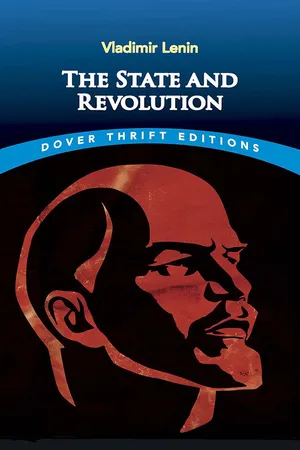
Among the most influential political and social forces of the twentieth century, modern communism rests firmly on philosophical, political, and economic underpinnings developed by Vladimir Ilyich Ulyanov, later known as Lenin. The State and Revolution is Lenin's most significant work, in which he totally rejects the institutions of Western democracy and presents his vision of the final perfection of communism. For anyone who seeks to understand the twentieth century, capitalism, the Russian revolution, and the role of communism in the tumultuous political and social movements that have shaped the modern world, this book offers unparalleled insight and understanding.
- 144 pages
- English
- ePUB (mobile friendly)
- Available on iOS & Android
eBook - ePub
The State and Revolution
About this book
Information
CHAPTER I: CLASS SOCIETY AND THE STATE
1. The State as the Product of the Irreconcilability of Class Antagonisms
WHAT IS NOW happening to Marx’s doctrine has, in the course of history, often happened to the doctrines of other revolutionary thinkers and leaders of oppressed classes struggling for emancipation. During the lifetime of great revolutionaries, the oppressing classes relentlessly persecute them, and treat their teachings with malicious hostility, the most furious hatred and the most unscrupulous campaign of lies and slanders. After their death, attempts are made to convert them into harmless icons, to canonize them, so to say, and to surround their names with a certain halo for the “consolation” of the oppressed classes and with the object of duping them, while at the same time emasculating the revolutionary doctrine of its content, vulgarizing it and blunting its revolutionary edge. At the present time, the bourgeoisie and the opportunists in the labor movement concur in this “revision” of Marxism. They omit, obliterate and distort the revolutionary side of its doctrine, its revolutionary soul. They push to the foreground and extol what is or seems acceptable to the bourgeoisie. All the social chauvinists are now “Marxists” (don’t laugh!). And more and more frequently, German bourgeois professors, erstwhile specialists in the extermination of Marxism, are speaking of the “national-German” Marx, who, they aver, trained the labor unions which are so splendidly organized for the purpose of conducting a predatory war!
In such circumstances, in view of the incredibly widespread nature of the distortions of Marxism, our first task is to restore the true doctrine of Marx on the state. For this purpose it will be necessary to quote at length from the works of Marx and Engels. Of course, long quotations will make the text cumbersome and will not help to make it popular reading, but we cannot possibly avoid them. All, or at any rate, all the most essential passages in the works of Marx and Engels on the subject of the state must necessarily be given as fully as possible, in order that the reader may form an independent opinion on the totality of views of the founders of scientific socialism and on the development of those views, and in order that their distortion by the now prevailing “Kautskyism” may be documentarily proved and clearly demonstrated.
Let us begin with the most popular of Engels’ works, Der Ursprung der Familie, des Privateigentums und des Staates, the sixth edition of which was published in Stuttgart as far back as 1894. We must translate the quotations from the German originals, as the Russian translations, although very numerous, are for the most part either incomplete or very unsatisfactory.
Summing up his historical analysis, Engels says:
“The state is therefore by no means a power imposed on society from the outside; just as little is it ‘the reality of the moral idea,’ ‘the image and reality of reason,’ as Hegel asserts. Rather, it is a product of society at a certain stage of devel opment; it is the admission that this society has become entangled in an insoluble contradiction with itself, that it is cleft into irreconcilable antagonisms, which it is powerless to dispel. But in order that these antagonisms, classes with con flicting economic interests, might not consume themselves and society in sterile struggle, a power apparently standing above society became necessary for the purpose of moderating the conflict and keeping it within the bounds of ‘order’; and this power, arising out of society, but placing itself above it, and increasingly alienating itself from it, is the state.”
This fully expresses the basic idea of Marxism on the question of the historical role and meaning of the state. The state is the product and the manifestation of the irreconcilability of class antagonisms. The state arises when, where and to the extent that class antagonisms cannot be objectively reconciled. And, conversely, the existence of the state proves that the class antagonisms are irreconcilable.
It is precisely on this most important and fundamental point that distortions of Marxism, proceeding along two main lines, begin.
On the one hand, the bourgeois ideologists, and particularly the petty-bourgeois ideologists, compelled by the pressure of indisputable historical facts to admit that the state only exists where there are class antagonisms and the class struggle, “correct” Marx in a way that makes it appear that the state is an organ for the conciliation of classes. According to Marx, the state could neither arise nor continue to exist if it were possible to conciliate classes. According to the petty-bourgeois and philistine professors and publicists—frequently on the strength of well-meaning references to Marx!—the state conciliates classes. According to Marx, the state is an organ of class rule, an organ for the oppression of one class by another; it creates “order,” which legalizes and perpetuates this oppression by moderating the collision between the classes. In the opinion of the petty-bourgeois politicians, order means the conciliation of classes, and not the oppression of one class by another; to moderate collisions means conciliating and not depriving the oppressed classes of definite means and methods of fighting to overthrow the oppressors.
For instance, when, in the Revolution of 1917, the question of the real meaning and role of the state arose in all its magnitude as a practical question demanding immediate action on a wide mass scale, all the Socialist-Revolutionaries and Mensheviks immediately and completely sank to the petty-bourgeois theory that the “state” “conciliates” classes. Innumerable resolutions and articles by politicians of both these parties are thoroughly saturated with this purely petty-bourgeois and philistine “conciliation” theory. Petty-bourgeois democracy is never able to understand that the state is the organ of the rule of a definite class which cannot be reconciled with its antipode (the class opposite to it). Their attitude towards the state is one of the most striking proofs that our Socialist-Revolutionaries and Mensheviks are not socialists at all (which we Bolsheviks have always maintained), but petty-bourgeois democrats with near Socialist phraseology.
On the other hand, the “Kautskyan” distortion of Marxism is far more subtle. “Theoretically,” it is not denied that the state is the organ of class rule, or that class antagonisms are irreconcilable. But what is lost sight of or glossed over is this: if the state is the product of irreconcilable class antagonisms, if it is a power standing above society and “increasingly alienating itself from it,” it is clear that the liberation of the oppressed class is impossible, not only without violent revolution, but also without the destruction of the apparatus of state power which was created by the ruling class and which is the embodiment of this “alienation.” As we shall see later, Marx very definitely drew this theoretically self-evident conclusion from a concrete historical analysis of the tasks of the revolution. And—as we shall show fully in our subsequent remarks—it is precisely this conclusion which Kautsky has “forgotten” and distorted.
2. Special Bodies of Armed Men, Prisons, Etc.
Engels continues:
“As against the ancient gentile organization, the primary distinguishing feature of the state is the division of the subjects of the state according to territory.”
Such a division seems “natural” to us, but it cost a prolonged struggle against the old form of tribal or gentile society.
“…The second is the establishment of a public power, which is no longer directly identical with the population organizing itself as an armed power. This special public power is necessary, because a self-acting armed organization of the population has become impossible since the cleavage into classes This public power exists in every state; it consists not merely of armed men, but of material appendages, prisons and coercive institutions of all kinds, of which gentile society knew nothing”
Engels further elucidates the concept of the “power” which is termed the state—a power which arises from society, but which places itself above it and becomes more and more alienated from it. What does this power mainly consist of ? It consists of special bodies of armed men which have prisons, etc., at their disposal.
We are justified in speaking of special bodies of armed men, because the public power which is an attribute of every state is not “directly identical” with the armed population, with its “self-acting armed organization.”
Like all the great revolutionary thinkers, Engels tried to draw the attention of the class conscious workers to the very fact which prevailing philistinism regards as least worthy of attention, as the most common and sanctified, not only by long standing, but one might say by petrified prejudices. A standing army and police are the chief instruments of state power. But can it be otherwise?
From the point of view of the vast majority of Europeans of the end of the nineteenth century whom Engels was addressing, and who have not lived through or closely observed a single great revolution, it cannot be otherwise. They completely fail to understand what a “self-acting armed organization of the population” is. To the question, whence arose the need for special bodies of armed men, standing above society and becoming alienated from it (police and standing army), the West European and Russian philistines are inclined to answer with a few phrases borrowed from Spencer or Mikhailovsky, by referring to the complexity of social life, the differentiation of functions, and so forth.
Such a reference seems “scientific”; it effectively dulls the senses of the average man and obscures the most important and basic fact, namely, the cleavage of society and irreconcilably antagonistic classes. Had this cleavage not existed, the “self-
acting armed organization of the population” might have differed from the primitive organization of a tribe of monkeys grasping sticks, or of primitive man, or of men united in a tribal form of society, by its complexity, its high technique, and so forth; but it would still have been possible. It is impossible now, because civilized society is divided into antagonistic and, indeed, irreconcilably antagonistic classes, the “self-acting” arming of which would lead to an armed struggle between them. A state arises, a special force is created in the form of special bodies of armed men, and every revolution, by destroying the state apparatus, demonstrates to us how the ruling class strives to restore the special bodies of armed men which serve it, and how the oppressed class strives to create a new organization of this kind, capable of serving not the exploiters but the exploited.
acting armed organization of the population” might have differed from the primitive organization of a tribe of monkeys grasping sticks, or of primitive man, or of men united in a tribal form of society, by its complexity, its high technique, and so forth; but it would still have been possible. It is impossible now, because civilized society is divided into antagonistic and, indeed, irreconcilably antagonistic classes, the “self-acting” arming of which would lead to an armed struggle between them. A state arises, a special force is created in the form of special bodies of armed men, and every revolution, by destroying the state apparatus, demonstrates to us how the ruling class strives to restore the special bodies of armed men which serve it, and how the oppressed class strives to create a new organization of this kind, capable of serving not the exploiters but the exploited.
In the above argument, Engels raises theoretically the very question which every great revolution raises practically, palpably and on a mass scale of action, namely, the question of the relation between special bodies of armed men and the “self-acting armed organization of the population.” We shall see how this is concretely illustrated by the experience of the European and Russian revolutions.
But let us return to Engels’ exposition.
He points out that sometimes, in certain parts of North America, for example, this public power is weak (he has in mind a rare exception in capitalist society, and parts of North America in its pre-imperialist days where the free colonist predominated), but that in general it grows stron...
Table of contents
- CHAPTER I: CLASS SOCIETY AND THE STATE
- CHAPTER II: THE STATE AND REVOLUTION. THE EXPERIENCE OF 1848-51
- CHAPTER III: THE STATE AND REVOLUTION. EXPERIENCE OF THE PARIS COMMUNE OF 1871. MARX’S ANALYSIS
- CHAPTER IV: CONTINUATION. SUPPLEMENTARY EXPLANATIONS BY ENGELS
- CHAPTER V: THE ECONOMIC BASIS OF THE WITHERING AWAY OF THE STATE
- CHAPTER VI: THE VULGARIZATION OF MARXISM BY THE OPPORTUNISTS
Trusted by 375,005 students
Access to over 1.5 million titles for a fair monthly price.
Study more efficiently using our study tools.
Frequently asked questions
Yes, you can cancel anytime from the Subscription tab in your account settings on the Perlego website. Your subscription will stay active until the end of your current billing period. Learn how to cancel your subscription
No, books cannot be downloaded as external files, such as PDFs, for use outside of Perlego. However, you can download books within the Perlego app for offline reading on mobile or tablet. Learn how to download books offline
We are an online textbook subscription service, where you can get access to an entire online library for less than the price of a single book per month. With over 1.5 million books across 990+ topics, we’ve got you covered! Learn about our mission
Look out for the read-aloud symbol on your next book to see if you can listen to it. The read-aloud tool reads text aloud for you, highlighting the text as it is being read. You can pause it, speed it up and slow it down. Learn more about Read Aloud
Yes! You can use the Perlego app on both iOS and Android devices to read anytime, anywhere — even offline. Perfect for commutes or when you’re on the go.
Please note we cannot support devices running on iOS 13 and Android 7 or earlier. Learn more about using the app
Please note we cannot support devices running on iOS 13 and Android 7 or earlier. Learn more about using the app
Yes, you can access The State and Revolution by Vladimir Ilyich Lenin in PDF and/or ePUB format, as well as other popular books in Politics & International Relations & Communism, Post-Communism & Socialism. We have over 1.5 million books available in our catalogue for you to explore.