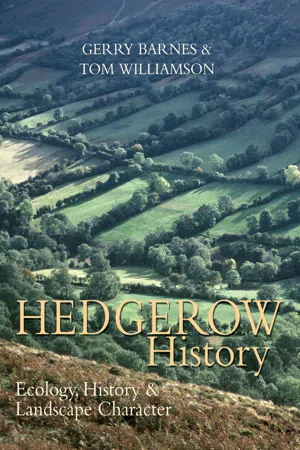
Oxbow says: For many years hedges have been the most common field boundary in rural Britain, providing a stock-proof barrier, a field boundary and a haven for wildlife. Despite this, they are rarely studied in any detail in landscape archaeology. The authors of Hedgerow History rightly argue that hedges, as an essential feature of the landscape, their origins and development, are as worthy of study as any other part of the landscape. Their book focuses on the species content and diversity of hedges, how these came about and how they changed over time. The introduction provides the background to hedges in Britain, the development of field boundaries, changes in fields and farming, especially the impact of enclosure, hedgerow management, and methods of dating hedges. In an attempt to evaluate the pioneering work of Hooper and Pollard in the 1960s and 1970s, and gain insights into the diversity of hedges and the possible human and animal reasons for it, Barnes and Williamson carried out a detailed survey of hedgerows in Norfolk. Finding 61 shrub species among the Norfolk hedgerows, they attempt to tie this data in with evidence on geology, soils, climate, woodland, enclosure, farming practices and historical factors, as an indicator of the processes of continuity and change that have taken place in the wider landscape.
eBook - ePub
Hedgerow History
Ecology, History and Landscape Character
- 152 pages
- English
- ePUB (mobile friendly)
- Available on iOS & Android
eBook - ePub
About this book
Information
Subtopic
EcologyIndex
Biological SciencesCHAPTER ONE
Hedges and Enclosure
Introduction
This book is about hedges – about their origins and development over time, and the marked variations they exhibit in species content and diversity. It concentrates on the hedges of a single English county – Norfolk – but it is not simply about this one region. Instead, it uses Norfolk as a case study, from which more general lessons about the history of hedges can be learnt. No apologies are offered for devoting a book solely to the subject of hedges, for they play a crucial role in the rural landscape. They are the most common form of field boundary in Britain: even in highland areas they were usually the preferred form of enclosure on the lower, more sheltered ground. They have a central place in English culture, have given their name to numerous plants and animal species, and have been incorporated into many phrases and expressions: we talk of hedgehogs and hedge sparrows, of particular issues being ‘hedged about with doubt’, or of people ‘hedging their bets’. Above all, hedges are vital to wildlife conservation, for in a countryside which is, for the most part, intensively farmed, hedges provide one of the places where a wide variety of plant and animal species are able to survive, and also form corridors along which they can move, and colonise new locations.
We usually think of a hedge as a line of shrubs which is, or was once, managed in such a way as to provide a stock-proof barrier. But even today we sometimes use the term in a rather wider sense. The great banks of earth and stone which enclose the fields in parts of Cornwall and Devon are ‘hedges’, in spite of the fact that many have only a rather meagre covering of shrubs. In the past, definitions were more blurred. The Old English word gehægan, hedge, originally meant any form of enclosure or fence, and both medieval and post-medieval documents sporadically refer to ‘dead hedges’ – that is, lines of brushwood staked to form a barrier. As late as 1815 such hedges were said to be widely used in Dorset, Kent and elsewhere (Boys 1813, 61; Stevenson 1815a, 172) Some memory of this form of boundary is still perpetuated in the ceremony of the ‘Penny Hedge’, or penance hedge, which takes place each year at Whitby in Yorkshire. In 1159 three knights, while hunting in Eskdale, pursued a wild boar into a hermitage: the hermit tried to save the animal but they attacked and mortally wounded him. The Abbot of Whitby ordered that they should serve an unusual penance: they and their descendants should forever, on the Eve of the Ascension, erect a ‘hedge’ of stakes and branches on the foreshore at Whitby, sturdy enough to withstand the incoming tide. Even the conventional, modern definition of a ‘hedge’ may be problematic. While in most districts of England a hedge is a well-defined, relatively narrow affair, in some areas wider and more sprawling strips of vegetation divide the fields, blurring the line between a hedge and a linear wood. The ‘shaws’ of the Kentish Weald are an extreme example, but in any area a period of neglect can convert a hedge into a long, narrow copse. In this short volume we will, however, be concerned almost exclusively with hedges as usually defined – lines of shrubs which form field boundaries.
The form and management of hedges
Hedges might be valued today primarily for their scenic qualities, and for their role as wildlife habitats, but all originally had a practical purpose in the farming economy. In the period before the development of barbed wire they were the main method, at least in the lowlands, of providing a stock-proof barrier. But to do this they had to be regularly managed, for a line of shrubs left to its own devices will soon become tall and ‘leggy’, allowing gaps to form through which livestock will inevitably find their way. Traditionally, the most common method of management was by laying or plashing, normally carried out during the winter, a relatively slack time of the farming year (Muir and Muir 1997, 96 – 104; Brooks 1975) (Figure 1). Laying involves a number of distinct procedures. The hedge is first hacked back rigorously with a billhook and any lateral suckers removed. So too is dead material and any unwanted species – those which might harbour pests (such as barberry) or which provide a poor barrier to stock (such as elder). Next, the principal stems are cut roughly three-quarters of the way through, at an angle of between 45 and 60 degrees and at a height of between five and ten centimetres above ground level: they are then bent downwards at an angle of 60 degrees or more so that each ‘pleacher’ (as the principal stems are usually called) overlaps its neighbour. In the spring, when growth resumes, a thick, impenetrable wall of vegetation is created. There was once a large number of local and regional forms of laying but today the main distinction is between Midland practice on the one hand, and Welsh and south-western practice on the other. In the Midlands the hedge is first cut back with particular thoroughness and the ‘pleachers’ are then bent over and woven around vertical poles of ash or hazel, called ‘stabbers’, spaced along the hedge at intervals of about two-thirds of a metre. The bushy or ‘brush’ side of the hedge is laid away from the associated ditch, to afford some protection from livestock. Long rods of elm or hazel, called ‘hethers’ or ‘binders’, are used to keep the stakes and the ‘pleachers’ in place, forming a kind of continuous ‘cable’ along the top of the hedge. Many local and regional variations in Midland practice are recorded by early agricultural writers. In Bedfordshire, for example, it was usual to lay each side of the hedge in turn, after a gap of several years, to ensure that it remained stock-proof; while in Northamptonshire and Leicester the hedges were laid in such a way that they grew particularly tall and thick – the so-called ‘bullfinches’, or bull fences, designed to contain the beef cattle which were a particular speciality of the region (Brooks 1975).

FIGURE 1. A recently ‘plashed’ or ‘laid’ hedge at the National Hedge Laying Championships at Fakenham in Norfolk.
In the Welsh method, which is also found across much of western England, the hedge is less drastically cut back prior to laying, and the ‘brush’ or twiggy growth remaining after thinning is often laid so that it projects on both sides of the hedge alternately – that is, the hedge is ‘double brushed’. ‘Crooks’, crook-shaped stakes, are often used to hold down the pleachers, and brushwood is frequently added to the base of the hedge to provide an additional barrier and to protect the new growth. As a consequence, hedges in these areas were traditionally denser, and often wider, than those in the Midlands, perhaps because sheep were more important than cattle in their economies: sheep are much better than cattle at scrambling through gaps at the base of a hedge.
Archaeological evidence suggests that laying was already practised in prehistory. By the time that the first agricultural texts and treatise made their appearance, in the sixteenth century, it seems to have been regarded as the usual method of hedge management. John Fitzherbert’s Booke of Husbandrie, for example, which was published in 1523, included a chapter on ‘How to plashe or pletche a hedge’. This gave instructions on how to lay a newly-planted hedge, after twelve years’ growth; how to lay a long-established hedge; and how to deal with outgrown hedges, comprising ‘great stubbs or trees, and thinne in the bottome that Cattell may go under or betweene the trees’ (Fitzherbert 1534, 23). But plashing was never, in fact, the only method of management. In some districts hedges were regularly coppiced. Coppicing is a term usually employed to describe the traditional management of woods, in which most of the trees and shrubs were cut back to a stump or stool every ten to fifteen years. Rapid regrowth ensured a ready supply of straight ‘poles’, suitable for firewood, fencing, building materials and a range of domestic uses. Hedges could be managed in a similar way. Their constituent shrubs could simply be cut down, at intervals of between ten and twenty years: usually to within a few centimetres of the ground but sometimes (in East Anglia especially) at a height of around 0.6 – 1 m (Kent 1796, 182; Stevenson 1815b, 212). This method required less skill than laying, but more careful farm management, for the new growth needed to be protected from browsing livestock for several years. Where (as was often the case) substantial ditches accompanied the hedge, animals were simply excluded from the unditched side for the necessary period. Alternatively, or in addition, the hedge might be temporarily protected with hurdles or lines of staked brushwood.
We know little about the geographical distribution of coppicing and laying in the period before the late eighteenth century, and it probably changed significantly over time: by then, it was complex and evidently the outcome of a range of factors. Not surprisingly, coppicing was usual in certain primarily arable districts, such as East Anglia. Because fewer animals were kept on farms, it was easier to protect the new growth of a coppiced hedge from browsing. Yet coppicing was also widely practised in some livestock-farming areas, such as Lancashire (Stevens 1815b, 212). Coppicing produced rather more wood than laying, and in early times hedges were often valued for the fuel they produced as much as for the barriers to livestock that they provided, so population density, and the size of the local demand for firewood, may also have been factors in deciding which method of management predominated. The situation is further complicated, however, by the fact that the two practices were not entirely mutually exclusive: hedges might normally be coppiced, but plashed or laid when they began to grow gappy. Moreover, some local traditions recorded in the early nineteenth century combined elements of both practices. Thus in Middlesex, it was usual to cut down a hedge every ten or so years ‘to within a few inches of the bank’; a ‘very thin hedge’ was then formed from a few remaining stems, supplemented by stakes. Within two or three years the vegetation had recovered enough to provide a reasonably stockproof barrier (Middleton 1813, 150).
When hedges were laid or coppiced any associated ditch was usually scoured out. Together with the bank on which the hedge grew, ditches helped provide a secure barrier against livestock but, more importantly on heavy land, they helped drain the adjacent fields and were connected – via a complex maze of similar drains – to natural watercourses. The soil dug out of the ditch was usually dumped on the adjacent hedge bank: this explains the traditional legal position regarding the line of rural property boundaries, which are deemed to run not along the line of the hedge itself, but along the further side of the ditch. The ditch, that is, is considered to be part of the property on the other side of the hedge.
Hedges have a number of other important characteristics. Most farmland trees were grouped within them, rather than being scattered across the fields, where they might get in the way of ploughs and carts. Some were managed as standards, and left to grow naturally for 80 – 100 years, when they would be felled and used for timber. But in most districts, at least before the start of the nineteenth century, the majority were pollarded – that is, managed as aerial coppices, cut at intervals of 10 – 15 years at a height of 2 – 3 m above the ground (Rackham 1986, 65 – 7). Oak was the most common hedgerow tree but ash and elm were also frequent; sycamore was important in many northern and western districts, and hornbeam and even maple might on occasion be permitted to grow into mature trees.
Some pollards were probably used to produce fodder for livestock, and some trees were ‘shred’ – systematically stripped of their branches, in order to produce a mass of young, succulent side growth which could be stored into the winter. ‘Leafy hay’ was an important part of peasant economies across much of Europe in earlier times (Halstead 1996; Slotte 2001). Elm and holly were particularly favoured as feed but other species, including oak, will also be happily consumed by livestock (Spray 1981) and it is possible that in some districts hedges themselves were used as a source of fodder, and cut for the purpose in the late summer. Hedges might also have provided some marginal sustenance for humans, in the form of fruit and nuts. Even today the early autumn sees an influx of town-dwellers into the countryside, eager to garner the rich harvest of blackberries.
Partly perhaps because many hedges were originally planted with a range of plants suitable for such a variety of uses, a large number of different species can today be found growing within them. Some of these, if left to their own devices, will develop into sizeable trees: alder, ash, beech, cherry, crab apple, the various kinds of elm, hawthorn, hornbeam, holly, oak, maple, poplar (black, white or aspen), rowan, sallow, sycamore, whitebeam, and goat willow. Others, in contrast, will remain, even if left unmanaged, as relatively low-growing shrubs, such as blackthorn, buckthorn, bullace, dogwood, elder, hazel, guelder rose, privet, wayfaring tree, and the various kinds of rose – dog rose, burnet, field rose and sweet briar. Most of our common hedge shrubs are natives, but some exotic introductions can also be found. Horse chestnut is thus sporadically encountered; lilac is a familiar feature of hedges on some sandy soils; fuchsia is found in parts of the south-west. But, as we shall see, the species found in hedges today are only in part those with which they were originally planted. Many, and in some hedges most, species are adventitious – natural colonists. Indeed, many hedges were originally planted with a single species, usually hawthorn, also known as ‘may’ or ‘whitethorn’. Its common name – from the Old English gehægen, hedge – attests its ancient importance in this role. Hawthorn grows quickly, flourishes on almost all soils, and is equipped with particularly unpleasant thorns. Blackthorn, or sloe, has always been the second most popular choice of hedging plant. It has similar advantages to hawthorn but is a strongly suckering species, and thus tends to spread into the adjacent fields, gradually forming a wide linear thicket, unless rigorously managed.

FIGURE 2. This species-poor hedge, largely composed of hawthorn, was planted when the open fields of Littlebury in north-west Essex were enclosed in 1816.
The particular mixture of shrub species found today in hedges displays considerable variation. Many are dominated by hawthorn or blackthorn, with other shrubs relatively limited in numbers (Figure 2). At the other extreme we find hedges which are much more mixed and in which no species is dominant, other than for a few metres of length (Figure 3). Some of these variations reflect loca...
Table of contents
- Title Page
- Copyright Page
- Table of Contents
- Table of Figures
- Abbreviations
- Acknowledgements
- CHAPTER ONE - Hedges and Enclosure
- CHAPTER TWO - The Hooper Hypothesis
- CHAPTER THREE - The Context of Norfolk Hedges
- CHAPTER FOUR - Hedges: Composition, Age and Environment
- CHAPTER FIVE - Hedges and Regional Character
- CHAPTER SIX - Conclusions
- Bibliography
- Index
Trusted by 375,005 students
Access to over 1.5 million titles for a fair monthly price.
Study more efficiently using our study tools.
Frequently asked questions
Yes, you can cancel anytime from the Subscription tab in your account settings on the Perlego website. Your subscription will stay active until the end of your current billing period. Learn how to cancel your subscription
No, books cannot be downloaded as external files, such as PDFs, for use outside of Perlego. However, you can download books within the Perlego app for offline reading on mobile or tablet. Learn how to download books offline
Perlego offers two plans: Essential and Complete
- Essential is ideal for learners and professionals who enjoy exploring a wide range of subjects. Access the Essential Library with 800,000+ trusted titles and best-sellers across business, personal growth, and the humanities. Includes unlimited reading time and Standard Read Aloud voice.
- Complete: Perfect for advanced learners and researchers needing full, unrestricted access. Unlock 1.5M+ books across hundreds of subjects, including academic and specialized titles. The Complete Plan also includes advanced features like Premium Read Aloud and Research Assistant.
We are an online textbook subscription service, where you can get access to an entire online library for less than the price of a single book per month. With over 1.5 million books across 990+ topics, we’ve got you covered! Learn about our mission
Look out for the read-aloud symbol on your next book to see if you can listen to it. The read-aloud tool reads text aloud for you, highlighting the text as it is being read. You can pause it, speed it up and slow it down. Learn more about Read Aloud
Yes! You can use the Perlego app on both iOS and Android devices to read anytime, anywhere — even offline. Perfect for commutes or when you’re on the go.
Please note we cannot support devices running on iOS 13 and Android 7 or earlier. Learn more about using the app
Please note we cannot support devices running on iOS 13 and Android 7 or earlier. Learn more about using the app
Yes, you can access Hedgerow History by Gerry Barnes, Tom Williamson, Tom Williamson in PDF and/or ePUB format, as well as other popular books in Biological Sciences & Ecology. We have over 1.5 million books available in our catalogue for you to explore.