Good Eggs
eBook - ePub

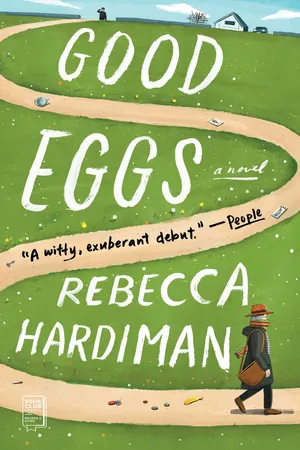
Good Eggs

A Novel

  1. 336 pages
  2. English
  3. ePUB (mobile friendly)
  4. Available on iOS & Android
eBook - ePub

Good Eggs

A Novel

About this book

Named a Best Feel-Good Book by The Washington Post

When a home aide arrives to assist a rambunctious family at a crossroads, simmering tensions boil over in this “witty, exuberant debut” (People) that is an “absolute delight from start to finish” (Sarah Haywood, New York Times bestselling author)—perfect for fans of Where’d You Go, Bernadette and Evvie Drake Starts Over.

When Kevin Gogarty’s eighty-three-year-old mother is caught shoplifting yet again, he has no choice but to hire a caretaker to keep an eye on her. Kevin, recently unemployed, is already at his wits’ end tending to a full house while his wife travels to exotic locales for work, leaving him solo with his sulky, misbehaved teenaged daughter. Into the Gogarty fray steps Sylvia, the upbeat home aide, who appears at first to be their saving grace—until she catapults the Gogarty clan into their greatest crisis yet.

“Bracing, hilarious, warm” (Judy Blundell, New York Times bestselling author), Good Eggs is an irresistibly charming study in self-determination; the notion that it’s never too late to start living; and the unique redemption that family, despite its maddening flaws, can offer.
Tools to learn more effectively

Saving Books

Saving Books

Keyword Search

Keyword Search

Annotating Text

Annotating Text

Listen to it instead

Listen to it instead

Information

1

Three-quarters of the way to the newsagent’s, a trek she will come to deeply regret, Millie Gogarty realizes she’s been barreling along in second gear, oblivious to the guttural grinding from the bowels of her Renault. She shifts. Her mind, it’s true, is altogether on other things: the bits and bobs for tea with Kevin, a new paperback, perhaps, for the Big Trip, her defunct telly. During a rerun of The Golden Girls last night, the ladies had been mistaken for mature prostitutes when the screen went blank (silly, the Americans, overdone, but never dull). After bashing the TV—a few sturdy blows optimistically delivered to both sides in the hopes of a second coming—she’d retreated to her dead Peter’s old sick room where she’s taken to sleeping ever since a befuddling lamp explosion had permanently spooked her from the second floor. Here, Millie had fumbled among ancient woolen blankets for her battery-operated radio and eventually settled down, the trusty Philips wedged snugly between a naked pillow and her good ear, humanity streaming forth. Her unease slowly dispelled, not unlike the effect of a five-o’clock sherry when the wind of the sea howls round her house postapocalyptically. Even the grimmer broadcasts—recession, corruption, lashing rain—can have an oddly cheering effect: somewhere, things are happening to some people.
Now a BMW jolts into her peripheral vision, swerves sharply away—has she meandered?—and the driver honks brutally at Millie, who gives a merry wave in return. When she stops at a traffic light, the two cars now parallel, Millie winds down her window and indicates for her fellow driver to do likewise. His sleek sheet of glass descends presidentially.
ā€œSorry!ā€ she calls out. ā€œI’ve had a frozen shoulder ever since the accident!ā€ Though her injury and her dodgy driving bear no connection, Millie feels some explanation is due. She flaps her right elbow, chicken wing style, into the chilled air. ā€œIt still gets quite sore.ā€ Millie offers the man, his face a confused fog, a trio of friendly, muffled toots of the horn and motors on past.
Before heading to the shop, Millie had phoned her son—technically, Kevin is her stepson, though she shuns all things technical and, more to the point, he’s been her boy and she his mum since his age was still measured in mere months. Millie began by relaying the tale of the unholy television debacle.
ā€œBlanche had checked the girls into a hookers’ hotel without realizing,ā€ Millie explains, ā€œand the policeā€”ā€
ā€œI’m just bringing the kids to school, Mum.ā€
ā€œWould you ever come down and take a look? I can’t bear to have no telly.ā€
ā€œDid you check the batteries?ā€
ā€œIt doesn’t run on batteries. It’s a television.ā€
ā€œThe remote batteries.ā€
ā€œAha,ā€ says Millie. ā€œWell now how would Iā€¦ā€
ā€œLet me ring you in two ticks.ā€
ā€œOr you can take a look when you come for supper?ā€
ā€œSorry?ā€
ā€œRemember? It’ll be your last chance, you know. I leave Saturday.ā€
ā€œFully aware.ā€
ā€œI may never come back.ā€
ā€œNow you’re just teasing me.ā€
ā€œAnd bring one of the children. Bring all of the children! I’ve got lamb chops and roasties.ā€
She had, in fact, neither. A quick inspection of the cabinet, during which she held the phone aloft, blanking briefly that her son was on the line, yielded neither olive oil nor spuds. A glimpse of the fridge—the usual sour blast and blinding pop of light—revealed exactly one half pint of milk, gone off, three or four limp sprigs of broccoli, and a single cracked egg.
ā€œOr maybe I’m the cracked egg,ā€ she muttered as she brought the receiver to her ear.
ā€œThat,ā€ her son said, ā€œhas never been in question.ā€

Once inside Donnelly’s, Millie tips her faux-fur, leopard-print fedora to one and all. Millie Gogarty knows many souls in DĆŗn Laoghaire and villages beyond—Dalkey, Killiney—and it’s her self-imposed mission to stop and have a chat with anyone whenever, wherever possible—along the windy East Pier, in the shopping center car park, standing in the bank queue (she would have no qualms about taking her coffee, used to be complimentary after all, in the Bank of Ireland’s waiting area), or indeed right in this very shop.
She sidles up to Michael Donnelly Jr., the owner’s teenage, pockmarked son who slouches behind the counter weekdays after school.
ā€œDid you know in three days’ time Jessica Walsh and myself will be in New York for the Christmas? My great-great-great-grandnephewā€ā€”she has slipped in an extra great or two, as is her wontā€”ā€œused to live in Ohio, but we’re not going there. Sure, there’s nothing there! I visited him once… oh I don’t know when, it’s not important.ā€ She crosses her arms, settles in. ā€œChristmas morning and not a soul in the street. Kevin and I—he’d just gone eighteen—we took a walk, mountains of snow everywhere, and there we were standing in the middle of the street calling out, ā€˜Hello? America? Is anyone there?ā€™ā€Šā€
ā€œThat so, Mrs. Gogarty?ā€ Michael says with a not entirely dismissive smile. He turns to the next customer, Brendan Doyle, whom Millie knows, of course, though Brendan appears to be deeply engrossed in his scuffed loafers.
She beams at them both, trailing away toward the tiny stationery section, a shelf or two of dusty greeting cards whose existence would only be registered by her generation. The young no longer put pen to paper. They text message. Her own grandchildren are forever clicking away at their mobiles with a frenzied quality Millie envies; she can’t remember the last time communication of any kind felt so urgent.
She selects a card embossed with a foil floral bouquetā€”ā€œIt’s Your Special Day Daughter!ā€ā€”and reads the cloying message within. Once in hand, the itch to swipe the thing, the very last thing under the sun that Millie Gogarty, daughterless, needs, gains powerful momentum, until she knows that she must, and will, take it.
She checks the till. Michael is ringing up Brendan’s bars of chocolate. The last time he’d crossed her path was in the chemist’s—he’d been buying a tube of bum cream, the thought of which now makes her giddy. Her pits dampen as she prods open the cracked folds of her handbag, pushes its chaotic contents—obsolete punt coins, balls of hardened tissue, irrelevant scribbles—to the depths so that it gapes open, a mouth begging to be fed. Her stomach whoops and soars. Her heart, whose sole purpose for days upon days has been the usual, boring biological one, now thumps savagely. With a wild, jerky motion she will later attribute to her downfall, she plunges the card into her bag.
Millie breathes. Feigning utter casualness, she plucks another card, this one featuring a plump infant and an elephant. She smothers a laugh. Perhaps Kevin’s right: perhaps I’ve finally gone mad! She steals another glance at Michael, who meets her gaze, nodding imperceptibly, and so she chuckles, as if the words inside particularly strike her fancy. Millie has sensed a calling to the stage all her life and she holds out a secret hope that she might still be discovered. Indeed for a moment, Millie Gogarty marvels at her own audacity, pulse pounding yet looking for all of DĆŗn Laoghaire as calm as you like. Her mind turns to supper—one of the grandchildren could turn up—and so she boldly heads toward a display box of Tayto crisps and nicks a packet of cheese and onion and a Hula Hoops.
Flooded with good cheer and relief, she fairly leaps back into her car, the spoils of the morning safely tucked beside her. She’s situating her left foot on the clutch, right foot poised to gun the engine and soar off back to her home, Margate, when she hears a timid knock on her window.
It’s Junior from the shop, not a smile on him. A panicky shot of darkness seizes her. Millie reluctantly draws down her window.
ā€œI hate to do this, Mrs. Gogarty, but I have to ask you to come back in.ā€
ā€œDid I leave something behind?ā€
He glances at her bag. ā€œYou’ve a few things in there I think you haven’t paid for.ā€
There follows a pause, long and telling.
ā€œSorry?ā€ she says, shifting into reverse.
ā€œI’m talking about that.ā€ He jabs a fat, filthy finger at her handbag. The boy—barely sixteen, she reckons, the twins’ age, probably in the first year of his Leaving Certificate—yo-yos his eyes from the steering wheel to the bag, back to the wheel.
ā€œMy dad said I was to phone the guards if it happened again.ā€
Phone the guards!
Millie assembles her most authentic aw-shucks grin, hoping to emit the picture of a hapless, harmless granny. But her body betrays her: her face boils; pricks of perspiration collect at her hairline. This is the sorry tale of all the oldies, the body incongruent with the still sharp mind—tumors sprouting, bones snapping with a mere slip on ice, a heart just giving up one day, like her Peter’s. Millie’s own heart now knocks so violently, for the second time today, that she has the image of it exploding from her chest and flapping, birdlike, away.
Junior’s still staring at her. She puts the back of her hand up to her brow like a fainting lady from an earlier century; she can’t bear to be seen. Then a single, horrid thought filters through: if the police become involved, Kevin will find out.
Kevin cannot find out.
He’s already sniffing around, probably trying to build a case, with a stagey, lethal gentleness that terrifies her, to stick his poor mum into some godforsaken home for withered old vegetables. Millie Gogarty has no plans to move in with a bunch of wrinklies drooling in a corner. Her dear friend Gretel Sheehy was abandoned in Williams House, not five kilometers down the road. Gretel, needless to say, didn’t make it out.
Now a second, equally ghastly thought: what if her grandchildren, the Fitzgeralds a few doors down, or all of south Dublin, gets wind of her thievery? The potential for shame is so sweeping that Millie rejects the idea outright, stuffs it back into her mental lockbox where, wisely or not, she’s crammed plenty of other unpleasantries over the years.
Wildly, she considers feigning an ailment, a stroke perhaps? It, or something like it, has worked in the past, but she can’t, in her muddled thinking, remember when she last trotted out such a deception and vaguely suspects that it was here in DĆŗn Laoghaire.
ā€œI’m really sorry,ā€ Michael says. He’s actually not, despite the acne, a bad-looking lad. ā€œThe thing is, I’ve already phoned the police.ā€

2

Kevin Gogarty gets the call over pints at The Brass Bell, one of the city center’s oldest pubs, known for showcasing promising comedians on its tiny makeshift stage in the upstairs room. Kevin had had his shot at the mic years and years ago, when he’d had the notion of becoming a stand-up comic. He’d bombed it badly with a running gag about blow jobs and priests that he later felt had been ahead of its time. Still, he loves the mahogany carvings and brass beer pulls, the shabby Victoriana of the place, and it’s where he and Mick, his former colleague and best mate, meet on the rare occasion when he can get out on the lash.
Leading up to Christmas week, the pub is mad packed with drinkers—everyone across the land is on the piss. It takes Kevin a full minute, plenty of sorrys and hands landing briefly on strangers’ backs, to nudge through the throngs and arrive at the bar, where he sighs happily: he’s out of the house with Mick, who’s sure to regale him with plenty of suss about the old magazine.
The barmen are on the hustle as ever, pulling pints of ale and stout and cider three, four across, taking orders from customers all down the long bar. It’s miraculous they never fuck it up, adding up your total, making fast change, no till required, mixing up Bacardi and Coke, Southern Comfort and Red, Irish coffee, whatever you like. If barmen ran the country, Kevin thinks, the economy would doubtless not be in the shitter.
Just outside, he can see, despite the cold, tiny huddles of smokers commiserating, blowing out their luxurious cancer plumes. No more smoking indoors anymore, who would ever have thought? He feels like an old fella, but can’t help marveling at how much Ireland has changed. Used to be this place was smoke-fogged and jammed like this at lunchtime any day of the week. No one has the dosh any longer, given the brutal, embarrassing slaying of the so-called Celtic Tiger. In the few months he’s been carpooling children in his whopping minivan, negotiating homework, refereeing sibling rows, cooking up plates of fish and chips and peas, the world seems to have shifted, the air seems to have leaked from the recently buoyant Dublin economy. The days of dossing, of not taking any of it too seriously, are up.
When Kevin’s mobile first rings—unknown caller—he rejects it and then spots and salutes Mick from afar. He hears music competing with the din—ah, Zeppelin. ā€œOver the Hills and Far Away.ā€ A Guinness in each hand, Kevin weaves his way expertly, cautiously, back to the bit of table Mick’s eked out for them, not coincidentally, Kevin is certain, beside two very beautiful, very young women, early twenties if that, a glass and minibottle of Chablis before each.
ā€œMind if we squeeze in here?ā€ Kevin says.
The hotter one—wide, clever eyes; breasts that have clearly not been suckled upon, by babies anyway; blinding Yank teeth—regards and dismisses him in the same millisecond. Kevin absorbs her indifference with a wince.
ā€œDone with work,ā€ says Mick. ā€œFor the year anyway.ā€
ā€œYa fucker.ā€ The two men exchange a lengthy handshake and Kevin’s feeling so generous of spirit—the tree is up, the kitchen stocked with food and drink, Grace’ll be about for a few days anyway, maybe he’ll even get laid, a Christmas miracle!—he throws his arms around Mick.
ā€œListen, I might have a lead for you,ā€ says Mick.
ā€œNot sure...

Table of contents

  1. Cover
  2. Title Page
  3. Dedication
  4. Chapter 1
  5. Chapter 2
  6. Chapter 3
  7. Chapter 4
  8. Chapter 5
  9. Chapter 6
  10. Chapter 7
  11. Chapter 8
  12. Chapter 9
  13. Chapter 10
  14. Chapter 11
  15. Chapter 12
  16. Chapter 13
  17. Chapter 14
  18. Chapter 15
  19. Chapter 16
  20. Chapter 17
  21. Chapter 18
  22. Chapter 19
  23. Chapter 20
  24. Chapter 21
  25. Chapter 22
  26. Chapter 23
  27. Chapter 24
  28. Chapter 25
  29. Chapter 26
  30. Chapter 27
  31. Chapter 28
  32. Chapter 29
  33. Chapter 30
  34. Chapter 31
  35. Chapter 32
  36. Chapter 33
  37. Chapter 34
  38. Chapter 35
  39. Chapter 36
  40. Chapter 37
  41. Chapter 38
  42. Chapter 39
  43. Chapter 40
  44. Chapter 41
  45. Chapter 42
  46. Chapter 43
  47. Chapter 44
  48. Chapter 45
  49. Chapter 46
  50. Chapter 47
  51. Chapter 48
  52. Chapter 49
  53. Chapter 50
  54. Chapter 51
  55. Chapter 52
  56. Chapter 53
  57. Chapter 54
  58. Chapter 55
  59. Chapter 56
  60. Chapter 57
  61. Chapter 58
  62. Chapter 59
  63. Chapter 60
  64. Chapter 61
  65. Chapter 62
  66. Chapter 63
  67. Chapter 64
  68. Acknowledgments
  69. Reading Group Guide
  70. About the Author
  71. Copyright

Frequently asked questions

Yes, you can cancel anytime from the Subscription tab in your account settings on the Perlego website. Your subscription will stay active until the end of your current billing period. Learn how to cancel your subscription
No, books cannot be downloaded as external files, such as PDFs, for use outside of Perlego. However, you can download books within the Perlego app for offline reading on mobile or tablet. Learn how to download books offline
Perlego offers two plans: Essential and Complete
  • Essential is ideal for learners and professionals who enjoy exploring a wide range of subjects. Access the Essential Library with 800,000+ trusted titles and best-sellers across business, personal growth, and the humanities. Includes unlimited reading time and Standard Read Aloud voice.
  • Complete: Perfect for advanced learners and researchers needing full, unrestricted access. Unlock 1.4M+ books across hundreds of subjects, including academic and specialized titles. The Complete Plan also includes advanced features like Premium Read Aloud and Research Assistant.
Both plans are available with monthly, semester, or annual billing cycles.
We are an online textbook subscription service, where you can get access to an entire online library for less than the price of a single book per month. With over 1 million books across 990+ topics, we’ve got you covered! Learn about our mission
Look out for the read-aloud symbol on your next book to see if you can listen to it. The read-aloud tool reads text aloud for you, highlighting the text as it is being read. You can pause it, speed it up and slow it down. Learn more about Read Aloud
Yes! You can use the Perlego app on both iOS and Android devices to read anytime, anywhere — even offline. Perfect for commutes or when you’re on the go.
Please note we cannot support devices running on iOS 13 and Android 7 or earlier. Learn more about using the app
Yes, you can access Good Eggs by Rebecca Hardiman in PDF and/or ePUB format, as well as other popular books in Literature & Literature General. We have over one million books available in our catalogue for you to explore.