Screwcutting in the Lathe for Home Machinists is a complete guide detailing the uses of a lathe for all forms of screwcutting in all thread forms, pitches, and diameters. Working in both imperial and metric standards, this comprehensive and invaluable resource will inform you on everything you need to know about lathe screwcutting. Also included are calculations, gear trains, conversions, and other helpful reference tables. Author Martin Cleeve was a well-respected contributor to Model Engineer magazine for more than 30 years. A known perfectionist to high-quality and accurate work, he designed and described many original lathe accessories, which have been made and regularly used in hundreds of amateur and professional workshops.
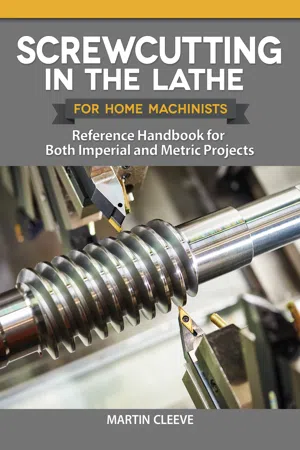
eBook - ePub
Screwcutting in the Lathe for Home Machinists
Reference Handbook for Both Imperial and Metric Projects
- 250 pages
- English
- ePUB (mobile friendly)
- Available on iOS & Android
eBook - ePub
Screwcutting in the Lathe for Home Machinists
Reference Handbook for Both Imperial and Metric Projects
About this book
Information
SECTION 1
Introduction
It has been said that lathe screwcutting cannot be taught from books, which seems to imply that students must learn this particular skill from trial and error after gathering a few basic facts from an instructor. However, this outlook may arise partly from the fact that few general engineering books can spare the necessary space, and partly because writers seldom take the trouble to make any specialized study of lathe screwcutting, with the result that the same few scraps of information are handed down from generation to generation without any attempt at sorting the wheat from the chaff; perhaps to disguise this deficiency it is sometimes remarked that too much emphasis can be placed upon the ability to cut threads in lathes. However, in this respect, while ordinary turning calls for the use of little more than common sense, efficient and time-saving lathe screwcutting cannot be undertaken on the same basis, and if a lathe operator is not in possession of all the relevant facts he may not be able to avoid wasting time: time which on small batch production can sometimes amount to whole working weeks, not just the odd 30 minutes. For example, it is not always necessary to follow the time-wasting instruction: ‘For all other threads, reverse the lathe’ (an instruction referring to tool repositioning between threading passes). Moreover, the adverse conditions for which lathe reversal is supposed always to be necessary can sometimes be turned to advantage for indexing the starts of multiple-start threads by a method whereby, after an initial setting, indexing takes place between every single threading pass without additional attention from the operator, and having the advantage that all starts (individual helices) are machined to identical proportions to close limits.
Having said that, it would only be fair to add that on deciding it might be a good idea to commit to paper the results of my researches, I had no idea that the describing of what is basically a simple process would call for such a plethora of writing, (and I have not used two words where one will serve) or indeed that the project would lead to two Patent Applications, one for an independently retractable and swing lathe toolholder (No. 1335978 – now lapsed), and one for a simple thread tool sharpening jig (No. 1417351 – not ‘Sealed’ although printed by the Patent Office), or that I would be devising formulas for the design of leadscrews of special lead for the automatic indexing of the starts of multiple-start threads when these cannot be auto-indexed from standard English or metric leadscrews.
In general, despite the rapid advancement in fully automatic machine control, the ordinary center lathe is likely to remain with us for a long time for the reason that it does not pay to set an automatic machine for only one or a few threaded components such as those required for jig and tool-making, or for experimental and prototype work. And in many instances, even when the quantity of components reaches the 50 to 150 total, a center lathe can offer a saving when compared with the cost of a more specialized machine and the time taken to set it.
On the other hand, automatic and semi-automatic threading attachments can now be obtained for use with standard center lathes, and such attachments can be fairly quickly set. However, the initial cost can be high, and this has to be weighed against the quantity of threading likely to be called for.
In contrast to the foregoing, I have heard it remarked that screwcutting facilities are not really necessary on center lathes these days, as all threads can be cut with taps and dies. Now although modern taps and die-heads are capable of cutting clean bright threads to close limits, their use sometimes calls for very high torques, whereas a center lathe always forms threads in easy stages, admirably suited to those components which by nature of their design could not be gripped with sufficient security to withstand the high torques imposed when tap or die running. Moreover a lathe will cut a thread of any pitch on any diameter: for example it is as easy to cut 16 tpi on a diameter of 4 in. as on a diameter of ½ in. or less, whereas the use of taps and dies limits one to standard sizes, and when only a few special threads are called for one obviously would not wish either to pay the high cost of special taps or dies, or to await delivery when such threads can be lathe screwcut for the trifling cost of...
Table of contents
- Cover
- Title
- Copyrights
- Contents
- Acknowledgment
- Section 1 Introduction
- Section 2 Principles of lathe Screwcutting
- Section 3 Gearing an English Leadscrew for Metric Threads
- Section 4 Lathes with Metric Leadscrews
- Section 5 Problems and Analysis of Repeat Pick-Up
- Section 6 Multiple-Start Threads
- Section 7 Single Point Lathe Threading Tools
- Section 8 Practical Aspects Of Lathe Screwcutting
- Section 9 Practical Thread Sizing Measurement
- Appendix 1 List of Tables
Trusted by 375,005 students
Access to over 1.5 million titles for a fair monthly price.
Study more efficiently using our study tools.
Frequently asked questions
Yes, you can cancel anytime from the Subscription tab in your account settings on the Perlego website. Your subscription will stay active until the end of your current billing period. Learn how to cancel your subscription
No, books cannot be downloaded as external files, such as PDFs, for use outside of Perlego. However, you can download books within the Perlego app for offline reading on mobile or tablet. Learn how to download books offline
Perlego offers two plans: Essential and Complete
- Essential is ideal for learners and professionals who enjoy exploring a wide range of subjects. Access the Essential Library with 800,000+ trusted titles and best-sellers across business, personal growth, and the humanities. Includes unlimited reading time and Standard Read Aloud voice.
- Complete: Perfect for advanced learners and researchers needing full, unrestricted access. Unlock 1.5M+ books across hundreds of subjects, including academic and specialized titles. The Complete Plan also includes advanced features like Premium Read Aloud and Research Assistant.
We are an online textbook subscription service, where you can get access to an entire online library for less than the price of a single book per month. With over 1.5 million books across 990+ topics, we’ve got you covered! Learn about our mission
Look out for the read-aloud symbol on your next book to see if you can listen to it. The read-aloud tool reads text aloud for you, highlighting the text as it is being read. You can pause it, speed it up and slow it down. Learn more about Read Aloud
Yes! You can use the Perlego app on both iOS and Android devices to read anytime, anywhere — even offline. Perfect for commutes or when you’re on the go.
Please note we cannot support devices running on iOS 13 and Android 7 or earlier. Learn more about using the app
Please note we cannot support devices running on iOS 13 and Android 7 or earlier. Learn more about using the app
Yes, you can access Screwcutting in the Lathe for Home Machinists by Martin Cleeve in PDF and/or ePUB format, as well as other popular books in Technology & Engineering & Mechanical Engineering. We have over 1.5 million books available in our catalogue for you to explore.