eBook - ePub
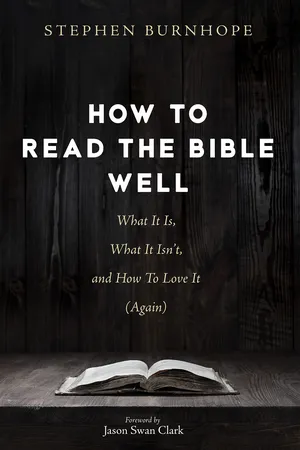
How to Read the Bible Well
What It Is, What It Isn’t, and How To Love It (Again)
- 234 pages
- English
- ePUB (mobile friendly)
- Available on iOS & Android
eBook - ePub
About this book
How to Read the Bible Well takes on the big questions about the Bible that we've always wanted to ask. What do people mean when they say it's the Word of God? In what way, exactly? How can an ancient world text be offering supposedly timeless truths? Can we really take what "the Bible says" as authoritative for life today? Isn't it obviously sexist and outdated? Do we have to believe in Adam and Eve, and the world being made in six days? Why did God command genocide in the Old Testament? Are people really going to burn in hell for eternity? Why is there evil and suffering in the world? And, how can we explain the Big Story of the Bible, from cover to cover, in ways that will make sense to people today? Stephen Burnhope suggests there are very good answers to all of these questions and more--once we know how to read the Bible well!
Information
8
Heaven and Hell
When we talk about “heaven,” I wonder what kind of mental images come to mind? How do you picture it? The classic imagery is of course cherubs playing harps, sitting on clouds. Doesn’t sound like lots of fun to me! But it’s interesting that when it comes to what the Bible has to say about both heaven and hell—two of the things that people are most interested in hearing about—those are almost entirely described in “picture-language.” Because we live in an age of science, we tend to expect the Bible to give us facts and data and technical information—like a textbook would. But that wasn’t the expectation of people at the time the Bible was written. That doesn’t make the Bible “flawed” for that reason, it’s just that it wasn’t that kind of literature. People then had different “literary styles” or “genres”—different ways of explaining things—and that included using words to “paint pictures.” Especially when they were communicating transcendent things. We, on the other hand, tend to think that pictures and picture language are a second-best way of communicating truth. And that’s partly because we don’t value the arts as much as the sciences.
But communicating truth through pictures has a lot going for it. For one thing, pictures are “timeless.” However much scientists discover as time goes by and we learn more and more about life and the cosmos, pictures still “speak to us” in a “timeless” way. They engage our imagination, they’re easy to remember, and quite literally they help us to keep “the big picture” in mind. Pictures also leave room for some mystery. Science is really important for human life and human well-being, but the very nature of science involves trying to get rid of mystery. And it’s certainly true that none of us wants any more mystery than we have to when it comes to diseases and health risks. But we do need some space for mystery when it comes to spiritual things—when it comes to God. We can’t expect to have him under control like we want to have diseases under control.
When we approach the Bible, it’s important to give it the respect that it deserves and not to critique it for being something that it never intended to be. This includes respecting the original authors by taking account of what they were intending to be saying and not saying in what they wrote. Similarly, to respect their original audience, as to how they would have understood what was being said and what it would have meant to them at the time. Equally importantly, we need to consider the reasons that God himself may have had, as the ultimate divine author of the Bible, in choosing to convey truth through pictures and stories rather than a text book of scientific facts. We can readily imagine that part of his reasoning in choosing to speak through “timeless” art rather than “time-bound” science is that, whether we’re reading the Bible in the first century, the sixteenth century, the twenty-first century, or even the twenty-fifth century, God can still speak to us about the same truths. It doesn’t require scientific knowledge from another era in order to be grasped. Of course, this is not to say that “pictures” are picturing something that isn’t real; they’re simply describing realities in a different way. We shall need to keep that in mind when we look at both heaven and hell in this chapter.
Heaven and the Kingdom of God
As we saw when we looked earlier at the “Big Story” of the Bible, the starting point for us to look at heaven is the way that God intended his creation should be and then, by contrast, the way that it ended up being. That includes how God intended we should be and how we ended up being. We saw in the creation account in Genesis that at every stage—every “day”—God looked at each aspect that he “spoke” into being and said it was “good.” And when he had finished creating, including humanity as the pinnacle, he looked at everything together and said that it was “very good.” On the seventh day, it says God rested, which gave rise to the Jewish Sabbath—the day on which God said to Israel that they should imitate him (as indeed, they were called to do in the whole of life) by resting from their labors (see, e.g., Exodus 20:11 and elsewhere). That day of rest was not intended simply as some kind of “pyjama day” of doing nothing, but a day of enjoying God and his “very good” creation together.
For various reasons, centered on the infiltration of a cosmic enemy that we call “sin,” this “very good” creation then became damaged and knocked off-kilter. It was an enemy that we humans collaborated with and allowed to become more powerful, to a point where the kind of creation that God designed—and the kind of people God designed—ended up a long way from the blueprint. We became a creation in which a holy God could not dwell in the way that he wanted to; our incompatibility with him had become too great. It would not have been surprising, given what happened, if God were to give up on this damaged creation completely and give up on us completely. But that would, of course, have meant that this cosmic enemy had won. “Sin”—and the damage and suffering and death that it leads to—would have won. God could not stand by and allow that to happen. Immediately this enemy entered the story, God declared his intention not to abandon his creation but to restore his creation. And if we then fast forward to the pivotal point in that restoration plan—God personally entering into his creation in his Son, the “turning point” when death itself goes into reverse and the power of sin is broken—we see the “future” arriving in the “present.” This is described in the New Testament as the “coming of the kingdom.”
People have often found it puzzling that Jesus said both that the kingdom of God had arrived in his ministry (e.g., Luke 9:2 and 11:20) and that it was still to come (e.g., Mark 9:1 and Mark 14:25). He taught his disciples to pray for the kingdom to come in what we call the Lord’s Prayer (Luke 11:2 and Matthew 6:10) even though the kingdom was among them. Theologians make sense of this apparent dichotomy through what’s called the “now” and the “not yet” of the kingdom—or, the “already” but not yet. In other words, both are true. Jesus inaugurated or “launched” the beginning of the rule and reign of God in this world in his personal earthly ministry. However, the completion of the coming of the kingdom in all of its fullness awaits his return. Until then, we are living in a period of the “now and the not yet,” in which we have a foretaste of the way things will be, but not its fullness. We have the “first-fruits” of the coming harvest—the same in quality but not in quantity. Other biblical language pictures it as a “down-payment” or “guarantee,” through the Holy Spirit working among us between now and then.
In both Old and New Testaments, the Bible pictures “the way things will be” in this future state when the kingdom has come in all its fullness. This is what we call heaven for short. Bear in mind that neither heaven nor the kingdom is referring to a place. I remember many years ago hearing a sermon in which the lay preacher asked the rhetorical question, “How do we know that heaven is real?” and answered it with Genesis 1:1—“In the beginning, God created the heavens and the earth.” It wasn’t appropriate to point out to him that this Jewish phrase “the heavens and the earth” had nothing to do with a place called heaven, it was simply their way of saying “the cosmos” or the “entire created order,” for which biblical Hebrew lacked a word.
In this present age, the kingdom is present wherever we see a foretaste of the rule and reign of God happening. It’s wherever and whenever we see something (or someone, or someone’s situation) coming into line with God’s rule and reign through his divine power at work—God supernaturally changing things from what they are to what they should be. It’s when the future “breaks in” to the present. Examples of this would be Jesus’ healings and deliverances—as a “foretaste” of the way things will one day be in their entirety, “signposts” to the fullness of that future kingdom. This is why we do well to speak of them as “signs and wonders” rather than simply “miracles.” In this present era between Jesus’ first and second comings, we see the kingdom having come “now” in part but “not yet” in all its fullness. This current period has been helpfully described as being like the time between D-Day (the Normandy landings towards the end of the Second World War) that decisively broke the enemy’s grip of power and through the success of which ultimate victory was then certain and VE Day (“Victory in Europe” Day) when that final victory could be declared as having been completed, in the enemy’s unconditional surrender. Rather than talking about “heaven,” therefore, we should really be talking about the fullness of the coming kingdom at the end of the age. It’s OK for us to use heaven as shorthand in one sense, but given how easily it can conjure up images of cherubs, harps, and clouds, perhaps we should use it sparingly.
The picture of heaven that the Bible paints, through a variety of imagery (and I’m using heaven here in the kingdom-sense that we’ve just been discussing) has a number of features. They are all describing and reflecting a state where every enemy of human life and flourishing—everything that has invaded and infiltrated God’s “very good” creation and caused this present disorder—has been removed and defeated. This includes the “personified” enemies of “Sin,” “Death,” and “Satan” and so too, sickness, poverty, injustice, oppression, and suffering. The imagery speaks of a “new” creation—a cosmos that has been restored in conformity to its original design. A new creation in which there will be no more predators and no more victims. This new creation includes eternal life as an intrinsic feature because death (and everything that leads to death) will no longer be present—so there is nothing left to bring an end to life.
At the same time as the removal of every thing that damages God’s creation comes the removal of everyone who wants to continue to damage God’s creation, since their continued presence is also totally incompatible with this new era, in which God both reigns and is present.
There is a linkage or “echo” here with the biblical concept of shalom, which doesn’t simply mean “peace,” as it’s often translated. The concept has far more to do with a state of complete wholeness and well-being, “when the world’s all as it should be” (per the line in the Matt Redman song, “Blessed Be Your Name”).
Further biblical images, or pictures, speak of the natural world (as we would call it) also being brought into line and no longer bringing suffering and destruction in its own ways.
A Story That Starts with “Original Goodness”
The reason that this broader perspective is important is because it offers us concepts of what a restored cosmos looks like. If we simply do a Bible word-search for heaven we will miss all of this. Understanding the nature of heaven begins with God’s promise, as soon as things started to go wrong, that one day he will put everything right. He will do that because what he said in Genesis is still...
Table of contents
- Title Page
- Foreword
- Preface
- Introduction
- What Is the Bible?
- The Word of God or the Words of People?
- The Bible Story as a Box Set
- The God of the Old Testament and the God of the New Testament
- How the Biblical Writers Saw Their World
- Does the Old Testament Apply Today?
- The Bible and Judaism
- Heaven and Hell
- Was Jesus Superman?
- Why Is There Evil and Suffering in the World?
- Original Context and the Boundaries of Biblical Interpretation
- Bible Versions
- Bibliography
Trusted by 375,005 students
Access to over 1.5 million titles for a fair monthly price.
Study more efficiently using our study tools.
Frequently asked questions
Yes, you can cancel anytime from the Subscription tab in your account settings on the Perlego website. Your subscription will stay active until the end of your current billing period. Learn how to cancel your subscription
No, books cannot be downloaded as external files, such as PDFs, for use outside of Perlego. However, you can download books within the Perlego app for offline reading on mobile or tablet. Learn how to download books offline
Perlego offers two plans: Essential and Complete
- Essential is ideal for learners and professionals who enjoy exploring a wide range of subjects. Access the Essential Library with 800,000+ trusted titles and best-sellers across business, personal growth, and the humanities. Includes unlimited reading time and Standard Read Aloud voice.
- Complete: Perfect for advanced learners and researchers needing full, unrestricted access. Unlock 1.5M+ books across hundreds of subjects, including academic and specialized titles. The Complete Plan also includes advanced features like Premium Read Aloud and Research Assistant.
We are an online textbook subscription service, where you can get access to an entire online library for less than the price of a single book per month. With over 1.5 million books across 990+ topics, we’ve got you covered! Learn about our mission
Look out for the read-aloud symbol on your next book to see if you can listen to it. The read-aloud tool reads text aloud for you, highlighting the text as it is being read. You can pause it, speed it up and slow it down. Learn more about Read Aloud
Yes! You can use the Perlego app on both iOS and Android devices to read anytime, anywhere — even offline. Perfect for commutes or when you’re on the go.
Please note we cannot support devices running on iOS 13 and Android 7 or earlier. Learn more about using the app
Please note we cannot support devices running on iOS 13 and Android 7 or earlier. Learn more about using the app
Yes, you can access How to Read the Bible Well by Stephen Burnhope in PDF and/or ePUB format, as well as other popular books in Theology & Religion & Biblical Criticism & Interpretation. We have over 1.5 million books available in our catalogue for you to explore.