eBook - ePub
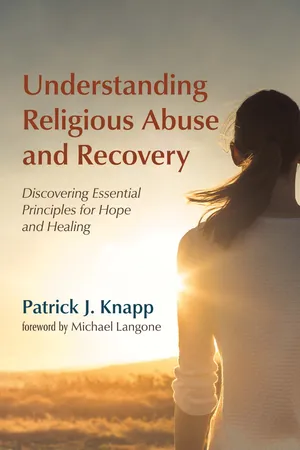
Understanding Religious Abuse and Recovery
Discovering Essential Principles for Hope and Healing
- 218 pages
- English
- ePUB (mobile friendly)
- Available on iOS & Android
eBook - ePub
Understanding Religious Abuse and Recovery
Discovering Essential Principles for Hope and Healing
About this book
Currently there are at least four major, identifiable perspectives on how people best understand and recover from religious abuse. Both secular and faith-based (Christian) adherents can be variously identified in each of these approaches. This book examines these viewpoints and evaluates their various strengths and limitations. It concludes that each perspective is helpful to the extent possible, given the limitations of its respective philosophic or theological assumptions. This book summarizes each viewpoint and suggests a larger contextual perspective, helpful to better understand involvement in and recovery from religiously abusive environments. The conclusion is an integration of the various conceptual frameworks, and a different model (SECURE) is described that includes essential principles and practical strategies necessary for recovery from religious abuse. Suggestions are made for future research and study both for academics with interest in the cultic studies and counseling fields, and for various people negatively affected by religious abuse and in need of recovery.
Information
1
Historical Overview
Religious abuse has a broad, significant, and painful worldwide history (Cowan & Bromley, 2008; Engh, 2007; Singer & Lalich, 1995; Stark & Corcoran, 2014). Some professionals in the field have chosen to write about religious abuse specifically within the context of the Christian church (Frend, 1981; Foxe & Wright, 1811); others have focused deeply within the history of particular groups (Giambalvo & Rosedale, 1996; Lindsey, 2014; Tanner & Tanner, 1989). In the first section of this chapter, I highlight the historical relevance of abuse under religiously motivated behaviors and belief. This discussion is not intended to be comprehensive; instead it will address only some of the more significant representative occurrences of religious abuse while placing them in a historical and relevant cultural context.
The second and larger section of this chapter includes a general review of relevant literature in the field of religious abuse and recovery as expressed from four basic theoretical perspectives on religious abuse and recovery: a mind-control, victimization approach; a psychosocial, needs-based understanding; a deliberative or Conversionist conceptualization; and finally, a dynamic-systems approach. These perspectives include adherents who self-identify as faith based and others who appeal to a secular orientation. I distinguish varying opinions, and identify both organized and assorted contributions to this field of study.
Section 1: Historical Relevance of the Problem
Depending on one’s primary intent, each of several approaches to reviewing the history and relevance of spiritual abuse over time might be appealing, and choosing among them can be difficult. For instance, some researchers may wish to begin their historical focus on recent occurrences of blatant religious abuse to make the subject more manageable. For them, the Jonestown Massacre (1978) provides just such an example. Starting at this historic juncture is tempting; it significantly shortens the historical narrative of religious abuse and is an easily identifiable target because of the 913 members who lost their lives in Guyana, South America (Layton, 1999). Similarly, on our own shores, one might suggest the history behind the infamous 1993 Waco Massacre as a starting place (Thibodeau & Whiteson, 1999).
Others who hold a Christian theological persuasion might suggest looking to some of the earliest written records, citing the account of the Garden of Eden (Gen 3) and what is commonly referred to as the Fall of humankind as indicative of the source and earliest identifiable cause of religious or spiritual abuse (Wright, K., 2001, p. 90–91). This choice too is tempting because it suggests a theological context from which to better understand religious abuse and recovery that includes important presuppositional philosophical constructs. These worldview assumptions include the nature of humankind, the source of the human dilemma, and ultimately a redemptive or restorative solution (Schaeffer, 1968).
Still others have focused on more recent times and more broadly sociological factors, identifying religious abuse across all belief systems (Stark & Corcoran, 2014). A benefit of this approach is that it acknowledges the universality of various religious abuses commonly identified both in recent history and throughout all religious persuasions.
Combining the strengths of each of these approaches, however, potentially provides a more comprehensive, anthropological context and therefore a theoretical benefit to both this chapter and this thesis as a whole. Accordingly, I have chosen to begin with the second option, citing the Garden of Eden (Gen 3) as the source and earliest identifiable cause of religious or spiritual abuse; proceed through the significant and well-known occurrences represented in the first suggestion, focusing on the recent historical accounts of blatant religious abuse; and finally conclude with the universal sociological characteristics noted in the third approach that identify religious abuse across belief systems.
I begin with the Bible’s account of the Garden of Eden as the historical source of religious abuse and a starting point for understanding recovery because it has already been suggested that, knowingly or unknowingly, consistently or inconsistently, individuals start their evaluations of self and others through a worldview that requires a philosophical or theological interpretative understanding of reality. If one holds to a high view of biblical inspiration and authority, as suggested in the next chapter, then it stands to reason that the historical account of moral failure presented in Genesis 3 as the first recorded occasion of religious abuse may provide a helpful context for understanding the religious abuse that has followed since. It might also provide some helpful indicators of how recovery from religious abuse may occur. Assuming this as our starting place, what does the Bible say about this topic? Consider the following comments from one researcher, Gary R. Veenhuizen (2011), in his doctoral dissertation:
The term “spiritual abuse” was coined about thirty years ago in the book, The Subtle Power of Spiritual Abuse, by D. Johnson and VanVonderen (1991). However, the issue has been with us since Satan questioned the words of God in the Garden of Eden (Gen 3 KJV), to further his own sedition. Hoping to influence and corrupt this new creation, he re-interpreted God’s directive, distorting and misrepresenting the order, resulting in an egocentric conclusion that plunged humanity into a cycle of sin and abuse.
The word sin in the OT [Old Testament], chata’ (אָטָח), refers to one’s personal offense, to lead astray or to the harm he has done (Bauer, Arndt, & Gingrich, 1957, p. 38). This would include relational offenses to another that rise to this definitional level. Sin is the root and result of abuse because it distorts and defiles the human creation made in the “image of God” (Gen 1:27). We say the root because sin, the ultimate self-indulgence, is the impetus that causes people to abuse others and the result because sin is the outcome. (pp. 40–41)
As Veenhuizen (2011) suggested, this reference point can provide a theological starting place for a historical understanding of religious abuse. In addition to the use of the Garden of Eden as the initial reference point, the writings of the Old Testament prophetic books provide many examples and denunciations of spiritual abuse (Ezek 34:1–24; Jer 5:26–31; Zech 11). Each of these representative passages conveys the common denominators of religiously abusive leaders being guilty of evil deeds, failure to defend those under their care, neglect, falsity, self-centeredness, and injustice, all of which result in condemnation by the God of scripture. One section of the Ezekiel passage is illustrative:
The word of the Lord came to me: “Son of man, prophesy against the shepherds of Israel; prophesy and say to them: ‘This is what the Sovereign Lord says: Woe to you shepherds of Israel who only take care of yourselves! Should not shepherds take care of the flock? You eat the curds, clothe yourselves with the wool and slaughter the choice animals, but you do not take care of the flock. You have not strengthened the weak or healed the sick or bound up the injured. You have not brought back the strays or searched for the lost. You have ruled them harshly and brutally. So they were scattered because there was no shepherd, and when they were scattered they became food for all the wild animals. My sheep wandered over all the mountains and on every high hill. They were scattered over the whole earth, and no one searched or looked for them.’” (Ezek 34:1–6 NIV; emphasis added)
In addition to the Old Testament providing many clear historical descriptions of and exhortations against religious abuse, there also are many New Testament examples. Thematic examples in each of the four Gospels, with corrective statements attributed to Jesus, include Matthew 9:35–38; Mark 6:33–34; Luke 15:1–2; and John 10:11–13. In each of these, as in the Old Testament scriptures, religiously motivated abusive behaviors and values are described. It also has been suggested that
The Gospels present numerous pictures of ways people are hurt by abusive spiritual systems in another way: by legalistic attack. It takes only a superficial reading of the New Testament to see that Jesus was not at odds with “sinners”—the prostitutes, lepers and the demonized–but with the religious system of that day. (Johnson, D., & VanVonderen, 1991, p. 31)
These writers, D. Johnson (pastor) and VanVonderen (addictions interventionist and professor; 1991), additionally state,
Little wonder that it was part of Jesus’ mission to expose an abusive system. It’s important to remember four things about His confrontations. First, His confrontations landed on those who saw themselves as God’s official spokespersons—the most religious, the best performers. They gave money, attended church and had more Scripture memorized than anyone. They set the standard for everyone else. Second, Jesus broke the religious rules by confronting those in authority out loud. Third, He was treated as the problem because He said there was a prob...
Table of contents
- Title Page
- List of Illustrations
- Foreword
- Preface
- Acknowledgments
- Abbreviations
- Introduction
- Historical Overview
- An Evaluative Standard and Apologetic
- Evaluation of Approaches to Religious Abuse and Recovery
- A Fifth Perspective (Secure)
- Remaining Research and Development (SECURE)
- Appendix A - Glossary for the SECURE Approach
- Appendix B - SECURE—Essential Recovery Principles
- Appendix C - Resources for the Secure Approach
- References
Trusted by 375,005 students
Access to over 1.5 million titles for a fair monthly price.
Study more efficiently using our study tools.
Frequently asked questions
Yes, you can cancel anytime from the Subscription tab in your account settings on the Perlego website. Your subscription will stay active until the end of your current billing period. Learn how to cancel your subscription
No, books cannot be downloaded as external files, such as PDFs, for use outside of Perlego. However, you can download books within the Perlego app for offline reading on mobile or tablet. Learn how to download books offline
Perlego offers two plans: Essential and Complete
- Essential is ideal for learners and professionals who enjoy exploring a wide range of subjects. Access the Essential Library with 800,000+ trusted titles and best-sellers across business, personal growth, and the humanities. Includes unlimited reading time and Standard Read Aloud voice.
- Complete: Perfect for advanced learners and researchers needing full, unrestricted access. Unlock 1.5M+ books across hundreds of subjects, including academic and specialized titles. The Complete Plan also includes advanced features like Premium Read Aloud and Research Assistant.
We are an online textbook subscription service, where you can get access to an entire online library for less than the price of a single book per month. With over 1.5 million books across 990+ topics, we’ve got you covered! Learn about our mission
Look out for the read-aloud symbol on your next book to see if you can listen to it. The read-aloud tool reads text aloud for you, highlighting the text as it is being read. You can pause it, speed it up and slow it down. Learn more about Read Aloud
Yes! You can use the Perlego app on both iOS and Android devices to read anytime, anywhere — even offline. Perfect for commutes or when you’re on the go.
Please note we cannot support devices running on iOS 13 and Android 7 or earlier. Learn more about using the app
Please note we cannot support devices running on iOS 13 and Android 7 or earlier. Learn more about using the app
Yes, you can access Understanding Religious Abuse and Recovery by Patrick J. Knapp in PDF and/or ePUB format, as well as other popular books in Psychology & Psychotherapy Counselling. We have over 1.5 million books available in our catalogue for you to explore.