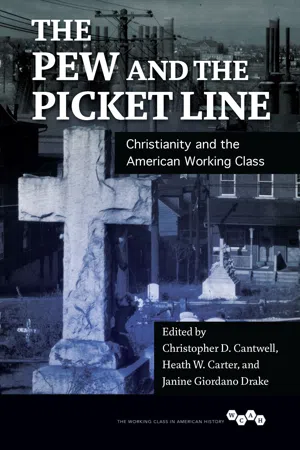
The Pew and the Picket Line collects works from a new generation of scholars working at the nexus where religious history and working-class history converge. Focusing on Christianity and its unique purchase in America, the contributors use in-depth local histories to illustrate how Americans male and female, rural and urban, and from a range of ethnic backgrounds dwelt in a space between the church and the shop floor. Their vivid essays show Pentecostal miners preaching prosperity while seeking miracles in the depths of the earth, while aboveground black sharecroppers and white Protestants establish credit unions to pursue a joint vision of cooperative capitalism. Innovative and essential, The Pew and the Picket Line reframes venerable debates as it maps the dynamic contours of a landscape sculpted by the powerful forces of Christianity and capitalism. Contributors: Christopher D. Cantwell, Heath W. Carter, Janine Giordano Drake, Ken Fones-Wolf, Erik Gellman, Alison Collis Greene, Brett Hendrickson, Dan McKanan, Matthew Pehl, Kerry L. Pimblott, Jarod Roll, Evelyn Sterne, and Arlene Sanchez Walsh.
eBook - ePub
The Pew and the Picket Line
Christianity and the American Working Class
- English
- ePUB (mobile friendly)
- Available on iOS & Android
eBook - ePub
The Pew and the Picket Line
Christianity and the American Working Class
About this book
Information
Publisher
University of Illinois PressYear
2016Print ISBN
9780252081484
9780252039997
eBook ISBN
9780252098178
PART I
Manufacturing Christianity
1
George Lippard, Ignatius Donnelly, and the Esoteric Theology of American Labor
DAN MCKANAN
The American labor movement has always had a theology—indeed, many theologies. But it has not always had professional theologians who are credentialed by both academic and ecclesiastical authorities. The Social Gospel movement that began around 1880 has been rightly celebrated for forging an enduring link between American labor and the guild of professional theologians. Washington Gladden, Walter Rauschenbusch, George Herron, Clarence Skinner, Harry Ward, John Ryan, and Reinhold Niebuhr were genuine allies of labor, and they marshaled the intellectual resources of the Christian tradition on behalf of campaigns for living wages, the eight-hour day, safe working conditions, and an end to child labor.1 Their efforts in mobilizing both Protestant and Catholic churches helped bring the American labor movement to its pinnacle of influence in the postwar period, and the alliance continues in the work of contemporary theologians who work in solidarity with Interfaith Worker Justice or congregation-based community organizing projects.2 The Social Gospel, as traditionally defined, was an authentic theology of labor, but it was not the first or only such theology.3 Nor was it a direct expression of the theological vision of the workers themselves. Social Gospel theology was always a theology of allyship; it expressed the convictions (sometimes moderate, sometimes radical) of middle-class intellectuals whose consciences had been pricked, who wanted to prick the consciences of their middle-class students and parishioners, and who had the power to transform educational and ecclesial institutions. Decades before the Social Creed of the Churches gave definitive expression to Social Gospel theology, another theology of labor—sometimes more militant and often much stranger—could be found on the pages of popular fiction.
In this essay, I explore the works of two labor novelists, George Lippard (1822–54) and Ignatius Donnelly (1831–1901).4 I focus especially on their use of esoteric Christianity as a source of worker empowerment. By esotericism I mean that strand of belief and practice that finds hidden significance beneath the surface of religious traditions. Esotericists view all nature as alive and posit elaborate correspondences between heaven and earth, or the self and God. They use various “magical” practices, such as alchemy, to transmute earthly realities into heavenly ones.5 In the West, most esotericists see themselves as bearers of an ancient tradition—traceable back to ancient Egypt, and sometimes behind that to Atlantis—that has been transmitted through initiations by secret brotherhoods. For some Western esotericists, this secret tradition is outside of and antithetical to Christianity; for others—certainly including Lippard and Donnelly—it is the vital heart of Christianity itself, albeit a heart that has often been suppressed by ecclesiastical institutions. Indeed, both Lippard and Donnelly built complex theologies—by which I mean religious reflection in general, not exclusively reflection on the doctrine of God6—on the foundation of their belief that Jesus of Nazareth had been a class-conscious worker with a revolutionary social blueprint. For them, this was the esoteric secret par excellence.
Both Lippard and Donnelly developed this idea by drawing heavily on such submerged spiritual traditions as ancient Hermeticism and Neoplatonism, and early modern alchemy and Rosicrucianism. Lippard was fascinated by the Rosicrucians and by the radical Pietists who had settled in Pennsylvania in the eighteenth century; indeed, he regarded his own labor union as the “exoteric” work of the Rosicrucian order. Donnelly was his generation’s leading exponent of the Atlantis myth, and he imagined that economic change might involve the same sort of cataclysmic changes that had ended the Atlantean civilization. In telling their stories and retelling their fictions, I do not mean to suggest that they articulated a more “authentic” theology of labor than the Social Gospelers, or even that theirs was the most important alternative to the Social Gospel. Recent scholars have suggested that freethinkers, revivalists, Catholics, African American Protestants, and many others all made distinctive contributions to the theology of labor.7 In lifting up the distinct contributions of esoteric Christianity, I hope simply to join this diverse chorus of scholarship. More specifically, I hope to show that Lippard and Donnelly articulated an esoteric understanding of social sin that was earlier and, in some ways, more profound than the articulations of the Social Gospelers.8
In their own time, George Lippard and Ignatius Donnelly were enormously influential spokesmen for the cause of the workers. Lippard’s first novel, The Quaker City, or, The Monks of Monk Hall, published when he was just twentytwo years old, was a runaway best seller and the most influential exposé of urban injustice to appear prior to the Civil War.9 Just four years (and twelve books!) later, he organized the Brotherhood of the Union, a labor organization that provided the organizational blueprint for the Knights of Labor, which would become the largest union federation prior to the American Federation of Labor. He cooperated closely with the German immigrants who planted the first seeds of Marxism in the United States. He was so sufficiently well regarded by labor activists that he was invited to give the valedictory address to the Industrial Congress of 1848, promising the gathered socialists and land reformers a coming day “when the regeneration of the workers, from the anguish of physical suffering, shall prepare the way for the spiritual redemption of all mankind.”10 Donnelly penned the founding manifesto of the Populist Party in 1892, galvanizing urban workers and rebellious farmers with a sweeping critique of the “vast conspiracy against mankind” that included mainstream politicians as well as plutocrats.11
Neither is well remembered today, in part because of the seemingly bizarre eclecticism of their interests. Lippard was utterly sincere in his radical commitments, but he was also addicted to salacious tales of rape and seduction, replete with gory deaths and heaving bosoms. At the same time, he published dozens of fanciful “legends” about George Washington and other Revolutionary heroes. Donnelly, for his part, espoused multiple ideologies over the course of his career, and he also introduced the rather questionable theory that Francis Bacon was the true author of Shakespeare’s plays. In addition, both men harbored prejudices that sometimes obscured their radical intentions. Lippard was infuriated by both rape and slavery, but most of his female and African American characters are disturbingly two-dimensional. Donnelly trafficked in anti-Semitic stereotypes even as he professed to see Jews as a “noble race” who had long been victimized by “bigoted” Christians. The two writers, finally, have been victims of academic specialization. As novelists, they are of more interest to literary scholars than to historians of labor or of religion. But on purely aesthetic grounds, the novels are of only minor significance: the importance of Lippard and Donnelly is visible only to those who look simultaneously at the literary, radical, and religious dimensions of their work. A multidisciplinary approach to Lippard and Donnelly also has the potential to unlock aspects of the labor movement that have been obscured by the scholarly boundaries separating labor history from religious and literary scholarship.
Fortunately, scholarship on esoteric spirituality has a long-standing commitment to multidisciplinary approaches. At different historical moments, Gnosticism, Rosicrucianism, Freemasonry, Transcendentalism, Theosophy, and the New Age movement have all been important carriers of esotericism, but esoteric practice is not easily contained within obviously “religious” organizational structures. Esoteric practices are as likely to appear within artistic, medical, or conventionally religious organizations as within explicitly esoteric contexts.12 For this reason, Wouter Hanegraaff and Catherine Albanese have argued persuasively that esoteric or metaphysical spiritualities are not a sideshow but “a neglected dimension of the general culture” of the West and “a major player in the evolution of the national religiosity” of the United States.13 It was precisely the eclecticism of Lippard’s and Donnelly’s interests, and the liminality of their vocational identities, that allowed them to make esoteric resources accessible to labor activists and working-class readers who might not have understood themselves as esoteric practitioners.
Lippard’s and Donnelly’s access to labor activists was also enhanced by the fact that their primary commitment was to the esoteric dimension of Christianity. From the Middle Ages to the early modern period, Western esotericists generally worked within the broader cultural context of Christianity, exploring the hidden meaning of Christian texts and rituals.14 This was changing in Lippard’s and Donnelly’s lifetimes, as Andrew Jackson Davis and other spiritualists explicitly rejected Christianity and the Theosophical Society turned to Buddhism and other Eastern alternatives. But Lippard and Donnelly largely followed the path charted by their early modern predecessors. They could be harshly critical of mainstream churches and ministers, but insisted that their alternative was actually more faithful to Jesus’s original teaching. Indeed, their esoteric Christianity had porous boundaries with many other strands of Christian tradition: they shared an interest in the hidden meaning of prophetic texts with evangelical millennialists; an affirmation of humanity’s essential goodness with liberal Protestants; and both were well aware of the strands of Roman Catholicism that were sympathetic to labor. (Although Donnelly’s family roots were Irish Catholic, he did not practice the faith in his adulthood.15) Though they also drew on popular freethought’s critique of Christian institutions, on the whole their spirituality did not pose as sharp a challenge to lay Christian culture as did such freethinkers as Thomas Paine, Robert Owen, and Robert Ingersoll.
Esoteric Christian resources are most clearly on display in Lippard’s and Donnelly’s novels. Lippard’s first and by far most successful novel, The Quaker City, already contained most of the political and spiritual themes he would develop over the course of his brief and intense career. Centered on “Monk Hall,” a brothel and gambling den controlled by wealthy Philadelphians who masquerade as monastics, the novel features multiple plotlines of rape, murder, and seduction. Borrowing tropes from anti-Catholic and anti-Masonic literature, Lippard suggested that the truly dangerous and secretive power was capitalism itself, buttressed by scheming and rapacious bankers, lawyers, politicians, merchants, and Protestant clergy. He also suggested that spiritual resources were available to combat capitalism, with an astrologer predicting the course of the plot early on, and a charismatic wizard offering an ambiguously utopian vision of the national future near the end.
Lippard was just twenty-two years old when he began publishing The Quaker City in serial form, and the early chapters are shaped more by his tragic family history than by a broader sociopolitical critique. Both of Lippard’s parents and most of his siblings died during his youth, and the oncemiddle-class family sold off most of its property to pay debts. When the great depression of 1837 to 1844 hit Philadelphia, Lippard was a homeless teenaged orphan who turned to writing for survival. Concerned for the virtue of his one surviving sister, Lippard initially designed The Quaker City as a manifesto against seduction. But he was radicalized by the public response to his work: working-class readers bought up thousands of copies, while respectable editors blasted him for immorality. Lippard incorporated more pointed criticisms of capitalism into the novel’s later chapters, and began making contacts with Philadelphia’s community of labor radicals.16
In his subsequent writing, Lippard often built a novel’s plot around just one of the interwoven themes in The Quaker City. The Memoirs of a Preacher (1849) is a scathing indictment of clerical hypocrisy and of attempts to merge church and state; The Nazarene (1846) takes aim at popular anti-Catholicism and nativism by portraying a series of Catholic, poor, and nonwhite characters who are victimized by a banker named Calvin Wolfe and his “Holy Protestant League.”17 Lippard’s critique of capitalism is front and center in New York: Its Upper Ten and Lower Million (1853), the plot of which centers on a New York City fortune that is held in trust from 1823 to 1844, at which point it is to fall either to the rightful heir or to seven members of the extended family. Lippard uses the fortune itself, which grows from two million to one hundred million dollars, to illustrate the inhuman and irresponsible power of capital: “Has this wealth no duties to mankind? Is there not some...
Table of contents
- Cover
- Title
- Copyright
- Contents
- Foreword: A Spiritual Turn?
- Acknowledgments
- Introduction: Between the Pew and the Picket Line
- Part I: Manufacturing Christianity
- Part II: Christianizing Capitalism
- Contributors
- Index
Trusted by 375,005 students
Access to over 1.5 million titles for a fair monthly price.
Study more efficiently using our study tools.
Frequently asked questions
Yes, you can cancel anytime from the Subscription tab in your account settings on the Perlego website. Your subscription will stay active until the end of your current billing period. Learn how to cancel your subscription
No, books cannot be downloaded as external files, such as PDFs, for use outside of Perlego. However, you can download books within the Perlego app for offline reading on mobile or tablet. Learn how to download books offline
Perlego offers two plans: Essential and Complete
- Essential is ideal for learners and professionals who enjoy exploring a wide range of subjects. Access the Essential Library with 800,000+ trusted titles and best-sellers across business, personal growth, and the humanities. Includes unlimited reading time and Standard Read Aloud voice.
- Complete: Perfect for advanced learners and researchers needing full, unrestricted access. Unlock 1.5M+ books across hundreds of subjects, including academic and specialized titles. The Complete Plan also includes advanced features like Premium Read Aloud and Research Assistant.
We are an online textbook subscription service, where you can get access to an entire online library for less than the price of a single book per month. With over 1.5 million books across 990+ topics, we’ve got you covered! Learn about our mission
Look out for the read-aloud symbol on your next book to see if you can listen to it. The read-aloud tool reads text aloud for you, highlighting the text as it is being read. You can pause it, speed it up and slow it down. Learn more about Read Aloud
Yes! You can use the Perlego app on both iOS and Android devices to read anytime, anywhere — even offline. Perfect for commutes or when you’re on the go.
Please note we cannot support devices running on iOS 13 and Android 7 or earlier. Learn more about using the app
Please note we cannot support devices running on iOS 13 and Android 7 or earlier. Learn more about using the app
Yes, you can access The Pew and the Picket Line by Christopher D. Cantwell, Heath W. Carter, Janine Giordano Drake, Christopher D. Cantwell,Heath W. Carter,Janine Giordano Drake in PDF and/or ePUB format, as well as other popular books in Politics & International Relations & Labour & Industrial Relations. We have over 1.5 million books available in our catalogue for you to explore.