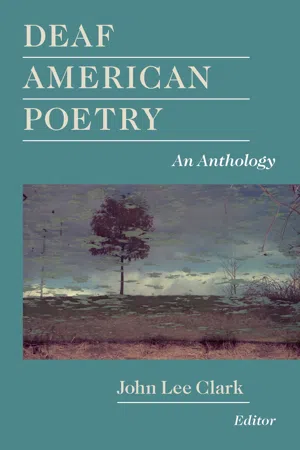
"The Deaf poet is no oxymoron," declares editor John Lee Clark in his introduction to Deaf American Poetry: An Anthology. The 95 poems by 35 Deaf American poets in this volume more than confirm his point. From James Nack's early metered narrative poem "The Minstrel Boy" to the free association of Kristi Merriweather's contemporary "It Was His Movin' Hands Be Tellin' Me," these Deaf poets display mastery of all forms prevalent during the past two centuries. Beyond that, E. Lynn Jacobowitz's "In Memoriam: Stephen Michael Ryan" exemplifies a form unique to Deaf American poets, the transliteration of verse originally created in American Sign Language.
This anthology showcases for the first time the best works of Deaf poets throughout the nation's history — John R. Burnet, Laura C. Redden, George M. Teegarden, Agatha Tiegel Hanson, Loy E. Golladay, Robert F. Panara, Mervin D. Garretson, Clayton Valli, Willy Conley, Raymond Luczak, Christopher Jon Heuer, Pamela Wright-Meinhardt, and many others. Each of their poems reflects the sensibilities of their times, and the progression of their work marks the changes that deaf Americans have witnessed through the years. In "The Mute's Lament," John Carlin mourns the wonderful things that he cannot hear, and looks forward to heaven where "replete with purest joys/My ears shall be unsealed, and I shall hear." In sharp contrast, Mary Toles Peet, who benefitted from being taught by Deaf teachers, wrote "Thoughts on Music" with an entirely different attitude. She concludes her account of the purported beauty of music with the realization that "the music of my inward ear/Brings joy far more intense."
Clark tracks these subtle shifts in awareness through telling, brief biographies of each poet. By doing so, he reveals in Deaf American Poetry how "the work of Deaf poets serves as a prism through which Deaf people can know themselves better and through which the rest of the world can see life in a new light."
- 312 pages
- English
- PDF
- Available on iOS & Android
eBook - PDF
About this book
Information
Table of contents
- Contents
- Editor’s Note
- Introduction
- John R. Burnet (1808–1874)
- James Nack (1809–1879)
- John Carlin (1813–1891)
- Mary Toles Peet (1836–1901)
- Laura C. Redden (1840–1923)
- Angeline Fuller Fischer (1841–1925)
- Alice Cornelia Jennings (b. 1851)
- George M. Teegarden (1852–1936)
- J. Schuyler Long (1869–1933)
- Agatha Tiegel Hanson (1873–1959)
- James William Sowell (1875–1949)
- Howard L. Terry (1877–1964)
- Alice Jane McVan (1906–1970)
- Earl Sollenberger (c. 1912–1947)
- Felix Kowalewski (1913–1989)
- Loy E. Golladay (1914–1999)
- Rex Lowman (1918–2001)
- Robert F. Panara (1920– )
- Mervin D. Garretson (1923– )
- Dorothy Miles (1931–1993)
- Linwood Smith (1943–1982)
- Curtis Robbins (1943– )
- Clayton Valli (1951–2003)
- E. Lynn Jacobowitz (1953– )
- Debbie Rennie (1957– )
- Willy Conley (1958– )
- Peter Cook (1962– )
- Katrina R. Miller (1965– ) and Damara Goff Paris (1965– )
- Raymond Luczak (1965– )
- Abiola Haroun (1970– )
- Christopher Jon Heuer (1970– )
- Kristi Merriweather (1971– )
- Pamela Wright-Meinhardt (1971– )
- John Lee Clark (1978– )
- Kristen Ringman (1979– )
- Alison L. Aubrecht (1979– )
- Bibliography
Trusted by 375,005 students
Access to over 1.5 million titles for a fair monthly price.
Study more efficiently using our study tools.
Frequently asked questions
Yes, you can cancel anytime from the Subscription tab in your account settings on the Perlego website. Your subscription will stay active until the end of your current billing period. Learn how to cancel your subscription
No, books cannot be downloaded as external files, such as PDFs, for use outside of Perlego. However, you can download books within the Perlego app for offline reading on mobile or tablet. Learn how to download books offline
Perlego offers two plans: Essential and Complete
- Essential is ideal for learners and professionals who enjoy exploring a wide range of subjects. Access the Essential Library with 800,000+ trusted titles and best-sellers across business, personal growth, and the humanities. Includes unlimited reading time and Standard Read Aloud voice.
- Complete: Perfect for advanced learners and researchers needing full, unrestricted access. Unlock 1.5M+ books across hundreds of subjects, including academic and specialized titles. The Complete Plan also includes advanced features like Premium Read Aloud and Research Assistant.
We are an online textbook subscription service, where you can get access to an entire online library for less than the price of a single book per month. With over 1.5 million books across 990+ topics, we’ve got you covered! Learn about our mission
Look out for the read-aloud symbol on your next book to see if you can listen to it. The read-aloud tool reads text aloud for you, highlighting the text as it is being read. You can pause it, speed it up and slow it down. Learn more about Read Aloud
Yes! You can use the Perlego app on both iOS and Android devices to read anytime, anywhere — even offline. Perfect for commutes or when you’re on the go.
Please note we cannot support devices running on iOS 13 and Android 7 or earlier. Learn more about using the app
Please note we cannot support devices running on iOS 13 and Android 7 or earlier. Learn more about using the app
Yes, you can access Deaf American Poetry by John Lee Clark in PDF and/or ePUB format, as well as other popular books in Literature & North American Literary Collections. We have over 1.5 million books available in our catalogue for you to explore.