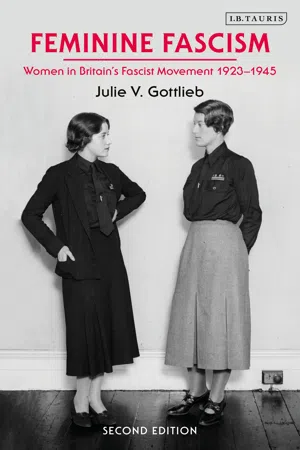
The British Fascisti, the first fascism movement in Britain, was founded by a woman in 1923. During the 1930s, 25 per cent of Sir Oswald Mosley's supporters were women, and his movement was 'largely built up by the fanaticism of women.' What was it about the British form of Fascism that accounted for this conspicuous female support? Gottlieb addresses these questions in the definitive work on women in fascism.
This book continues to fill a significant gap in the historiography of British fascism, which has generally overlooked the contribution of women on the one hand, and the importance of sexual politics and women's issues on the other. Gottlieb's extensive research makes use of government documents, a large range of contemporary pamphlets, newspapers and speeches, as well as original interviews with those personally involved in the movement.
This new edition includes a preface analysing the current affairs of the last 20 years, reframing the book according to contemporary context. Here, Gottlieb looks at the resurgence of populism, the rise of women as leaders of far-right parties across Europe and North America, and the normalisation of fascism in fiction and political discourse.
- 400 pages
- English
- ePUB (mobile friendly)
- Available on iOS & Android
eBook - ePub
About this book
Information
Chapter 1
Feminized Fascism: Rotha Lintorn-Orman and the British Fascists, 1923–35

From the outset, British fascism had a very feminine side and was characterized by a high degree of female activism and propaganda directed towards women. Britain’s first fascist movement was founded by a woman, Miss Rotha Lintorn-Orman. As the probably apocryphal story goes, the British Fascisti (BF) was conceived while she was digging in her Somerset kitchen garden, and reflecting on the news that the Labour Party had sent a delegation to a Socialist Party conference in Hamburg, Lintorn-Orman awoke to her mission to deliver the nation from the communist menace. She would do so by forming an organization of disinterested patriots – composed of all classes and all Christian denominations – who were prepared to react in defence of King and Country in any emergency. Following her epiphany in the garden, Lintorn-Orman proceeded to plant a series of recruitment articles in the Duke of Northumberland’s Patriot (1922–50) in May 1923, and a membership soon sprouted. Herself a member of the country gentry, it was thanks to her family’s wealth that her seed of an idea could bear fruit. The Founder’s mother, Mrs Lintorn-Orman, made over the greater part of her fortune, approximately £50,000, to her daughter to finance the endeavour and paid her a monthly allowance.
Female foundership, and (after 1926) female leadership was almost unique in the history of fascist movements during the inter-war period,1 and the high level of women’s participation in the BF was no doubt facilitated by the revolution in gender roles instigated by the First World War and the achievement of women’s emancipation through franchise extension immediately afterwards. While the BF was not an exclusively female organization, the influence of women among the leadership and their direction of the campaigns to deliver Britain from Communism, to rid her of the ‘alien menace,’ and to protect her children from subversive and blasphemous teachings, demonstrated how women’s work was indispensable to the radical Right. However, it was precisely because the BF was popularly identified with the spirited wives of Colonel Blimps and the jingoistic, humourless and eccentric types among politicized women that British fascism was of little real consequence before the formation of Sir Oswald Mosley’s British Union of Fascists in 1932.
The BF’s equivocal identification with fascism also suggests that the movement was not necessarily the direct predecessor of Mosley’s British Union of Fascists, and indicates a discontinuity in the history of British fascism during the 1920s and the 1930s. British fascism’s broken road was as much exemplified by the dissimilar styles of leadership and propaganda between the BF and BUF as by their different approach to the role of women and the interpretation of the place of the feminine in fascist ideology. It is ironic, perhaps, that the male-led BUF lent more voices to inter-war feminist discourse, while the female-led BF confronted the issues reserved for women through action and pragmatism rather than by formulating a doctrine of ‘fascist feminism.’ Lacking the will to define its stand as such, the BF developed a distinctive creed to support female extreme-Right activism that can either be termed feminized fascism or ultra-patriotic feminism.
Precedents and Influences: ‘It Seems Unfortunate That a Nationalist Organization Should Have To Go Abroad For its Name and Symbol’2
Set beside the history of European fascism, the BF seems a particularly insubstantial and confused expression of fascist ideology and tactics. Gertrude M. Godden, a witness at the birth of Fascism in Italy, believed that ‘the influence of Fascismo is an inspiration for which the men and women of all nations made common sacrifice during five years of war – “Our country and not ourselves,”’3 and such vague understandings also characterized the BF’s preliminary identifications with the Italian experiment. As Mussolini’s Fascismo became more coherent, the BF’s own definition of fascism gained clarity and by the early 1930s the movement championed a Corporate state for Britain. Nonetheless, the BF’s interpretation of fascist ceremony and regalia, and the development of their programme were never extricated from the British context and the specific issues which had fuelled the radical Right since the end of the 19th century. One of the BF’s self-appointed tasks was to steward Conservative Party meetings, and as a self-described non-political body, members were encouraged to vote Tory at elections.4 Indeed, the BF took great offence at being labelled a foreign import, and in its bid to represent quintessential Britishness members came to regret having adopted the alien-sounding title. The BF defended itself against allegations that they were following an imported creed: ‘Let us accept this cry of “Foreign” for what it is, a red-herring drawn across the trail, a desperate attempt to divert the attention of the people from the soundness of Fascist principles and policy.’5 Like the BUF after it, the BF was ardent in pointing out that they were co-opting the foreign example for specifically English purposes.
To understand the inspiration for the BF it is as important to consider the influence of Edwardian radical Right organizations, the impact of the female auxiliary services during the war, and the appearance at the same time of other patriotic organizations, as it is to decipher the examples the BF took from Continental fascism. The BF’s most enthusiastically claimed precedent was the Scouting movement. R.B.D. Blakeney, BF president from 1924 to 1926, cited fascism as ‘the adult growth of … the Scout Movement. Both uphold the same lofty ideals of brotherhood, service and duty.’6 In terms of both ideological derivation – Empire Free Trade – and the mobilization of women, Joseph Chamberlain’s Tariff Reform League (established in July 1903) offered a precedent for the BF when it formed a Women’s Section in 1903, which had forty branches by 1905 as well as a junior Tariff Reform Association.7 By 1927 the BF, one of whose main slogans was ‘Buy British Goods,’ noted ‘with satisfaction the formation of the League of Empire Housewives. The members of the League wear a distinctive badge, which will intimate to a shopkeeper that the wearers wish to buy only home products or Empire goods.’8
Since the Conservative Party’s allocations for the female political role so closely resembled that fashioned by the BF in the 1920s, the more obvious precedent for the BF’s mobilization of women was the Primrose League.9 The Primrose League had its own children’s section, the Buds, and in the 1920s the Conservative Party had its own anti-Communist and anti-Red Sunday School youth section, the Young Britons.10 Both rivalled the BF’s Fascist Children’s Clubs (FCCs) and tended to render the Clubs redundant. The Primrose League was directed by a ‘Grand Council,’ bringing into question whether the BF modelled its own Grand Council on that of the League rather than on Mussolini’s executive body, which was first established in January 1923. Paradoxically, the League’s Grand Council was under male control, leading to a situation where ‘the Ladies Grand Council had been the inspiration for the League’s breathless rise, and yet women were strictly subordinate to the Grand Council.’11A key difference between the BF and Primrose League hierarchy, then, was that the BF’s Grand Council was composed of both sexes, ruling over a both-sex organization, and this can go some way in explaining why BF women resisted joining the existing body and sought independence in order to practice their brand of militant rear-guard activism.
The BF’s ideal that women should be able to prove their loyalty through unhampered but disciplined action was made possible by the new opportunities opened to women through war work. As an extreme-right expression of an ex-servicemen and women’s association, memories of the roles played by women during the war were central to the definition of the movement and to constructing notions of self-worth. Lintorn-Orman praised the women’s services during the war for upholding the great tradition of commanding women in British history, and asked: ‘Shall British women now do more or less?’12 The war saw the inauguration of the Women’s Army Auxiliary Corps (1917), the Women’s Royal Naval Service (1917), and the Women’s Royal Air Force (1918). In these services ‘women enjoyed a prestigious uniform, military discipline and an official hierarchy corresponding to that of male service.’13 The Voluntary Aid Detachment of nurses organized by the Red Cross and attached to the Territorial Army, offered new opportunities and freedom to upper and middle-class women. On the home front, women were the main activists in the many patriotic societies, such as the Red Cross Society, the Prince of Wales Fund, and the Soldier’s Parcel Fund.
Right-wing women emerged from their war-time experiences with a renewed sense of patriotic endeavour, and during the 1920s the BF was not alone among those organizations which gave vent to women’s profound dread of communism. The Loyalty League appeared in October 1922 with the purpose of fighting communism. More closely coinciding with the activities of Lintorn-Orman’s women, Dorothy Walthall formed the Victory Corps in 1923 as a successor to the Women’s Auxiliary Force. Its objects were to promote patriotism, loyalty and industry, and to administer First Aid in times of strikes and riots. In 1928 former-suffragette ‘General,’ Flora Drummond, graduated from the Pankhurst’s anti-socialist Women’s Party (1918) to form her own Women’s Guild of Empire with the object of opposing strikes and communism. The ex-suffragette Mary Allen formed the Women’s Auxiliary Service in 1923, as the successor to Margaret Damer Dawson’s war-time Women’s Police Service, and BF women would enlist in Allen’s Service during the General Strike. Allen and Lintorn-Orman shared a horror of communism, an infatuation with women in uniform, and the attitude that women’s public responsibilities transcended women’s right.
Portraits of a Founder: Lintorn-Orman in Myth and Memory
While many women were dedicating themselves to the fight for ‘Votes for Women,’ the young Rotha Lintorn Orman (1895–1935) joined the Girl Scouts in 1909 and, in her own words, ‘had the honour to command the only two troops to be under Royal patronage (First and Second Bournemouth, Princess Louise’s own) and in those days the Scouts and Guides carried our own flag, the Union Jack.’14 Her youthful interests reflected her service background: Lintorn-Orman was the grand-daughter of a Field Marshal, Sir John Lintorn Simmons (1812–1902), and daughter of Major Charles Orman of the Essex Regiment. During the war she served with the Women’s Reserve Ambulance and later transferred to the Scottish Women’s Hospital Corps with whom she sailed to Serbia in 1916. According to one later report in the fascist press: ‘she served in the Drins front as an ambulance driver and was awarded the Croix de Charité (twice) for gallantry and was also recommended for the Order of St Savs, but the papers of recommendation were lost in the fire of Salonika.’15 In 1917, she was invalided home with malaria, and because she failed to pass any medical board for further service overseas, she joined the British Red Cross Society and was appointed Commandant of the Motor School at Devonshire House where she was in charge of all ambulance drivers. Lintorn-Orman’s war experience contributed to her frequent illnesses and her problems with alcohol and drugs, factors which were to serve to discredit her leadership of the BF and place the movement in a precarious position. Male combatants were not alone in returning from the war shell-shocked and paranoid, and the biography of Lintorn-Orman provides a v...
Table of contents
- Cover
- Title Page
- Contents
- Dedication
- Acknowledgements
- Preface to Second Edition
- Introduction: Feminine Fascism: Women in Britain's Fascist Movement, 1923-45
- 1 Feminized Fascism: Rotha Lintorn-Orman and the British Fascists, 1923-35
- 2 Women in the British Union of Fascists: Organization and Forms of Participation
- 3 The Ideology of Feminine Fascism
- 4 The Legacy of the Suffragettes to British Fascism
- 5 Mosley's Women and Mosley's Woman: The Leader's Sexual Politics
- 6 Behind Bars and Barbed Wire: Women's Experiences of Internment Under Defence Regulation 18B, 1940-45
- Conclusion: Women, Fascism and Fanaticism, Past and Present
- Appendix: Who's Who in the History of Women and Fascism in Britain
- Bibliography
- Index
- eCopyright
Trusted by 375,005 students
Access to over 1.5 million titles for a fair monthly price.
Study more efficiently using our study tools.
Frequently asked questions
Yes, you can cancel anytime from the Subscription tab in your account settings on the Perlego website. Your subscription will stay active until the end of your current billing period. Learn how to cancel your subscription
No, books cannot be downloaded as external files, such as PDFs, for use outside of Perlego. However, you can download books within the Perlego app for offline reading on mobile or tablet. Learn how to download books offline
Perlego offers two plans: Essential and Complete
- Essential is ideal for learners and professionals who enjoy exploring a wide range of subjects. Access the Essential Library with 800,000+ trusted titles and best-sellers across business, personal growth, and the humanities. Includes unlimited reading time and Standard Read Aloud voice.
- Complete: Perfect for advanced learners and researchers needing full, unrestricted access. Unlock 1.5M+ books across hundreds of subjects, including academic and specialized titles. The Complete Plan also includes advanced features like Premium Read Aloud and Research Assistant.
We are an online textbook subscription service, where you can get access to an entire online library for less than the price of a single book per month. With over 1.5 million books across 990+ topics, we’ve got you covered! Learn about our mission
Look out for the read-aloud symbol on your next book to see if you can listen to it. The read-aloud tool reads text aloud for you, highlighting the text as it is being read. You can pause it, speed it up and slow it down. Learn more about Read Aloud
Yes! You can use the Perlego app on both iOS and Android devices to read anytime, anywhere — even offline. Perfect for commutes or when you’re on the go.
Please note we cannot support devices running on iOS 13 and Android 7 or earlier. Learn more about using the app
Please note we cannot support devices running on iOS 13 and Android 7 or earlier. Learn more about using the app
Yes, you can access Feminine Fascism by Julie V. Gottlieb in PDF and/or ePUB format, as well as other popular books in Politics & International Relations & British History. We have over 1.5 million books available in our catalogue for you to explore.