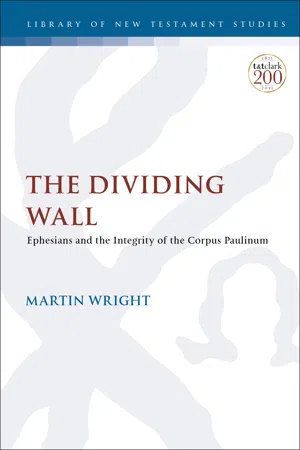
This book argues for the integrity of the Pauline Corpus as a complex, composite text. Martin Wright critiques the prevailing tendency to divide the Corpus in two, separating the undoubtedly authentic letters from those of disputed authorship. Instead, he advocates for a renewed canonical hermeneutic in which the Corpus as a whole communicates Paul's legacy, and the authorship of individual letters is less important, stressing that that current preoccupations with authorship have a distorting effect on exegesis, and need to be reconsidered.
Wright uses Ephesians as a focal text to illustrate the exegetical potential of this approach. He critically investigates the history of the prevailing hermeneutics of pseudonymity, with particular attention to the theological and confessional partiality with which it is often inflected. And constructively, he proposes a new hermeneutical model in which the Pauline Corpus is read as a continuous interpretative dialogue, leaving the question of authorship to one side. In two substantial exegetical studies, Wright offers new readings of passages from Ephesians and other Pauline letters, amplifying the proposed approach and illustrating its value.
- 232 pages
- English
- ePUB (mobile friendly)
- Available on iOS & Android
eBook - ePub
About this book
Information
Part 1
Canon and countercanon
1
The formation of the Corpus Paulinum
How did fourteen distinct letters become a single book? Was there a particular moment when the collection was formed, a particular codex that established its scope, or did the letters coalesce together more gradually? Did a single collection prevail throughout the Christian world, or was there variation from place to place? Did some letters gain earlier or wider acceptance than others? Were all fourteen treated in the same way, or was there differentiation between them? These questions are fundamental to how we understand the Corpus Paulinum as a composite text. Its history plays into its interpretation, just as the history of Paul and the Corinthians, for example, plays into the interpretation of their correspondence. And as with the individual letters, the background to the Corpus is shrouded, but not completely opaque.
This chapter investigates the earliest reception and collection of the Pauline letters, reviewing the main theories for the Corpus’s formation and reconsidering the available evidence. Our familiar cp is well attested from the fourth century: for example, Eusebius, as we have noted, acknowledges fourteen letters as Paul’s, and they are all listed in Athanasius’s famous Festal Letter of 367.1 But it is disputed how early this collection was in widespread use, and what process brought it about. Some reconstructions we will find to be overly speculative, but although the sources are sparse, we will see at least the outline of a picture emerging. There is evidence of considerable variation through the second century, with a number of proto-collections probably in circulation, but the situation is not totally chaotic, and a relatively stable Corpus develops surprisingly soon. Throughout, we will be particularly attentive to the place of what are now the antilegomena; for this study, it is especially important to understand whether the modern dividing wall has any foundation, or any parallel, in the history of the cp’s formation.
This complex topic can easily occupy a monograph in its own right. Our discussion is necessarily selective, and draws particularly upon two such longer treatments, namely the doctoral dissertations of Lovering and Trobisch.2 First, the main reconstructions of the cp’s history will be sketched in outline, before we proceed to an analysis of the relevant evidence, and finally an assessment of the competing theories and the implications for the present study.
1. Theories
1.1. A single, early collection
The first systematic investigations of the cp’s origins concluded that, apart from Hebrews, it reached its canonical form in the first century. This was Theodor Zahn’s view: from Pauline citations in the Apostolic Fathers, and from lists in Tertullian, the Muratorian Fragment and elsewhere, he infers that a thirteen-letter collection was extant before the time of 1 Clement, and that it originally began with 1 Corinthians and ended with Romans. Letters were undoubtedly exchanged before this, as suggested by Col. 4.16 and 2 Pet. 3.15-16, and so would have been occasionally found in small collections, but the production of the thirteen-letter corpus was a deliberate act of authoritative selection independent of any such earlier private collections. This cp’s suitability for liturgical reading led to its widespread acceptance, displacing any alternatives, which in any case could not have been very well established. It is therefore to be dated very early, not long after Paul’s death; the question of when Hebrews was added remains open.3
Adolf von Harnack’s position does not depart far from Zahn’s. He refuses to speculate about smaller collections that may have predated the surviving mss, with the exception of the ten-letter canon attested in Marcion. This is as far back as we can trace, and represents a collection formed in the last quarter of the first century, to which the Pastorals were added before 100.4 Although Paul’s letters were therefore known as a corpus from very early on, they were not weighted equally alongside the gospels and ot until after Marcion. The formal canonization of a (admittedly edited) cp and gospel was his innovation, to which the church was obliged to respond, albeit hesitantly; he forced the church fathers into Paulinism, and so led indirectly to the cp’s eventual enshrinement as canonical scripture. The Muratorian Fragment shows that by ca. 200, this push was succeeding.5
A scheme of an early and comprehensive collection can accommodate the possibility that Ephesians, Colossians or 2 Thessalonians were written after Paul’s death, but allows no distinction in their canonical reception. Any special place they may have had in the earliest circulation is no longer traceable; so far as can be determined, they have always been received in the middle of a Pauline Corpus. The case with respect to the Pastorals is less clear in this model, and Hebrews is treated as distinctive.
1.2. A gradual collection
A number of later scholars have been more confident than Zahn or Harnack of the pre-canonical circulation of various small letter collections. In their view, the shaping of the cp owes less to its final redactor than to the gradual process of accretion by which these collections were exchanged and gathered together. This model places greater weight upon variation in the attested forms of the cp, seeing there traces of an originally more fluid state, while still postulating a decisive redaction at some point. A representative exponent is Günther Zuntz, who traces subsequent tradition back to an archetypal cp around 100, but believes that smaller collections were made and circulated before this point.6
Kurt Aland adopts a similar view after a survey of varying text character in Pauline minuscule mss, which leads him to reject a single Ursammlung in favour of multiple early corpora; this study will be discussed in §2.2.2 below.7 The completest and most sober survey of our question in recent times, Eugene Lovering’s doctoral dissertation, also reaches a conclusion of this kind, adopting Zuntz’s image of a ‘river’ into which flow various streams at different points.8 Lovering also emphasizes that if this model is correct, it causes difficulties for many historical critics who presuppose not only the pseudonymity of Ephesians, Colossians, 2 Thessalonians and the Pastorals but also partition theories in many of the undisputed letters. Where authorship or redaction really does postdate Paul, it must have occurred at a very early stage to have been so widely accepted across different collections, and such theories need to plausibly account for how and why this could be.9
Inasmuch as there is a twentieth-century scholarly ‘mainstream’ on the formation of the cp, it can be plotted on a rough continuum from (e.g.) Harnack, emphasizing uniformity in the sources and postulating a single early edition, to (e.g.) Aland, emphasizing diversity and postulating multiple early collections. Within this framework, a spectrum of basically commensurable views have been debated. But there have also been proposals that sit altogether outside the square.
1.3. Ephesians as dam buster
The first and most influential such radical alternative was proposed by Edgar J. Goodspeed.10 His account of the cp begins from the observation that the synoptic gospels and Acts do not appear to refer to Paul’s letters, suggesting that their collection and dissemination was yet to occur.11 The publication of Acts provided the stimulus for an admirer of Paul’s to collect letters which had been individually preserved by their recipients. This person then wrote a meditative digest drawn from all the letters, the text we now know as Ephesians. In this he most closely follows the text he knows best, Colossians; Colossae being the one church to which Acts would not have led him, it is likely that his prior acquaintance with this letter led to the idea of seeking out the others. He probably also had Philemon, which was addressed to much the same community as Colossians, and which is ‘doubtless’ the original letter to the Laodiceans (Col. 4.16).12 Around this nucleus, the letters to the Romans, Corinthians, Galatians, Phil...
Table of contents
- Cover
- Series Page
- Title Page
- Contents
- List of Tables
- Acknowledgements
- List of Abbreviations
- Introduction: The dividing wall
- Part One Canon and countercanon
- Part Two Reading Paul in Ephesians
- Conclusion: Corpus conpactum et conexum
- Bibliography
- Index of Authors
- Index of Biblical References
- Index of Subjects
- Copyright Page
Trusted by 375,005 students
Access to over 1.5 million titles for a fair monthly price.
Study more efficiently using our study tools.
Frequently asked questions
Yes, you can cancel anytime from the Subscription tab in your account settings on the Perlego website. Your subscription will stay active until the end of your current billing period. Learn how to cancel your subscription
No, books cannot be downloaded as external files, such as PDFs, for use outside of Perlego. However, you can download books within the Perlego app for offline reading on mobile or tablet. Learn how to download books offline
Perlego offers two plans: Essential and Complete
- Essential is ideal for learners and professionals who enjoy exploring a wide range of subjects. Access the Essential Library with 800,000+ trusted titles and best-sellers across business, personal growth, and the humanities. Includes unlimited reading time and Standard Read Aloud voice.
- Complete: Perfect for advanced learners and researchers needing full, unrestricted access. Unlock 1.5M+ books across hundreds of subjects, including academic and specialized titles. The Complete Plan also includes advanced features like Premium Read Aloud and Research Assistant.
We are an online textbook subscription service, where you can get access to an entire online library for less than the price of a single book per month. With over 1.5 million books across 990+ topics, we’ve got you covered! Learn about our mission
Look out for the read-aloud symbol on your next book to see if you can listen to it. The read-aloud tool reads text aloud for you, highlighting the text as it is being read. You can pause it, speed it up and slow it down. Learn more about Read Aloud
Yes! You can use the Perlego app on both iOS and Android devices to read anytime, anywhere — even offline. Perfect for commutes or when you’re on the go.
Please note we cannot support devices running on iOS 13 and Android 7 or earlier. Learn more about using the app
Please note we cannot support devices running on iOS 13 and Android 7 or earlier. Learn more about using the app
Yes, you can access The Dividing Wall by Martin Wright in PDF and/or ePUB format, as well as other popular books in Théologie et religion & Études bibliques. We have over 1.5 million books available in our catalogue for you to explore.