eBook - PDF
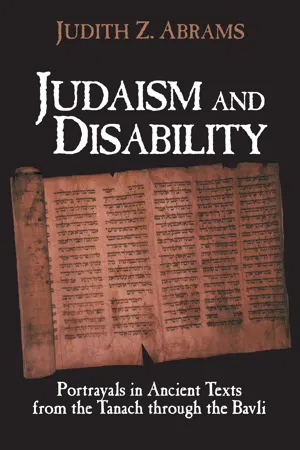
Judaism and Disability
Portrayals in Ancient Texts from the Tanach through the Bavli
- English
- PDF
- Available on iOS & Android
eBook - PDF
Judaism and Disability
Portrayals in Ancient Texts from the Tanach through the Bavli
About this book
The Jewish religion owns a virtually uninterrupted record of scripture and commentary dating back to 1,000 B.C.E. (B.C.), portions of which allow the new book Judaism and Disability: Portrayals in Ancient Texts from the Tanach through the Bavli to document attitudes toward disabled people in the earliest centuries of this ancient culture. Abrams examines the Tanach, the Hebrew acronym for the Jewish Bible, including passages from the Torah, Prophets, and Writings, and subsequent commentaries up to and through the Bavli, the Talmud of Babylonia written between the 5th and 7th centuries C.E. (A.D.).
In Judaism and Disability, the archaic portrayals of mentally ill, mentally retarded, physically affected, deaf, blind, and other disabled people reflect the sharp contrast they presented compared to the unchanging Judaic ideal of the "perfect priest." All of these sources describe this perfection as embodied in a person who is male, free, unblemished, with da'at (cognition that can be communicated), preferably learned, and a priest. The failure to have da'at stigmatized disabled individuals, who were also compromised by the treatment they received from nondisabled people, who were directing and constraining.
As the Judaic ideal transformed from the bodily perfection of the priest in the cult to intellectual prowess in the Diaspora, a parallel change of attitudes toward disabled persons gradually occurred. The reduced emphasis upon physical perfection as a prerequisite for a relationship with God eventually enabled the enfranchisement of some disabled people and other minorities. Scholars, students, and other readers will find the engrossing process disclosed in Judaism and Disability one that they can apply to a variety of other disciplines.
Frequently asked questions
Yes, you can cancel anytime from the Subscription tab in your account settings on the Perlego website. Your subscription will stay active until the end of your current billing period. Learn how to cancel your subscription.
No, books cannot be downloaded as external files, such as PDFs, for use outside of Perlego. However, you can download books within the Perlego app for offline reading on mobile or tablet. Learn more here.
Perlego offers two plans: Essential and Complete
- Essential is ideal for learners and professionals who enjoy exploring a wide range of subjects. Access the Essential Library with 800,000+ trusted titles and best-sellers across business, personal growth, and the humanities. Includes unlimited reading time and Standard Read Aloud voice.
- Complete: Perfect for advanced learners and researchers needing full, unrestricted access. Unlock 1.4M+ books across hundreds of subjects, including academic and specialized titles. The Complete Plan also includes advanced features like Premium Read Aloud and Research Assistant.
We are an online textbook subscription service, where you can get access to an entire online library for less than the price of a single book per month. With over 1 million books across 1000+ topics, we’ve got you covered! Learn more here.
Look out for the read-aloud symbol on your next book to see if you can listen to it. The read-aloud tool reads text aloud for you, highlighting the text as it is being read. You can pause it, speed it up and slow it down. Learn more here.
Yes! You can use the Perlego app on both iOS or Android devices to read anytime, anywhere — even offline. Perfect for commutes or when you’re on the go.
Please note we cannot support devices running on iOS 13 and Android 7 or earlier. Learn more about using the app.
Yes, you can access Judaism and Disability by Judith Z. Abrams in PDF and/or ePUB format, as well as other popular books in Social Sciences & Jewish History. We have over one million books available in our catalogue for you to explore.
Information
Publisher
Gallaudet University PressYear
2014Print ISBN
9781563683428, 9781563680687eBook ISBN
9781563682292Table of contents
- Contents
- Preface and Acknowledgments
- 1. Introduction
- 2. Priestly Perfection
- 3. Persons with Disabilities, Symbolism, and Collective Israel
- 4. Disabilities, Atonement, and Individuals
- 5. Body, Soul, and Society
- 6. Categorization, Disabilities, and Persons with Disabilities
- 7. The River Flows On
- Notes
- Glossary
- Bibliography
- Index