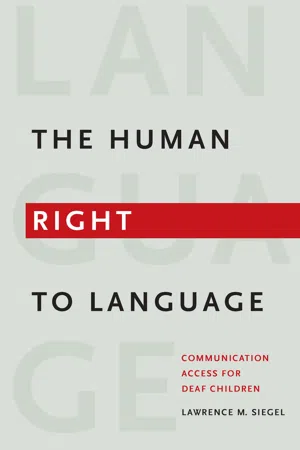
The Human Right to Language
eBook - PDF

The Human Right to Language

Communication Access for Deaf Children

  1. English
  2. PDF
  3. Available on iOS & Android
eBook - PDF

The Human Right to Language

Communication Access for Deaf Children

About this book

In 1982, the United States Supreme Court ruled that Amy Rowley, a deaf six-year-old, was not entitled to have a sign language interpreter in her public school classroom. Lawrence Siegel wholeheartedly disagrees with this decision in his new book The Human Right to Language: Communication Access for Deaf Children. Instead, he contends that the United States Constitution should protect every deaf and hard of hearing child's right to communication and language as part of an individual's right to liberty. Siegel argues that when a deaf or hard of hearing child sits alone in a crowded classroom and is unable to access the rich and varied communication around her, the child is denied any chance of success in life.

In The Human Right to Language, Siegel proposes that the First and Fourteenth Amendments of the Constitution be enforced so that Amy Rowley and her peers can possess that which virtually every other American child takes for granted – the right to receive and express thought in school. He asserts that the common notion of a right to "speech" is too infrequently interpreted in the narrowest sense as the right to "speak" rather than the broader right to receive and transmit information in all ways. Siegel reveals that there are no judicial decisions or laws that recognize this missing right, and offers here a legal and constitutional strategy for change. His well-reasoned hypothesis and many examples of deaf children with inadequate communication access in school combine to make a compelling case for changing the status quo.

Frequently asked questions

Yes, you can cancel anytime from the Subscription tab in your account settings on the Perlego website. Your subscription will stay active until the end of your current billing period. Learn how to cancel your subscription.
No, books cannot be downloaded as external files, such as PDFs, for use outside of Perlego. However, you can download books within the Perlego app for offline reading on mobile or tablet. Learn more here.
Perlego offers two plans: Essential and Complete
  • Essential is ideal for learners and professionals who enjoy exploring a wide range of subjects. Access the Essential Library with 800,000+ trusted titles and best-sellers across business, personal growth, and the humanities. Includes unlimited reading time and Standard Read Aloud voice.
  • Complete: Perfect for advanced learners and researchers needing full, unrestricted access. Unlock 1.4M+ books across hundreds of subjects, including academic and specialized titles. The Complete Plan also includes advanced features like Premium Read Aloud and Research Assistant.
Both plans are available with monthly, semester, or annual billing cycles.
We are an online textbook subscription service, where you can get access to an entire online library for less than the price of a single book per month. With over 1 million books across 1000+ topics, we’ve got you covered! Learn more here.
Look out for the read-aloud symbol on your next book to see if you can listen to it. The read-aloud tool reads text aloud for you, highlighting the text as it is being read. You can pause it, speed it up and slow it down. Learn more here.
Yes! You can use the Perlego app on both iOS or Android devices to read anytime, anywhere — even offline. Perfect for commutes or when you’re on the go.
Please note we cannot support devices running on iOS 13 and Android 7 or earlier. Learn more about using the app.
Yes, you can access The Human Right to Language by Lawrence Siegel in PDF and/or ePUB format, as well as other popular books in Pedagogía & Educación general. We have over one million books available in our catalogue for you to explore.

Table of contents

  1. Cover
  2. Title page
  3. Copyright page
  4. Dedication
  5. Contents
  6. Acknowledgments
  7. Prologue
  8. Part 1: Communication and Language
  9. Part 2: The Argument for a Consitutional Right to Communication and Language
  10. Part 3: Conclusions and Recommendations
  11. Index