This is a hodgepodge of a disordered, systematically arranged collection of the Polish nobility. On these pages you will find out everything about: descent, aristocracy, aristocratic literature, aristocratic name endings, aristocratic association, genealogy, bibliography, books, family research, research, genealogy, history, heraldry, heraldry, herb, herbarity, indigenous, information, literature, names, nobility files, Nobility, personal history, Poland, Schlachta, Szlachta, coat of arms, coat of arms research, coat of arms literature, nobility, coat of arms, knight, Poland, szlachta, herb, Herbarz. Sammelsurium, vel temere, systematice ordinaretur collectio super principes Poloniae, Gathering, vel timere, systematic ordinaretur collectio super principes Poloniae, Rassemblement, vel timere, ordinaretur systématique super collection Poloniae, Translations in: Polish, English, German, French.
eBook - ePub
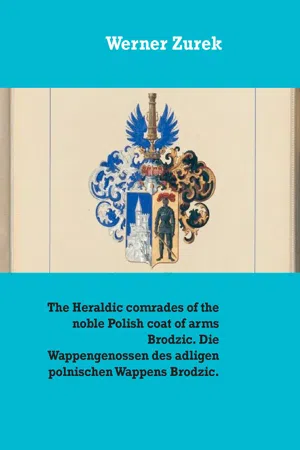
The Heraldic comrades of the noble Polish coat of arms Brodzic. Die Wappengenossen des adligen polnischen Wappens Brodzic.
- 482 pages
- English
- ePUB (mobile friendly)
- Available on iOS & Android
eBook - ePub
The Heraldic comrades of the noble Polish coat of arms Brodzic. Die Wappengenossen des adligen polnischen Wappens Brodzic.
About this book
Information
Edition
1 The Heraldic comrades of the noble Polish coat of arms Brodzic.
Die Wappengenossen des adligen polnischen Wappens Brodzic.
In a red field a small, golden ring, on the outer edge of which, equidistant from each other, stand three larger golden crosses, one of them pointing straight down; Helmet decoration: three or five ostrich feathers. The seat of the tribe was probably the Brody estate in the Płock Voivodeship. It is stated that King Kazimierz gave this coat of arms to an owner of Brody, who gave it to him in 1041 in the battle against the. Mazovian voivod Maslaus and the Jazdzwinger supported him with distinction, even awarded him, who was besieged by three enemies, who had rescued the oncoming by brave defenses and chased away. The same thing, called Brodzic, do the:
Bonikowski, Borodzicz, Brodzic, Brodzicki, Dybowski, Frackiewicz, Kliczewski, Koniecki, Kulwiec, Kunecki, Kurzatkowski, Lipinski, Lacki, Loski, Mojecki, Noyszewski, Ostrzykowski, Pilitimkiowski, Pynzyminsski, Radomutki, Podziminsski, Pokyminsski, Pokomki, Podzinsski, Sieromski, Talibski, Wiplar, Wosinski, Wroczynski, Zacharkiewicz, Zawadzki, Zochowski.
The Zawadzki carry the coat of arms in silver.
Brodzic (Broda, Brodzicz, Trzy Krzyże), Polish coat of arms.
Description of the coat of arms
On the red field, three golden cavalry crosses cross on a golden ring - one diagonally on the right, one on the left and the third below (Rosocha). Five ostrich feathers in the jewel above the crowned helmet.
• Earliest mentions:
Entry from 1414, seal from 1444.
• Herbowni:
Bilina, Blum, Bonikowski, Boniuszko, Bońkowski, Borodzic, Borodzicz, Brodzic, Brodzicki, Brodzicz, Brodzki, Dobrzycki, Dobszewicz, Dolanowski, Dubowski, Dybowski, Frąckiewicz, Kunkiewicz, Kunckiewiecki, Kulckiewicz, Fronckzcieckwie, Kulosjwickiki, Fronckiewicz, Kucznowosłowski, Kucziczki, Fronckiewicz, Kulosjwicki, Fronckiewicz, Kucznowosłowski Kurzątkowski, Lipiński, Łącki, Łoski, Milkint, Modelski, Mojecki, Mojek, Noiszewski, Nojszewski Pokutyński, Politowski, Radomski, Radzimiński, Rzym, Rzymski, Sieromski, Talibski, Talrockiń, Zławadoszyiński, Zechławzzyiń, Zachławzzyiński, Wiplaros Wipplar, Wipplar, Wiplar , Zochowski, Żochowski, Żoch.
Brodzice
Other names of this coat of arms:
Broda, Brodzicz, Trzy Krzyże
Description of coat of arms:
On the red field, three golden cavalry crosses cross on a golden ring - one diagonally on the right, one on the left and the third below (Rosocha). Five ostrich feathers in the jewel above the crowned helmet.
Widely used in the countries:
Krakow, Lublin, Sandomierz
Heraldic legend:
The coat of arms was presented to a brave young man with a long beard who fought with a rebel Masław next to Kazimierz the restorer, and was given the Brodzice coat of arms to protect the ruler's life. Others derive the name of the coat of arms not from the beard, but from the goods of Brody.
Bilina, Blum, Bonikowski, Boniuszko, Bońkowski, Borodzic, Borodzicz, Brodzic, Brodzicki, Brodzicz, Brodzki, Dobrzycki, Dobszewicz, Dolanowski, Dubowski, Dybowski, Frąckiewicz, Kunkiewicz, Kunckiewiecki, Kulckiewicz, Fronckzcieckwie, Kulosjwickiki, Fronckiewicz, Kucznowosłowski, Kucziczki, Fronckiewicz, Kulosjwicki, Fronckiewicz, Kucznowi Kurzątkowski, Lipiński, Łącki, Łoski, Milkint, Modelski, Mojecki, Mojek, Noiszewski, Nojszewski Pokutyński, Politowski, Radomski, Radzimiński, Rzym, Rzymski, Sieromski, Talibski, Talrockiń, Zławadoszyiński, Zechławzzyiński, Wiplaroszyiński, Wipplar, Wiplarzski, Wiplaroszyiński , Zochowski, Żochowski
Mentions:
"Radzimiński vom Brodzic coat of arms (vol. 8, p. 34-36)
Radzimiński from the Brodzic coat of arms, still under the rule of the Dukes of Mazovia, famous and in honor and works of great families. Maciej Radzimiński, who worked for many years at the court of Prince Ziemowit, was later his marshal in 1382. The second with the same name or the same voivode of Mazowiecki 1400. Jan Castellan of Warsaw and Hetman of the Duchy of Mazovia. Fern. Jan, the son of the same Jan, a noble and happy captain who brought considerable rottenness from Mazovia to the Polish kings, was on the Wołoska expedition near Bukowina for
Jan Albrycht. Hardow. Palace. Bartłomiej von Miastków, Cześnik Czerski, signed a decree of the Duchy of Mazovia against heretics in 1525 in Łubieńsk. in Vitis Episcop. Roach. Adam Starosta Czechowski on the King's List during the reign of Sigismund I, in MS. Petricov. Jan was seventeen years old at the court of King Zygmunt August and was on duty. "
"Ends of the Brodzic coat of arms (vol. 5, p. 190)
Koniecki coat of arms Brodzic, in the Sandomierz Krzysztof Koniecki Voivodeship in 1587, signed the laws of the Pokrzywnicki Congress. Constit. fol. 427. Others write it from Kunecki Jan Socha. u Paprocki: Jędrzej roku 1637. Acta Castr. Cracov. "
"Zawadzki vom Brodzic coat of arms (vol. 10, p. 99)
Zawadzki from the Brodzic coat of arms in the Wyszogrodzka region and in Podgorze. Sebastian Zawadzki, a brave and worthy husband from Zdziarska, left descendants. Jan Bailiff of the Różańska Land and collector from the Sejm from 1628. University. Collection. Piotr 1674. in the country of Wyszogród, Jan in Boszków in the country of Warsaw. P1. she was behind Stanisław Bromirski. "
"Dybowski vom Brodzic coat of arms (vol. 11, pp. 119-120)
Dybowski from the Brodzic coat of arms. The same coat of arms comes from Dybowo near Warsaw in a village in the municipality of Mokrzecka and from the old records of the Dybowski family in Radzymin and Parczów and from records in Gród Warszawski. These pages 120 the old family of a district with Brodzice, abandoned in other herbaria, briefly mentioned here. Dybowski from Brodzice in Dybów and Mokre with Ciołkowna fathered Krzysztof, great-great-grandfather, of Kasper's great-grandfather, grandfather Wojciech, and of him father Wojciech Dybowski and son Jan Dybowski. - Herbarz Duńczewski. "
Bonikowski from the Brodzic coat of arms. Paweł, Canon of Płocki, member of the same diocese for the composition between the clergy and the secular state. In Płock there is Daniel Bonikowski from the Order of St. Francis, for the great religious virtues, no less serious, and for God's grace.
Franciszek Bonikowski Zawskrzyński dome during the reign of Stanisław August. - Józef podstoli, - Wojciech, castle grave of Płock. - Wielądek heraldry.
1778. Bonikowski or Bońkowski Michał the Płocki hunter. - Krasicki's footnotes.
In heraldry, Wielądek later writes about the Bońkowski family, but if people like their whereabouts completely coincide with the Bonikowski family described above and Krasicki also names them Bonikowski or Bońkowski in his footnotes, I include here those that Wielądek speaks about separately, such as Borkowski writes, especially as Kuropatnicki in §. II. On the families of the local nobility in the crown and W. Ks. Zündete. he places them as if he were not expressing a coat of arms.
Bylicki from the Pobóg coat of arms. Bylicki from the Brodzic coat of arms is included in the index of the first volume by Okolski, but because neither the page he mentions there nor the place near Brodzice is nothing in them; that's why I suspect it. The Bylicki family of the coat of arms Pobóg and Okolski and Paprocki in Krakow Voivodeship is documented, but it seems to me that it is a house with Bielicki, also Pobożany, which I mentioned above, and Bylicki was accidentally written. [S. 379]
Dybowski from the Brodzic coat of arms. The same coat of arms comes from Dybowo near Warsaw in a village in the municipality of Mokrzecka and from the old records of the Dybowski family in Radzymin and Parczów and from records in Gród Warszawski. This [S. 120] old family in a district with Brodzice, in other abandoned weapons, briefly mentioned here. Dybowski from Brodzice in Dybów and Mokre with Ciołkowna fathered Krzysztof, great-great-grandfather, of Kasper's great-grandfather, grandfather Wojciech, and of him father Wojciech Dybowski and son Jan Dybowski. - Duńczewski's herbarium.
Frąckiewicz from the Brodzic coat of arms. One is the house with Radzimińskie Brodzice, who for a long time served in the Mazowieckie Voivodeship for the well-being of this homeland, because the first Kasper Radzimiński from the Czerska country had been quoting his salary in Lithuanian wax for a long time and took important names from the king down there: his son Franciszek, whom the simpler community called Frącem, and from whom the new house took the name of the Frąckiewiczs; After all, they should always be written together in memory of the tribe from which they came, either the Frąckiewiczs from Radzimin or the Frąckiewiczs Radzimińscy. I really like Radzimiński Brodzice in Mazowieckie, after all I will talk about the Lithuanian under the letter R, here I managed and this serves to distinguish it from other Radzimińskis who live in Samogitia in Lithuania. Franciszek, then son of Kasper, governor of Połock, chamberlain of Połock and royal colonel, while King Augustus, he left his son Michał, the great king of Stefan the Warrior, near Gdansk in Moscow and Inflanciech near Toropiec back and drew several castles with his people: he is recalled in the 1590 constitutions. 568. Chamberlain von Płock, when the republic entrusted the money raised from contributions to Members of Parliament that year so that he could spend it on war purposes; and sent to Moscow. He was reunited for life with Anna Sapieżanka, Starosta Drogicka, the sister of Lev Sapieha from the voivode and Chancellor of Vilnius, from whom he took two daughters, one of whom was married to Makowiecki, the other to Talwosz, Castellan von Żmudzki, and three sons, Krzysztof, Mikołaj and Jerzy: o one of them was written in MS by Janczyński. that there was heresy, it got tangled up, the church spent a lot of money on dissenters, including his terminally ill illness, Lew [p. 47] Sapieha, regarding his nephew and began to convince him that he could better consult his soul. He worries Frąckiewicz the more he insists that he sees his imminent death and offers him a priest. I, my conscience, confide in this priest, what does he shudder at him? With such a sacred meaning, not only did the sick confess him, but after receiving all the sacraments, he went to a better life; In this church, which he built himself, heretics were buried because Sapieha had been driven from there. After Sapieżanka, he took Maciej's daughter, Kaweczyńską, who was Jan's son. The sick man confessed, but after receiving all the sacraments, he went to a better life; In this church, which he built himself, heretics were buried because Sapieha had been driven from there. After Sapieżanka, he took Maciej's daughter, Kaweczyńską, who was Jan's son. The sick man confessed, but after receiving all the sacraments, he went to a better life; In this church, which he built himself, heretics were buried because Sapieha had been driven from there. After Sapieżanka he took Maciej's daughter, Kaweczyńska, and there his son Jan. Heretics were buried because Sapieha had been expelled from there. After Sapieżanka, he took Maciej's daughter, Kaweczyńską, who was Jan's son. The sick man confessed, but after receiving all the sacraments, he went to a better life; In this church, which he built himself, heretics were buried because Sapieha had been driven from there. After Sapieżanka, he took Maciej's daughter, Kaweczyńską, who was Jan's son. The sick man confessed, but after receiving all the sacraments, he went to a better life; In this church, which he built himself, heretics were buried because Sapieha had been driven from there. After Sapieżanka he took Maciej's daughter, Kaweczyńska, and there his son Jan. Heretics were buried because Sapieha had been expelled from there. After Sapieżanka, he took Maciej's daughter, Kaweczyńską, who was Jan's son. The sick man confessed, but after receiving all the sacraments, he went to a better life; In this church, which he built himself, heretics were buried because Sapieha had been driven from there. After Sapieżanka, he took Maciej's daughter, Kaweczyńską, who was Jan's son. The sick man confessed, but after receiving all the sacraments, he went to a better life; In this church, which he built himself, heretics were buried because Sapieha had been driven from there. After Sapieżanka he took Maciej's daughter, Kaweczyńska, and there his son Jan. After Sapieżanka, he took Maciej's daughter, Kaweczyńską, who was Jan's son. The sick man confessed, but after receiving all the sacraments, he went to a better life; In this church, which he built himself, heretics were buried because Sapieha had been driven from there. After Sapieżanka, he took Maciej's daughter, Kaweczyńską, who was Jan's son. The sick man confessed, but after receiving all the sacraments, he went to a better life; In this church, which he built himself, heretics were buried because Sapieha had been driven from there. After Sapieżanka he took Maciej's daughter, Kaweczyńska, and there his son Jan. After Sapieżanka, he took Maciej's daughter, Kaweczyńską, who was Jan's son. The sick man confessed, but after receiving all the sacraments, he went to a better life; In this church, which he built himself, heretics were buried because Sapieha had been driven from there. After Sapieżanka, he took Maciej's daughter, Kaweczyńską, who was Jan's son. The sick man confessed, but after receiving all the sacraments, he went to a better life; In this church, which he built himself, heretics were buried because Sapieha had been driven from there. After Sapieżanka he took Maciej's daughter, Kaweczyńska, and there his son Jan. he went to a better life; In this church, which he built himself, heretics were buried because Sapieha had been driven from there. After Sapieżanka, he took Maciej's daughter, Kaweczyńską, who was Jan's son. The sick man confessed, but after receiving all the sacraments, he went to a better life; In this church, which he built himself, heretics were buried because Sapieha had been driven from there. After Sapieżanka he took Maciej's daughter, Kaweczyńska, and there his son Jan. he went to a better life; In this church, which he built himself, heretics were buried because Sapieha had been driven from there. After Sapieżanka, he took Maciej's daughter, Kaweczyńską, who was Jan's son. The sick man confessed, but after receiving all the sacraments, he went to a better life; In this church, which he built himself, heretics were buried because Sapieha had been driven from there. After Sapieżanka he took Maciej's daughter, Kaweczyńska, and there his son Jan. In this church, which he built himself, heretics were buried because Sapieha had been driven from there. After Sapieżanka he took Maciej's daughter, Kaweczyńska, and there his son Jan. In this church, which he built himself, heretics were buried because Sapieha had been driven from there. After Sapieżanka he took Maciej's daughter, Kaweczyńska, and there his son Jan.
Krzysztof, the first son of the Chamberlain of Sapieżanka, a royal courtier, was with Stefan Król in Moscow with the post office of the hussar. When he returned from the war, he died as a descendant. Mikołaj, the second son, court ensign of the Lithuanian, Lidzki, Mścisławski, Wasilkowski staroste and Marshal of the Lithuanian Tribunal; The enemy suffered his bravery in Inflanciech, where the riots took place: his sons Bogdan the Stolnik Trotsky, Władysław and Michał. Jerzy, the third son, royal secretary, under Zygmunt III. He was a soldier, then a judge, and finally a marshal of Lidzki. In 1629 he was the marshal of the Lithuanian tribunal with volunteers. He was in distress in Biały Kamień in 1604. The Chamberlain from Kaweczyńska in Minska had two daughters. one of them went to the castellan of Nowogrodzki Stetkiewicz, the other to Zienowicz; is MS. Q. He was reassuring. But Erydan, the triple panegyric of Valerian the High, testifies to the third Anna, who in 1629 married Piotr Gotajski from the Korczak coat of arms. Three sons, Michał, Janusz and Krzysztof, of whom Michał was a Połock, he served a long time in Holland with Prince Maurice, died in 1649. He was a Klonowska voivode of Brzeska, from whom he left his sons Kazimierz, Aleksander and Dawid. Of these Kazimierz, first Civon Wieśśniański, Starost von Krewski, then treasurer of the Lithuanian court treasurer, Starost von Lidzki, and Seym 1690, commissioner for the inspection of the Crown Treasury. Const. fol. The 16th was Lidzki's first chamberlain in 1674e. With his wife Anna Naruszewicz, a Lithuanian court treasurer, he founded the Carmelite Fathers in his hereditary Zołudkowski lands approved by the Constitution of 1685. 9. He was marshal in the Lithuanian tribunal three times,
Jan, fourth son of Chamberlain of Chamberlain Połocki from Kaweczyńska, Ensign from Lidzki, royal courtier, made a considerable number to Wołoch, to Livonia one hundred Kopjinika, from Naruszewiczowny, his two sons Maciej and Stefan. Of these, Maciej, ensign of Nowogrodzki, served as King Władysław, [p. 48] in Smolensk against the Zaporovsky Cossacks, lieutenant under the hussar banner of 1660. He bravely led the Poviats against Moscow, he had Rogalska behind him, from whom his son Paweł, Mozyrski, 1674. The same or another Maciej, Starosta Mozyrski, deputy in 1653, deputy of the tribunal from him tax: Constit. fol. 16. Later he was a Lithuanian field clerk. as is evident from the constitution of 1662. fol. 16. when Katarzyna Abrahamowiczowna remembers his wife and his successors are asked to pay for bloody merits or in the 1670 constitutions. Fol. 5. no more Maciej, but his name is Marcjan, and under the same name he is praised by Potocki Centur. fol. 155. adds that near Szepielów he laid his life for his country: when he was in a hundred thousand. Moscow on Fr. Radziwiłła attacked eight thousand people to fight; Like such a large congregation, he valiantly resisted for some time after seeing that such a small handful of people could not be like to break numerous enemies, he ordered him to trumpet the other way and get his riders off the square but he lost his foot, and what was most pathetic for the army was Marcjan Frąckiewicz, whose bravery they pleased on many occasions. Stefan, a royal courtier, set up important post offices for Władysław near Smolensk, for Kazimierz near Zborów, he was the ensign of Nowogrodzki at the time, and in 1662 he was a member of the Sejm. with the title he was after the convocation of 1614 member for the revision of the Crown Treasury. Constit. fol. 13. Behind him was from Rajecka vom Schwanenwappen, the voivode of Minsk, from whom the son of Gedeon, the Lithuanian court ensign, the Starost of Słonim 1697. Constit. fol. 11. Hooded marshal and the daughter of first Józef Firlej, then Stanisław Potocki, coat of arms of Pilawa, the Lithuanian guardian of the spouse, finally Sterilis with him. Poniatowski Sea. Stefan, the nephew of Gedeon, the standard bearer, the Starost von Trąbski, renounced heresy, his mother was a Georgian chamberlain from Żmudzka, took Szymkowicz 'writer of the Lithuanian tax office, Judycka Marshal Rzeczycka. Jan Chryzostom, Archimandryta Czerejski 1720. Michał Radzimiński Frąckiewicz, Cupbearer of Oszmiański, Royal Captain. Kazimierz Jan, judge and captain of Lidzki poviat 1700. He was a deputy who inspected the treasury. Constit. fol. 13. Behind him was from Rajecka vom Schwanenwappen, the voivode of Minsk, from whom the son of Gedeon, the Lithuanian court ensign, the Starost of Słonim 1697. Constit. fol. 11. Hood marshal and the daughter of first Józef Firlej, then Stanisław Potocki, coat of arms of Pilawa, the Lithuanian guardian of the spouse, and finally Sterilis went with him. Poniatowski Sea. Stefan, the nephew of Gedeon, the standard bearer, the Starost von Trąbski, renounced heresy, his mother was a Georgian chamberlain from Żmudzka, took Szymkowicz 'writer of the Lithuanian tax office, Judycka Marshal Rzeczycka. Jan Chryzostom, Archimandryta Czerejski 1720. Michał Radzimiński Frąckiewicz, winner of the Oszmiański Cup, Royal Captain. Kazimierz Jan, district judge and captain of Lidzki poviat 1700. He was a deputy who searched the Treasury Constit. fol. 13. Behind him was from Rajecka vom Swan coat of arms, the voivode of Minsk, from whom the son of Gedeon, the Lithuanian court ensign, the Starost of Słonim 1697. Constit. fol. 11. Hood Marshal and the daughter of first Józef Firlej, then Stanisław Potocki, coat of arms of Pilawa, the Lithuanian guardian of the spouse, finally Sterilis went with him. Poniatowski Sea. Stefan, the nephew of Gedeon, the ensign, the Starost von Trąbski, renounced heresy, his mother was a Georgian chamberlain from Żmudzka, took Szymkowicz 'writer for the Lithuanian tax office, Judycka Marshal Rzeczycka. Jan Chryzostom, Archimandryta Czerejski 1720. Michał Radzimiński Frąckiewicz, the cup holder of the royal captain Oszmiański. Kazimierz Jan, district judge and captain of Lidzki poviat 1700. He had Rajecka from the Swan coat of arms, the voivode of Minsk, behind him, from whom Gedeon's son, the Lithuanian court ensign, the starost of Słonim 1697. Constit. fol. 11. Hood marshal and the daughter of first Józef Firlej, then Stanisław Potocki, coat of arms of Pilawa, the Lithuanian guardian of the spouse, and finally Sterilis went with him. Poniatowski Sea. Stefan, the nephew of Gedeon, the ensign, the Starost von Trąbski, renounced heresy, his mother was a Georgian chamberlain from Żmudzka, took Szymkowicz 'writer for the Lithuanian tax office, Judycka Marshal Rzeczycka. Jan Chryzostom, Archimandryta Czerejski 1720. Michał Radzimiński Frąckiewicz, winner of the Oszmiański Cup, Royal Captain. Kazimierz Jan, district judge and captain of Lidzki poviat 1700. He had Rajecka from the Swan coat of arms, the voivode of Minsk, behind him, from whom Gedeon's son, the Lithuanian court ensign, the starost of Słonim 1697. Constit. fol. 11. Hood Marshal and the daughter of first Józef Firlej, then Stanisław Potocki, coat of arms of Pilawa, the Lithuanian guardian of the spouse, finally Sterilis went with him. Poniatowski Sea. Stefan, the nephew of Gedeon, the standard bearer, the Starost von Trąbski, renounced heresy, his mother was a Georgian chamberlain from Żmudzka, took Szymkowicz 'writer of the Lithuanian tax office, Judycka Marshal Rzeczycka. Jan Chryzostom, Archimandryta Czerejski 1720. Michał Radzimiński Frąckiewicz, the cup holder of Oszmiański, the royal captain. Kazimierz Jan, judge and captain of Lidzki poviat 1700. Hood Marshal and the daughter of first Józef Firlej, then Stanisław Potocki, coat of arms of Pilawa, the Lithuani...
Table of contents
- Titelseite
- Impressum
Trusted by 375,005 students
Access to over 1.5 million titles for a fair monthly price.
Study more efficiently using our study tools.