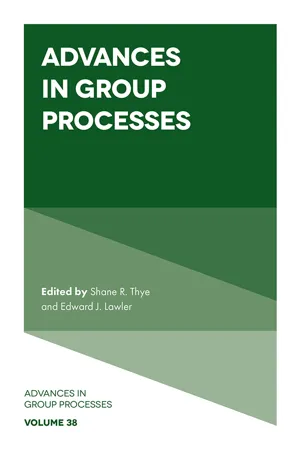
Advances in Group Processes publishes theoretical analyses, reviews and theory based empirical chapters on group phenomena. This includes work on topics such as status, power, exchange, justice, influence, altruism, decision making, intergroup relations and social networks. Contributors have included scholars from diverse fields including sociology, psychology, political science, economics, biology, philosophy, mathematics and organizational behaviour.
Volume 38 brings together papers related to a variety of topics in small groups and organizational research. The volume includes papers that address theoretical and empirical issues related to occupational deference structures, emotions generated by social identities, racial threat, sticky expectations, status and response latency, race and moral expectations in employment, comparison processes and competition and models of intergroup association. Overall, the volume includes papers that reflect a wide range of theoretical approaches from leading scholars who work in the general area of group processes.
The Big Tent: Integrating Macro Models for Intergroup Association with Experimental Data on Exchange Relations in a Minimal Group Setting
Zbigniew Karpiński, John Skvoretz, Adam Kęska and Dariusz Przybysz
Abstract
Purpose:This chapter aims: (a) to extend biased net models of homophily to complete networks; (b) to extend the scope of application of these models to processes of social exchange in a small-group laboratory setting; and (c) to link the theoretical model of attraction and repulsion with a standard statistical model of logistic regression as a way of estimating and evaluating the model.
Methods:We discuss the logic of biased net theory and show how it leads to formal mathematical models of tie formation and tie renewal under mechanisms of attraction and repulsion. We then estimate key theoretical parameters in the models by means of logistic regression.
Findings:The estimated effects of homophily in our models are moderate in strength, weaker than corresponding reciprocity effect, and processes of tie formation and tie renewal are driven more by considerations of direct reciprocity than group membership. Under attraction, homophily effects are stronger for tie renewal than tie formation. Under repulsion, the opposite holds.
Limitations:Participants in our study are divided into two groups based on a criterion that is likely to have been too weak to induce strong group identity. Measures that enhance the sense of group identity need to be introduced in future studies.
Keywords: Exchange; reciprocity; homophily; biased net theory; dynamic networks; minimal group
Introduction
The earliest formal modeling tradition in social network analysis is that of random and biased net theory proposed by Rapoport and colleagues in the early 1950s (Landau, 1952; Rapoport, 1951a, 1951b; Rapoport & Solomonoff, 1951; Solomonoff, 1952). In this tradition, both random and biased forces create connections. If only random forces exist, the result is a Bernoulli graph. In the original development, biases refer to events that, if they occur, insure a certain type of connection. The probability the event occurs defines the strength of its associated bias. A simple example is reciprocity, the idea that an
tie is more likely than chance if there is a
tie. The biased net framework hypothesizes an unobserved “reciprocity” event which, if it occurs, insures the
tie forms given the
ties exists. The strength of the reciprocity bias is the probability the reciprocity event occurs.1 Rapoport's models focused on complete networks and the motivating question was the “tracing problem” – the conditions under which an entire population could be reached by tracing outward from a random set of “starter” nodes.
Fararo and Sunshine (1964) offered an extension of the modeling framework of biased net theory by introducing the concept of “inbreeding bias,” or the idea that a tie from
to
is more likely than chance if
and
share membership in a category of a socially salient characteristic, such as gender, ethnicity, or social class. In other words, using the definitions of biases proposed by Rapoport and his colleagues, Fararo and Sunshine (1964) defined the inbreeding bias in terms of an unobservable “event” which, if it occurs, ensures that the resulting tie is between members of the same category. Otherwise, the tie is between members of the same category with the probability equal to chance. The inbreeding bias was then used in modeling homophily in social networks, that is, the tendency for people to associate with others like themselves (e.g., Lazarsfeld & Merton, 1954; McPherson, Smith-Lovin, & Cook, 2001). Research on social networks and social stratification is rich in evidence of homophily in many different types of social relations – marriage (Domański & Przybysz, 2007; Smits, Ultee, & Lammers, 1998), friendship (Marsden, 1981; Skvoretz, 1991), discussing important matters with (McPherson, Smith-Lovin, & Brashears, 2006; Smith, McPherson, & Smith-Lovin, 2014), career support in the workplace (Ibarra, 1992, 1995) – and many different types of attributes – race and ethnicity (Leszczensky & Pink, 2015, 2019), age (Fischer, 1982), religion (Cheadle & Schwadel, 2012; Cook, Schwadel, & Cheadle, 2017), sex and gender (Brashears, 2008), education (Smits et al., 1998), and status (Kalmijn, 1991), to give just few exampl...
Table of contents
Cover
Series Editor
Editorial Advisory Board
Title
Copyright
Contents
List of Contributors
Preface
The Emotional Implications of Occupational Deference Structures
Separate and Unequal: Predicting Intergroup Behavior and Emotions from Social Identity Meanings
The Multidimensionality of Racial Threat: A Consideration of Its Affective Dimension
Sticky Expectations
Are They High Status or Just Assertive? Response Latency in Task Groups
The Double Disadvantage: Using Status and Stigma Processes to Understand Race, Criminal Record, and Moral Expectations in Employment
Comparing and Being Compared: A Dual Process Framework of Competition
The Big Tent: Integrating Macro Models for Intergroup Association with Experimental Data on Exchange Relations in a Minimal Group Setting
Index
Trusted by 375,005 students
Access to over 1.5 million titles for a fair monthly price.
Study more efficiently using our study tools.
Frequently asked questions
Yes, you can cancel anytime from the Subscription tab in your account settings on the Perlego website. Your subscription will stay active until the end of your current billing period. Learn how to cancel your subscription
No, books cannot be downloaded as external files, such as PDFs, for use outside of Perlego. However, you can download books within the Perlego app for offline reading on mobile or tablet. Learn how to download books offline
Perlego offers two plans: Essential and Complete
Essential is ideal for learners and professionals who enjoy exploring a wide range of subjects. Access the Essential Library with 800,000+ trusted titles and best-sellers across business, personal growth, and the humanities. Includes unlimited reading time and Standard Read Aloud voice.
Complete: Perfect for advanced learners and researchers needing full, unrestricted access. Unlock 1.5M+ books across hundreds of subjects, including academic and specialized titles. The Complete Plan also includes advanced features like Premium Read Aloud and Research Assistant.
Both plans are available with monthly, semester, or annual billing cycles.
We are an online textbook subscription service, where you can get access to an entire online library for less than the price of a single book per month. With over 1.5 million books across 990+ topics, we’ve got you covered! Learn about our mission
Look out for the read-aloud symbol on your next book to see if you can listen to it. The read-aloud tool reads text aloud for you, highlighting the text as it is being read. You can pause it, speed it up and slow it down. Learn more about Read Aloud
Yes! You can use the Perlego app on both iOS and Android devices to read anytime, anywhere — even offline. Perfect for commutes or when you’re on the go. Please note we cannot support devices running on iOS 13 and Android 7 or earlier. Learn more about using the app
Yes, you can access Advances in Group Processes by Shane R. Thye,Edward J. Lawler in PDF and/or ePUB format, as well as other popular books in Business & Comportamento organizzativo. We have over 1.5 million books available in our catalogue for you to explore.