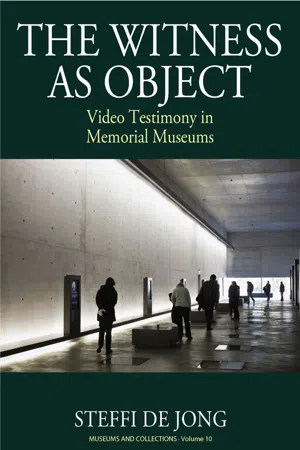
In recent years, historical witnessing has emerged as a category of "museum object." Audiovisual recordings of interviews with individuals remembering events of historical importance are now integral to the collections and research activities of museums. They have also become important components in narrative and exhibition design strategies. With a focus on Holocaust museums, this study scrutinizes for the first time the new global phenomenon of the "musealization" of the witness to history, exploring the processes, prerequisites, and consequences of the transformation of video testimonies into exhibits.
- 280 pages
- English
- ePUB (mobile friendly)
- Available on iOS & Android
eBook - ePub
About this book
Information
Chapter 1
THE WITNESS TO HISTORY
Conceptual Clarifications
The Zeitzeugenbörse in Berlin
In 1993, senior citizens of Berlin founded a society called ‘Zeitzeugenbörse’.1 The society is designed to encourage dialogue between the generations. Its primary goal is to make public the memories of its members who, at least during the first years of the society’s existence, mostly belonged to the war generation. The Zeitzeugenbörse administers, inter alia, a database of its members, establishes contacts between these members and public institutions looking for a witness to give testimony on a historical event, and organizes seminars to prepare its members for public appearances. Several similar societies have by now been founded in other German cities. The name of the Zeitzeugenbörse is composed of two words: ‘Zeitzeuge’ and ‘Börse’. ‘Börse’ means stock exchange or, more generally, any kind of exchange market. ‘Zeitzeuge’ is a relatively new concept consisting of the words ‘Zeit’, meaning time, and ‘Zeuge’, meaning witness. In this chapter, I wish to reflect specifically on the concept of ‘Zeitzeuge’ and the ideas connected to it. I will start by analysing the different uses of the concept in German and will then propose two analytical concepts for this study taking up the meanings of the German ‘Zeitzeuge’: ‘witness of the past’ and ‘witness to history’. In the second part of this chapter, I will, with reference to the figures of the juridical witness and the martyr, outline some of the characteristics of the figure of the witness to history.
Witnesses of the Past, Witnesses to History and Video Testimonies
While Germans use the word ‘Zeitzeuge’, the Dutch talk about ‘tijdgetuiger’, the Norwegians of ‘tidsvitner’2 and the Swedes of ‘samtidsvittner’. All three words specifically designate people who have witnessed a time period or an event of historical importance. In German especially, the concept of ‘Zeitzeuge’ is now used frequently in everyday speech. The historian Martin Sabrow (2012: 13) observes that ‘Zeitzeuge’ can be counted amongst those concepts:
that suddenly appear out of nothing, just in order to be integrated into everyday language so quickly, that they appear to have swallowed their own genealogy and seem to transcend history, as if they had always been there and it becomes impossible to imagine what it was like without them.
Sabrow (2012) traces the first uses of the concept back to the mid 1970s. Nowadays, the term has an entry in the German dictionary Der Duden, which defines it as ‘sb. who as a contemporary can give testimony on certain occurrences (of historical importance)’. Although the word has been used for objects, such as in the title of Rosmarie Beier-de Haan and Gottfried Korff’s (1992) study Zeitzeugen: Ausgewählte Objekte aus der Sammlung des Deutschen Historischen Museums (Zeitzeugen: Selected Objects from the Collection of the German Historical Museum), it is generally used to designate people.
As the Duden definition shows, the German concept ‘Zeitzeuge’ combines the idea of having witnessed something in situ with that of giving testimony ex post facto. ‘Zeitzeuge’ can designate an individual who has merely witnessed an event, or the person who both witnesses and gives testimony of this event. Up to this point, no English equivalent has been defined. A literal translation would result in something like ‘time-witness’. For my analysis of the musealization of video testimonies, I will use the concept ‘witness of the past’ when referring to the first meaning of the German ‘Zeitzeuge’. Witnesses of the past are people who have witnessed – in the sense of having seen, heard or experienced – an event of historical importance. Witnesses of the past have ‘been there’ and their bodies are – visibly or invisibly – marked by the events that they witnessed. I will use the concept ‘witness to history’ when referring to the second meaning of the German ‘Zeitzeuge’. Witnesses of the past become witnesses to history once they give testimony of their experiences in a public space in which their addressees intentionally go beyond the circle of their friends and family. Witnesses to history willingly or unwillingly construct or consolidate a certain narrative of the past – a certain history.
There are numerous fora in which the testimonies of witnesses to history can be made public: talks in front of school classes, talk shows, conferences, TV documentaries, newspaper articles, autobiographies, more recently websites and online platforms such as YouTube or Facebook, and of course museums. The medium for public presentation that I will be analysing here comes in the form of videotapes on which the testimonies of the witnesses to history have been recorded. German studies generally talk of ‘Zeitzeugenvideos’ (videos of witnesses to history) or ‘Videozeugnisse’ (video testimonies), while in English we find alongside the concept ‘video testimony’ that of ‘visual history’. The USC Shoah Foundation, for example, calls its archive the ‘Visual History Archive’. ‘Visual history’3 used in this sense makes reference to oral history and concentrates on the medium used to record the testimonies. It describes oral historians’ use of videotapes instead of audiotapes. The term ‘video testimony’ on the other hand refers to the content of the videos. It was first used by the collaborators of the Fortunoff Archive. They had, in fact, decided early on to use the term ‘testimony’ instead of the term ‘interview’. Joanne Weiner Rudof (2009: 59–60), one of the collaborators, explains that:
right from the beginning it was clear that the existing vocabulary was not suited to describe the process. The use of words like ‘interview’ and ‘interviewer’ would have generated a wrong impression. The founders, looking well ahead, decided on the concept of testimony in order to express more clearly the dimensions of the process.
For the Fortunoff Archive, it is thus the speech act recorded on video that is of importance – an act that they call testimony. The use of the term ‘testimony’ expresses, first, the idea that the Holocaust survivors who appear in these videos do not only tell their life stories, but that they also testify to the past. The term refers, second, to the ‘testimonial’ character of the videos. Geoffrey Hartman (1996: 140) of the Fortunoff Archive observes that most of the video testimonies of Holocaust survivors are also ‘testimonial videos’: the testimonies are also given in the name of the family members and, more generally, the millions who were murdered. If we consider this second meaning, the concept of video testimony could only be used with reference to survivors of catastrophes and massacres. Not all of the videotaped testimonies that I will be analysing in this study are testimonies of Holocaust survivors. I opt for the concept of video testimony nevertheless. For one thing, by using the concept of video testimony, I want to stress the genealogy of video testimonies as a medium that was first used for recording the testimonies of Holocaust survivors. On the other hand, I wish to underline that video testimonies are always used to testify to a certain narrative of the past – to a certain history – regardless of whether they are based on the testimonies of Holocaust survivors or on those of other witnesses to history. However, before turning to the characteristics of the witness to history, let us turn to those of the paradigmatic witness figure: the juridical witness.
The Juridical Witness and the Witness to History
The etymological origins in Latin and in old Germanic languages of the words denoting both the act of witnessing and the witness can be located in a juridical context. The English word witness goes back to the Old High German ‘gawitzi’, ‘gewizzi’ or ‘gewizze’ and the Middle High German ‘gewizze’, which in turn have developed from the Latin ‘cum’ (together) and ‘scientia’ (knowledge). Witness therefore has the same roots as the English ‘conscience’ and the German ‘Gewissen’ (conscience). The German word ‘Gewissen’ in turn is used to mean in the first instance ‘cognizance’ and in the second instance ‘awareness of that which is proper’, as well as ‘inner consciousness’ (Paul 1992: 262). The Oxford English Dictionary gives as its first entry a now obsolete meaning for witness: ‘knowledge, understanding, wisdom’. The witness is thus somebody who knows something, but also somebody who is aware of the moral consequences of her or his knowledge. Passing from the abstract to the concrete, the witness used to mean ‘attestation of a fact, event, or statement’ and the ‘evidence given in a court’, as well as ‘the action or condition of being an observer of an event’. The word ‘witness’ was only eventually used to designate a person ‘who gives evidence in relation to matters of fact under inquiry’. Here it first designated the third party present at the signing of a document or a transaction.
The German word for witness, ‘Zeuge’, goes back to the Old High German ‘giziugon’ and the Middle High German ‘ziugen’, meaning ‘producing through technical activity’. The meaning of ‘zeugen’ as giving testimony might go back to this first meaning and denote the act of putting forth facts in court. As with the oldest uses of the Anglo-Saxon witness, the Germanic ‘Zeuge’ used to denote the evidence given in court, the court witness and the third party present at the signing of a contract (Paul 1992: 825–26). The origins of the Anglo-Saxon ‘testimony’ as well as, for example, the French ‘témoin’ or the Italian ‘testimone’ can, according to Giorgio Agamben (2002: 17), be found in the Latin ‘testis’, signifying ‘the person who, in a trial or lawsuit between two rival parties, is in the position of a third party (*terstis)’.
Those etymological origins (being an observer, producing knowledge and conscience) find their reflections in the functions of the juridical witness. In fact, reflections on the act of witnessing and of giving testimony generally start with reflections on the roles of the juridical witness (cf. Peters 2001; Assmann 2006: 85–92; Krämer 2008). The philosopher Sibylle Krämer (2008: 228) defines five ideal-type characteristics of the juridical witness: the creation of evidence, perception, the speech act, the audience and trustworthiness.
First, during a trial, the juridical witness provides information that cannot be acquired in another way. She or he produces evidence. The juridical witness allows the victim to obtain justice and the perpetrator to be punished. Ultimately her or his testimony helps to renew a social balance that has been damaged (Krämer 2008: 228–29).
Second, one of the preconditions for becoming a juridical witness is that the person in question has directly perceived the event to which she or he bears testimony, at best without having actively taken part in it. The juridical witness is ideally a neutral recipient of information that she or he reproduces objectively. Any interpretation, judgement or opinion on the event under scrutiny that a witness might utter can damage her or his trustworthiness as a juridical witness (Krämer 2008: 229–30).
Third, juridical witnesses have to put their perceptions into words. Being a witness means performing a speech act, while giving testimony in court is a ritual. The witness is positioned in a witness-stand, facing the judge, who represents the interests of the community under whose auspice the trial takes place, and is flanked by the prosecution and the defence representing in their turn the interests of the accused and the law. The testimony that the witness gives is framed and conditioned by the oath that is foregrounded at the beginning of the act of giving testimony and by the questions of both the defence and the prosecution. It is the ritual of the trial that turns individuals into juridical witnesses and defines their testimony as trustworthy. Being a juridical witness is ultimately a part that has to be performed (Krämer 2008: 231).
Fourth, at the same time as being a speech-act, giving testimony is a ‘listening-act’. Witnesses can only give testimony in front of an audience. A trial is a dialogue and the testimonies of juridical witnesses are conditioned and steered by this dialogue (Krämer 2008: 231–32).
Fifth, a precondition for an individual to be accepted as a juridical witness is that this individual be trusted by the audience at the trial. An individual who seems untrustworthy – even if she or he might be telling the truth – cannot serve as a juridical witness (Krämer 2008: 232–33).
These five characteristics are archetypal characteristics. They only rarely correspond to the real situation of bearing witness in court. Any testimony is fallible, and this fallibility, as Sibylle Krämer points out, goes back to the very simple fact that juridical witnesses are humans. Humans are not disinterested recipients, but people with feelings and their own sense of judgement who are prone to forget what might be of importance for the resolution of the case under scrutiny. Moreover, since words can be exchanged, but emotions and impressions first need to be put into words in order to be transferable to another person, there is necessarily a gap in correspondence between the testimony given by the witness and the reception of this testimony by those who are listening to the testimony. The figure of the juridical witness is thus caught in a constant dialectic between what Krämer (2008: 238, italics in original) calls its ‘Subjektstellung’ (subject character) – the quality of being human – and its ‘Sach- und Objektstatus’ (status as an object) – its function as a means towards the resolution of a criminal case.
I have stated that I will use the concept ‘witness to history’ in order to designate individuals who give testimony of a past event in a public space. This space can, of course, also be the courtroom. As I will show in Chapter 2, the Eichmann trial that took place in Jerusalem in 1961 can be considered as the birthplace of the figure of the witness to history. The figure of the witness to history, as I understand it here, takes its legitimacy and many of its characteristics from the juridical witness. In what follows, I will try to give an overview over these characteristics. In doing so, I will follow the five ideal-type characteristics proposed by Krämer and will show how these characteristics are extended and distorted in the case of the witness to history.
Unlike for the juridical witness, it is impossible to define an archetypal case of the witness to history. This is due to the fact that, unlike the juridical witness, the witness to history does not need to fulfil a clear function. The functions of witnesses to history are defined by the settings in which the individual witnesses appear. As we will see, in the particular case of the use of video testimonies in the museum setting, witnesses to history can variably serve as providers of historically relevant information, in order to reinforce the authenticity of other objects in the museums, in order to affect visitors, as a means for moral education or, most frequently, as a combination of all of the above. The multiplicity of functions performed by witnesses to history leads, second, to a proliferation of individuals who could potentially perform the role of witness to history. Individuals who would never be considered for the role of juridical witness can become witnesses to history. Witnesses to history can be victims, perpetrators or bystanders, members of the population who witnessed crimes but did not intervene (Hilberg 1992). They can have held a leading position or merely have observed certain events. They can have been active or passive, willingly or unwillingly involved. Nevertheless, while being diverse, witnesses to history also share some characteristics.
If the primary function of the juridical witness is evidence production, the primary function of the witness to history is education. Under the heading ‘Zeitzeuge werden’ (becoming a witness to history), the Zeitzeugenbörse advances the following definition on its website: ‘We are all of us witnesses to history because we all have experiences, and collect memories that might enlighten other people.’4 The role of a witness to history is to give new insights to those who listen to her or his testimony. The educative role of witnesses to history can thereby serve different ends: it can be cognitive, providing the audience with information that they did not have before the encounter; it can be affective, making them respond emotionally in a way in which they have not responded before; it can be an end in itself, making the audience discover historical details that it did not know before; and it can be a means to an end, for example, when this historical knowledge is used in peace and human rights education. Most often, we find a combination of those four functions.
The second characteristic of the juridical witness, her or his physical presence at the event on which they are giving testimony, is intensified for the witness to history. In the case of the juridical witness, hearsay is accepted, although presence in time and space is preferred. In the case of the witness to history, presence in time and space is crucial. In his reflections on the figure of the witness, Geert Gooskens (2011: 155, italics in original) underlines that ‘witnesses are living traces of the things that they have experienced’: ‘Through the witness we are not only looking for information on an event, we are rather looking for contact with this event’ (2011: 154, italics in original). The knowledge that witnesses to history provide their audience with always refers to a past event that is inaccessible for the audience. Through contact with the witness to history, the audience also tries to get in contact with the event in question. It is this presence in time and space that distinguishes the witness to history from the expert. As I will show in greater detail in Chapter 4, the witness to history who, unlike the historian, might only know little about the same event’s political and historical background is imbued with an aura of authenticity. She or he has the bonus of seemingly knowing what it ‘was really like and what it felt like’. Therefore, the closer to the core of the event that the witnesses have been, the more valuable their testimonies are.
Third, as with juridical witnesses, witnesses to history have to put their experiences into words. While for juridical witnesses, the verbalization takes place in the highly institutionalized and ritualized setting of the court, witnesses to history verbalize their experiences in a variety of settings. Their testimonies, while not being completely free from set structures, are therefore less ritualized than the testimonies of juridical witnesses. Unlike in the case of the juridical witness, the subject character (Krämer 2008: 238) of the witness to history is well accepted; it is not only acceptable, but even desirable for witnesses to history to reflect on and to give their own interpretations of what they have experienced. Nevertheless, while giving their testimonies, witnesses to history might make reference to other ritualized or institutionalized forms of narrating, such as court hearings, but also curricula vitae, TV interviews or the genre of written autobiographies. The Zeitzeugenbörse even develops and provides tools and skills for its members to give testimony in front of different audiences. As I will show in Chapter 3, the genre of video testimony has been standardized and ritualized over the years, and both the interviewers and the interviewees have internalized its rules.
Fourth, similar to the juridical witness, witnesses to history need an audience. It is this audience that turns witnesses of the past into witnesses to history. When the Zeitzeugenbörse observes that ‘we are all of us witnesses to history because we all of us have experiences, and collect memories that might enlighten other people’, it only tells half of the story. It is true that we are all of us constantly experiencing things and collecting memories. However, it is only in hindsight that the importance of an experience becomes apparent. In the case of the juridical witness, it is the juridical case under investigation that defines what experiences, and what details thereof, are relevant – which ones the witnesses should have ...
Table of contents
- Cover
- Title Page
- Copyright Page
- Contents
- List of Illustrations
- Acknowledgements
- Notes on the Text
- Introduction
- Chapter 1. The Witness to History: Conceptual Clarifications
- Chapter 2. Genealogy: The Mediation of the Witness to History as a Carrier of Memory
- Chapter 3. Collecting: Turning Communicative Memory into Cultural Memory
- Chapter 4. Exhibiting: The Witness to History as a Museum Object
- Chapter 5. Communicating: Witnesses to History as Didactic Tools
- Conclusion
- Bibliography
- Index
Trusted by 375,005 students
Access to over 1.5 million titles for a fair monthly price.
Study more efficiently using our study tools.
Frequently asked questions
Yes, you can cancel anytime from the Subscription tab in your account settings on the Perlego website. Your subscription will stay active until the end of your current billing period. Learn how to cancel your subscription
No, books cannot be downloaded as external files, such as PDFs, for use outside of Perlego. However, you can download books within the Perlego app for offline reading on mobile or tablet. Learn how to download books offline
Perlego offers two plans: Essential and Complete
- Essential is ideal for learners and professionals who enjoy exploring a wide range of subjects. Access the Essential Library with 800,000+ trusted titles and best-sellers across business, personal growth, and the humanities. Includes unlimited reading time and Standard Read Aloud voice.
- Complete: Perfect for advanced learners and researchers needing full, unrestricted access. Unlock 1.5M+ books across hundreds of subjects, including academic and specialized titles. The Complete Plan also includes advanced features like Premium Read Aloud and Research Assistant.
We are an online textbook subscription service, where you can get access to an entire online library for less than the price of a single book per month. With over 1.5 million books across 990+ topics, we’ve got you covered! Learn about our mission
Look out for the read-aloud symbol on your next book to see if you can listen to it. The read-aloud tool reads text aloud for you, highlighting the text as it is being read. You can pause it, speed it up and slow it down. Learn more about Read Aloud
Yes! You can use the Perlego app on both iOS and Android devices to read anytime, anywhere — even offline. Perfect for commutes or when you’re on the go.
Please note we cannot support devices running on iOS 13 and Android 7 or earlier. Learn more about using the app
Please note we cannot support devices running on iOS 13 and Android 7 or earlier. Learn more about using the app
Yes, you can access The Witness as Object by Steffi de Jong in PDF and/or ePUB format, as well as other popular books in Arte & Museología. We have over 1.5 million books available in our catalogue for you to explore.