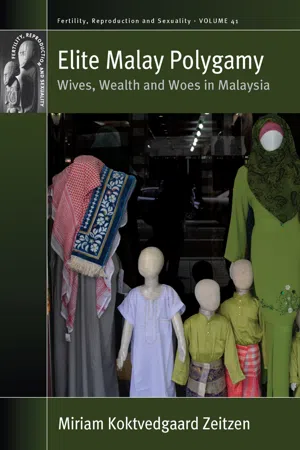
Elite Malay women's polygamy narratives are multiple and varied, and their sentiments regarding the practice are conflicted, as they are often torn between personal and religious convictions. This volume explores the ways in which this increasingly prominent practice impacts Malay gender relations. As Muslims, elite Malay women may be forced to accept polygamy, but they mostly condemn it as women and wives, as it forces them to manage their lives and loves under the "threat" of polygamy from a husband able to marry another woman without their knowledge or consent; a husband that is married but available.
- 268 pages
- English
- ePUB (mobile friendly)
- Available on iOS & Android
eBook - ePub
About this book
Trusted by 375,005 students
Access to over 1.5 million titles for a fair monthly price.
Study more efficiently using our study tools.
Information
Chapter 1
STORIES
Asmah’s Story bout Imagining Polygamy
Like many monogamously married Malay women, 56-year-old Asmah worries about polygamy. Mostly, it is a general worry. For Asmah, relating what she would do and feel if her husband took a second wife remains a theoretical exercise. Yet Asmah has done more imagining than most, fuelled by her intense sharing in the emotions and experiences that her relatives and friends facing polygamy go through. For Asmah, there is a fundamental schism between men’s and women’s perspectives on polygamy. Trying to reconcile them often seems an impossible task:
A second wife is not accorded the same dignity as the first wife. There is some stigma and she might feel inferior; she is looked at as someone who takes another woman’s husband. It is mostly other women who look at her this way; they have the most at stake, since their husbands can do that to them. Men mostly don’t care about polygamy, and men are never blamed for doing it. In men’s eyes they don’t see it as a problem.
To Asmah, polygamy is one of the worst fates that can befall a woman. A friend of hers became very distraught when the husband took a second wife, but deals with it by being very religious and accepting polygamy as a Muslim institution. The husband takes good care of her financially, so she has learned to cope. Asmah is adamant, however, that Malay women do not possess any special personal coping mechanisms with regards to polygamy: ‘It does not help to be Malay or Muslim, for you are a woman first and it is difficult for all.’ Yet Asmah’s own perceptions of living with polygamy have become less sharp and more pragmatic as the years have gone by:
I always felt or said to my husband when I was younger, if you are lying in the drain drunk I will pick you up, if you are in jail or if you lose your job, I will stand by you, but if you take a second wife that is unacceptable, I will leave you. But now, when I advise my friend who faces the threat of seeing her husband getting married to a second wife, my perspectives have changed, why should she leave and loose the house and his pension, after all these years, why make it so easy for him, better stay and endure it.
Polygamy Storytelling
‘Just like there are seasons for rambutan or durian [local fruits], there are seasons for talks on such issues’, Aisyah noted when we discussed the prominence of polygamy in Malaysian media. High profile polygamy cases involving elite Malays feature regularly in various media. Polygamy’s present public prominence is probably partly a result of more publicity. Yet for the women who shared their polygamy stories with me it was very real indeed, and they increasingly rearrange their lives and loves on the assumption that for them too polygamy can become a reality.
When elite Malay women recount their thoughts or experiences with polygamy in narrative form it creates meaning. Through their narratives, the women try to make sense of what is for many of them an unknown or unwanted world of polygamy. I went through a similar meaning-creating process by engaging in a common interpretive process with my interlocutors, in order to make women’s own interpretations of polygamy, as they offered them in their narratives, the basis and premise of my analysis of polygamy (Abu-Lughod 1993; Lindisfarne 2000). This interpretational pluralism was part of my attempt to contextualize polygamy, of evaluating earlier anthropological narratives and cultural assumptions about polygamy, as well as utilizing the narrative possibilities of engaging with the women in understanding and presenting their bodies of knowledge about polygamy (Bruner 1986; Harvey 1999). The result is very much an ethnography of the particular (Abu-Lughod 1991). My aim is to give some insight into elite Malay women’s emotional journeys in polygamy (Svasek 2005; Tonkin 2005; Wulff 2011), as well as their everyday practices in managing such a challenging matrimonial arrangement.
Gossip, a favourite pastime of urban elite Malays (and most other people), is a prime production site for polygamy narratives, and hence for insights into women’s emotional journeys and everyday practices in managing polygamy. A number of ‘publicly owned’ stories about polygamy circulate in town and in various media, acquiring increasing infamy the more they get around. These stories help create a sense of a growing number of polygamous unions in the K.L. area. Such stories, especially if they are spectacular or involve public personalities, may be published in various media, though not necessarily in full detail. Invariably, someone will know or have heard of one or more of the persons involved, so people start filling in missing details and persons, developing the story, adding to the gossip. I would also swap stories and add dimensions in order to create my own space on the polygamy gristmill. My motto was ‘give in order to get’, while being exceedingly careful not to reveal any one’s identity – a very hard task indeed when many of my interlocutors were on the ‘known list’ or had bonds of family or friendship – or indeed enmity – with the gossiping crowd. It required consummate social manoeuvring. Much of my knowledge of women’s perceptions and experiences of polygamy in fact came not through formal interviews, but from casual conversation. Many stories I heard and exchanged – based on their typically sensationalist content, their stereotypical narrative structure and their impassioned performance – were clearly gossip. It was admittedly a gratifying way of learning.
A classic polygamy gossip story in modern day K.L. might typically contain elements of power, fame, wealth, violence between wives, scorned first wife and betrayed second wife. Regular players in such scenarios might include beauty queens, actresses, media women, top civil servants and senior politicians or their offspring, leading businessmen, as well as members of aristocratic and royal families. In one particularly ‘gratifying’ gossip story, a woman moved from one man to another as a potential second wife, going, I was told, ‘for a bigger fish’. This act outraged high society while simultaneously thrilling them, especially as her second choice of husband ultimately died, adding a touch of scandal. Others claimed she was dumped by her different boyfriends because she was too expensive to maintain, in the process reclaiming polygamous initiative for men. As Shamsul (1999:92) notes, gossip and stories laced with envy or insult are often associated with the new rich Malays, and what may be considered by some to be their inappropriate displays of wealth.
An important aspect of gossip is indeed how it is used instrumentally by the women who are in, or are faced with being in, polygamous unions themselves (Paine 1967; Scott 1987). Gossip can be used to secure allegiances from friends and family. Getting your children or your parents-in-law on your side might help you avert your husband engaging in polygamy for fear of family sanctions. A second wife spreading the word about her husband’s first wife can be an attempt to get allies on her side, get greater attention from her husband and achieve the ultimate; namely, to get her husband to divorce his first wife. Similarly, spreading the word about one’s husband’s second wife can discredit her (Geertz 1961: 132–33).
One of my interlocutors related how her family was often the target of polygamy rumours, because many people assumed that her father had a second wife, ‘in his position, when he would go outstation, and stay away for some days’. There is a widespread belief that men who travel a lot, and regularly spend some days away from home, ostensibly on business, probably have a second wife installed somewhere (see Chapter 6). She relates how:
There was also the problem of confused identities, since there was one or two other Tan Sri1 … around, who had a second wife. Once my father brought me in his car to run an errand, and because I was seen waiting outside in the car, people thought I was his second wife. Another time he brought my pregnant sister-in-law to a hospital for check-up and then after a few days rumours started to circulate that he had a second wife who was pregnant.
Women often use their female friends to gather intelligence on their husbands, either through the gossip mill or by direct observation. First wife Fatimah, for example, gets updated on her husband’s second wife by a friend who works in her husband’s office; she regularly receives reports on ‘how unpleasant and disliked the second wife is’. Halima recounted how she was asked to spy on her colleague, the husband of a close friend, who suspected him of ‘polygamous intent’. Halima refused, and so her friend had to rely on other sources of information, such as gossip, to gauge her husband’s polygamy plans. Polygamy ‘intelligence’ can indeed be very significant, for alerting a friend that her husband has an eye for another woman can help her deal with the situation before it gets out of her reach. Zainab had been married for twenty-five years when she heard through friends that her husband wanted to marry a young girl. Rather than confront him directly, she told him that if he wanted to marry again she would sign the consent form but then wanted to lead her own life without interference from him. So he knows that she knows, and so she averted him marrying the other woman because of his fears of family sanctions, particularly from his children.
Using gossip to secure intelligence or allegiance from friends and family can also backfire, however, as Rokiah suggests: ‘We don’t see a friend who became a second wife any more, because she is not sincere; she makes up stories which are not true; she says bad things about the first wife to get more of her husband’s attention. But she has taken someone else’s husband, so she should not make up stories about the first wife.’
Much knowledge of polygamy thus comes from gossip and stories exchanged among women in the family, in the network of friends, in the office or in various media. The same goes for me as an outside observer as for local people, who might not themselves have direct experience with polygamy. Gossip can constitute significant ethnographic data (Stewart and Strathern 2003). Rather than just being a result of the way I conducted fieldwork, and the very real constraints I faced in obtaining data, these stories are of analytical importance. They gave me ample empirical insight into the potential psychological and physical turbulence of living in polygamy, or with the threat of it. Gossip is clearly very prominent in narrating elite polygamy in Malaysia, perhaps because gossip – as a form of narrative, a sort of story – in a very direct but also very dynamic way can encapsulate women’s perceptions and experiences of polygamy.
Exploring gossip allowed me to see polygamy through a prism of words and worlds. When women gossip about polygamy, they are also describing and discussing the cultural and social worlds they live in. Gossip may give them room for reflecting on their lives and the lives of others inhabiting their worlds. It may help them to better navigate a cultural and social landscape where polygamy can suddenly seem to occupy a more prominent position than they may have expected or been prepared for. Keeping updated about peers through gossip – who has married whom, under what circumstances and with what consequences – may help women prepare for similar eventualities in their own lives or in the lives of those close to them.
Everyday exchanges about polygamy provide a way for women to build common frameworks for handling polygamy, through constant negotiation and alignment of cultural ideas and ideals, and potentially associated social behaviours with respect to polygamy, among their peers. Stories about polygamy, whether told through gossip or other forms of storytelling, may provide women with an opportunity to explore cultural conventions regarding love, marriage and partnership. Yet cultural conventions are never clear-cut or static, and women may not reach consensus on how to deal with polygamy, personally, in practice. It may not be the aim of exchanging gossip, for gossip both fragments and reaffirms their daily lived world; rather, gossip and other stories allow them to vent worries and seek solutions to problems, even if only to get empathy from the listener. For some, gossip clearly acted as a stress-management strategy (Bergmann 1993; Haviland 1977; Stewart and Strathern 2003; Wardle 2001).
Urban Polygamy Legends
In a typical scenario from my fieldwork, I was attending a ‘power-lunch’ with three prominent women at a Japanese restaurant in K.L. We had our own little room, surrounded by rice paper walls, entailing that our conversation could be heard far and wide. One woman in particular freely discussed corruption and commented on government policies and people, even though people in the restaurant knew who she was, her name and title having been loudly announced by the waiter when we entered the restaurant. I put it down to her power and position that she felt at ease talking publically about such potentially divisive topics. Our conversation invariably strayed onto the latest affairs and marriages among the elites, and before long polygamy came up. At this point, the loud lady hushed us up and made gestures to the paper walls to indicate that other people could hear us. Polygamy was considered a sensitive topic. She did know salacious details, yet intriguingly she felt that this issue was more off limits than corrupt politicians, a topic that is not entirely without risk to discuss publically. It involved people personally known to them, part of their extended families, networks of friends, colleagues and business partners, so it was prudent to be discrete.
It was the gossip mill that most forcefully alerted me to polygamy’s ambiguous status among elite Malays. Polygamy might be on the fringe of acceptability, a culturally ambiguous domain that is both accepted and rejected, often by the same people, for different reasons. This cultural ambiguity towards polygamy makes it something that one still gossips about, something slightly shady and a bit scandalous to be passed on with fright and delight, at least among women. It is not just a matter of marriage; it is still to some degree considered an extraordinary event. An important element of polygamy’s ambiguous acceptability among elite Malays is the fact that many men keep their second wives secret to all but a few friends. This was abundantly illustrated in the stories told by the lunching ladies. Not even the first wife may know that her husband has taken another wife; in fact, that seems to be the case in many polygamous unions in urban Malaysia. The secrecy of the institution might imply that it is not fully accepted by society. The many layers of meaning involved in secret polygamous marriages will be explored in Chapter 4.
Among women polygamy was thus a favourite topic of conversation – perhaps not surprisingly, considering what is potentially at stake for the individual woman. They would revel in stories about whose husband had married whom, why and under what circumstances. With a sense of thrill and outrage they would tell me particularly hair-raising stories about men’s cunning and women’s abandon in polygamous unions. The more stories I heard and collected, the more it became apparent that there were myth-like elements in many of the polygamy stories that circulated among women (Rudie 1994: 159; Segal 2004). In a typical story, I was told of a man who obtained consent from his first wife for taking a second wife by putting the consent form in a stack of papers she was to sign for the jointly owned company. She did not actually read the form but just signed it. It might have happened, but it might also fall within the category of mythical stories that women exchange on polygamy.
I began to wonder if there was a production of what may be termed ‘urban legends’ about polygamy in K.L. Such legends tend to exaggerate and fabricate events, so that the core might be true, but time, place and persons involved will change and evolve to suit the needs of the person telling the story (Brunvand 1981; Stewart and Strathern 2003). Elite Malay women, like all people in living cultures, connect culturally by sets of connected stories. They create and develop cultural identity through the stories they exchange, including myths of polygamy. Myths are often understood to be fictional stories about imaginary happenings, but in contexts where people actively create, perform and use myths, this is not necessarily so. Myths may in some contexts be understood as ‘true’ stories relating to some reality, akin to what in other contexts passes as history, based on happenings considered to have objective reality. The distinction between myth and history may thus be considered to some extent fictional, in the sense that they both represent narratives that might be considered true or real in their cultural contexts (Tonkin 1992).
Urban polygamy legends are stories women exchange to make sense of difficult and culturally challenging situations. The point of these stories may not be whether they in fact happened as described – that is, whether they are ‘true’ in relation to an ‘objective’ reality. Myths at their most basic, according to Segal (2004: 4–6), are stories whose main figures are personalities, who accomplish something significant for their adherents, who hold to them tenaciously. The myths of polygamy are indeed stories of significant upheavals and emotional turbulence in elite women’s lives. The main protagonists may be public personalities, and the stories provide culturally appropriate narratives about how (women believe) men trick and hurt their wives when engaging in polygamy. They are held tenaciously by women in the way myths may be believed, if we understand myths as ‘traditional’ narratives about semi-historical happenings that explain some of the ultimate questions about human existence (Bowie 2006). Urban polygamy legends are generalizing and moralizing stories that illustrate the predicament of elite women facing polygamy. They may not necessarily be factual stories relating to actual situations, yet they may still be believed to be true by the women exchanging them.
One of the central aspects of urban polygamy legends is their ability to subvert women’s public claim that men are not to blame for polygamy (see Chapter 5). They offer women an outlet to blame men without doing so directly. The legends narrate a phenomenon, polygamy, which in many ways goes against the grain of Malay (and Muslim) emphasis on complementarity between spouses (Karim 1992, 1998). Polygamy cannot easily be told within conventional categories in Malay culture, because it has not been a significant part of Malay marriage; through urban legends, women can redefine polygamy as the exception from the marriage norm. By defining polygamy as something aberrant, the ‘normal’ way of marrying – that is, monogamy, is confirmed. Through a narrative context, where there are rules and structures for what is right and wrong, legends can both explain and explain away polygamy as something deviant from normal Malay monogamous marriage (Tonkin 1992).
Narrating polygamy as aberrant is fuelled by the strong personal emotions involved. Fifty-six-year-old Rokiah, who grew up in polygamy, often described to me how very hard polygamy is on women; how they feel discarded, useless, betrayed by their husbands, and how difficult it is to deal with personally and socially. She described how a friend, who had married very young, nearly went mad when after twenty years of marriage her husband took another wife of the same age as her. Krulfeld (1986: 204) reports similar themes of insanity and betrayal among women in polygamous unions in Indonesia (Ahmed 1992: 108). Narratives of madness and betrayal eminently provide fuel for urban polygamy legends. The legends provide women with a framework for relating the personal pain they go through in polygamy, by reinforcing culturally appropriate categories of what is right and wrong with respect to marriage. The narrated theme of female madness in trying times is part of Malay cultural discourses, as exemplified in the phenomenon ‘latah’. Latah is usually explained as a form of temporary insanity or cognitive disassociation displayed by women frustrated and disempowered in the face of adversity. Though rare, it is a culturally recognizable way of dealing with intense stress in a cultural context where women are not supposed to express strong emotions in public (Baker 2008; Kenny 1990; Ong 1987). Latah-like acts can help narrate the extreme stress experienced by some women in polygamy.
Urban polygamy legends may involve certain factual elements, which are then embellished with more colourful if less factual elements for dramatic effect. Certain apartment complexes in K.L., for example, have become infamous for housing secret second wives and mistresses. As Kartini wryly noted, ‘in the … apartments the gym is always full of models, they go there to be picked up.’ Such often luxurious complexes may be patronized by expatriates and polygamous wives alike, both groups enjoying above average incomes. Living among expatriates rather than locals furthermore lessens secret second wives’, and their husbands’, chances of being ‘exposed’ in the Malay community. The theme of ‘second wife complexes’ is common in narratives of polygamy, reflecting a factual element that may then be embellished by being portrayed as secret sites of sin. Katijah related the following story:
Such women are usually kept in particular areas, in condos. … There was a block of flats which collapsed not far from my house; it was full of mistresses and second wives, because I always saw young women drive by ver...
Table of contents
- Cover
- Title Page
- Copyright Page
- Contents
- Introduction: Polygamous Anxieties
- Chapter 1. Stories
- Chapter 2. Elites
- Chapter 3. Islam
- Chapter 4. Secrets
- Chapter 5. Blame
- Chapter 6. Husbands
- Chapter 7. Wives
- Chapter 8. Desires
- Chapter 9. Co-wives
- Chapter 10. Sharing
- Chapter 11. Children
- Chapter 12. Families
- Chapter 13. Rivals
- Chapter 14. Magic
- Chapter 15. Divorce
- Conclusion: To Be or Not to Be Polygamous
- Bibliography
- Index
Frequently asked questions
Yes, you can cancel anytime from the Subscription tab in your account settings on the Perlego website. Your subscription will stay active until the end of your current billing period. Learn how to cancel your subscription
No, books cannot be downloaded as external files, such as PDFs, for use outside of Perlego. However, you can download books within the Perlego app for offline reading on mobile or tablet. Learn how to download books offline
Perlego offers two plans: Essential and Complete
- Essential is ideal for learners and professionals who enjoy exploring a wide range of subjects. Access the Essential Library with 800,000+ trusted titles and best-sellers across business, personal growth, and the humanities. Includes unlimited reading time and Standard Read Aloud voice.
- Complete: Perfect for advanced learners and researchers needing full, unrestricted access. Unlock 1.5M+ books across hundreds of subjects, including academic and specialized titles. The Complete Plan also includes advanced features like Premium Read Aloud and Research Assistant.
We are an online textbook subscription service, where you can get access to an entire online library for less than the price of a single book per month. With over 1.5 million books across 990+ topics, we’ve got you covered! Learn about our mission
Look out for the read-aloud symbol on your next book to see if you can listen to it. The read-aloud tool reads text aloud for you, highlighting the text as it is being read. You can pause it, speed it up and slow it down. Learn more about Read Aloud
Yes! You can use the Perlego app on both iOS and Android devices to read anytime, anywhere — even offline. Perfect for commutes or when you’re on the go.
Please note we cannot support devices running on iOS 13 and Android 7 or earlier. Learn more about using the app
Please note we cannot support devices running on iOS 13 and Android 7 or earlier. Learn more about using the app
Yes, you can access Elite Malay Polygamy by Miriam Koktvedgaard Zeitzen in PDF and/or ePUB format, as well as other popular books in Social Sciences & Cultural & Social Anthropology. We have over 1.5 million books available in our catalogue for you to explore.