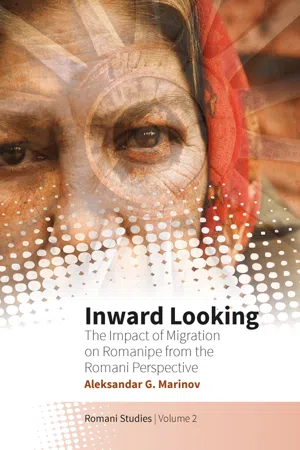
At present, Roma are an integral part of Europe, though they face structural and social inequalities and different forms of exclusion and discrimination. Inward Looking seeks to understand the relationship between Romani identity, performance and migration. Particularly, it studies the idea of 'Romanipe' through the prism of the personal accounts of Romani migrants. It also seeks to understand the relationships between the Romani groups in Europe, due to their increased travel and convergence, and predict the effects of migration on (new) Romani consciousness. The findings are based on qualitative data gathered from Romani migrants from three towns in Bulgaria.
eBook - ePub
Inward Looking
The Impact of Migration on Romanipe from the Romani Perspective
- 266 pages
- English
- ePUB (mobile friendly)
- Available on iOS & Android
eBook - ePub
About this book
Trusted by 375,005 students
Access to over 1.5 million titles for a fair monthly price.
Study more efficiently using our study tools.
Information
CHAPTER 1

PERCEPTIONS, INTERPRETATIONS AND IDENTITIES
Introduction
This work seeks to bring greater insight into the Romani mobilities in the European Union context. It is relevant for two main reasons. On the one hand, one of the general stereotypes of the Roma is that they are a peripatetic group, which makes them be generally perceived as a homogeneous group; but on the other hand, the lifting of travel restrictions within the EU has provided greater opportunities for many Roma to pursue better lives. Since this work seeks to better understand the impacts of recent Romani mobilities on their identities, perceptions, customs, behaviour and Romanipe, there are several key themes that emerge naturally in the context of this work that relate with the discussions about Roma identity, mobilities, migration, displacement and belonging. Our growingly globalised world is characterised by an increased use of internet, easier access to and spread of information, and new technologies, and these all contribute to the migratory experiences and to the displacement of both ‘migrants’ and ‘non-migrants’. Furthermore, whether multiculturalism is celebrated or nationalist sentiments are embraced in a contemporary European Union (EU) context can be an informative issue, as these can determine the behaviour, preferences and choices of identification of migrant and non-migrant Roma.
In late 2010, Germany’s head of state, Angela Merkel, had declared publicly that the country’s attempts to build a multicultural society have ‘utterly failed’ (BBC News 2010a). What exactly Merkel meant seems to be gravitating towards certain ideas of citizenship based on a good command of the German language and on immigrants’ wilful aspirations and actions towards their integration into the society. Whether multiculturalism, or the idea of people with various backgrounds, interests and orientations living happily together, is celebrated today in Germany, or in Europe as a whole, is a different story. Taking into consideration some of the primary visions of the EU, a union characterised by an open market, advocacy of human rights and greater freedom of movement for goods, capital, services and people, and comparing these with contemporary trends – such as the rise of nationalist sentiments across its member states, reinstating border controls (as recently observed in Germany and Hungary) and instances of human rights violations – it seems that the EU’s visions and rhetoric can be contradicted by current practices.
Even though a discussion on the EU as a political institution is not the primary focus of this work, it is pertinent to take this into consideration for two reasons: first, it is considered as ‘the most ambitious and most successful example of peaceful international cooperation in world history’ (Moravcsik 2001: 114); and second, it determines countless of aspects of the lives of those of us who are citizens of the European Union.
It is in this context of an ideally ‘united’ European Union and a greatly linked and interdependent world where people are enabled to perceive, learn, experience, ‘live’, develop and work towards their pursuit of happiness and well-being. In light of people’s constant search for happiness, well-being and development, we must recognise (despite its territory being just over 4 million km2 compared to the USA’s 9.8 million km2 or China’s 9.7 million km2) how diverse the EU is – it currently encompasses twenty-eight member states and has a population of about 508 million, which makes it the world’s third largest population after China and India.
Perhaps symptomatic of this diversity is the distribution and place of the Roma people of Europe. The case of the Roma seems to be a curious one. Even though recognised as currently belonging to the European space, the Roma were historically perceived as ‘other’ – they were seen as different owing to their essentially non-European origins and language, and their secluded communities, as well as their apparent physical and cultural differences and characteristics.
Migration within the boundaries of the European Union is very relevant as it seems to be the choice of Romanies, especially at times of uncertainty and crisis. In light of this discussion of the EU, the issues of identity formation, belonging and othering form the focus of this work; and Romani migration and displacement in a growingly globalised and interconnected world emerge as my key topics.
Identity
There has been a huge debate on the question of ‘who are the Roma people’? The way people choose to perceive and identify themselves might prove helpful in such a quest. One way to address this might be to understand that someone’s identity or ‘self’ is a combination of numerous possible options; they can emerge and gain relevance in different and various situations, and can also combine and culminate in defining a person’s identity. At the same time, it is hard to conceive it as being detached from a broader (group) identity. If this work seeks to contribute to the discussions of the Romani people and their identities, and to give them a greater voice, then we would have to consider the subjectivity of what they see or perceive as ‘Romanipe’ (i.e. their Romaness, or all that defines a person as Roma). The literature on identity indicates that it is difficult to speak of a person’s ‘essential’ identity, and this cannot be done in isolation from the political, power, social or geographical settings. Prior to a more in-depth discussion on the question of ‘who the Roma are’ it is necessary to address the question of how and why people (choose to) identify themselves in one way or another. The messages that individuals want to convey in a particular setting or situation can determine how they decide to identify themselves and, at the same time, their collective identities can be influenced by states’ projects and visions about the essential qualities of their citizens.
The concept of identity has its origins in areas of philosophy, psychology, sociology and cultural theory. They all have tended to see identity, even though in their different ways, as related to a ‘self’ that is an autonomous entity shaped by the context, structures, social class, and the surroundings (Marx 1967; Durkheim and Halls 1984; Freud and Strachey 1989; Descartes 1993). Foucault, one of the pioneers of the poststructuralist movement, in contrast, challenged these ideas and argued that discourse can determine the way individuals and groups define themselves. Thus, the self is seen as never fixed or certain (Foucault 1972).
Poststructuralist thinking has managed to gain relevance today when considering the concept of identity. The way people tend to identify themselves can be determined by the meanings and expressions they would wish to convey about themselves. This could be influenced by the existence and presence of other people, and by the surrounding environment and place. As a result, identities are not only chosen but are unstable, multiple, constantly challenged, and negotiated (Gonzalez and Habel-Pallan 1994: 82). Furthermore, they are ‘managed’, rediscovered and influenced by power and context (Valentine 1993a, 1993b; Panelli 2004).
Moreover, identities can help to improve our perceptions of meanings, other people, and other places (Panelli 2004). Thus, one of the results that could come out of the construction of identities is the creation and emergence of boundaries. Defining differences, sameness or boundaries plays a crucial role in grasping the world, and in our lives. Thus, while boundaries might be sought as ways to define ourselves, they create distances from others at the same time (ibid.). For Hetherington (2000), identity is how we associate and how we include or exclude others from membership of a particular identification.
Two of the ways identities could be created are (1) through discursive processes or narratives, and (2) the ways in which they are practised (Panelli 2004). Discursive processes, on the one hand, might include narratives of the society expressed though culture, institutions and master narratives through which history and society are communicated. On the other hand, identities could be performed through bodies, languages, dress style, actions and space (Panelli 2004). Derrida (1998) goes even further, and conveys that even language is not a sufficient element for the identification of groups. For him, when people are speaking in their own sole language, they try to use that language as a way to demonstrate certain ideas, to pay allegiance to certain places, or as a way to remind, or promise, something to themselves. Thus, when people refer to themselves as ‘I’, they attempt to return to their own ‘selves’ in imaginative ways (ibid.: 28).
Personal identities can have multiple layers and many sides which come to the fore at various instances and in various situations; however, it would be unwise to take the visions of the nation-states out of the whole picture. A state’s power and authority play a crucial role in the construction of national identity. States often endeavour to create their ‘ideal citizens’, which depend on the visions of their leaders and on the messages they want to convey. The imagination and perceptions of states’ leaders about who could be a ‘real citizen’ often result in the disciplining of these citizens (Radcliffe 2007: 224). Therefore, the construction of identity is an ongoing process that relies on power relations and on the disciplining of bodies occupying certain geographical locations and having specific meanings within a particular context. Thrift (2007: 301) saw space and time not as ‘neutral grids’ or ‘containers’ which are filled with meaning but as ‘what we labour to produce as we go along’. Disciplining of bodies was the aim of colonial administrators from early sixteenth century in South America through to the nineteenth-century environmental racialisms (Radcliffe 2007). Such projects have often been countered, however, by those subject to these projects by resisting, appropriating and reordering (ibid.). Thus, socially constructed identities could be appropriated and reoriented by those who are subject to racialisation. The Roma people could be found all across Europe and within specific national boundaries. Their inclusion or ‘integration’ depends on the projects envisioned by the respective nation-states. This could explain some of the observed differences between Roma throughout Europe such as the use of language, religion, language dialects, observations of customs, and so on.
However, there are observed differences between Roma found within the boundaries of a given nation-state which on its part gives grounds for them to be seen, by certain scholars, as a heterogeneous group. Even though space, or in this context a nation-state, is socially constructed and dependent on relations, it is not totally coherent. Societies and various social groups, as Massey (2007) puts it, each live and exist in their own specific and unique space which has its own environment. For Massey, space (1) is a process of interaction, a product of interrelations; (2) allows for multiplicity to exist – it is multiple, and more than one voice can exist at the same time, and (3) is the sphere that gives rise to disruption, it can be disruptive. Thus, in certain geographical locations/spaces/places, regardless of how coherent or homogeneous they might seem, it is possible for multiple visions, ideas and experiences to coexist, affecting and reinforcing each other even though they might come into conflict with each other (ibid.). This can explain the observed differences that exist between seemingly ‘similar’ groups and the differences in their identities. Therefore, to speak about ‘the characteristics’ of a people who occupy a certain geographical location, or a nation-state, in a way that would suggest they are ‘homogeneous’ or similar, would face a lot of challenges. There are differences that can be observed between the citizens of a nation-state, regardless of the fact that they are commonly united by their citizenship, language and other factors.
Perceiving the World around Us
The previous section showed that it is hard to get a good and representative idea about the world around us. Getting a good understanding of the surrounding world and, in this context, of the differences associated with identification, is not straightforward. According to Thrift’s Non-Representational Theory (2007: 297), it is impossible for us to get a clear and proper understanding of our surrounding world. It is so, because we as humans see ourselves situated in the middle of the world itself, ‘co-constructing it with numerous human and non-human others for numerous ends (or more accurately beginnings)’. In order for a better perception of the world to be achieved, Soja (2007: 262) proposed that the world be studied not only through its social and historical aspects but also its space, and this he called ‘trialectics of being’. Also known as ‘third space’ or ‘lived space’, it is vital and fundamental in order to understand our lives and times as the three aspects are interrelated and work together (Soja 2007: 262). Things should not be considered/perceived in a dualistic way – good or bad – as there must be other dimensions that are of equal importance. Getting a practical or more realistic knowledge of identities situated in certain places/spaces would require a continuous expansion of knowledge and open-mindedness which might enable us to see beyond what is presently known as ‘true’. Soja maintained that the full meanings of identity could be only understood when fully practised and lived, while links, or associations, have little meaning because of their unstable nature. ‘Lived space’ is the meeting ground of something new to emerge – a hybrid, a ‘mestiza’, as Anzaldúa (1987, cited in Soja 2007: 274) puts it – which cannot be defined through the boundaries of rigid differentiations. Equally, ‘third space’ is seen as a hybridity which enables other voices and positions to exist (Bhabha 1990). It establishes new structures of authority, new political initiatives, which are equally true even though inadequately understood.
The Creation of Boundaries, the ‘Other’ and Stereotypes
As seen above, the ways we identify ourselves cannot be taken in isolation from the broader context, the geographical location or the willingness of authorities and the messages they wish to convey. Also, from the sections above we could infer that it is hard to perceive the world in a dualistic or essentialised fashion of ‘either–or’, as this would leave out other qualities that are equally important and true. A person’s identifications depend also on the creation of boundaries and rely on the existence of ‘others’, which help them to better define their own. Thus, stereotypes are created to help us to perceive the surrounding world more easily.
The Roma of Europe find themselves physically, socially and politically marginalised. They have often been seen and portrayed as ‘other’ – or different from the norm, or the mainstream population. Othering, the creation of boundaries and relying on stereotypes play equally import roles for the identification and defining of the Roma people themselves.
Cavallaro (2001) conveys that the other is the factor that enables us to create a self-image, and we rely on it when perceiving knowledge. The world is thus inter-subjective, and each individual’s interpretations always interact with those of other people (ibid.). The concept of the other is necessary for the perception of the world around us and our self-realisation, but it needs to be discarded once this has been achieved. This is because relying on dichotomies and differences between the other and the self would impede better knowledge and greater realisation. Teresa de Lauretis (1987) argues that clear dichotomies between male and female, for instance, offer little, and are not intelligible as there are wider frames of cultural representations such as class, race and sexuality. Similarly, relying on dichotomies and borderlines would not be enough when considering hybrid groups or mixtures, ‘mestizas’ (Anzaldúa 1987, cited in Soja 2007: 274). These groups of people could be regarded as insiders and outsiders at the same time, and the boundaries of the nation-state are sufficient when defining such groups.
For Bhabha (1994) stereotypes are simplifications, and are a fixed form of representation that denies the play of difference. The ‘other’ – or anyone/anything who/which is seen as different in a fundamental way – plays a key role in defining not only the outside world but also the self (Said 1978). Sibley conveys that ‘others’ disturb the view of the observer, and stereotypes are created in order to remove these others from the scene. People and the world around us are thus divided into good and bad objects and those that are seen as ‘bad’ are projected onto bad stereotypes (Sibley 1995). In Gilman’s view, ‘for the non-pathological individual, the stereotype is a momentary coping mechanism, one that can be used and then discarded once anxiety is overcome’ (Gilman 1985: 18).
Similarly, wishful thinking and retaining the images, qualities and messages that groups wish to project could be linked to the Object Relations Theory (ORT). There is a link between ORT and images which play an important role in the construction of stereotypes. Objects are seen as playing a key role for the emotional life of people, and ORT could be regarded as a complex relationship between the self and the other. Dealing with the earliest experiences and defences, Object Relations Theory tries to distinguish between what is self and the other, inside and outside, as well as the good or bad parts of the self or the other. It also refers to the complexities of external relations with others, which can be seen as people’s fantasies, desires and fears linked with images of representations with other people (Flanagan 2011). Both the self and stereotypes are products of culture and society, and verbal and visual images are things to which people relate, because they are culturally rooted (Sibley 1995: 29). Viewing certain groups as being close to nature, such as native Australians, Gypsies or Africans, has influenced the way they have been perceived. They were thus seen as different from the ‘civilized’ societies, and this has legitimised their exploitation and exclusion. Mayall has noted that in racist discourses ‘the Gypsies’ are seen as closer to animals in comparison with any European race. The negative treatment of Roma in Europe is also evident in the harsh laws, transportation and executions in several European countries in the eighteenth and nineteenth centuries (Mayall 1988). Stereotypes could be eradicated or rejected by engaging with the other (Sibley 1995). This might result in diminishing uncertainties and perceived threats. However, there is a danger that comes with limited engagement or ‘superficial encounter’ which should be avoided, and it could be even more damaging than ignorance, especially if this knowledge were held by academia or state authorities (Sibley 1995: 29).
The existence of ‘others’ within the boundaries of a nation-state, as is the case with ethnic groups such as the Roma, can be seen as helping to maintain and sustain the existence of each group (Roma and non-Roma) – mutually helping each to define itself in relation to the ‘other’. In the context of the nation-state, it mig...
Table of contents
- Cover
- Title Page
- Copyright Page
- Contents
- Acknowledgements
- Introduction
- Chapter 1. Perceptions, Interpretations and Identities
- Chapter 2. Research Design and Methodology
- Chapter 3. Migration: The Types, Reasons and Effects
- Chapter 4. Belonging, Attachment and Space
- Chapter 5. Romani Identity as Part of Migration and ‘Romanipe’
- Chapter 6. Eye-Opening Processes: The Culture of Migration
- Conclusion
- Glossary
- References
- Index
Frequently asked questions
Yes, you can cancel anytime from the Subscription tab in your account settings on the Perlego website. Your subscription will stay active until the end of your current billing period. Learn how to cancel your subscription
No, books cannot be downloaded as external files, such as PDFs, for use outside of Perlego. However, you can download books within the Perlego app for offline reading on mobile or tablet. Learn how to download books offline
Perlego offers two plans: Essential and Complete
- Essential is ideal for learners and professionals who enjoy exploring a wide range of subjects. Access the Essential Library with 800,000+ trusted titles and best-sellers across business, personal growth, and the humanities. Includes unlimited reading time and Standard Read Aloud voice.
- Complete: Perfect for advanced learners and researchers needing full, unrestricted access. Unlock 1.5M+ books across hundreds of subjects, including academic and specialized titles. The Complete Plan also includes advanced features like Premium Read Aloud and Research Assistant.
We are an online textbook subscription service, where you can get access to an entire online library for less than the price of a single book per month. With over 1.5 million books across 990+ topics, we’ve got you covered! Learn about our mission
Look out for the read-aloud symbol on your next book to see if you can listen to it. The read-aloud tool reads text aloud for you, highlighting the text as it is being read. You can pause it, speed it up and slow it down. Learn more about Read Aloud
Yes! You can use the Perlego app on both iOS and Android devices to read anytime, anywhere — even offline. Perfect for commutes or when you’re on the go.
Please note we cannot support devices running on iOS 13 and Android 7 or earlier. Learn more about using the app
Please note we cannot support devices running on iOS 13 and Android 7 or earlier. Learn more about using the app
Yes, you can access Inward Looking by Aleksandar G. Marinov in PDF and/or ePUB format, as well as other popular books in Social Sciences & Cultural & Social Anthropology. We have over 1.5 million books available in our catalogue for you to explore.