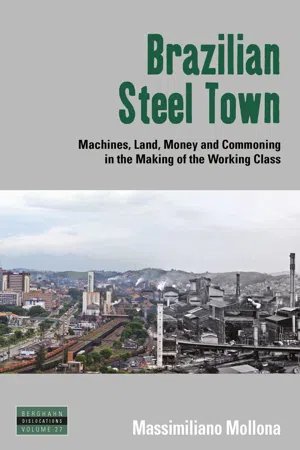
Volta Redonda is a Brazilian steel town founded in the 1940s by dictator Getúlio Vargas on an ex-coffee valley as a powerful symbol of Brazilian modernization. The city's economy, and consequently its citizen's lives, revolves around the Companha Siderurgica Nacional (CSN), the biggest industrial complex in Latin America. Although the glory days of the CSN have long passed, the company still controls life in Volta Redonda today, creating as much dispossession as wealth for the community. Brazilian Steel Town tells the story of the people tied to this ailing giant – of their fears, hopes, and everyday struggles.
eBook - ePub
Brazilian Steel Town
Machines, Land, Money and Commoning in the Making of the Working Class
- 334 pages
- English
- ePUB (mobile friendly)
- Available on iOS & Android
eBook - ePub
Brazilian Steel Town
Machines, Land, Money and Commoning in the Making of the Working Class
About this book
Trusted by 375,005 students
Access to over 1.5 million titles for a fair monthly price.
Study more efficiently using our study tools.
Information
– Chapter 1 –
CAPITAL ENCLOSURES, LABOUR ABSTRACTION AND THE STRUGGLE OVER VALUE FORMS

During my first days of fieldwork in Volta Redonda, I joined a guided tour of the Usina Presidente Vargas. While our group of visitors walked through the smelting shop, a smelter opened the furnace door. We all stopped and stared at the red magma boiling inside it – thick, formless, multicoloured and sinuously moving. ‘It’s magic, isn’t it?’ the tour leader said. Mesmerised, we all agreed in silence. That sight reminded me of how, for the philosopher Castoriadis, the magma is the metaphor for human collectives, which are interconnected and, at the same time, autonomously self-organised. Unlike the autonomy of non-human species, which is based on closed self-organisations, human autonomy involves an ontological opening and the potential for radical ruptures. In fact, in their quest for freedom and autonomy, humans ‘continuously question their own institutions and significations’ (Castoriadis 1994: 23) and can destroy anytime the principles governing their lives. Castoriadis argues: ‘Democracy is the only tragic political regime – it is the only regime that takes risks, that faces openly the possibility of self-destruction. But human autonomy has ‘always been occulted and covered by the representation, itself highly instituted, of an extra-social force (the gods, the ancestors, or “reason”, “Nature”)’ (27). These institutionalised ideologies lock humans in a state of permanent closure.
For Castoriadis, the metaphor of the magma prefigures revolutionary societies – based on forms that are also formless, closures that remain open, collectives sharing autonomy and a movement that never ceases or disperses. The magma is the threshold between movement and stasis – between the flow that erases differences and liberates people, and the institutions that protect and occupy their spaces and freeze their development. The philosopher George Simmel (1918) describes the human condition as a process of ‘life transcendence’ involving a similar magmatic process. Non-human mediums – written texts, images or money – allow us to step outside the physical and mental boundaries of our bodies, to see ourselves from the outside and hence to experience finitude. But with time, these non-human mediums become ossified substitutes for social relations, circulating independently from them and blocking the flow of life. Thus, for Simmel, the process of self-transcendence also implies the construction of new boundaries and the abstraction, objectification and externalisation of life into autonomous and rigid forms. From the human point of view, such a movement of abstraction is experienced as progressive dematerialisation, stasis and impotence.
Under normal circumstances, life breaks all human-made moulds and remerges as flow. But under capitalism, according to Simmel, the dematerialisation and ossification of life reaches its apex because of the social technology of money. Instead of being a simple mediator of value, capitalist money is valuable in itself and circulates independently from social relations taking up a life of its own. While money is subjectified and made alive, humans are in turn objectified, abstracted, frozen and turned into formal equivalences of wealth and hollow vessels of labour. Consequently, for Simmel, modern capitalist metropoles have an eerie quality, as they are inhabited by ghost people who, following the flow of money, circulate in the form of flat cinematic images, flickering surfaces and fragmented, isolated and competitive individuals. Thus, as I was staring at the furnace during the guided tour, I asked myself: ‘Is steelmaking so mesmeric because the animacy of steel and its internal tensions between flow and form prefigure, like Castoriadis’s magma, human autonomy and freedom? Is not the labour of the smelters so magical because of how it manipulates liquid and formless matter to produce the solid objects and infrastructures that make up our everyday environment?’ Indeed, the mesmeric, hypnotic, spirited and enchanting movements of steel in the furnace seemed to me to embody the movement of labour and prefigure its potential for emancipation.
In a polemical exchange with Toni Negri, the philosopher Giorgio Agamben (2005) argues that left-wing scholars’ (ab)use of the term ‘movement’ betrays their lack of trust in democratic institutions including the role of ‘the people’. Likewise, this book looks at the tensions and contradictions between capitalist institutions – including states, trade unions, factories, money and finance – and the movement of labour. On one hand, capital aims at freezing labour in the fetish forms of land, machines and money. Confronting it, labour resists reification, occupation and enclosures and strives to overflow them and reproduce life. I am interested in introducing the notion of movement into political economy. What can the animacy of steel tell us about work under capitalism and life beyond it? How can it describe the unevenness of labour (Kasmir and Gill 2016) and its motion – around, across and beyond the spatial, temporal and institutional fixes and enclosures of capital?
Capital as Enclosure
The edifice of capitalism rests on the institution of private property – a state-sanctioned enclosure of common goods (Polanyi [1944] 2001) that produces ‘scarcity’, and the market system of valorisation and distribution. For Rosa Luxemburg, capitalist enclosures are always associated with imperialist processes of dispossession and annihilation of ‘the other’. Capitalists tend to justify their appropriation of common goods and of labour through the ideologies of equality, self-interest, freedom and social progress. Yet, central to capitalism is the bourgeoisie’s sense of entitlement to lead a parasitical life at the expenses of the marginal classes. Indeed, for the American sociologist Immanuel Wallerstein (1983), the historical function of the bourgeoisie is not to increase profits but rather to live off rents and enclosures, like the aristocrats did before it. It is the process of working-class proletarianisation – achieved despite and not because of the bourgeoisie – that forced the parasitical classes to act like business people. Here, I will develop an anthropological framework for the study of contemporary capitalism intended as a form of enclosure – of land, knowledge and labour. I use the Marxian mode of production (MOP) framework adopted by the anthropologist William Roseberry to focus on capitalism’s historical and contemporary entanglement with non-capitalist social relations such as kinship, slavery and state despotism.
Modes of production have two components: factors of production (land, labour and tools) are the material support structure for humans’ actions, and relations of production are the specific social forms (slavery, serfdom, wagework) taken by these actions. MOPs are historically specific forms of labour organisation and corresponding forms of consciousness – they show the historical interplay between material existence (infrastructure) and forms of imagination (superstructure). Marx’s MOP framework has been criticised for being Eurocentric and dismissing the cultural specificity of subaltern struggles (Chakrabarty 2000; Chalcraft 2005: 15).1 At the other extreme, idealist anthropologists and anarchist scholars have used MOP analysis to describe the ‘original’ communism and affluence of indigenous and non-Western communities (Clastres 1974; Wengrow and Graeber 2015; Overing Kaplan 1975; Sahlins 1972). Unlike these scholars, I used, in line with the anthropological structural-Marxism of the 1970s, the MOP framework comparatively to look at the articulations between capitalism and non-capitalism. For instance, Emanuel Terray (1972: 22) shows that kinship societies are stratified along lines of class, as elder kinsmen control the reproductive labour of women, and junior kinsmen through various kinship obligations (virilocal residence, patrilineality, exogamy) rather than in monetary terms.2
Claude Meillassoux goes even further by arguing that capitalist and domestic MOPs – productive and reproductive labour – are structurally entangled both among traditional pastoral communities and in contemporary Western societies. In both contexts, wage contracts deprive workers of their means of subsistence and make them dependent both on domestic labour and on commodity markets. After the French colonisation of Guroland (Ivory Coast), foreign food and agricultural companies broke the local self-subsistence agriculture, employing local peasants as wageworkers and underpaying them, thus forcing them to rely on the domestic labour of their kin for survival. As well as incorporating the family system into the capitalist system, colonial industrialisation created masses of dispossessed peasant proletarians who migrated circularly between factories and villages to survive. For Meillassoux (1964: 58) the forced circular migration of the Guro people is akin to that of the impoverished rural workers in early capitalist Europe. For the French anthropologist, labour mobility is a central prerequisite for capitalist accumulation in the centre, too. For instance, he presents ethnographic evidence of how a big share of the workforce of a French multinational corporation consisted of underpaid African workers on short-term and precarious contracts and surviving on domestic and informal labour.
Moreover, anticipating the reality of contemporary flexible capitalism, Meillassoux (1981: 92) highlights how South-to-North circular migration of wageworkers is central to the functioning of capitalism. North African migrant workers employed in the French company were paid three times less in indirect wages than French workers, and this wage differential was justified through racialised categories of skill and seniority. Because of their marginal position in the labour market, impoverished ethnic workers returned to their villages periodically for survival. Indeed, the management of transnational circular migration, through regularised temporary programmes that feed the demand for flexible labour in developed countries, is a central mechanism of accumulation in late capitalism (Kalm 2010: 37). In other words, Meillassoux reframes Marx’s argument of the fragmentation between wageworkers and lumpen, as a tension between productive and reproductive labour within the broader context of dependent development. Combining anthropology and political economy, Meillassoux shows capitalism cannot be separated form imperialism, intended as brutal movement of colonisation and occupation of the sphere of reproduction, and in fact is structurally but unevenly related to underdevelopment in those parts of the world where extraction of reproductive labour is possible.
Thus, Meillassoux reworks anthropologically Trotsky’s notion of ‘combined and uneven development’, unveiling ethnographically the historical, spatial and ideological oscillatory entanglements between production and reproduction. Moreover, in his book on African slavery, Meillassoux (1986) shows how slavery, capitalism and war form a unique and interconnected economic system. Thus, the French articulationist school shows that, in addition to class relations being reproduced in non-capitalist societies, capitalism is internally constructed through the non-capitalist relations of kinship, war and slavery. Adopting the structuralist perspective of Claude Lévi Strauss, this Marxist anthropological school considers the tension between infrastructure and superstructure – production and social reproduction – both historically and diachronically, that is, through cosmologies, myths and ideologies associated with specific forms of livelihood and recurring across cultures (see Lévi-Strauss et al. 1976). Indeed, I will argue the fetish forms of machines, land and money cut across different geographical and historical contexts.
Lastly, French structural Marxism put an end to the long dispute between formalist and substantivist anthropology around the issue of ‘economic rationality’ – the former arguing that rationality and self-interest are universal human features, and the latter that non-capitalist economies are socially embedded and geared towards the basic reproduction of life rather than towards growth and profit. Reworking the notion of ‘bounded rationality’ formulated by the Nobel Prize–winning economist Herbert Simon, the anthropologist Maurice Godelier (1966) argues all societies – whether ruled by kinship, state violence or economics – mix conscious and unconscious, selfish and social, and rational and irrational drives, evaluations and motivations. Such a focus on the entanglement between social reproduction and capitalism is central to feminist theories of labour value, too. Silvia Federici (2012) in particular argues the reproductive and affective labour – vastly performed by women – is systematically devalued and exploited under capitalism and that the sphere of social reproduction is one of the many human commons that is constantly under threat of occupation by capital (De Angelis 2018).
The economic historian Thorstein Veblen shows that industrial capitalism marked a shift in the form of capital’s enclosures – from land to labour. Veblen ([1904] 2005: 56) describes modern business enterprises as legalised forms of predation, theft, sabotage and waste that combine the speculative logic of capitalism and the predatory logic of feudalism. In economic terms, business enterprises do not produce wealth by maximising outputs, as per traditional economic theory. Instead, they are moneymaking endeavours that profit from the enclosure and waste of human labour. In this light, the wage contract is a form of rent extraction achieved by enclosing and commodifying labour. In particular, modern factories (1) deskill workers and externalise their knowledge into machines, thus making them dependent on the market for their reproduction, and (2) embed the logic of speculation and finance within the production system. In other words, the abstraction of labour under capitalism happens first by externalising human knowledge and skills into the technological apparatus of the factory and then by creating a market for it, independent from human value. In experiential terms, business capitalism is predatory because it dispossesses humans of their ‘instincts of workmanship’ (‘to turn things into human use’) and ‘care for the other’, and forces them into permanent competition and emulation of the wealthy ‘leisure classes’ (Veblen [1914] 2006a: 23).
Moreover, Veblen anticipates current debates on how finance is parasitical on industry (Marazzi 2009; Vercellone 2013). The bigger and more complex industrial production, the more human knowledge is externalised into the firms’ technological system controlled by a new class of ‘technical experts’. As technical systems become more complex and valuable, technicians morph into ‘consulting engineers’ who audit the value of machines and advise the bankers involved in the underwriting of the company (Veblen [1904] 2005: 68). The main objective of the new financial class – consulting engineers, business managers and corporate bankers – is to inflate the monetary value of firms rather than make them productive. Under such a regime, corporate profits come not from production but from financial speculation and leverage on the assets of firms mainly machines. In fact, the financial classes increase their profits by systematically obstructing production and deskilling workers (Veblen [1899] 1994: 10). But with the deskilling of workers, the knowledge of how to run the machines is lost, so business capitalists are ‘out of touch’, ‘incompetent’ and ‘absentees’ (15). As the money value of the firm is invested in the financial market and returns on investments overshadow industrial profits, the capitalisation of the firm becomes independent from the productive cycle ([1904] 2005: 27). The more the industrial system expands, the more financial capital spreads and multiply itself, in the form of loans, securities and collateral debts, capturing the main state infrastructures – railways, iron mills and main roads (10).
As a result, the financial class controls industrial monopolies and state infrastructures.
In other words, finance accelerates the repression, occupation and waste associated with capitalist markets3 and entangles it within the state – making it work on a logistical and infrastructural level. Besides, the economy of war of modern nation-states creates new forms of finance and speculative bubbles that redistribute wealth from the industrial to the financial class accentuating existing inequalities. Exponents of new Marxian labour theory argue abstract labour is a transmutation of the money form, which hence both predates and follows production (Bellofiore 2009; Pitts 2018). With Veblen, we can appreciate how such a transmutation of labour into the money form takes place through the technological apparatus of production. Lenin ([1910] 2010) and Hobson ([1904] 2011) – contemporaries of Veblen – also famously discussed the relationship between finance, industry and imperialism. But unlike them, Veblen emphasises the internal and national dimension of imperialism. For instance, the early German state systematically opposed the emergence of capitalist markets and private property, as these undermined its monopoly over the economy. Following the ‘warlike logic’ of the Prussian empire, the German state systematically sabotaged and inhibited national economic development to make citizens dependent on it (Veblen [1915] 2006b: 262). The German nation-state controlled its ‘community’ not only through corporate plunder but also through forms of taxation and redistribution that required heavy and efficient bureaucracies. This predatory form of state imperialism is central to my analysis of the Brazilian state.
Veblen’s argument that states and firms are part of the same infrastructure of capitalism runs counter to the bourgeois ideology that the economy – both as field of knowledge and as form of human behaviour – exists independently from social relations. In fact, the fictitious separation between the economical and the political functions of the state started with the legal invention of the ‘corporate person’ in Europe in the twelfth and thirteenth centuries. Corporate persons were organisations such as charities, religious communities and universities, to which the Crown granted by royal charter semi-independent status, privileges and immunities (Hodgson 2015: 225). Initially used by the Crown to raise revenues by selling privileges to specific groups, the chartered form eventually became a way to regulate the economic behaviour of state subjects through highly moralised and codified agreements. In the sixteenth and seventeenth centuries, European monarchs used chartered companies such as the East India Company (1600), the Royal African Company (1660) and the Hudson’s Bay Company (1670) to plunder and police the territories of the colonies and freely operate in the Atlantic slave trade. In these territories, corporations acquired extra-legal status being legally allowed to use force to maintain economic supremacy.
As the exploitation of the colonies intensified, the need for further capital concentration and separation between economies and states was achieved with the new legal form of the joint-stock company. The Limited Liability Act of 1855 granted full juridical personality to corporations, de facto granting them political immunity. Thus, the modern corporation emerged as extra-legal extension of state power, which allowed modern sovereigns to discipline their economic subjects through a mixture of violence, loyalty and the impersonal law of the market. For the legal historian Joshua Barkan (2013), this progressive personification of the corporation runs in parallel with the depersonalisation of the Crown and the birth of the Hobbesian state as ‘social contract’. Thus, modern corporations emerged from the historical transformation of colonial mercantilism into industrial capitalism fuelled by the imperialist m...
Table of contents
- Cover
- Title Page
- Copyright Page
- Dedication
- Contents
- List of Figures
- Acknowledgements
- List of Abbreviations
- Introduction. Brazilian Steel Town and Companhia Siderúrgica Nacional
- Chapter 1. Capital Enclosures, Labour Abstraction and the Struggle over Value Forms
- Chapter 2. Cyclopes at Work: Capital as Technology
- Chapter 3. Old and New Land Questions: Capital as Land
- Chapter 4. Of Ants and Steelworkers: Capital as Labour
- Chapter 5. Capital as Money and the Invention of People’s Capitalism
- Chapter 6. Labour as Commons
- Conclusion. Towards an Anthropology of Uneven and Combined Development
- References
- Index
Frequently asked questions
Yes, you can cancel anytime from the Subscription tab in your account settings on the Perlego website. Your subscription will stay active until the end of your current billing period. Learn how to cancel your subscription
No, books cannot be downloaded as external files, such as PDFs, for use outside of Perlego. However, you can download books within the Perlego app for offline reading on mobile or tablet. Learn how to download books offline
Perlego offers two plans: Essential and Complete
- Essential is ideal for learners and professionals who enjoy exploring a wide range of subjects. Access the Essential Library with 800,000+ trusted titles and best-sellers across business, personal growth, and the humanities. Includes unlimited reading time and Standard Read Aloud voice.
- Complete: Perfect for advanced learners and researchers needing full, unrestricted access. Unlock 1.5M+ books across hundreds of subjects, including academic and specialized titles. The Complete Plan also includes advanced features like Premium Read Aloud and Research Assistant.
We are an online textbook subscription service, where you can get access to an entire online library for less than the price of a single book per month. With over 1.5 million books across 990+ topics, we’ve got you covered! Learn about our mission
Look out for the read-aloud symbol on your next book to see if you can listen to it. The read-aloud tool reads text aloud for you, highlighting the text as it is being read. You can pause it, speed it up and slow it down. Learn more about Read Aloud
Yes! You can use the Perlego app on both iOS and Android devices to read anytime, anywhere — even offline. Perfect for commutes or when you’re on the go.
Please note we cannot support devices running on iOS 13 and Android 7 or earlier. Learn more about using the app
Please note we cannot support devices running on iOS 13 and Android 7 or earlier. Learn more about using the app
Yes, you can access Brazilian Steel Town by Massimiliano Mollona in PDF and/or ePUB format, as well as other popular books in Sciences sociales & Anthropologie culturelle et sociale. We have over 1.5 million books available in our catalogue for you to explore.