In historical writing on World War I, Czech-speaking soldiers serving in the Austro-Hungarian military are typically studied as Czechs, rarely as soldiers, and never as men. As a result, the question of these soldiers' imperial loyalties has dominated the historical literature to the exclusion of any debate on their identities and experiences. Men under Fire provides a groundbreaking analysis of this oft-overlooked cohort, drawing on a wealth of soldiers' private writings to explore experiences of exhaustion, sex, loyalty, authority, and combat itself. It combines methods from history, gender studies, and military science to reveal the extent to which the Great War challenged these men's senses of masculinity, and to which the resulting dynamics influenced their attitudes and loyalties.
eBook - ePub
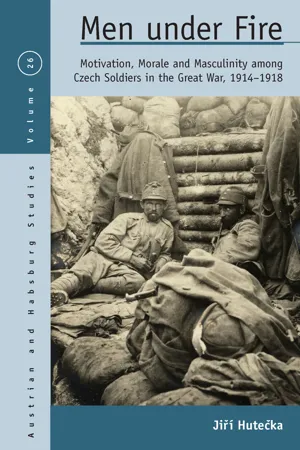
Men Under Fire
Motivation, Morale, and Masculinity among Czech Soldiers in the Great War, 1914–1918
- 300 pages
- English
- ePUB (mobile friendly)
- Available on iOS & Android
eBook - ePub
Men Under Fire
Motivation, Morale, and Masculinity among Czech Soldiers in the Great War, 1914–1918
About this book
Trusted by 375,005 students
Access to over 1.5 million titles for a fair monthly price.
Study more efficiently using our study tools.
Information
Chapter 1
TOURNAMENT OF MANLINESS
Mobilization
All the young people down the ages
They gladly marched off to die.
They gladly marched off to die.
—The Clash, ‘The Call Up’1
By the end of June 1914, the generally sleepy summer streets of the city of Brno (or Brünn, as it was known to its mostly German-speaking inhabitants) were uncharacteristically lively. Tens of thousands of Czechs not only from the Habsburg monarchy, but from all over the world, arrived to watch the massive celebration of Czech nationalism in the form of the Sokol gathering (‘slet’, meaning literally a flocking of birds, namely ‘sokols’, or falcons). That year, for the first time, the Czech gymnastic and sports movement bearing that name organized its mass meeting outside of Prague. The whole event was considered a high security risk by the Cisleithaenian authorities, who quite reasonably expected a conflict between the Sokols and the local German population. The Germans considered the entire gathering to represent a provocation against the very nature of ‘their’ ‘German town’. Violent clashes, so common in the nationally divisive atmosphere of many regions of the monarchy at the beginning of the twentieth century, resulted in several dozen arrests on both sides, but could not disrupt the proceedings on the old military training ground of Královo Pole. The slet was primarily a celebration of unity between the aestheticized individual human body and the collective national body, which drove its point home through the absolute subordination of the individual to the national mass, and it proceeded well and according to plan following its opening on 27 June.2 The thousands of spectators were more than satisfied: ‘We all but forgot the close proximity of German hatred. The final march [during the male gymnastics finale] sounded like a war fanfare to us’. However, the militaristic idyll did not last long because bad news was arriving from the southern provinces of the old monarchy:
Suddenly, there was an inexplicable commotion and bustle in the crowd. We asked everyone around what had happened, but nobody knew a thing. Then, one brother climbed on the instructor’s stage and announced that the heir to the throne, Archduke Francis Ferdinand, had been murdered in Sarajevo and that the slet was to be suspended … The slet was forgotten. There was only one thought in everyone’s mind – there would be a war!3
Although this particular Moravian Sokol and his fellow travellers on the train home from Brno were quite certain of it, in the afternoon of 28 June 1914, it was actually not at all clear that there would be a war, not to mention its possible scale. Even the Austro-Hungarian government took three weeks to finally act upon its fateful decision that would lead to one. Meanwhile, the public had forgotten Sarajevo as quickly as it was reminded of its existence by the fateful shootings. As Max Brod, a close friend of Franz Kafka, remembered, ‘the tragedy … was the topic of all talks for a few days and then everybody forgot about it’. In his opinion, most people in Bohemia and Moravia condemned ‘the Sarajevo murder’ as ‘a brutal crime’, but in general paid little attention to it.4 ‘Therefore, the Czechs were extremely surprised when that death re-emerged on that beautiful July Friday and took on the form of an ultimatum, a word almost nobody knew before that day’.5 Two days later, on Sunday, 26 July 1914, Brod and his wife were returning back from a field trip and a social visit to their friends’ house:
When we entered the city, the walls of Prague welcomed us with their lights, giving us strange and hostile looks. The outskirts of the Dejvice suburb. It was already dark. People were standing in front of the doors of their houses, whispering. Fear, fear! Unwittingly, we quickened our pace. What had happened? No, it’s not possible. No, it’s not possible. I approached a man: grudgingly, with a listless look, he passed a special edition of a Czech newspaper and said: ‘War is coming’.6
A day before, on Saturday, 25 July, upon receiving word that the Serbs had refused to accept one of the many points of his ultimatum, Emperor Franz Joseph I ordered a partial mobilization of eight army corps, including the VIII Corps stationed in Prague and the IX Corps based in the north Bohemian town of Litoměřice. Mobilization was to start on Tuesday, 28 July. On that day, Austria-Hungary declared war on Serbia. A short time after midnight, the roar of gunfire resounded on the River Danube beneath Belgrade. The Moravian Sokol had been right after all.7
The war that started at the end of July 1914 and escalated into a global conflict within the following week was destined to change the lives of millions in the Bohemian Crown Lands. Few of them could imagine that it was actually going to happen and even fewer people had any idea whatsoever of what was coming next: ‘For forty-five years … there has been no war in the heart of the world’, Max Brod mused about the recent events:
War was a word that sounded almost medieval to us, echoing the ridiculousness of a knightly rattling of arms. For the present, it floated in the air like some unbelievable shiny ball or a soap bubble. War was thought to be something historically discredited, gone forever, a thing of fantasies, a thing past human generations believed in (those poor devils!) – but not us, realists armed with reason.8
However, one of the few conceptual notions regarding war that was common to everyone was the general understanding of its highly gendered nature. War, most of the population felt, was redrawing the social order almost overnight, and its very existence as an event suddenly made the gender order more visible than ever before.
In almost every memory and recollection of images seen around the country, picturing the crowds reading the Emperor’s declaration To My Peoples (An Meine Völker) that announced mobilization, those present are clearly divided in their behaviour. Men read silently or grumble in a low voice. Women, on the other hand, are louder, more emotional and often openly critical of the situation, with tears of sadness and protest appearing now and then. František Chmela, a gunner in the k.u.k. Field Artillery Regiment 24, remembered: ‘People were walking around the town, women and children crying, because they had to say goodbye to their father … husband … son … in a few hours’.9 In a similar way, Václav Poláček added a laconic note in his diary on 26 July 1914: ‘All the womenfolk crying a lot’.10 The beginning of the war seems to divide the seemingly unified peacetime world into two visibly separate spaces – that of men, soon to be associated with military uniform and frontline service, and of women, associated with ‘keeping the fires burning’ back home. Both of these notions were, of course, grossly inaccurate both in terms of statistics and general experience.
It was Maureen Healy who rightly claimed that the traditional image of the ‘feminized home front’ and ‘masculinized frontline’ was more than anything else a product of government propaganda and consequent contemporary discourse that made it into modern historiography. In reality, about 70% of men of military age (18–52 late in the war) were conscripted into the army between 1914 and 1918, amounting to 8,420,000 by 1917.11 Out of this number, hundreds of thousands of men serving in the army staff and logistical services never came close to the frontlines or combat. There were hundreds of thousands of men in Bohemia and Moravia who stayed at home because of their occupation, health or age, as well as many others who were soldiers only by being designated so by their uniform. As a result, at best, only about one-third of the male population of the Crown Lands left for ‘the front’ during the war.12 In the same way, there were always a substantial number of women present at or close to combat areas, whether voluntarily or otherwise. However, it seems that most of the participants in the events of 1914 were structuring their experience along the lines of a clearly gendered social space: ‘Son, brother, even father had to go’, one of them concludes his description of the events, referring to the most basic categories of masculine existence, ‘leaving their loved ones behind, they hurried to join their regiment’.13 Here, everyone who was ‘a son, brother or a father’ was leaving for the front and those who stayed at home were defined through not being sons, brothers or fathers, i.e. by being women. The same simplified picture of spatial gender hierarchy remained in people’s minds during the war years, the reality around them notwithstanding: ‘Thank you for the photograph’, wrote a girl to Fähnrich Janošík, serving on the Eastern Front in June 1916. ‘Really pretty company you have there, it is such an injustice! The gentlemen are alone, the ladies are alone’.14 This geography of war, composed of ‘gentlemen’ in the army and ‘ladies’ at home, appeared to be an insurmountable framework that easily stood for the wartime reality, as in the minds of the people, statistics did not matter.
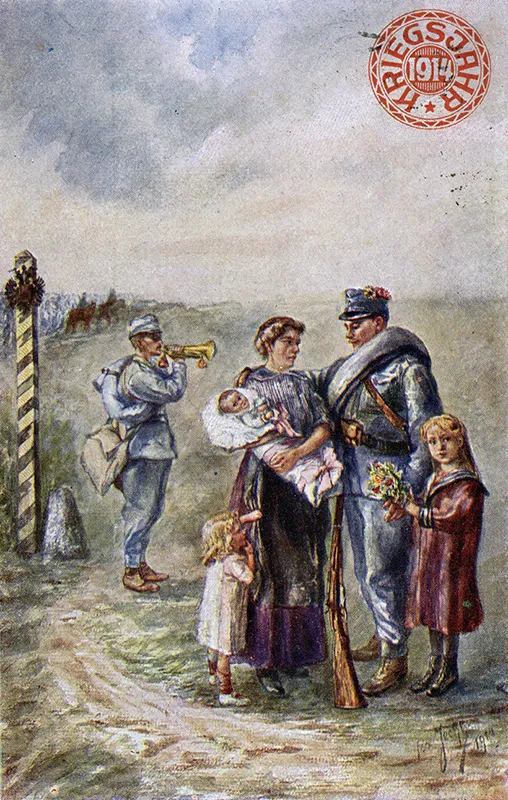
Figure 1.1 Heeding the call. An example of the propaganda that divided the wartime social space into the masculine frontline and the feminine home front (wartime postcard, Regional Museum in Olomouc).
The famous Bohemian-Jewish journalist Egon Erwin Kisch, whose close and poignant observations of his Czech comrades (he was serving with the k.u.k. Infantry Regiment 11, composed of 45% Czech-speaking soldiers) make him a source that cannot be neglected in any analysis, saw the situation in the same vein. As he noted in his diary after he and his comrades had rummaged through the mail of the fallen after the first battle: ‘Letters, in which a mother, mistress, or wife is writing how lonely she is and how she yearns for the moment of reunion’.15 In his world and that of his comrades, it did not appear that there could be anyone else writing a letter from home other than a person belonging to those categories. It seemed to him that there were no ‘men’ back home. It is clear that the wartime construction of hegemonic masculinity was militarized not only in the public space, as Rudolf Kučera claims in his study of the Czech working class during the war, but in the personal views of the actors as well. Of course, it is beyond doubt that the Austro-Hungarian authorities spent much effort and resources in promoting ‘the ideal male recruited soldier, who quickly acquired the position of hegemonic masculinity’ throughout the Empire’s population.16 However, this norm was actually already present in the minds of the population, and people went on to define war in gendered categories almost by default from the beginning until the very end. Whatever their attitude towards war, most contemporaries agreed that it was a business of men.17 For example, Jan Šlesingr, a Czechoslovak legionnaire on his way through Siberia, met ‘a young Russian soldier, tastefully attired … I look at him closely and to my surprise I see that, it is not a soldier, it is a girl, a volunteer in a women’s military unit’. To Šlesingr, the categories of ‘girl’ and ‘soldier’ evidently do not mix and if there is some overlap between them, the result is necessarily a negative deformation of one of the forms: ‘Although the girl was altogether pretty and all, she repelled me because of her coarse voice. The war did not do well in raising her to girlish bashfulness’.18 The disruption of gender geography was bound to leave its mark on the ‘natural’ femininity of a woman who reached its limits.
As mentioned above, this way of thinking ran parallel to the official discourse of war as presented by the Austro-Hungarian state, which went to great lengths to ensure that whatever the population thought, enthusiasm was the only emotion that made it to the public space in 1914, carrying gendered discourse of wartime social space with it. However, this discourse was nothing new; it merely became momentarily widespread with the declaration of war.19 Military service had been presented as a sort of rite of passage ever since the introduction of general conscription in Austria-Hungary in 1868.20 As Laurence Cole has demonstrated, a process of ‘societal militarization took place in later imperial Austria during the second half of the nineteenth century, much as it occurred in other European countries’. Through veterans’ associations, public rituals and dynastic self-presentation, or officially embraced cults of military heroes, war had become a constant presence in the subconscious background of the population’s peacetime existence.21 And, of course, all these venues of societal militarization designated warfare as a purely masculine enterprise, further entrenching its highly gendered nature. Also, as mentioned by Christa Hämmerle, the Habsburg ‘common army’ was never enthusiastic about the whole idea of building an army out of conscripts and was particularly hostile to the philosophy of ‘citizens at arms’. After it had been more or less forced to adopt the principle of universal conscription following the defeat of 1866, it held tight to its notion of soldiers as obedient tools unquestionably loyal to dynastic policies and kept the citizen-soldier ideal firmly in the background. However, by the turn of the ...
Table of contents
- Cover
- Title Page
- Copyright Page
- Dedication
- Contents
- List of Illustrations
- Preface to the English Edition
- Introduction
- 1. Tournament of Manliness: Mobilization
- 2. Compromises of Manliness: Everyday Experience
- 3. Transformation of Manliness: Comradeship
- 4. Degradation of Manliness: The Military Authorities
- 5. Venues of Manliness: Home
- 6. Manliness under Fire: Combat and the Body
- Conclusion
- Bibliography
- Index
Frequently asked questions
Yes, you can cancel anytime from the Subscription tab in your account settings on the Perlego website. Your subscription will stay active until the end of your current billing period. Learn how to cancel your subscription
No, books cannot be downloaded as external files, such as PDFs, for use outside of Perlego. However, you can download books within the Perlego app for offline reading on mobile or tablet. Learn how to download books offline
Perlego offers two plans: Essential and Complete
- Essential is ideal for learners and professionals who enjoy exploring a wide range of subjects. Access the Essential Library with 800,000+ trusted titles and best-sellers across business, personal growth, and the humanities. Includes unlimited reading time and Standard Read Aloud voice.
- Complete: Perfect for advanced learners and researchers needing full, unrestricted access. Unlock 1.5M+ books across hundreds of subjects, including academic and specialized titles. The Complete Plan also includes advanced features like Premium Read Aloud and Research Assistant.
We are an online textbook subscription service, where you can get access to an entire online library for less than the price of a single book per month. With over 1.5 million books across 990+ topics, we’ve got you covered! Learn about our mission
Look out for the read-aloud symbol on your next book to see if you can listen to it. The read-aloud tool reads text aloud for you, highlighting the text as it is being read. You can pause it, speed it up and slow it down. Learn more about Read Aloud
Yes! You can use the Perlego app on both iOS and Android devices to read anytime, anywhere — even offline. Perfect for commutes or when you’re on the go.
Please note we cannot support devices running on iOS 13 and Android 7 or earlier. Learn more about using the app
Please note we cannot support devices running on iOS 13 and Android 7 or earlier. Learn more about using the app
Yes, you can access Men Under Fire by Jiří Hutečka in PDF and/or ePUB format, as well as other popular books in History & Eastern European History. We have over 1.5 million books available in our catalogue for you to explore.