Focused on the German-speaking parts of the former Habsburg Empire, and on present-day Austria in particular, this book offers a series of highly innovative analyses of the interplay of nationalism's discursive and institutional facets. Here, Christian Karner develops a distinctive perspective on Austrian nationalism over the longue durée, tracing nationalistic ways of thinking and mobilizing from the late eighteenth century to the present. Through close analyses of key texts representing diverse settings and historical episodes, this book traces the connections, continuities and ruptures that have characterized the varieties of Austrian nationalism.
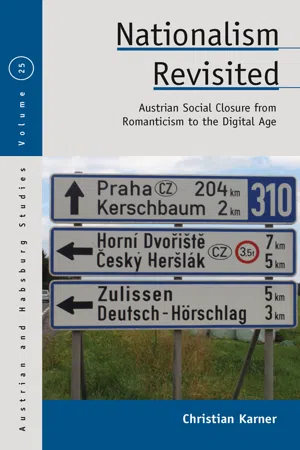
eBook - ePub
Nationalism Revisited
Austrian Social Closure from Romanticism to the Digital Age
- 308 pages
- English
- ePUB (mobile friendly)
- Available on iOS & Android
eBook - ePub
About this book
Trusted by 375,005 students
Access to over 1.5 million titles for a fair monthly price.
Study more efficiently using our study tools.
Information
Chapter 1
The Crystallization of Discursive Structures

At the dawn of the post–Cold War period, Arjun Appadurai (1990: 308, 295–296) observed in the then “new global cultural economy” a “contest” between “sameness and difference.” Contrary to the fear that modernization involves inevitable standardization, Appadurai located a “tension between cultural homogenization and . . . heterogenization” at the heart of the late twentieth century. Appadurai argued further that “five cultural flows” underpinned these struggles between universalism and particularism. He termed these flows “ethnoscapes” (i.e., the movement of people), “finanscapes” (i.e., the cross-border flow of capital), “technoscapes” (i.e., the transnational diffusion of technology), “mediascapes,” and “ideoscapes.” The latter two “cultural flows,” in particular, warrant closer examination here. Mediascapes, according to Appadurai (1990: 299), include “the capabilities to produce and disseminate information ([e.g., through] newspapers, magazines, television stations, film production studios etc.) . . . and the images of the world created by those media.” Ideoscapes interface with the latter dimension, for they include these and other “images of the world” that are “often directly political, [articulating] ideologies of states [or] the counter-ideologies of movements explicitly oriented to capturing state power or a piece of it.”
Later chapters of this book will corroborate the continuing relevance of Appadurai’s argument—particularly of his awareness of the often hostile confrontations between centripetal and centrifugal political forces—to contemporary globalization and (neo-)nationalism. Yet, nearly thirty years on, Appadurai’s framework needs to be extended: each of the “cultural flows” he identified in 1990 have since acquired novel dimensions, contexts, and characteristics (e.g., digital social media and their more recent impact on each of the five “scapes”). In the present chapter, however, my intention is different. I here propose to project Appadurai’s ideas backwards and to show that at least some of the above-mentioned flows have a considerably longer history. In fact, some flow of the media of exchange, of technology, people, images, and ideas across social and geographical boundaries is a hallmark of all human civilization. The key question is therefore not whether such cultural flows occur in a given historical setting but what form they take and what consequences they have.
Premised on a historical broadening of Appadurai’s framework, I argue here that two of its core insights can be extended to illuminate the early stages in the history of nationalism in former Habsburg Central Europe. The two core insights concern, first, the closely interrelated phenomena of mediascapes and ideoscapes as defined above, and, second, the observation that, rather than enabling homogenization, cultural flows can trigger political opposition, counterreactions, and tensions. My historical focus in this chapter is the period from the 1780s until the period prior to the revolutions of 1848/49. More specifically, I focus on thinkers and writers commonly associated with the romantic movement and their impact—often across geographical and cultural distance—on the predominantly German-speaking parts of the Habsburg Empire. It is not my aim to develop a philosophical or literary analysis of particular texts. Instead, this discussion is geared toward contextualizing a number of lasting contributions to scholarly, cultural, and political life made in the period in question, and, most importantly, toward revealing their discursive patterns and argumentative structures that, as we shall discover, were to subsequently shape nationalisms across (former) Habsburg Central Europe. Put simply, this chapter reveals discursive structures in the writings of some key figures of (German) romanticism. It then discusses moments, places and cultural sites of crystallization, when romantic (national) discourses manifested in the historical and geographical context in question.
Locating, Tracing, and Analyzing Romantic Discourse
Before providing conceptual and methodological groundwork for this chapter, it seems prudent to offer more preemptive disclaimers. While it is a purpose of this chapter to trace the structures and circulation of romantic ideas across considerable distances in the late eighteenth and early nineteenth centuries, it is crucial not to postulate uniformity among the discourses in question. Romantic ideas, throughout the period in focus here, showed considerable internal diversity and underwent shifts in the positions being adopted. It will turn out that the thinkers and texts to be examined display important family characteristics typical of romanticism (e.g., Safranski 2013), while also furnishing different, not always easily coexisting, “grammars of identity” (Baumann and Gingrich 2004) and argumentative topoi. Therein lies a main challenge: to extrapolate the discursive patterns, argumentative strands, and structures of interpretation that defined romanticism, in its internal diversities, and that—as we discover in later chapters—were subsequently, and repeatedly, reappropriated and rewritten by later generations of nationalists (see Karner and Kazmierczak 2017).
This raises questions of broader disciplinary relevance. This book involves a sociologist treading on intellectual terrain already exceptionally well covered by historians and philosophers. What, then, will this sociologist offer that promises to be novel and relevant across disciplinary boundaries? The answer to this important question lies in the particular analytical apparatus sketched in the introduction: that is, the application of critical discourse analytical tools, complemented by Baumann and Gingrich’s notion of “grammars of identity,” to texts that are here understood as social practices to be analyzed both in their generative contexts and in relation to their political intentions and (later) impact. Crucially, the discursive structures and their early crystallizations discussed in this chapter pave the way to the second step to be taken in later chapters: in this second step it will be shown how particular ideas, interpretations, and claims came to enable social closure over the longue durée.
Further, it is important to briefly sketch how this fits into nationalism studies at large. As will become clear, this discussion does not set itself the task of addressing, let alone resolving, the long-standing, paradigmatic clash between modernist (e.g., Anderson 1983; Gellner 1983) and ethnosymbolist (e.g., Smith 1986; Özkirimli 2000) positions on the historical origins of nationalism and its sociological conditions of possibility. Instead, to repeat, I here examine discursive characteristics of romantic, (proto-)nationalist discourses and their textual and cultural crystallizations in predominantly German-speaking parts of the Habsburg Empire between the end of the eighteenth century and the momentous events of 1848/49 that are often referred to as “the romantic revolution” and the “springtime of the peoples” (e.g., Sperber 2005: 1). An examination of how such an analysis may reinflect the modernist-ethnosymbolist debate will not be offered here. That said, such a wider discussion is certainly desirable, and I hope that the arguments developed here may spur broader theoretical reflections. For instance, future research could probe historically yet deeper and examine whether—and, if so, where—the discursive-argumentative characteristics of romantic nationalism discussed below already featured in the age prior to the French Revolution and the Napoleonic Wars. While earlier epochs lie beyond my present historical focus, a potential resolution of the modernist-ethnosymbolist debate will require such a longer historical lens (e.g., Smith 2008).
There is more to be said concerning the methodological approach adopted here and in subsequent chapters. I have referred to the textual and cultural crystallizations of romantic nationalism as my focus in this chapter. While I will persist with this terminology throughout, there is another metaphor that usefully captures the approach adopted below. Instead of a focus on one particular locality, in its complexities and over a prolonged period of time, as defines some of the most compelling historical scholarship on former Habsburg Central Europe (e.g., Boyer 1995; King 2002), the questions examined here demand a different methodological strategy. The capturing of “cultural flows” à la Appadurai requires geographical flexibility and the tracing of movements and appropriations of ideas across distances and boundaries. Metaphorically, this may be likened to what biologists do when researching mushrooms connected, often over surprising distances, by subterranean hyphae. My coverage of considerable historical and geographical distances resembles this: I locate and analyze texts as prominent, visible “outgrowths” of larger networks of interconnected ideas—of an ideational mycelium, so to speak. To continue the analogy: for biologists researching (rather than picking) mushrooms, not only the fungi above surface level but also their deeper roots and wider interconnections across space matter. Similarly, while different texts and thinkers examined here could be looked at in isolation, this would miss the structural characteristics and less obvious connections shared between them. My focus here thus comprises the structural-discursive similarities as well as historical connections and ideational “flows” between texts and thinkers.
The following analysis shares ontological assumptions with conceptualizations of language as “an elementary medium for understanding and changing the world”; the uses of political narratives are thereby recognized as including the articulation of meaning and the construction of legitimacy, and as enabling power-claims (Gadinger, Jarzebski, and Yildiz 2014: 3; 10–11, my translation, italics added). The ways in which romantic discourses offered increasingly prominent interpretations of the world and political blueprints for altering it are here analyzed through concepts outlined in the introduction: these include the identity-bestowing discursive work performed by rhetorical pointing, or deixis; coexisting “grammars of identity” postulating different relationships between “self” and “other”; and recurring topoi and interpretative schemata, offering a distinctive view of history. Also keeping with the approach sketched in the introduction, I begin with contextualization.
Contexts
Habsburg Central Europe’s best-known, historically most consequential feature was its multinational makeup. This is succinctly summarized by Robin Okey’s (2001: 12–13) geographical and demographic “snapshot” of the situation in 1780:
Excepting far-flung possessions in the Austrian Netherlands . . . and the duchies of Milan and Mantua in Lombardy (all acquired in 1714–1715) and the scattered Vorlande . . . in south-west Germany, the core of the Monarchy contained a dozen nationalities, albeit in a relatively compact territory (by 1780) of over 230,000 square miles . . . The population . . . was approaching 22 million (the Hungarian lands contributing some 45%, the Czech and Alpine lands 40%, Galicia and the Bukovina 15%) . . . Vienna [was] the hub of a wheel whose three chief spokes since 1526 had been German, Magyar and Czech, making up . . . approximately a quarter, a fifth and a sixth of the population of the central lands.
Ethnic and geographical units were anything but congruent. Each big territorial component—that is, the Czech, Alpine, and Hungarian lands (with the latter two stretching far beyond present-day Austria and Hungary), Galicia, and the Bukovina—was inhabited by culturally-linguistically diverse populations. Moreover, and an aspect that would acquire utmost political importance in due course, power was distributed highly unequally on an aggregate level among the Empire’s constitutive groups: for instance, (some) German-speakers occupied privileged positions as “the land-owning and bourgeois class in Slav areas”; in terms of political loyalty, the Habsburgs could “most naturally rely” on the geographically scattered German-speakers who “had never acquired a collective identity to match their historic loyalties to province, dynasty and, where relevant, Holy Roman Empire” (Okey 2001: 15, 13).
Yet, while ethnic sentiments existed and mattered in the late 1700s, they could not at this stage—and not yet for at least another century, particularly in some of the Empire’s most heterogeneous areas (see King 2002; Judson 2006; Cohen 2014)—command the singular, exclusive identifications nationalism presupposes and demands. The subsequently highly divisive overlap and articulation of ethnic diversity and social hierarchy notwithstanding, this was not yet the period of nationalist mass mobilization but still a world dominated by late feudal structures and, for the majority, by a largely agricultural mode of production, although the epochal transformations of urbanization and gradual industrialization lay not too far ahead. In this context, “peasant identity was a diffuse mix of religious, linguistic, social and regional factors,” with (emerging) “national consciousness” largely confined to “historic nations,” such as Hungary, which had previously “had a state of [her] own” and which had retained a linguistically and in some cases religiously marked (e.g., Calvinist) elite; in the Czech case, “memories of Bohemian independence,” combined with the widespread experience of status subordination (see above), furnished a “Bohemian Slav” identity, which was much less pronounced in neighboring Moravia (Okey 2001: 17).
In political and cultural terms, the late eighteenth century also saw, as elsewhere, the growing impact of the Enlightenment. In Habsburg Central Europe, taking the shape of an “enlightened absolutism” (see Okey 2001: 25–52) associated with the reigns of Maria Theresia (1740–1780) and her successor and son Joseph II (1780–1790), this manifested in educational and legal reforms, some administrative centralization and “stream-lining,” military conscription, and some extension of civil rights (for the complexities of Theresian-Josephinian reforms, see Beller 2006: 91–102).
In longer historical terms, an enduring particularity of the Habsburg lands must be remembered: the fact that over successive historical epochs, Habsburg territories, viewed in their entirety, straddled different political units and thus subsumed different loyalties, identifications, and points of political orientation. Put simply, until its dismantling in 1806, the Holy Roman Empire’s southeasterly boundaries cut across Habsburg lands, internally separating the Alpine and Czech parts from the Hungarian territories as well as from the Tuscan and Lombardic possessions. In turn, the Holy Roman Empire was “not a state” but a “legal or peace order” subdivided into smaller feudal units with only minor “provisions for . . . diplomacy and war”; it provided a “channel for handling disputes between its members and between individual rulers and subjects” and was “associated, at elite level, with a . . . German ‘patriotism’ which in turn Austria and Prussia claimed to represent” (Breuilly 2002: 5). This incongruence, or only partial overlap, of different and coexisting political and territorial-cultural units continued after the Congress of Vienna (1814/15), when the newly created German Confederation (Deutscher Bund) subsumed the Czech and Alpine lands of the Habsburg Empire, and of German-, Czech-, Italian-, Slovene-, Croat- and Polish-speakers (Langewiesche 1992: 356), but again excluded the Hungarian territories, including present day Slovakia, Transylvania, and large parts of the Balkans.
The consequences of these territorial-political overlaps and ambivalences would prove persistent and complex. As Wolf Gruner (2012: 99) argues, Vienna’s leadership within the German Confederation after 1815—and subsequently the growing tensions with Prussia—need to be seen in the context of the Habsburgs’ centuries-long role as both a major power in Central Europe and as closely entangled in German history. John Breuilly (2002: 104) emphasizes that ethnonational categories often imposed rigidly in hindsight were in flux for centuries, when “Germany was a cultural and political ‘zone,’ not a country with distinct boundaries,” and were still being formed in the nineteenth century: the “terms ‘Germany,’ ‘Austria,’ and ‘Prussia’ are elusive,” Breuilly (2002: 6) concludes; “they refer to political entities which underwent constant territorial and institutional change and shifts in relationships both among themselves and with the rest of Europe.”
The thinkers and texts discussed here played important roles in the ideological struggles over boundaries, identities, and histories in the late eighteenth and early nineteenth centuries. Arguably the most crucial contextual factor to these political-definitional struggles was the impact of the French Revolution and the Napoleonic Wars across Central Europe, in and beyond Habsburg lands. As this chapter illustrates, an internally heterogeneous discursive formation, comprising literary, philosophical, and political writings often subsumed under the notion of “romanticism” and commonly, though too simplistically, seen as an anti-Enlightenment reaction (e.g., Malik 1996), played a particularly prominent part here. In addition to preparing the ground for later nationalist politics, this discursive formation also spanned the German-speaking world at the time, originating largely outside the Habsburg Empire but impacting it directly. Thus, we here come face to face with a late-eighteenth- and early-nineteenth-century media- and ideoscape. Further, this cross-boundary “flow” of romantic ideas and texts underlines the close historical connections between the territories of present-day Germany and Austria. As significant contributions to historical scholarship suggest (e.g., Kretschmann 2003), post-1945 Austrian society has sometimes been too preoccupied with presentist concerns, including the delineation and reproduction of clear symbolic boundaries separating Austria from Germany (e.g., Thaler 2001; Karner 2005a), to engage with their historical entanglements. Harry Ritter (1984: 235) has gone further in declaring that while this relative historiographical neglect since 1945 is politically understandable, the regrettable weakness of a “comparative history” of Germany and Austria “has meant that developments in Germany have [often] been treated in unwarranted isolation from those of Austria-Hungary.” This chapter, in examining the discursive structures and ideational flows of romantic discourse, also makes a modest but particular contribution to redressing this imbalance.
The Origins of the Romantic Ideoscape
Our ideational “archaeology” of proto-nationalism starts with Johann Gottfried Herder (1744–1803). The discursive line stretching from Herder’s wide-ranging thought, which included a form of “humanistic nationalism” (Wimmer 2002: 46), to later nationalist movements has been widely asserted (e.g., Gellner 1998: 30–34; Avraham 2016: 513) and anchored in Herder’s understanding of “human history” as revolving around culturally distinct “ways of life” whose “standards of excellence” are “internal to themselves and . . . expressed in distinctive languages” (Pinkard 2002: 133). Yet, Pinkard also argues that the nationalist “re-cycling” of Herder’s “organic” understanding of culture and language occurred in a “manner unintended by Herder” (also see Eggel, Liebich, and Mancini-Griffoli 2007: 54–55, 75; Bhatti 2014: 23). This suggests a discursive ambivalence, arguably even a polysemy, in Herder’s thought that requires discussion. Rather than merely reasserting Herder’s ideological-philosophical relevance to later nationalists, we need to get a clearer sense of which particular discursive assumptions, claims, and features in Herder’s oeuvre have subsequently recurred and been selectively reappropriated in nationalists’ speeches, texts, organizational efforts, and political “logics.”
The breadth of Herder’s contributions has led to him being portrayed as a “poet, critic, linguist, philosopher, educationalist and theologian” all in one, with his enduring legacies being summarized as follows:
Alongside Justus Möser, he discovers [sic] the terms “peoplehood” and “nation.” As a philosopher, he develops a new historical consciousness that transcends the Enlightenment’s optimism of progress to postulate a different development . . . [through which] the whole universe is seen as humanity’s historical space. He discovers the folk song for Germany . . . [R]omanticism’s song and the new image of the middle ages are unthinkable without him. . . . In contrast to the Enlightenment, Herder saw all poetry and language as grounded in the people [and its original strength, and] . . . he was open to other cultures . . . Herder the poet discovers himself in the exotic. As translator of folk songs in diverse languages, of Greek, Latin, Hebrew, English, Italian and Spanish poetry, he enriches the German spirit. An incomparable gift of empathy and understanding enables him to turn the most distant into the most intimate. (Flemmer 1960: 5–6, 12, 15)1
The ambivalence of Herder’s legacy, his use and appeal to later generations of nationalists and his simultaneous relevance to a multicultural recognition of the “integrity and diversity of other cultures” (Bowie’s 1996: 15; also Chirot 1996; Spencer 1997; White 2005: 167, 180–181), is discernible in this account. While discussions of Herder’s corpus of work have to acknowledge its reach and heterogeneity, it bears particular analytical dividends for a longue durée study of nationalism to pay closer attention to some of the central discursive building blocks in his writings.
Several features stand out. The first is Herder’s criti...
Table of contents
- Cover
- Title Page
- Copyright Page
- Contents
- Acknowledgments
- Introduction
- 1. The Crystallization of Discursive Structures
- 2. National Closure in the Nineteenth Century and Beyond
- 3. The Darkest Sides of Modernity: World Wars and the Holocaust
- 4. From Political and Discursive Reconstruction to Selective Memories and “Banal Nationalism”
- 5. Multiple Crises Turning Banal Nationalism(s) “Hot”
- 6. Localizing Strategies against Global Flows
- 7. Renationalization Gathering Pace
- 8. Conclusion
- References
- Index
Frequently asked questions
Yes, you can cancel anytime from the Subscription tab in your account settings on the Perlego website. Your subscription will stay active until the end of your current billing period. Learn how to cancel your subscription
No, books cannot be downloaded as external files, such as PDFs, for use outside of Perlego. However, you can download books within the Perlego app for offline reading on mobile or tablet. Learn how to download books offline
Perlego offers two plans: Essential and Complete
- Essential is ideal for learners and professionals who enjoy exploring a wide range of subjects. Access the Essential Library with 800,000+ trusted titles and best-sellers across business, personal growth, and the humanities. Includes unlimited reading time and Standard Read Aloud voice.
- Complete: Perfect for advanced learners and researchers needing full, unrestricted access. Unlock 1.5M+ books across hundreds of subjects, including academic and specialized titles. The Complete Plan also includes advanced features like Premium Read Aloud and Research Assistant.
We are an online textbook subscription service, where you can get access to an entire online library for less than the price of a single book per month. With over 1.5 million books across 990+ topics, we’ve got you covered! Learn about our mission
Look out for the read-aloud symbol on your next book to see if you can listen to it. The read-aloud tool reads text aloud for you, highlighting the text as it is being read. You can pause it, speed it up and slow it down. Learn more about Read Aloud
Yes! You can use the Perlego app on both iOS and Android devices to read anytime, anywhere — even offline. Perfect for commutes or when you’re on the go.
Please note we cannot support devices running on iOS 13 and Android 7 or earlier. Learn more about using the app
Please note we cannot support devices running on iOS 13 and Android 7 or earlier. Learn more about using the app
Yes, you can access Nationalism Revisited by Christian Karner in PDF and/or ePUB format, as well as other popular books in Social Sciences & European History. We have over 1.5 million books available in our catalogue for you to explore.