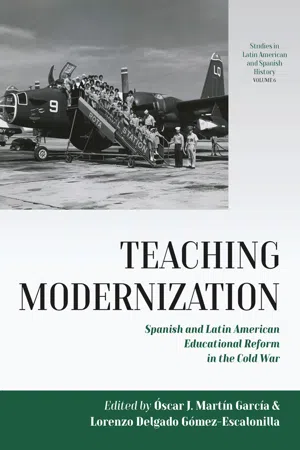
In the 1960s and 1970s, the educational systems in Spain and Latin America underwent comprehensive and ambitious reforms that took place amid a "revolution of expectations" arising from decolonization, global student protests, and the antagonism between capitalist and communist models of development. Deploying new archival research and innovative perspectives, the contributions to this volume examine the influence of transnational forces during the cultural Cold War. They shed new light on the roles played by the United States, non-state actors, international organizations and theories of modernization and human capital in educational reform efforts in the developing Hispanic world.
eBook - ePub
Teaching Modernization
Spanish and Latin American Educational Reform in the Cold War
- 282 pages
- English
- ePUB (mobile friendly)
- Available on iOS & Android
eBook - ePub
Teaching Modernization
Spanish and Latin American Educational Reform in the Cold War
About this book
Trusted by 375,005 students
Access to over 1.5 million titles for a fair monthly price.
Study more efficiently using our study tools.
Information
Chapter 1
Educational Reform, Modernization, and Development
A Cold War Transnational Process
Óscar J. Martín García and Lorenzo Delgado Gómez-Escalonilla

International Aspects of Educational Reform
The objective of this book is to analyze the set of external factors that intervened in the processes of educational reforms that took place in Spain and several Latin American countries during the 1960s and 1970s. The book pays special attention to the role played in such processes by the United States, non-state actors, international organizations, and the theories of modernization and human capital. A collective approach is used that includes contributions by several international history scholars and historians of education who examine programs of educational modernization in various case studies resulting from the interaction between international and domestic elements in the context of the cultural Cold War.
The origin of this book was a research project on the international dimensions of educational and scientific modernization in Spain in the 1960s and 1970s. The initial focus of the research was therefore on Spain. However, in the course of the project, we found there were obvious analogies with other educational reforms in that period in South America. For this reason, we thought it would be relevant to incorporate into the present volume several studies on Latin America that complemented the Spanish case. Such an approach would allow the educational transformations that occurred in Spain to be contextualized in a more global framework. However, it is our purpose not to make a systematic comparison between Spain and other Latin American countries but rather to analyze each case included in the book in a concrete way and try to establish connections between both sides of the Atlantic. In this sense, this volume does not claim to be comprehensive. A good number of significant Latin American cases and educational experiences are not included here. Instead, the book is intended to open up new perspectives for debate and to deepen existing ones in order to encourage further research that gives priority to a comparative approach and integrates new case studies.
The methodological approach adopted in this volume is not intended to apply central concepts and approaches as unitary axes with which to endow the chapters with methodological homogeneity. It is not the book’s goal to reflect a particular methodological approach as a whole. Indeed, one of its strengths is the rich variety of analytical tools used by the different authors. Thus, there are chapters that organize and analyze their content around concepts such as “private diplomacy,” “public diplomacy,” and “academic dependency”; others put the focus on the United States and the spread of its influence through a mix of demand factors and supply of educational assistance. There are also contributions that adopt a transnational perspective and focus on non-state actors, as well as those that inquire into the influence of educational discourses and practices sponsored by various international operators. In summary, regarding the selection of chapters, the book speaks with different voices and approaches on a coherent and common theme: the study of the external dimensions of educational modernization within the framework of the Cold War.
United States, a Leading Force in the Modernization of Developing Countries
The educational reforms described in this book represent an unprecedented advance in attempts to modernize the educational systems of countries such as Spain, El Salvador, Chile, and Brazil. In the case of Spain, Mariano González-Delgado and Tamar Groves (chapter 4) consider that the process that led to the General Education Law of 1970 was the “most important reform in the history of Spanish education in the twentieth century.” Likewise, Héctor Lindo-Fuentes (chapter 7) argues the educational reforms in El Salvador initiated in 1968, which ended in July 1971 with the promulgation of the General Education Law, constituted “a deep and comprehensive overhaul of the nation’s public school system,” an ambitious educational plan aimed at transforming the Central American country “into a modern, urban, industrialized nation.” For his part, Colin Snider (chapter 8) points out that the university reform of 1968 “marked a transformational moment that dramatically changed the development of higher education in Brazil in a myriad of ways.”
The United States was a leading force behind these processes of educational reform. From the beginning of the 1960s, the US government began to show greater interest in the role of education in its relations with the countries of the periphery and global semi-periphery. In September 1961, a report entitled “International Educational and Cultural Policies and Programs for the 1960s” collected the proposals of several working groups assembled by the Kennedy administration in order to elaborate “a philosophy and objectives for educational, cultural and scientific activity for the decade of the sixties as they relate to both governmental and private sectors.” According to this report, education was a basic ingredient of the early stages of economic development. The takeoff toward the modernization of backward countries would involve training through modern educational systems to create human capital with the necessary technical capacities to solve the problems of underdevelopment. Therefore, “an increased effort in international programs in education, culture and science is as important as any effort our country may undertake, and that without it, our efforts in the areas of politics, of military assistance and of economics can never be truly effective.”1 In that same year and in a similar vein, President John F. Kennedy highlighted the importance of education for United States foreign policy toward the Third World:
As our own history demonstrates so well, education is in the long run the chief means by which a young nation can develop its economy, its political and social institutions and individual freedom and opportunity. There is no better way of helping the new nations of Latin America, Africa and Asia in their present pursuit of freedom and better living conditions than by assisting them to develop their human resources by education.2
The US government saw education as a development factor at a juncture where the socioeconomic growth of poor nations became a fundamental objective of the Kennedy administration’s foreign policy. Washington’s interest in promoting education and development in the Third World was also part of the US response to the international challenges arising from the interaction between decolonization, the Cold War, and the expansion of communism in many regions of the planet. With such an international panorama, facts like the launching of Sputnik (1957), the Cuban Revolution (1959), the support of Nikita Khrushchev for anticolonialist movements (1961), and the increasing economic, technical, and military aid of the Soviet Union to newly independent nations all elevated communism as an alternative model of modernization to US capitalism in the Third World. According to US Deputy National Security Adviser Walt Rostow, such events had high potential to project “an image of communism as the most efficient method of modernizing underdeveloped regions” (Simpson 2008: 8)—even more so considering the interest and admiration of postcolonial leaders for the rapid industrialization experienced by the USSR, which, in a few decades, had gone from being a backward and agrarian country to becoming one of the world’s main economic powers (Engerman 2004: 51–52).
Given this challenge, the Kennedy government created the US Agency for International Development (USAID) in 1961 and promoted initiatives such as the Decade of Development in order to expand the US vision of modernization in the periphery and global semi-periphery. According to this vision, democracy, capitalism, and technocratic reform represented the pillars of an ideal of progress that ran counter to the class struggle and the Marxist utopia embodied by the USSR. Within this liberal conception of modernization, education could contribute to promoting development in a framework of order and stability. In other words, education could help foster the economic growth necessary to face revolutionary threats in places like Cuba, the Congo, Laos, or Vietnam, where ignorance, poverty, frustration and political instability were fertile breeding grounds for radical ideas and movements (Gilman 2003: 48–49; Latham 2003a: 3–4). As we will see, the governments of many developing countries enthusiastically adopted this notion of education. For example, Lindo-Fuentes (chapter 7) points out that in 1962, in the inaugural address of Colonel Julio Rivera, the new Salvadoran president, education was presented as a way for his country to both modernize its economy and defeat communism.
The US emphasis on educational issues was also closely related to a series of internal and external factors that gained intensity during these years. First, the educational expansion at the domestic level was one of the priorities of US leaders from the arrival of Kennedy in the White House. Interest in the stimulus of education continued and was accentuated with the Great Society of President Lyndon B. Johnson. Second, decolonization generated new dynamics of global social transformation whose repercussions were more accentuated in a growing youth sector desperate for change and education. Likewise, there were the effects on the Third World of the economic boom experienced by all the capitalist First World countries that also reached the communist Second World, with the consequent emergence of an incipient society of mass consumption in some parts of the Southern Hemisphere. As a result, several countries in the periphery and semi-periphery global witnessed the growing role of an urban middle class with expectations of economic growth and increased purchasing power. These new intermediate social strata demanded the expansion of education and a rapid modernization of their countries, thus influencing domestic and international politics.3 Immersed in this epoch of a “revolution of expectations,” the foreign actions of the United States had to confront this “combination of hope and urgency.”4
The confluence of all these processes caused an explosion of demand for education in Third World countries, as well as in others that were at an intermediate stage of development. As stated in another official report in 1961, the “passion for education” from the beginning of this decade became a “rising tide in the newly developing nations.”5 As a result of this sharp increase in popular aspirations for education—and encouraged by the theories of modernization and educational development, and by the progressive importance of technology and demographic growth—there was a dramatic global upsurge in demand for education between the 1950s and 1970s. Consequently, during these years there was a remarkable educational expansion, clearly observable in the increase in the number of students. A palpable example of this phenomenon was Latin America, where the student population (at all levels) went from 30.5 million to 78.7 million between 1960 and 1977.
The enormous expansion of educational demand in the postwar period threatened world stability and provoked what Philip H. Coombs (1968) called a “world educational crisis” (Arnove 1980: 48; Meyer et al. 1979: 37–56).6 Consequently, educational reform went from being a primarily domestic issue to an international one. It became a central component of North-South relations and East-West competition. Thus, from the beginning of the 1960s, educational modernization became a battlefield in the struggle between the Americans and the Soviets for winning the hearts and minds of the inhabitants of postcolonial and developing societies. In fact, in 1965, LBJ announced—along the lines already initiated by the Kennedy administration—the call for a special task force on international education to recommend a broad and long-range plan of worldwide educational endeavor. Based on the recommendations of that task force, the International Education Act of 1966 would be prepared, in charge of coordinating its activities at the Interagency Council on International Educational and Cultural Affairs. This agency included all government agencies with significant programs in this field: the Department of State, USAID, Peace Corps, Department of Defense, Department of Health Education and Welfare, and US Information Agency (USIA).
An Antidote against the Cuban Revolution: United States and Latin America in the Development Decade
For the analysts and strategists of the US Department of State, the situation in Latin America clearly illustrated the capacity of the international communist movement to exploit political and social instability in the underdeveloped areas of the planet. The Latin American region became a hot zone in the ideological competition of the Cold War in the second half of the 1950s. From this time onward, the political situation south of the Rio Grande attracted increasing attention from US foreign policy makers. They viewed with concern the hostile reception and anti-Americanism that accompanied the official tour of Richard Nixon in several Latin American countries in 1958. The visit of the then US vice president to countries such as Uruguay, Peru, and Venezuela raised numerous student protests, which in some cases resulted in serious incidents (Black 2007: 356–363).
Nevertheless, the true turning point in this regard occurred with the Cuban Revolution in 1959 (McPherson 2003; Rabe 1988). As Thomas Wright points out, such an event “embodied the aspirations and captured the imagination of Latin America’s masses as no other political movement had ever done” (2001: 1). The victory of the guerrilla forces over the regime of Fulgencio Batista served as an example of inspiration for many other revolutionary movements from the Andes to the Southern Cone (Gleijeses 2009). This was why Fidel Castro’s assault on the established power base ignited all the alarms in Washington, especially when the approach of the new Cuban authorities to the USSR triggered the fears of the US leaders regarding a possible spread of the Castro virus to other poor societies of the hemisphere (Latham 2000: 75–77). This threat lasted throughout the following decade, as indicated by information prepared by the Department of State in 1968: “The Latin American countries remain a prime target of direct and indirect subversion by Cuba, the Soviet Union, and, to a lesser extent, Communist China.”7
To contain this threat, the Kennedy administration launched the Alliance for Progress (AfP) in 1961. This initiative was aimed at ending poverty, illiteracy, instability, and authoritarianism in the Latin American subcontinent by carrying out reforms in the fields of education, health, housing, agriculture, and the distribution of wealth. It was a matter of carrying out, under the aid and tutelage of the United States, a peaceful revolution from above that fostered economic growth and constrained communism in the region (Darnton 2012; Rabe 1999). The start-up of the AfP was accompanied by a whole informative, propagandistic, and cultural offensive orchestrated by the USIA, aimed at presenting the United States before Latin American public opinion as an advanced and benevolent leader, committed to development aid in a region burdened by the legacy of Spanish imperialism and by the influence of communist and Castroist ideas (Field 2012; Latham 2000: 70–72; Taffet 2007). The emphasis on concepts such as democracy in action, self-help, and cooperative effort accompanied the deployment of an important package of economic aid, mostly in the form of loans. The final result would be very different from the initial purpose outlined by Kennedy to modernize Latin American societies, taking as a reference the United States model. In general terms, the AfP has been described as “a remarkable policy failure of the Cold War” (Rabe 2012: 90).
Support for education occupied an important place in this endeavor. The US government encouraged the establishment of bilateral...
Table of contents
- Cover
- Title Page
- Copyright Page
- Contents
- Illustrations
- Acknowledgments
- Chapter 1. Educational Reform, Modernization, and Development: A Cold War Transnational Process
- Chapter 2. US Assistance to Educational Reform in Spain: Soft Power in Exchange for Military Bases
- Chapter 3. Forerunners of Change? The Ford Foundation’s Activities in Francoist Spain
- Chapter 4. Educational Transfer and Local Actors: International Intervention in Spain during the Late Franco Period
- Chapter 5. Much Ado about Nothing? Lights and Shadows of the World Bank’s Support of Spanish Aspirations to Educational Modernization (1968–1972)
- Chapter 6. US Foreign Policy toward Spanish Students: Youth Diplomacy, Modernization, and Educational Reform
- Chapter 7. How a Cold War Education Project Backfired: Modernization Theory, the Alliance for Progress, and the 1968 Education Reform in El Salvador
- Chapter 8. “Passing through a Critical Moment”: The United States and Brazilian University Reform in the 1960s
- Chapter 9. Between the Eagle and the Condor: The Ford Foundation and the Modernization of the University of Chile (1965–1975)
- Chapter 10. Between Modernization and University Reform (1957–1973): Technical Assistance from UNESCO to the University of Concepción
- Index
Frequently asked questions
Yes, you can cancel anytime from the Subscription tab in your account settings on the Perlego website. Your subscription will stay active until the end of your current billing period. Learn how to cancel your subscription
No, books cannot be downloaded as external files, such as PDFs, for use outside of Perlego. However, you can download books within the Perlego app for offline reading on mobile or tablet. Learn how to download books offline
Perlego offers two plans: Essential and Complete
- Essential is ideal for learners and professionals who enjoy exploring a wide range of subjects. Access the Essential Library with 800,000+ trusted titles and best-sellers across business, personal growth, and the humanities. Includes unlimited reading time and Standard Read Aloud voice.
- Complete: Perfect for advanced learners and researchers needing full, unrestricted access. Unlock 1.5M+ books across hundreds of subjects, including academic and specialized titles. The Complete Plan also includes advanced features like Premium Read Aloud and Research Assistant.
We are an online textbook subscription service, where you can get access to an entire online library for less than the price of a single book per month. With over 1.5 million books across 990+ topics, we’ve got you covered! Learn about our mission
Look out for the read-aloud symbol on your next book to see if you can listen to it. The read-aloud tool reads text aloud for you, highlighting the text as it is being read. You can pause it, speed it up and slow it down. Learn more about Read Aloud
Yes! You can use the Perlego app on both iOS and Android devices to read anytime, anywhere — even offline. Perfect for commutes or when you’re on the go.
Please note we cannot support devices running on iOS 13 and Android 7 or earlier. Learn more about using the app
Please note we cannot support devices running on iOS 13 and Android 7 or earlier. Learn more about using the app
Yes, you can access Teaching Modernization by Óscar J. Martín García, Lorenzo Delgado Gómez-Escalonilla, Óscar J. Martín García,Lorenzo Delgado Gómez-Escalonilla in PDF and/or ePUB format, as well as other popular books in Education & Educational Policy. We have over 1.5 million books available in our catalogue for you to explore.