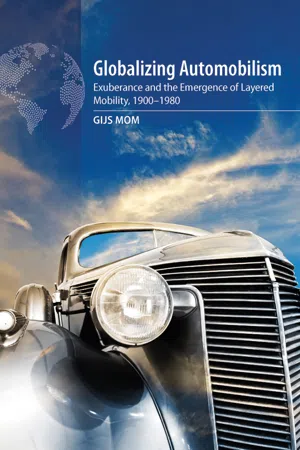
Why has "car society" proven so durable, even in the face of mounting environmental and economic crises? In this follow-up to his magisterial Atlantic Automobilism, Gijs Mom traces the global spread of the automobile in the postwar era and investigates why adopting more sustainable forms of mobility has proven so difficult. Drawing on archival research as well as wide-ranging forays into popular culture, Mom reveals here the roots of the exuberance, excess, and danger that define modern automotive culture.
eBook - ePub
Globalizing Automobilism
Exuberance and the Emergence of Layered Mobility, 1900–1980
- 688 pages
- English
- ePUB (mobile friendly)
- Available on iOS & Android
eBook - ePub
About this book
Trusted by 375,005 students
Access to over 1.5 million titles for a fair monthly price.
Study more efficiently using our study tools.
Information
Part I
EMERGENCE AND PERSISTENCE (AGAIN)
The Shaping of Mobility Layeredness beyond the West
Chapter 1
MODERNIZING WITHOUT AUTOMOBILIZATION
Subverting and Subalternizing Mobility History (1890–1945/1950)

The dragon-monsters continue to fight on the highways at night
… another epoch is approaching.
—Zeng Pu, “A Flower in a Sinful Sea”
Imperialist Mobilities: Japan and the Modernization of Manchuria
At the very start of the new century, from 1900 to 1902, Natsume Sōseki (1867–1916), nowadays regarded as “one of Japan’s greatest writers,” spent “the most unpleasant years of [his] life” in London, living “like a poor dog that had strayed among a pack of wolves.” In terms of mobility, Sōseki (Natsume being his family name, Sōseki his pen name) most of all practiced and experienced pedestrianism, observing how Londoners “were in no way ill at ease in a crowd.” Prefiguring the ‘swarm’ I have used elsewhere to explain the emergence of the automobile, he described in one of his short stories how a “sea of humanity” followed “the watery movements of the ocean.” “There could be no thought of escaping from it … I too progressed forward, adapting my step to that of the thousands of dark beings who appeared to have agreed among themselves to move at one uniform rate,” in a city darkened by “soot-colored smoke.”1 Sōseki’s early fictionalized experience of the movement of a pedestrian swarm (a group moving without a proper control center) in what he conceived as a fluid society, reads as an experience of transcendence, where the individual becomes larger than herself, part of a seemingly unstoppable and inevitable “progress” observed in a modernizing context.
This was only the beginning of his submergence in mobile modernity. Advised by a Japanese roommate to combat his upcoming depression through a therapeutic bicycle ride, he also experienced the cyborg condition that has been described as so typical for Western-style modernity. Because of his small stature opting for a lady’s bicycle (thus confirming the stereotype that the non-West is not masculine), he incorporated his not-so-hilarious trip (with lots of falls and confrontations with the police) in the short story “The Diary of a Bicycle Rider” (1903). “Finding myself stuck to the bicycle and glued to its saddle, as it were—a perfect communion between the man and his machine!” he soon discovers the bicycle rather than himself is in charge. When he manages to avoid a collision with a tram car by diving, a gentleman in a horse-drawn cabriolet shouts: “‘Everything’s all right. You’re not going to be killed, don’t worry!’ Stupefied, I murmured to myself, ‘Is it possible that they get people to ride bicycles in order to kill them? England’s certainly a fearful place!’”2
Little did Sōseki realize how this relationship between modern mobility and killing would become quite close pretty soon, in the annual production of traffic victims. What he could not avoid realizing, however, was the flip side of what he called “Westerners’ logic,” for instance, when another cyclist whom he caused to fall called him a “Chink.” In London, while his homesickness heightened because his wife back in Japan delivered a son, he discovered the color of his skin: “Since I have been here,” he wrote to his wife, “I have fretted at finding myself so yellow. Furthermore, I am small. I have not yet met anyone smaller than me. Nor am I broad shouldered. When I think to myself, ‘Look, there’s a funny person coming towards me!’ it’s my own reflection that I see in the mirror … I wish I were taller … I shut myself away in my boarding house as in a besieged castle, and my only resource is to study.”3 Sōseki’s comparative attitude emphasizes the differences between a ‘Western’ and a ‘Japanese’ modernization path, in which the mobility mode and the intensity of its use will soon develop into crucial measuring tools, which allow characterization of Japan as an “Asian Prussia” that skipped the (European and American) shift from Gemeinschaft to Gesellschaft away from the family as all-pervasive basis.4 Traffic (swarm) and transport (cyborg) were the metaphors he used to make his readers feel the ill fit of a Japanese modernist in London’s modernity. If he became yellow, feminine, and small (also to himself) only through the gaze of a Westerner, one wonders what such Westerners did with non-Western mobility. We will find some clues for an answer in the reception of Sōseki’s work.
As the iconic transitional writer of the Meiji Restoration, Sōseki had gone to the United Kingdom to study English literature. Combined with his previous studies of the Chinese classics, his celebrated modernism was constantly held back by the old society and its customs, as later literary students diagnosed. In this sense, he was a solid representative of Japan’s ‘partial modernization.’ This is not surprising to a Western observer: Western literary modernity also struggled with reconciling the old and the new, as the work of Marcel Proust and his memories of things past testify. Japanese modernization initially followed the new railway lines: British firms had built the first Japanese railway line in the 1870s, but Japanese engineers soon took over, helping set in motion a process of labor-intensive industrialization and a growth ratio unique in the world. All rails and locomotives were imported until the turn of the century, and in 1890, 1,400 miles had been constructed, 40 percent “owned and operated by the government … The state financed and ran a number of so-called model enterprises,” from shipyards to beer factories, following “a German philosophy of state-led development.” The “call for a constitution” prompted the emergence of anti-government institutions, led by “journalists and educators, often former samurai, who made up the urban intelligentsia of the Meiji era.”
The constitution made the military “directly responsible to the emperor,” not to parliament. Within three decades, Japan made itself into the Workshop of Asia, populated by forty-five million inhabitants, with more women than men being part of the labor force, mostly in the textile and the sex industries. When the Japanese government nationalized the railways in 1906, there was a network of five thousand miles of tracks in the country. The standard work on Japanese railways by Steven Ericson, however, argued “for the relative unimportance of railroads to the economy of Meiji Japan.” Next to this modernization, which made Japan “the first non-Western industrial, capitalist economy,” a “Japanese” tradition was invented, including Shinto worship and modernized forms of martial arts and Noh and Kabuki theater, whereas a military culture was shaped along Prussian lines, with “military drills at schools” and “a spirit of sacrifice for the state.” In 1894, a war with China was fought in Korea, and Japan’s victory gave it the control of Taiwan and “railroad building rights in southern Manchuria.” The war with Russia in 1904 provided Japan with the control of the Russian railroads in Manchuria; in 1910, Japan annexed Korea “outright as a colony.”5
However, there is also a global dimension to this story. The spread of the railway over the globe as the first modern land mobility system took place in the decades around the turn of the century. While virtually all railway mileage was laying in the West in the 1870s, by 1910 Asia and Latin America each were equipped with one-tenth of the drastically increased global railway network length (Africa’s network size was half this). Transport infrastructure formed a central element in the struggle for hegemony between the industrializing West and the Rest: in 1750, the sum of the GDP of both amounted to $35 billion and $120 billion (of 1960), respectively, but in 1900, this had turned around to $290 billion and $188 billion (a difference that further increased to $3 trillion and $1 trillion in the 1970s). In this setting of explosive modernization with a twist, “an impossible hybrid of eastern and western civilization” in the eyes of one of Sōseki’s translators, he became the center of a neo-idealist avant-garde, publishing his work in serial form in the newspaper Asahi, for which he managed the literary columns for a while. His work invites us to rethink both modernity and mobility, compared to the French and Belgian avant-garde I have analyzed elsewhere. While the latter discovered the car as the mobile equivalent of their literary adventures, Sōseki found his adventures in literary experiments, “casting aside all the reticence of convention,” as he claimed in one of his short stories.6
This is not to say Sōseki did not include cars, especially streetcars, in his work. On the contrary, in After the Spring Equinox (Higan sugi made, 1912), for instance, the streetcar functions as an extension of the opportunity during walking to encounter strangers. “Civilization,” Sōseki said in a lecture from 1911, “is something that moves.” But civilization stands for “alienation and dehumanization,” too. When the protagonist in Sanshiro (1908, set in 1907) boards a streetcar, he “mutters loudly enough for the other passengers to hear, ‘Ah, it’s moving. The world is moving,” a nice example of nonautomotive inversion. “All of [Sōseki’s] important characters,” his translator said, “both long for and fear the movement.” One protagonist observes, “Wherever you have motion, you must also have vulgarity.” And another: “All the mundane world’s vomit comes from movement.” In her literary analysis of Japanese rail and road transport, Alisa Freedman observed the motion of the train (depicted in the novel in three types: “cross-country railroads, inner-city streetcars, and a commuter line”) is a metaphor for “rapid national changes that have not been fully understood.” Sanshiro is a novel not only about fear of trains, Freedman concluded, but also “of romantic relationships with women.” In The Three-Cornered World (1906), the protagonist describes the train as affected with “contempt for individuality.” The train, appearing “at either the beginning or the end of almost every of Sōseki’s novels and reflect[ing] this author’s fascination but ambivalence toward these machines,” is portrayed as a machine of coercion.7
In a lecture on “The Civilization of Modern-Day Japan” (“Gendai Nihon no kaika,” 1911), he explained Japan could not enjoy ‘civilization,’ because it had not freed its energies enough. The car, he claimed, is only used as a timesaving device and does not address its “desire for enjoyment, urging us to do exactly as we please.” His observation of London’s fledgling automobilism fully coincides with ours: Western car culture was hedonistic, nonutilitarian. Consequently, in a comparison with the rickshaw, Sōseki labels the car as an energy-saving device. Whereas “Western civilization (that is, civilization in general)” is intrinsically motivated, Japanese’s development is “the result of pressure from outside.” This leads Sōseki to pessimistically conclude “we have no choice but to develop in unnatural ways.” Because Japan “has had to leap all at once from a barely attained complexity level to [a very high level] in both time saving and consumption, it runs the risk of a nervous breakdown.” This clash of old and new, a phenomenon we will call ‘layeredness’ in this study, leads to internal turmoil. And perhaps to external turmoil as well, because here Sōseki may have referred, implicitly, to what historians have called “the era of popular riot” of two decades that started at the turn of the century: a list of nine riots between 1905 and 1918 in Andrew Gordon’s monograph on Japan gives four in which streetcars are smashed and stoned.8
Where I emphasized in the French-Belgian case the dynamic ‘affinity’ between car driving and writing, Sōseki observes a comparable homology between mobility and the act of reading (“My mind was riveted to the pages, yet it glided over them as smoothly as a sleigh over the snow”) and writing (“I am driving my fountain pen forward”), although in Sōseki’s case, the vehicle that should function as an intermediary between these experiences was not very well defined. In another essay, Sōseki emphasizes the social implications of his modern “individualism”: “It goes without saying that it is reassuring for twigs to be in a bundle.” Although he does not lay a connection with traffic here, in yet another essay he nonetheless observes an affinity with the writing process, which, “if it succeeds in achieving ‘correspondence’ with readers achieves a form of community.” In Japan, as in the West (as we saw in the introduction), transport modernity became closely connected with media modernity: the introduction, after 1872, of the movable type revolutionized book printing and consumption, as novels and other texts depended less on illustrations than on “descriptive prose,” enabling the middle class to verbalize its observations (similar to what Catherine Bertho has analyzed for early French motorization) while at the same time individualizing the reading process by replacing “traditions of communal reading aloud with solitary and silent reading.” Part of this revolution was the serialized publication of a novel, as Sōseki practiced, thus “blurring the distinctions between fact and fiction.”9
Yet, Sōseki’s work has been described by his many translators and other literary students as adorned with a “static quality” that “lack[s] the dynamic rhythm of action.” This seems to be an echo of the stereotyping dichotomy between West as mobile and East as immobile, masculine versus feminine. At closer look, his short stories and his novels are full of mobility, traditional and modern. They are, indeed, the first indications of the importance of the layeredness of modernization in the world beyond the West. Whereas the literary-cum-automobile avant-garde in France dived head-on into the violent acceleration enabled by the bicycle and the car, Sōseki’s transcendence is brought about by religion or, if that is impossible, “self-absorption,” an “authentically Oriental” solution according to his translator. Sōseki, therefore, is an attractive case for whoever wishes to study the mobility side of Edward Said’s Orientalism, the analysis of the West’s patronizing, if not racist gaze to the ‘East.’ Racism is not a prerogative of the West, although it seems to be invented, and developed into seemingly perfect ideological constructs, in a colonial setting, remarkably often related to mobility, a setting where the “native races” were declared “unfit to operate motorized vehicles,” unless they were trained by their superiors.10
***
Let us read in more detail, and in a contextualized way, one of Sōseki’s major works, The Wayfarer (Kōjin, serially published in Asahi, 1912/1913), to find out more about this ‘layeredness.’ At first sight, nothing seems to happen and mobility seems to be pushed away as far as possible from a life described as extremely sedentary: “At home in Tokyo things seemed to be going as usual, with little change to speak of … While things seemed to happen with me but nothing really did, the seemingly long but actually short winter—drizzling rains, thaws, dry winds—ran its own predestined course with monotonous regularity, and then it was gone.” Mobility in Sōseki’s literary universe seems to be confined to the gestures of the protagonist’s body, such as the movement of his arm while shaving, an activity described in detail. “The house where I was born is four or five hundred meters from the one in which I live,” he confesses in a serialized bundle of short stories published a year before his death in 1916. Yet, the novel’s title already suggests otherwise: the tragic battle between the sexes, reenacted in the struggle between the protagonist’s intellectual brother Ichiro and his brother’s wife, who are forced by tradition to live together, leads to a distancing from and alienation in society comparable to what the French avant-garde described at about the same time. And just like in the latter’s case, the pedestrian wayfarer advises his brother to undertake travel as a remedy against his depression. Visiting the mediator who arranged the trip for his brother, the protagonist, Jiro, an office clerk in Tokyo, finds near the entrance of this mediator’s house “many rickshaws … There were a couple of carriages but no automobiles.”11 This focus on the car as a measuring tool of modernity, mobilized by contemporary novelists and many mobility historians and social scientists in their wake, hides the fundamental synchronicity of ‘West’ and ‘East.’
Indeed, the last quote is one of the very few occasions the car is mentioned in the novel: as an absence. But the rickshaw is everywhere. Born in Tokyo when there were neither trams nor rickshaws, Sōseki in The Wayfarer makes the latter abound as feeder to the tram, as a vehicle for emergencies (“I hurry by rickshaw” to a hospital) and as a means to fetch forgotten items, a form of mobility unheard of in the West at that time, based on a special role of the rickshaw puller: “I do not know of any supreme being as trustworthy as a ricksha man.” Invented just a couple years after the start of the Meiji period (1868–1912), the jinrikisha (jin = man, riki = power, sha = vehicle) was an a...
Table of contents
- Cover
- Title Page
- Copyright Page
- Dedication
- Contents
- List of Illustrations
- Preface
- Introduction. Questioning the Car: Prolegomena for a Historical Analysis of Global Mobility
- Part I. Emergence and Persistence (Again): The Shaping of Mobility Layeredness beyond the West
- Part II. Exuberance, with a Twist: Spreading the Gospel of Automobilism
- Layered, Fragmented, Subversive, Subaltern: Conclusions
- Bibliography
- Index
Frequently asked questions
Yes, you can cancel anytime from the Subscription tab in your account settings on the Perlego website. Your subscription will stay active until the end of your current billing period. Learn how to cancel your subscription
No, books cannot be downloaded as external files, such as PDFs, for use outside of Perlego. However, you can download books within the Perlego app for offline reading on mobile or tablet. Learn how to download books offline
Perlego offers two plans: Essential and Complete
- Essential is ideal for learners and professionals who enjoy exploring a wide range of subjects. Access the Essential Library with 800,000+ trusted titles and best-sellers across business, personal growth, and the humanities. Includes unlimited reading time and Standard Read Aloud voice.
- Complete: Perfect for advanced learners and researchers needing full, unrestricted access. Unlock 1.5M+ books across hundreds of subjects, including academic and specialized titles. The Complete Plan also includes advanced features like Premium Read Aloud and Research Assistant.
We are an online textbook subscription service, where you can get access to an entire online library for less than the price of a single book per month. With over 1.5 million books across 990+ topics, we’ve got you covered! Learn about our mission
Look out for the read-aloud symbol on your next book to see if you can listen to it. The read-aloud tool reads text aloud for you, highlighting the text as it is being read. You can pause it, speed it up and slow it down. Learn more about Read Aloud
Yes! You can use the Perlego app on both iOS and Android devices to read anytime, anywhere — even offline. Perfect for commutes or when you’re on the go.
Please note we cannot support devices running on iOS 13 and Android 7 or earlier. Learn more about using the app
Please note we cannot support devices running on iOS 13 and Android 7 or earlier. Learn more about using the app
Yes, you can access Globalizing Automobilism by Gijs Mom in PDF and/or ePUB format, as well as other popular books in Technology & Engineering & 20th Century History. We have over 1.5 million books available in our catalogue for you to explore.