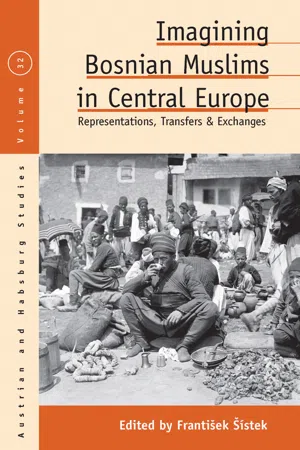
As a Slavic-speaking religious and ethnic "Other" living just a stone's throw from the symbolic heart of the continent, the Muslims of Bosnia and Herzegovina have long occupied a liminal space in the European imagination. To a significant degree, the wider representations and perceptions of this population can be traced to the reports of Central European—and especially Habsburg—diplomats, scholars, journalists, tourists, and other observers in the late nineteenth and early twentieth centuries. This volume assembles contributions from historians, anthropologists, political scientists, and literary scholars to examine the political, social, and discursive dimensions of Bosnian Muslims' encounters with the West since the nineteenth century.
Trusted by 375,005 students
Access to over 1.5 million titles for a fair monthly price.
THE ‘TURKISH THREAT’ AND EARLY MODERN CENTRAL EUROPE
Czech Reflections
Ladislav Hladký and Petr Stehlík
The primary motivation behind the formation of the Habsburg Monarchy, a large multinational empire that existed for just under four centuries in Central Europe, was the so-called ‘Turkish threat’. As early as the end of the fourteenth century, the Ottoman Turks, driven by their aims of power and religion, began expanding their territory into South East Europe. Initially, they took control of the southern part of the Balkan peninsula, and in 1453 they captured Byzantine Constantinople and made it the capital of their empire. In the beginning of the sixteenth century, Ottoman forces began invading the Great Hungarian Plain. In August 1526 at the Battle of Mohács, the army of Sultan Suleiman I had relatively little difficulty in defeating the troops of the Hungarian and Bohemian king, Louis II Jagiellon, who had attempted to stop them there. The fatal defeat at Mohács led to a decision by the Hungarian, Bohemian and Austrian political elite in 1526–27 to create, in the interest of increasing the military and economic prospects for defending Central Europe against the Ottoman Turks, an Austro-Bohemian-Hungarian confederation with a single ruler – the Austrian archduke Ferdinand I of Habsburg.
At first, representatives of the Bohemian, Hungarian and, to some degree, Croatian estates (representatives of the nobility, clergy and burghers) were not particularly impressed with the persona of Ferdinand I, but the majority of them respected the fact that as the husband of Princess Anna Jagiellon, sister of the deceased Louis II Jagiellon, the Austrian archduke had a legitimate claim to the vacated Hungarian and Bohemian throne. The decisive factor for accepting Ferdinand’s candidature, however, was the actuality that, at the time, the Habsburgs represented one of the politically most important dynasties in Europe. As early as the 1520s, thanks to the influence of his brother, Holy Roman Emperor Charles V, Ferdinand had succeeded in securing significant funding from German dukes for the defence of the Austrian lands from the approaching Turkish threat. The Bohemian, Hungarian and Croatian estates believed that the political leverage and money of the Habsburgs would help to safeguard their territories from the Ottomans too (see Vorel 2005: 7–26; Pánek et al. 2011: 191–95). In the interest of a balanced assessment, it must be noted that, in the end, the success of this experiment between Central European aristocracy and the Austrian Habsburgs was in fact determined by multiple factors. The Croatian historian Neven Budak worded it aptly when he wrote that the salvation of the ‘remains of the remains of the once great Kingdom of Croatia’ (reliquiae reliquiarum olim inclyti regni Croatiae), according to the fitting period characterization of the diminishing independent strip of Croatian territory under Habsburg rule, ‘must be credited not only to the heroism and sacrifice of the Croatians but to Ferdinand together with Austrian, German and Czech financing’ (Budak 2007: 22).
Countless historiographic titles have been written in modern times about the wars with the Ottomans, particularly those waged in lands that became immediate casualties of Ottoman expansion. A lesser known fact is that the Bohemian lands (more precisely the Lands of the Bohemian Crown, i.e. Bohemia, Moravia, Silesia, and Upper and Lower Lusatia) made significant contributions to the defence of Central Europe against the Ottoman Turks between the sixteenth and eighteenth centuries. Even though in the early modern period the Bohemian lands – with the exception of eastern regions of Moravia – were never directly attacked by Ottoman forces, they played an important role in protecting the Habsburg Monarchy, particularly in terms of funding (see Žáček et al. 1975; Veselá 1978; Válka 1995).
The objective of this chapter is to use the example of the Bohemian lands to describe and assess reflections of the phenomenon of the Turkish threat in early modern Central Europe. In the first part, we primarily examine the financial and military contributions of the Bohemian lands to the defence of the Habsburg Monarchy, specifically the area of Upper Hungary (present-day Slovakia), against the Ottoman Turks. Mention is also made of raids by Ottoman militants in Moravia during the seventeenth century and of relations between Bohemian Protestants and the Ottoman Empire. In the second part, we build upon this chronologically structured exposition by characterizing transformations of the image of the Turkish threat that was shaped in the Bohemian lands from the sixteenth to the eighteenth century. In so doing, we endeavour to capture the particularities of the local perception of this phenomenon in the context of the other countries of Central Europe, and also look at it from the perspective of later centuries. Initially, it might seem that the Lands of the Bohemian Crown, in large part spared the military catastrophes brought about by the struggle between the Habsburg Monarchy and the Ottoman Empire, present a somewhat atypical case upon which to base an accurate characterization of Central European reflections of the Turkish threat. In reality, however, it was perceived here much as it was in the territories facing immediate danger or areas directly exposed to Ottoman expansion, but there were certain peculiarities. The changes in the image of the Turk between the sixteenth and eighteenth centuries are helpful in understanding the subsequent (differentiated) development of attitudes among the population of Central Europe towards modern-day Bosnian Muslims.
Bohemian Lands and Defence of the Habsburg Monarchy against the Ottoman Turks
From the sixteenth to the eighteenth century, the Bohemian lands represented the most economically advanced and the wealthiest constituent of the Habsburg Empire. For example, according to Czech historians, of the overall war tax collected within the Habsburg Monarchy in 1541 for defence against the Ottoman Turks, a total of 371,000 guldens was provided by the so-called Austrian Hereditary Lands, 375,000 guldens by Bohemia alone, and 400,000 guldens by the adjacent lands of the Bohemian Crown. Hungary, which by that point had in large part been occupied by the Ottomans, did not pay the tax. Thus, in the middle of the sixteenth century, roughly two-thirds of the total sum of money collected to fight the Ottomans came from the Bohemian lands, while only the remaining one third came from Austrian territories. In the following decades, the tax continued to increase. At the turn of the seventeenth century, during the Long Turkish War (1593–1606), Bohemia provided 590,000 guldens for defence, and immediately prior to the outbreak of the Thirty Year’s War (1618–1648) supplied a total of 1,000,000 guldens (Žáček et al. 1975: 118–19).
Military divisions from the Bohemian lands participated in a number of battles against the Ottomans, such as in 1529 during the first Ottoman siege of Vienna when Moravian units defended the left bank of the Danube. In 1532, Bohemian soldiers helped to defend the castle in the town of Kőszeg (German: Güns) on the Hungarian–Austrian frontier, as well as at Osijek in Eastern Slavonia in the year 1537 (Žáček et al. 1975: 110–14).
The fall of Buda and the subsequent establishment of the Budin Eyalet by the Ottoman Turks (1541) gave rise to the need for intensive fortification of the towns in the remaining parts of Hungary not yet occupied by the Ottomans. In terms of the duty of the individual Habsburg territories to defend the areas bordering the sultan’s empire, the so-called Military Frontier, the Bohemian lands were charged with guarding Upper Hungary, now mostly present-day Slovakia, specifically the western areas around present-day Bratislava (German: Pressburg, Hungarian: Pozsony), the Váh and Nitra river basins, and a number of mining towns in central Slovakia. With financial support from the Bohemian lands, the so-called Old Fortress at the confluence of the Danube and Váh rivers at the town of Komárno (German: Komorn, Hungarian: Komárom) was enlarged between 1546 and 1557, and the fortress Nové Zámky (German: Neuhäufel, Hungarian: Érségújvár) was built on the bank of the River Nitra in western Slovakia between 1573 and 1581. According to historical sources, construction of practically the entire Nové Zámky fortress was financed with money from the Bohemian lands, primarily from Moravia. For several years, the imperial overseer of construction of the fortress was the influential Moravian nobleman Bedřich of Žerotín (German: Friedrich von Žerotin, sometimes spelled Zierotin). The fortress had six massive bastions, two of which were named for Bedřich of Žerotín (one known as ‘Žerotin’s’ and the other as ‘Friedrich’s’, according to the German form of his name). Another of the six bastions was called ‘the Bohemian’, a clear reference to the fact that most of the financial resources for construction of the fortress had come from the Bohemian estates (see Nové Zámky Fotoalbum 2017).
The ruling Habsburgs also occasionally attempted to engage the estates armies (provincial armies) of the Lands of the Bohemian Crown in wars with the Ottoman Turks. They twice largely succeeded in doing so, specifically during the exceptionally vigorous Ottoman campaigns into Hungary. The first instance was in 1566, when more than ten thousand soldiers from the Bohemian lands were mobilized against the army of Sultan Suleiman I, which had set out to lay siege to the Hungarian fortress of Szigetvár. At the time, the Bohemian provincial armies were commanded by the prominent nobleman William of Rosenberg, whose brother-in-law was Nikola Zrinski, defender of Szigetvár (see Pánek 2015). In the end, however, these forces did not partake in the battles against the Turks. Instead, they waited passively in the north of Hungary near the town of Győr (German: Raab) and then disbanded following word of the fall of Szigetvár. A campaign into Hungary in 1594, involving some eighteen thousand Bohemian soldiers led by Peter Vok of Rosenberg, came to a similar end. This time, too, the Bohemian army advanced only as far as the western part of Upper Hungary without engaging in any significant clashes with their Ottoman adversary (Pánek 1988: 870–71).
An important feature of the Lands of the Bohemian Crown in the sixteenth century and beginning of the seventeenth century was that from the time of the Hussite Wars in the fifteenth century, they were religiously divided. Apart from the Roman Catholics living in Bohemia and Moravia, there was a considerably powerful and politically influential community of Bohemian Utraquists (erstwhile ideological supporters of Jan Hus, later united in the independent Church of the Bohemian Brethren). Relatively soon after the Habsburgs had taken to the Bohemian throne, relations began to deteriorate between the ruling dynasty and the Bohemian estates, which comprised representatives of the nobility, clergy, and burghers of the Bohemian lands. The political attempts by the Habsburgs at centralization at the turn of the seventeenth century, particularly their efforts to continually increase war taxes, to weaken the system of estates in Bohemia and Moravia, and to strengthen the standing of Roman Catholics, came to a head in 1618–20 in an unsuccessful attempt by the Bohemian estates to stage a revolt against the Habsburgs and re-establish the full independence of the Lands of the Bohemian Crown.
In 1620, some of the Bohemian nobility contemplated trying to break free from Habsburg authority by following the example set by certain groups of the Protestant Hungarian and Transylvanian nobility of playing the so-called ‘Turkish card’. The Utraquists in particular viewed the Ottomans as a potential ally in the resistance against the Roman Catholic Habsburgs. The rebels first sent their delegation to the capital city of the Ottoman Empire, and then, in 1620, the sultan’s envoy, Mehmed Ağa, undertook a brief stay in Prague with the goal of determining how realistic military cooperation between the Ottoman Porte and the Bohemian rebels might be. His guide and interpreter in the Bohemian capital was Václav Budovec of Budov, an influential Utraquist nobleman well versed in the Ottoman Empire and the language of its political centre – Ottoman Turkish. In the 1570s, Budovec spent several years in the Ottoman Empire as a member of an Austrian delegation to Sultan Murad III. At the end of the sixteenth century, he wrote – as a bigoted Christian with unambiguous opinions – an obstinate polemic against Islam entitled Antialkorán (Budovec 1989), in which he rejected the Muslim religion as a corrupt Christian heresy, while at the same time warning his co-religionists against certain appealing characteristics of the Muslim religion that could, as he saw it, sway careless Christians in their faith and, when combined with the immense military might of the Ottomans, put an end to Christendom as a whole (Kučera 2010: 286). However damnatory the view Budovec held towards Islam, it did not prevent him as one of the leaders of the anti-Habsburg rebellion from arranging negotiations between Mehmed Ağa and other representatives of the rebels in this politically charged time. According to highly fragmented information, the Ottoman envoy was very cautious in Prague, and made no specific promise of assistance to the rebels (ibid.: 285–86). The revolt of the Bohemian estates came to an abrupt end in November 1620 with the defeat of their army by Habsburg forces at the Battle of White Mountain near Prague. Václav Budovec of Budov and twenty other noblemen and burghers were executed the following year in Prague’s Old Town Square.
After the defeat of the anti-Habsburg rebellion, the majority of evangelicals from the Bohemian lands were forced into emigration. Their standing worsened even further with the end of the Thirty Year’s War in 1648, which resulted in the strengthening of Habsburg power in Central Europe. The likelihood of the exiles returning to their homeland under such circumstances was minimal. In their political calculations, therefore, some of them, just as they had in the critical year 1620, again placed their hopes in the Ottoman Empire as a potential ally and saviour.
The best-known of the Bohemian exiles of the time, John Amos Comenius, also believed in political (more precisely military) help from the Ottomans (see Lisy-Wagner 2013: 101–17). In the 1650s, he held the opinion that through the efforts of Western intellectuals, the Ottomans could be brought to embrace Christianity, overturn the Habsburgs, and secure the unity of the Christian world. (This utopian school of thought of the period was known as Calvinoturcism.) In 1658, Comenius began work on an international project to translate the Bible into Turkish. The project, however, would never see completion. All that has remained is the book’s introductory dedication in Latin (Bibliorum Turcicorum dedicatio), which Comenius had addressed to then sultan, Mehmed IV. In it, Comenius describes his humanistic conviction about the unity of all the peoples of the world, who, in his opinion, seek the same God despite taking various paths (Rataj 2002: 232; Kučera 2010: 286–87).
Of the individual Bohemian lands, the Ottoman Turks – or rather their military vassals and allies – only ever posed a direct threat to Moravia, and did so by means of occasional raids conducted from the territory of Hungary. The first raid of Tartars, who were Ottoman vassals, was chronicled in eastern Moravia in 1599. The attack was directed at the areas around the town of Uherský Brod. In the following years, the east and south of Moravia were plundered multiple times by divisions of Hungarian soldiers or Transylvanian anti-Habsburg insurgents who collaborated with the Ottoman Turks: in the year 1605, there were the militants of István Bocskai, and later of Gábor Bethlen (1621–23) and Imre Thököly (1680–82) (Čapka 2001: 82, 93, 107).
The greatest loss of life was inflicted upon Moravia by the Ottomans and their vassals in the year 1663, when Ottoman Grand Vizier Fazil Ahmed Köprülü amassed an army of more than one hundred thousand soldiers, and set out with it to capture the Habsburg fortress of Nové Zámky. In the course of conquering the fortress, approximately ten thousand Ottoman militants – mostly Tartars – crossed the western Slovakian region of Pováží to invade Moravia (there were three invasions in total in September–October 1663). The attacks caused substantial material damage in an unbroken swathe of territory from the eastern Moravian towns of Vsetín, Uherský Brod and Uherské Hradiště to the southern Moravian towns of Hodonín, Břeclav and Hustopeče. Dozens of villages and smaller towns were burned down, thousands of people were slain, and some forty thousand – mostly younger people – were taken into slavery by Ottoman militants (Válka 1995: 119–20, Čapka 2001: 104–5).
Moravia was again subjected to smaller destructive invasions in 1683 in connection with the second Ottoman siege of Vienna. Of particular interest is the fact that this was effectively the first time the inhabitants of the western parts of Moravia and even Bohemia had been stricken with panic and fear of the Turks. Records from the period give evidence of an unprecedented increase in the number of suicides among the citizens of the western Moravian town of Jihlava following news of the siege of Vienna by the Ottoman army of Grand Vizier Kara Mustafa Pasha; they also tell that thousands of Bohemian villagers fled in droves to Prague to seek shelter from the Ottoman menace (Žáček et al. 1975: 180).
At the time of the conflicts with the Ottoman armies, Bohemian forces could not boast well-known commanders or heroes of the likes of Charles V the Duke of Lorraine, Ludwig von Baden, Eugene of Savoy, Nikola Jurišić and Nikola Zrinski. Despite this, it is possible to name several noblemen who distinguished themselves honourably in the struggle against the Ottomans. In the sixteenth century, for example, military d...
Table of contents
Cover
Title Page
Copyright Page
Contents
Acknowledgements
Introduction
Chapter 1. The ‘Turkish Threat’ and Early Modern Central Europe: Czech Reflections
Chapter 2. The Muslims of Bosnia and Herzegovina between Millet and Nation
Chapter 3. Ambivalent Perceptions: Austria–Hungary, Bosnian Muslims and the Occupation Campaign in Bosnia and Herzegovina (1878)
Chapter 4. Sleeping Beauty’s Awakening: Habsburg Colonialism in Bosnia and Herzegovina, 1878–1918
Chapter 5. The Portrayal of Muslims in Austro-Hungarian State Primary School Textbooks for Bosnia and Herzegovina
Chapter 6. Towards Secularity: Autonomy and Modernization of Bosnian Islamic Institutions under Austro-Hungarian Administration
Chapter 7. Under the Slavic Crescent: Representations of Bosnian Muslims in Czech Literature, Travelogues and Memoirs, 1878–1918
Chapter 8. Divided Identities in the Bosnian Narratives of Vjenceslav Novak and Rebecca West
Chapter 9. Austronostalgia and Bosnian Muslims in the Work of Croatian Anthropologist Vera Stein Erlich
Chapter 10. The Serbian Proverb Poturica gori od Turčina (A Turk-Convert Is Worse Than a Turk): Stigmatizer and Figure of Speech
Chapter 11. From Brothers to Others? Changing Images of Bosnian Muslims in (Post-)Yugoslav Slovenia
Chapter 12. Exploring Religious Views among Young People of Bosnian Muslim Origin in Berlin
Chapter 13. The West, the Balkans and the In-Between: Bosnian Muslims Representing a European Islam
Conclusion
Index
Frequently asked questions
Yes, you can cancel anytime from the Subscription tab in your account settings on the Perlego website. Your subscription will stay active until the end of your current billing period. Learn how to cancel your subscription
No, books cannot be downloaded as external files, such as PDFs, for use outside of Perlego. However, you can download books within the Perlego app for offline reading on mobile or tablet. Learn how to download books offline
Perlego offers two plans: Essential and Complete
Essential is ideal for learners and professionals who enjoy exploring a wide range of subjects. Access the Essential Library with 800,000+ trusted titles and best-sellers across business, personal growth, and the humanities. Includes unlimited reading time and Standard Read Aloud voice.
Complete: Perfect for advanced learners and researchers needing full, unrestricted access. Unlock 1.5M+ books across hundreds of subjects, including academic and specialized titles. The Complete Plan also includes advanced features like Premium Read Aloud and Research Assistant.
Both plans are available with monthly, semester, or annual billing cycles.
We are an online textbook subscription service, where you can get access to an entire online library for less than the price of a single book per month. With over 1.5 million books across 990+ topics, we’ve got you covered! Learn about our mission
Look out for the read-aloud symbol on your next book to see if you can listen to it. The read-aloud tool reads text aloud for you, highlighting the text as it is being read. You can pause it, speed it up and slow it down. Learn more about Read Aloud
Yes! You can use the Perlego app on both iOS and Android devices to read anytime, anywhere — even offline. Perfect for commutes or when you’re on the go. Please note we cannot support devices running on iOS 13 and Android 7 or earlier. Learn more about using the app
Yes, you can access Imagining Bosnian Muslims in Central Europe by František Šístek in PDF and/or ePUB format, as well as other popular books in History & Eastern European History. We have over 1.5 million books available in our catalogue for you to explore.