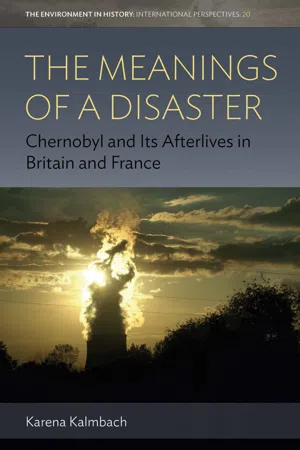
The disaster at the Chernobyl nuclear power plant was an event of obviously transnational significance—not only in the airborne particulates it deposited across the Northern hemisphere, but in the political and social repercussions it set off well beyond the Soviet bloc. Focusing on the cases of Great Britain and France, this innovative study explores the discourses and narratives that arose in the wake of the incident among both state and nonstate actors. It gives a thorough account of the stereotypes, framings, and "othering" strategies that shaped Western European nations' responses to the disaster, and of their efforts to come to terms with its long-term consequences up to the present day.
Trusted by 375,005 students
Access to over 1.5 million titles for a fair monthly price.
On the night of 25–6 April 1986, the Lenin nuclear power plant, situated approximately 100 km north of the Ukrainian capital Kiev, was the scene of an accident that would go down in history under the name of the nearby town Chernobyl. The Lenin plant consisted of four RBMK model1 reactor units, each capable of generating up to 1,000 Megawatts. The plant had been built in the 1970s and 1980s, and two new blocks were under construction in 1986. The nearby city of Pripyat was founded at the same time to serve the power plant. One of the most modern cities at that time in the USSR, Pripyat attracted young engineers and their families from all over the country. This symbiotic industrial-living-complex was considered the materialization of the USSR’s technical progress. On this night in April, during a systems test, a series of explosions occurred in unit number four. The cooling system broke down and the graphite, used as a moderator in RBMK reactors, caught fire. As the thermal explosions destroyed the building housing the reactor, radioactive material was released directly into the environment.2 The fires generated smoke and dust that carried radioactive particles high into the air, leading to a global dispersion of the radionuclides. The intensity of local contamination, however, depended on more than just the movement of the air masses. It also depended on the meteorological constellations and geographical settings. Chernobyl was not only a transnational event in regard its physical fallout. The media coverage also spread on a global scale. The USSR public only read about the events on 28 April, in a news brief released by the state press agency TASS, and no further information was provided. Several days later, Soviet television reported two deaths and declared that the radiation situation had been stabilized. At the same time, the media in the West, alarmed by the detection of radioactive fallout in Scandinavia, were already speculating about the causes of the accident and the possible total death toll. While the emergency measures were still ongoing, anti- and pro-nuclear activists outside the USSR were already fighting over the interpretation and political consequences of Chernobyl. Firefighters were only able to extinguish the graphite fires days later, after which clean-up workers moved in to replace them. These ‘liquidators’, as they were called, were responsible for decontaminating the other plant buildings, but also erected the ‘sarcophagus’ – the containment building that even today encloses destroyed reactor number four – and buried the contaminated soil, machines and debris. In all, more than 600,000 men and women were called to Chernobyl to work in the cleanup crews. Although the other three units were reconnected to the grid by the end of the year, an area with a radius of 30 km around the plant was declared a ‘forbidden zone’ and placed under military control. All the people in this region were evacuated, most of whom hoped and believed that they would soon return to their homes. But that would never happen. Pripyat became a ghost town and the smaller settlements in this region were demolished in the ensuing years. As measurements of the radioactivity in the environment continued to reveal dangerously high levels in the most contaminated areas of Belarus – the country hit with the most intense fallout – the initial number of 116,000 evacuees climbed to 350,000.3
Initial Media Reporting
The news of the accident in Chernobyl reached France and the UK at the same time. In France, the Première cohabitation – with François Mitterrand as President and Jacques Chirac as Prime Minister – was confronted with the events in the Ukraine, while in the UK, Margaret Thatcher’s government received the news. Both nations’ public authorities initially proclaimed the radioactive fallout would not have any serious impact on their country. This statement was profoundly called into question in France, resulting in an intense debate on whether the authorities had deliberately held back the true figures of the fallout intensity, a polemic referred to as the affaire Tchernobyl. In Britain, strong restrictions had to be implemented on sheep farms some weeks after the accident. Apparently, highland sheep had become too radioactive to be marketed after grazing on contaminated soil; however, these restrictions did not cause a long-lasting public scandal. This chapter focuses on why the dangers associated with the radioactive fallout deposited in France and Britain as well as the public experts’ role in evaluating this fallout were perceived so differently in these countries. The French and British news reports discussed below show how the public first learned about the accident.
In order to dive into the situation in Britain in 1986, this section provides a selection of the early British news reports on Chernobyl, published in the daily national broadsheet newspaper the Guardian.4 ‘Radioactive Russian Dust Cloud Escapes’ was the headline presented to the British public on 29 April; it was the first article the Guardian released about the Chernobyl disaster. Readers were informed that ‘a major nuclear power accident in the Soviet Union yesterday sent a cloud of radioactivity drifting across much of Scandinavia’.5 The article went on to quote the TASS announcement: ‘An accident has occurred at the Chernobyl nuclear power plant as one of the reactors was damaged. Measures are being taken to eliminate the consequences of the accident. Aid is being given to those affected. A government commission has been set up’.6
Apart from reporting on the radiation levels in Scandinavia, the article focussed on the technical details regarding radioactive fallout detection, not the potential health hazards. Hence, a positive story of British preparedness was provided: ‘If the Soviet plume begins to drift towards Britain – and there have been easterly winds – the National Radiological Protection will quickly pick up the signs from its fall-out monitoring stations’.7
The articles in the Guardian the following day addressed other aspects of the accident. Not only was the situation at the site of the accident itself discussed,8 but also the context of global energy policies,9 and the potential impact of this disaster on national movements in Belarus, Ukraine, Latvia and Lithuania.10 An entire article was dedicated to the particularities of the RBMK reactor, interestingly mentioning that ‘it was also a graphite-uranium core which caught fire in the Windscale accident of 1957, releasing large amounts of radioactive iodine and other materials over a wide area’.11 Comparisons to the Windscale Fire – the worst accident ever to have occurred at a British nuclear plant12 – were also made in this article to describe the ongoing situation at Chernobyl, touching on such aspects as the levels of radioactivity, the size of particles released into the environment and the actions taken to extinguish the fires. The author of this article was rather critical of the first official statements, asserting that: ‘although it is being claimed by Western “experts” that all power reactors in the West have secondary containment, this is not true. Britain’s Magnox reactors – which have dominated the nuclear programme – are without secondary containment because it was regarded as unnecessary at the time they were designed’.13
In another article, journalist David Fairhall took his analysis of the official statements on Chernobyl a step further, questioning the reasons for the strategy to distantiate the RBMK reactor and events in the Soviet Union from the actual situation in the UK:
The winds in Russia are blowing eastwards, not westwards towards the UK, and the burning Chernobyl reactor is of a type not used in the West. So can we now relax and get on with our own nuclear power programme without worrying about the Soviet disaster? That is certainly what the British nuclear industry will be recommending. They will point out that the Chernobyl plant is a peculiarly Soviet design …14
Thus, in the immediate aftermath of the accident at Chernobyl, the articles in the Guardian already made a direct connection between Chernobyl and the British nuclear enterprise. The event was first explained by comparison to the national Windscale Fire incident, then the articles enquired how the Chernobyl accident would impact the new build Pressurized Water Reactor (PWR) project in Sizewell. With regard to national nuclear policies, the journalists expressed a strong perception of personal affectedness. With regard to the possible (health) effects of the fallout in Western Europe, however, their perceived personal affectedness was quite low: ‘In Britain it seems unlikely that we shall feel any effects at all’.15
Reporting over the next days was primarily concerned with the British students evacuated from Kiev,16 speculations on the death toll17 and the debate over whether the accident should impact the new build project Sizewell B,18 an openly contentious issue within the Labour Party.19 Although the potential impact on health in the UK was further discussed, it did not dominate the headlines. Regardless of the fact that medical correspondent Andrew Vletch’s article ‘Parents Scour Chemists Shops for Iodine Tablets’ clearly stated that there would be health effects in the UK, albeit very minor ones, his column only made page six on 2 May. According to Vletch, ‘all it [the low-dose radiation from Chernobyl] will do is increase the incidence of cancer by an undetectable amount over the next 20 or 30 years’.20 Interestingly, however, this article quoted Joseph Rotblat’s statement, ‘it would be nonsense to start taking iodine tablets. People are panicking because the reports of what has happened in Russia have been exaggerated’. This all-clear came from the most well-known opponent of nuclear weapons, a man who had received the Nobel Peace Prize for his efforts to achieve a nuclear weapons test ban and nuclear disarmament, and who had worked intensively on the health impact of nuclear fallout. Without a doubt, his statement was received within the circle of nuclear critics as utmost credible. The front-page article the very next day in the Guardian (3 May) corroborated this rather untroubled stance on radioactivity levels in Britain. The article, headlined ‘Radiation Cloud Reaches Britain’, informed readers that ‘the radioactive cloud from the Soviet nuclear disaster reached Britain yesterday. But the National Radiological Protection Board [NRPB] described the contamination level as very low and the Department of Health said it posed no health risk to the public’.21 The article quoted Donald Acheson, the Department of Health’s Chief Medical Officer, who stated: ‘there was absolutely no need to take pot...
Table of contents
Cover
Title Page
Copyright Page
Contents
List of Abbreviations
Introduction
Chapter 1. 1986–1988: Direct Reactions and Early Narratives
Chapter 2. 1989–2005: Chernobyl Memory in the Making
Chapter 3. 2006: The Chernobyl ‘Renaissance’ within the ‘Nuclear Renaissance’
Conclusion
Epilogue
Bibliography
Index
Frequently asked questions
Yes, you can cancel anytime from the Subscription tab in your account settings on the Perlego website. Your subscription will stay active until the end of your current billing period. Learn how to cancel your subscription
No, books cannot be downloaded as external files, such as PDFs, for use outside of Perlego. However, you can download books within the Perlego app for offline reading on mobile or tablet. Learn how to download books offline
Perlego offers two plans: Essential and Complete
Essential is ideal for learners and professionals who enjoy exploring a wide range of subjects. Access the Essential Library with 800,000+ trusted titles and best-sellers across business, personal growth, and the humanities. Includes unlimited reading time and Standard Read Aloud voice.
Complete: Perfect for advanced learners and researchers needing full, unrestricted access. Unlock 1.5M+ books across hundreds of subjects, including academic and specialized titles. The Complete Plan also includes advanced features like Premium Read Aloud and Research Assistant.
Both plans are available with monthly, semester, or annual billing cycles.
We are an online textbook subscription service, where you can get access to an entire online library for less than the price of a single book per month. With over 1.5 million books across 990+ topics, we’ve got you covered! Learn about our mission
Look out for the read-aloud symbol on your next book to see if you can listen to it. The read-aloud tool reads text aloud for you, highlighting the text as it is being read. You can pause it, speed it up and slow it down. Learn more about Read Aloud
Yes! You can use the Perlego app on both iOS and Android devices to read anytime, anywhere — even offline. Perfect for commutes or when you’re on the go. Please note we cannot support devices running on iOS 13 and Android 7 or earlier. Learn more about using the app
Yes, you can access The Meanings of a Disaster by Karena Kalmbach in PDF and/or ePUB format, as well as other popular books in History & European History. We have over 1.5 million books available in our catalogue for you to explore.