Drawing from political sociology, pop psychology, and film studies, Cinemas of Boyhood explores the important yet often overlooked subject of boys and boyhood in film. This collected volume features an eclectic range of films from British and Indian cinemas to silent Hollywood and the new Hollywood of the 1980s, culminating in a comprehensive overview of the diverse concerns surrounding representations of boyhood in film.
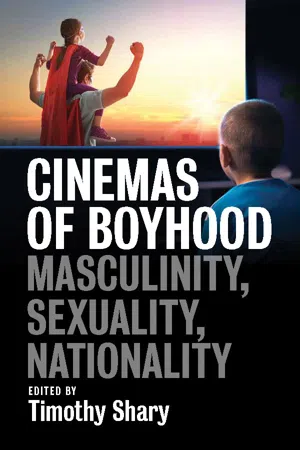
- 192 pages
- English
- ePUB (mobile friendly)
- Available on iOS & Android
eBook - ePub
About this book
Trusted by 375,005 students
Access to over 1.5 million titles for a fair monthly price.
Study more efficiently using our study tools.
Information
Chapter 1
Transition, Crisis and Nostalgia
Youth Masculinity and Postfeminism in Contemporary Hollywood, an Analysis of Superbad
Introduction
In this chapter we seek to understand the ways in which youth masculinities and boyhood are constructed and represented in popular teen comedy cinema by examining the film Superbad (Greg Mottola 2007). We argue that we need to take into account the impact that postfeminism has had on the representation of boyhood because the pervasiveness of postfeminist discourse has rarely been explored in the interrogation of men and masculinity. Given the centrality of male protagonists in contemporary Hollywood film, this is a particularly important endeavor.
We undertake close textual analysis to position the narrative themes and comic motifs of Superbad in both the historical context of Hollywood coming-of-age comedies, as well as the post-millennial adult comedies that surrounded its release. Superbad’s interception of these two types of comedy film will be analyzed through the film’s relational representation of youth and adult masculinities, highlighting a theme common to both the coming-of-age format and comedy of immaturity—the temporal.
The narrative of Superbad follows best friends Seth and Evan and their friend Fogell as they navigate their final weeks of high school. Their journey takes them on a quest for alcohol for a big party, where they hope to lose their virginity with female classmates Becca and Jules. On their way they encounter many hurdles, including a brush with the law, angering jealous drug dealers, and fights. The central role of these teenage boys provides a starting point from which to make sense of the representation and construction of youth masculinities, particularly when understood in relation to adult male characters, such as the cops (Officer Slater and Officer Michaels) and the driver (Francis) whom they encounter en route to the party. We draw on discourses of postfeminism, and, more specifically, we consider the emphasis postfeminism places on time, generation, and chronology within the life cycle. Given the centrality of male characters in the film and in focusing on the temporal aspect of youth masculinities in Superbad, we will, inevitably, be unable to analyze all representations of youth masculinity and boyhood that the film offers. However, what we do wish to illustrate throughout this chapter is the importance of understanding youth masculinities as relational and culturally contingent, which is heightened through the representations of masculine temporal struggles represented in Hollywood comedies more broadly. We therefore provide a rich contribution to a relatively underdeveloped field in film and cultural studies—the representation and construction of boyhood and youth masculinities.
Exploring Postfeminism in Superbad
There has been burgeoning academic debate surrounding the ways in which notions of postfeminism have become normalized in Western culture. Post-feminism, and the idea that feminism has had its day, has had a profound influence on culture and thus the discourses that govern identity.
Postfeminism has been understood in a number of ways in both academia and the media, with both celebration and criticism. Gill and Scharff outline four of these contexts and the extent to which these postfeminisms might be positive or negative conditions. They discuss postfeminism as “an epistemological break from feminism” (2011: 3), referring to a transformative condition moving away from “hegemonic” (3) second wave feminism in order to incorporate greater social diversity. Second, they outline understandings of postfeminism as code for an historical shift away from feminism, a condition in which feminism is past, complete, or in any case no longer necessary, described by Genz and Brabon as a “generational shift between the relationship between men and women and for that matter, women themselves” (2009: 3). As noted by Leonard regarding the film Monster-In-Law (2005), this generational battle is fought in popular culture under fierce competition since the postfeminist icon “publicly flogs” (2009: 114) feminist attributes in order to establish a new state of femininity.
The third postfeminist context is that of backlash against feminism and the direct criticism of that which is understood to be feminism’s fault—here, the weakening of masculinity. The loss of feminine virtue and the emergence of a hostile battleground of gender and sexual politics are all problems that feminism is perceived to have created.
Lastly, in reference to McRobbie’s work (2004), postfeminism is described and criticized as a state of tension for femininity, freedom and female power. In this “sensibility” (Gill 2007: 147), feminism is both visible and disavowed since women are seen to enjoy conspicuous freedoms as a result of feminist activism but in exhibiting such freedoms disavow the need for feminism henceforth. The parameters in which the successful postfeminist character is constructed and the freedoms she enjoys because of feminism are also strictly controlled. The postfeminist state is one of being independently wealthy and ultimately a healthy and proactive consumer. The postfeminist heroine’s relationship to men is also a site of this tension: even though she has the opportunity to live without a dependency on men, her life often orients around her romantic and sexual relationships with men. Postfeminism’s satisfactory conclusion of the narrative is one of heterosexual marriage and often the heroine’s departure from employment.
Much of the contemporary feminist debate places particular emphasis on the ways in which the postfeminist context has had an impact on femininities and female culture. While there has not been an absence of masculinity in these postfeminist works, there has been relatively little attention given to the topic, and even less so to youth masculinities. This reflects the relatively under-explored field of boyhood in film studies. However, we believe that the lens of postfeminism offers an insightful way in which to understand the multiple and complex ways in which boyhoods are constructed and (re)presented in contemporary Hollywood movies.
Superbad and Postfeminism’s Preoccupation with the Temporal
Critiques of postfeminism have identified a range of themes that can be applied to a reading of boyhood in relation to Superbad. However, postfeminism’s “distinct preoccupation with the temporal” (Tasker and Negra 2007: 10) is of particular interest in a consideration of the representation of youth cultures. Postfeminist “preoccupation with the temporal” has led to a rise in anxieties about aging (Negra 2009), with, in the case of femininity, emphasis placed on girlishness and adolescence. This had led to what Wearing has argued is the normalization of “chronological decorum” (2007: 298) within popular culture. While in this instance she refers more specifically to the temporal constraints of aging, it also bears relevance to youth since being young also requires the performance of particular appropriate gendered behaviors (as found in the empirical work of Cann (2014) and Ging (2005)). Therefore, if we consider gender to be relationally constructed, youth masculinities must be situated in relation to adult masculinities, which carry with them their own chronological proprieties, and thus performances of being masculine. This leads us to the works of West and Zimmerman (1987) and Butler (1990) through which we must understand gender as performed and thus contextually contingent. Masculinity in boyhood can therefore be understood as a contextually contingent performance, following the work of Chu (2014) and Corbett (2009). This understanding of gender can be problematized when placed within a postfeminist framework since gender is simultaneously promoted as both equal and thus irrelevant, or irrevocably unequal and thus essential.
In film, as discussed below, boyhood has been conceptualized as being extended, with the “moratorium on adulthood put back further and further” (Pomerance and Gateward 2005: 3). This mirrors the preoccupation with feminine youthfulness in postfeminist culture. However, we suggest that in the case of youth masculinity this preoccupation with youth can be understood as the delaying of adult masculine gender roles, more so than the resistance of physical biological aging, which is often the case in postfeminist feminine gender cultures. The departure here from the postfeminist preoccupation with being and looking young, as desirable femininity has been described, is that for masculinity, extending youth beyond childhood is a site of crisis, not of virtue.
In the case of Superbad, the understanding of where boyhood ends is informed both by age and the appropriate responsibilities signified in characters who are either entering manhood, or already constructed as men. For Seth and Evan, their transition to manhood can be navigated only through rites of passage. This understanding can be seen in contemporary Hollywood comedy more widely, and one of the central ways in which boyhood is marked as ending in these narratives is through the completion of high school. As Gateward (2005) has noted, graduating from high school is marked as a rite of passage into adulthood in this genre and so its centrality in Superbad makes the film a rich text for analysis.
Contemporary Youth Masculinities
It is useful to reflect on young masculinities, their normalization(s) and reproduction within the shifting academic context of masculinity theory. As Benwell (2003) has noted, defining masculinity itself can be problematic, and compared to women’s studies, critical men’s studies and studies of masculinity are still somewhat in their early days (Roberts 2014), particularly in the field of film studies (Shary 2013; Greven 2009; Baker 2006; Osgerby 2004; Powerie, Babington, and Davies 2004). The timeliness of this examination of Hollywood representations of youth masculinity can be illustrated by the current academic context; masculinity studies, and particularly young masculinity studies, is at a decisive moment in its history, with its central theory of hegemonic masculinity being placed under ever increasing scrutiny by proponents of inclusive masculinity theory (such as Anderson 2009 and McCormack 2012).
Connell’s (2005) hegemonic masculinity theory nevertheless remains pervasive within academia, and its application of hegemony as the means of understanding how a particular form of masculinity is able to guarantee the dominant position of (particular types of) men is appealing to many academics working in this field. By using hegemonic masculinity theory we are able to make sense of the ways in which traditionally masculine stereotypes are used as reference points in a range of contemporary Hollywood films.
In this chapter we deconstruct masculinity as an essential category and work through the ways in which it is nevertheless constituted as a normative category in these representations. As a result, we follow the argument that masculinities are both “constructed in discourse and used in discourse” (Connell and Messerschmidt 2005: 842), arguing that these discourses can be contained both in and outside the texts offered by Hollywood. It has often been argued that masculinity has “been understood as meaningful only in relation to femininity and as constructed as through an interplay of opposites and alternatives” (Pattman, Frosh and Phoenix 1998: 125). Our thesis is thus that masculinity is not only relational to femininity, but, importantly, it is also generationally relational (in and between older and younger men and masculinities). Some of these temporal tensions of masculinity can be better understood through the lens offered by postfeminism (discussed above). Therefore postfeminism has an impact not only the experiences of women and femininity, but also on men and masculinity.
Masculinity in Crisis?
Resulting from what have been seen to be women’s increasing gains through feminism, the academic literature has charted a number of changes in the ways in which men experience masculinity (Roberts 2014). Men are said to be in crisis, characterised by panic and/or anxiety, a perception of power or privilege lost and a broader sense of “powerlessness, meaninglessness and uncertainty” (Edwards 2006: 7–8). The fragility of masculinity places it under threat of collapse, and is thus understood as an “impossible ideal” (Kirkham and Thumin 1995: 11).
Gill notes that while there have been many attempts to classify masculinities, “none have had the staying power of ‘new man’ and ‘new lad’” (2003: 36) and these new incarnations of masculinity can be seen, at least in part, as embodiments of a new era of masculinity. While the new man is understood to be a consumer, a narcissist, and to be physically and mentally soft (Benwell 2003; Beynon 2002), the new lad is meanwhile theorized as “a clear reaction to the ‘new man,’ and arguably an attempt to reassert the power of masculinity deemed to have been lost by the concessions made to feminism by the ‘new man’” (Benwell 2003: 13). Benwell notes that there is an ethnic whiteness to the new man, who addresses women only as sexual objects. As we explore below, the tensions between the new man and the new lad are played out within the Superbad narrative through the characters of Seth and Evan.
However, in terms of boys’ lives we question the extent to which this so-called crisis is a new one. For example, Tebbutt writes that as boys grew to manhood during the inter-war years, they negotiated “areas of anxiety and vulnerability” (2012: 27). Meanwhile, in the representations of other twentieth-century masculinities, Doherty notes that the “teenpic hero” is more often a “hapless kid seeking direction, not a tough rebel fleeing restriction” (1988: 237). These are discourses that we argue can also be evidenced in the worlds and masculinities of the boys in Superbad.
For Faludi, the postfeminist environment places manhood “under siege,” and this is articulated through matters of virility, unemployment, and a demographic of male consumers dubbed “the Change Resisters” (1999: 7). For contemporary Hollywood comedies, the resistance of change, and particularly responsibility, is at the center of male protagonists’ crisis states; their masculinity fails to live up to the post-war male ideal of being “masters of the universe” (5) and seeks comfort in adolescent behavior and humor. This comfort in adolescence has been described as a “nostalgic retreat” (Benwell 2003: 14) with “cultures of prolonged adolescence” resulting from “male redundancy” (Rutherford 1997: 7). Thus, it can be said that “white American men cling ever more tenaciously to old ideals” (Kimmel 2012: 240), leading to what Rehling describes as a self-fulfilling prophecy of “masculinity in crisis” (2009: 3). The pervasiveness of discourses of masculinity as being in crisis therefore require us to understand what this means and how it is represented as relating to boys’ lives in cotemporary popular film—the latter being particularly pertinent since boys have often been overlooked in these theorizations of crisis and of postfeminism.
Representing Youth (and) Masculinity
Coming-of-age discourses are ones that have crossed Hollywood genres—comedy, drama, horror and musical—all using peer pressure, puberty and rites of passage to explore the human condition. Because of the nature of a narrative that considers the characters’ emotional, physical and behavioral maturation, these movies are intrinsically linked to notions of the temporal—childhood, adolescence, adulthood and transition.
In the instance of the coming-of-age comedy, much of the comic business of these movies is derived from the discrepancy between the adult behavior the teens wish to engage in, and the restrictions placed upon them by their age, and by authority figures. In terms of narrative, these movies often depend on the struggle that occurs when the teens pursue their urges for (heterosexual) sex and alcohol, and their desire for freedom; they have to navigate their own ages in order to pursue what they perceive t...
Table of contents
- Cover
- Title Page
- Copyright Page
- Contents
- List of Illustrations
- Introduction
- Part I
- Part II
- Index
Frequently asked questions
Yes, you can cancel anytime from the Subscription tab in your account settings on the Perlego website. Your subscription will stay active until the end of your current billing period. Learn how to cancel your subscription
No, books cannot be downloaded as external files, such as PDFs, for use outside of Perlego. However, you can download books within the Perlego app for offline reading on mobile or tablet. Learn how to download books offline
Perlego offers two plans: Essential and Complete
- Essential is ideal for learners and professionals who enjoy exploring a wide range of subjects. Access the Essential Library with 800,000+ trusted titles and best-sellers across business, personal growth, and the humanities. Includes unlimited reading time and Standard Read Aloud voice.
- Complete: Perfect for advanced learners and researchers needing full, unrestricted access. Unlock 1.5M+ books across hundreds of subjects, including academic and specialized titles. The Complete Plan also includes advanced features like Premium Read Aloud and Research Assistant.
We are an online textbook subscription service, where you can get access to an entire online library for less than the price of a single book per month. With over 1.5 million books across 990+ topics, we’ve got you covered! Learn about our mission
Look out for the read-aloud symbol on your next book to see if you can listen to it. The read-aloud tool reads text aloud for you, highlighting the text as it is being read. You can pause it, speed it up and slow it down. Learn more about Read Aloud
Yes! You can use the Perlego app on both iOS and Android devices to read anytime, anywhere — even offline. Perfect for commutes or when you’re on the go.
Please note we cannot support devices running on iOS 13 and Android 7 or earlier. Learn more about using the app
Please note we cannot support devices running on iOS 13 and Android 7 or earlier. Learn more about using the app
Yes, you can access Cinemas of Boyhood by Timothy Shary in PDF and/or ePUB format, as well as other popular books in Social Sciences & Film History & Criticism. We have over 1.5 million books available in our catalogue for you to explore.