![]()
On the Death of Jews
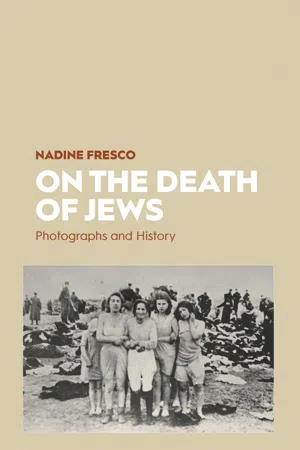
The eight photographs that open this book are among the very few that show the death of Jews at the moment of its execution during the Second World War. Because so few exist, it is these we often see. In books, films, and exhibits, and on websites that deal with this death as it was underway.
To whom do these photographs belong? Who owns the rights to them? And what rights come into play here? Moral right? The copyright, a right so widespread that it only needs the laconic but vigilant symbol ©? As soon as such questions are posed, they reveal conflicts of interest that are often as intense as they are dynamic and shifting. These issues have become even more pointed now that history and memory have gone “online”: questions involving appropriation are constantly being raised by the Internet. The eight photographs reproduced here illustrate with abundant clarity this mobility of conflicts and the instability of the agreements put in place to shut them down.
In the 1990 edition of The Pictorial History of the Holocaust, a book published by the Israeli museum Yad Vashem, these photographs fell under the copyright designation “All photos © Yad Vashem, Jerusalem.”1 For years, some of these shots could be found on the Simon Wiesenthal Center website together with the Center’s copyright symbol, after which most of them remained there, but with no copyright designation.2 Also, six of the eight photographs reproduced here spent years on the United States Holocaust Memorial Museum (USHMM) website under the copyright designation “Copyright: Public Domain.” Until one day in July 2008, when they promptly disappeared.3
Like other documents, these photographs are not, by virtue of their very existence, protected against identification errors. Some are captioned as coming from elsewhere than the place where the murders they show happened, while others, made elsewhere, are said to have been taken in that place.
Solely by virtue of their existence, these photographs have been no more immune than other documents from shameful exploitations. And there have been plenty of them. The creators of a short-lived Jewish anti-Palestinian website, for instance, insulted the memory of its coreligionists by posting images of their persecuted faces and bodies, including those of the woman and three adolescents advancing naked with arms crossed to shield them from the cold, “in case the Arab world and their oil-thirsty supporters have forgotten what a real Holocaust is.”4
Alain Resnais’s 1956 film Night and Fog includes one of these photos.5 The one with the woman and the three adolescents. Around the twentieth minute of this half-hour long film, we are shown a train full of dead bodies piled on top of one another. The voice-over, written by Jean Cayrol,6 says, “For some, the selection has already been made. For others, it is made right on the spot. Those on the left will go to work. Those on the right. . . .7 These images were taken a few minutes before an extermination.” Just as this final phrase is being uttered, a silent sequence of five shots containing five photographs begins—photographs of people who are mostly undressed or already naked a few moments before their extermination. The fourth is that of the woman and the adolescents. Resnais came across some of these photographs in the collections of the Jewish Historical Institute in Warsaw. The fourth he found in Paris in the archives at the Center for Contemporary Jewish Documentation.8 A series of shots without comment, then. As they say, the images speak for themselves. The commentary starts up again, this time in front of a row of cylinders that have a skull and crossbones on them: “Killing by hand takes time. Cylinders of Zyklon gas are ordered.” In 1956, the five photographs that appeared in Night and Fog were hardly known, if at all. Hearing the voice-over that precedes and follows these images, at the same time as seeing the buildings of a camp, the viewer thinks that these “few moments” are happening just before the deportees are to be taken to the gas chamber. He does not know that these undressed persons are going to be killed elsewhere, in the open air and by firearm, a few moments later.9
American documentary filmmaker Leo Hurwitz is put in charge of the video recording of the hearings for Adolf Eichmann’s trial, which begins in Jerusalem on 11 April 1961. At the request of the prosecution to make the presentation of facts “more vivid and concrete,” as prosecutor Gideon Hausner puts it, Hurwitz also makes a one-hour long film—a montage consisting of extracts from several documentaries, including Night and Fog.10 This montage is screened on 8 June during a closed session, journalists excepted. The photograph of the woman and the three adolescents is included in this montage. Eichmann sees it on that day for the second time in Jerusalem: days earlier, when court was not in session, they had screened Night and Fog for him to watch from the “glass cage” in which, for security reasons, he made his court appearances for the entire duration of the proceedings.11 Leo Hurwitz also films this session during which Eichmann, in a practically empty courtroom, watches the Resnais film in its entirety.12
Images en abyme. The viewer watches Eichmann watching a film in which he sees the naked woman and adolescents, whose photograph had been taken a few moments before their deaths.
Gerhard Schoenberner, a political science student in West Berlin, is twenty-six years old when he goes to Poland in 1957 with some other German students. They are taking advantage of the “Polish October” atmosphere of the previous year, a sign of the “thaw” that had begun in the Eastern Bloc following Stalin’s death. They go to visit Auschwitz then, at a time when such visits are still very rare. Upon their return, these German students are even more aware than they were before the trip of how crucial it is for their compatriots to confront head-on the crimes that had been perpetrated by their country. But the Germany of that time did not want to see, and the elites, having largely collaborated, had also largely succeeded in returning to their former positions. “I do not know anyone my age,” reports German writer Lothar Baier (1942–2004), “who learned anything in school about the camps, the SS, the Nazi party, their racial policies, the program to exterminate the Jews. When anyone brought up the period 1933 to 1945, it was to talk about the war. Our teachers, mostly former combatants, substituted a history lesson with stories about their own heroic deeds. The Nazi system was passed over in silence, quite simply because practically all of our teachers had emerged from it.”13 Schoenberner and his friends succeed in organizing an exhibition that opens in the spring of 1960 in West Berlin’s Kongresshalle before touring other large West German cities. Entitled “The Past Exhorts: An Exhibit of the History of the Jews and Their Persecution under the Third Reich,” it is the first exhibition of its kind in the Federal Republic.14 During the same period, Schoenberner continues his search for images with the aim of collecting them into a volume, and travels to many centers housing archives. To London, Paris, Warsaw, Amsterdam. To Moscow, too, where, at the State Archives in 1959, as he is sorting through copious boxes filled with photographs—the majority of which were of little interest and poor technical quality—he stumbles upon a “real discovery.” A series that he had not seen anywhere up to that point and that had not yet been published anywhere.15
The eight photographs reproduced here belong to this series.16
Schoenberner’s book appears late in 1960 under the title Der gelbe Stern (The Yellow Star). It contains nearly two hundred photos documenting the persecution of the Jews in Europe.17 Five of them come from the series that he discovered in Moscow.18 As an epigraph to the introduction to the book, he cites a line of verse by Klabund: “Germany, you ought to forget neither the murdered, nor the murderers!”19 The epigraph that he chose for translations of Der gelbe Stern is itself an epigraph: “Let others speak of their shame, I speak of mine”—written in 1933 by Bertold Brecht for his poem “O Deutschland bleiche Mutter” (“Oh Germany, pale mother”).20 Born two years before Hitler came to power, Gerhard Schoenberner had been strongly immunized against Nazism by his family environment since early childhood. His father and one grandfather were pastors. An uncle, Franz Schoenberner, was the last managing editor of the satirical magazine Simplicissimus before the Gleichschaltung began in March 1933.21
Because it is written without pathos, without posturing or outbursts, and in a “subdued tone,”22 Gerhard Schoenberner’s introduction to Der gelbe Sterne shows all the more powerfully what it must have been like for this young man in the late 1950s and early 1960s to have to confront both such a recent past and his compatriots, who did not want to see. He writes on the first page:
What is shown in this book is our own deed. It happened through us, even if we did not commit it ourselves. We tolerated it—it concerns us. That is why we stand embarrassed before it and would prefer not to know about it. The persecution of the Jews was only one—but the most terrible—among countless others committed by the Nazis. It provides a particularly clear example of the inhuman nature of Nazi ideology and the criminal character of its practice. The mass murder of millions of innocent people was no perversion of National Socialism, but the logical application of its inherent principles. There is already an extensive literature on the phenomenon of antisemitism and on the gas chamber regime that was its dreadful realization. This book attempts to tell in pictures the story of the persecution of the Jews by the Third Reich. It is a book of the dead. All the people pictured here, unless exceptionally good fortune saved them, were murdered. Only their persecutors, unless exceptional misfortune took them, are still alive.23
Five of the eight photos reproduced here were made publicly available for the first time in that book of the dead, first published in Germany in 1960. They have not stopped circulating since.
Hanns Eisler, the composer for the music in Night and Fog, had been living in Berlin since 1925 but found himself in Vienna, where he had grown up and studied under Arnold Schoenberg, when Hitler came to power in January 1933. He was twenty-seven years old at the time. Jewish, a composer of committed works and numerous Kampflieder (battle songs), and a music critic for the Communist daily Die rote Fahne (The Red Flag)—although never a member of the Communist Party, Eisler is one of many artists, writers, and German politicians who were forced into exile to escape from a mother who had suddenly gone pale and was throwing into horror the “period of teeming intellectual development, social inventiveness, and cultural experimentation between the end of the Second Reich and the emergence of the Third.”24 Just one year before, Brecht had brought an entirely different Mother to the stage, based on the novel by Maxim Gorky and accompanied by the music of Hanns Eisler. A collaborative creation among many others, one which they worked on in Berlin before exile, then in California where they would find each other again in 1938, and again in Berlin—this time East Berlin—where Brecht and Eisler both ended up after being forced to leave the United States during the Cold War.
When distribution for the film is being organized in West Germany, Eisler recommends Brecht and his wife Helene Weigel as translators of the narration, which, he thought, would be of a “more concise and brutal” sort than the “too written” one of Jean Cayrol.25 But in the middle of the Cold War, the Federal Republic of Germany is not going to risk having two East Berlin authors in charge of the work. During the same period, incidentally, the Federal Press Office (Bundespresseamt), which is responsible for covering the costs of the translation, simply attempts to have Eisler’s name removed from the credits. But without success. At the suggestion of Cayrol himself, this translation of Nuit et brouillard, which was released in 1957 under the title Nacht und Nebel, was entrusted to the poet Paul Celan.26 He who, in a speech he gave a little later when receiving the Bremen Literature Prize, said of the German language—his language:
Reachable, near and not lost, there remained in the midst of the losses this one thing: language.
It, the language, remained, not lost—yes, in spite of everything. But it had to pass through its own answerlessness, pass through frightful muting, pass through the thousand darknesses of deathbringing speech. It passed through and gave back no words for that which happened; yet it passed through this happening. Passed through and could come to light again, “enriched” by all this.27
Hanns Eisler composed the music for the anthem of the German Democratic Republic, which did not prevent him from defending the works of Schoenberg against denunciations by Stalinist bureaucracy. In the Dorotheenstadt Cemetery in Berlin, where Brecht was buried in 1956 and Eisler in 1962, their tombstones face each other.28
The fact that Eisler’s name appears even before Jean Cayrol’s in the credits to Nuit et brouillard seems to indicate how important the musical score was to Resnais, who insisted that it be uninterrupted, “the only continuous voice in the entire film.”29 The sequence of the five photographs, including the one with the woman and the adolescents, arms crossed, is wordless but not silent. The brass and the flutes that accompanied the narrator’s voice up to that point go silent just as he breaks off, and it is the stripped-down phrase of a violin that sustains the sequence of these photographs (it is as stripped-down as is the narrator’s voice—that of actor Michel Bouquet, who later commented on “the difficult work of undercutting emotion” that Resnais had demanded of him, “of arriving every time at absolute neutrality in spite of the emotion [that he] felt”).30 Without necessarily being aware of it, the viewer thus finds him- or herself protected by this deep and calm melody from the potentially staggering effect of the wordless images. In some cases, later, nothing remains of this sequence but Eisler’s phrasing, and then it is t...