The UNESCO World Heritage Convention is one of the most widely ratified international treaties, and a place on the World Heritage List is a widely coveted mark of distinction. Building on ethnographic fieldwork at Committee sessions, interviews and documentary study, the book links the change in operations of the World Heritage Committee with structural nation-centeredness, vulnerable procedures for evaluation, monitoring and decision-making, and loose heritage conceptions that have been inconsistently applied. As the most ambitious study of the World Heritage arena so far, this volume dissects the inner workings of a prominent global body, demonstrating the power of ethnography in the highly formalised and diplomatic context of a multilateral organisation.
eBook - ePub
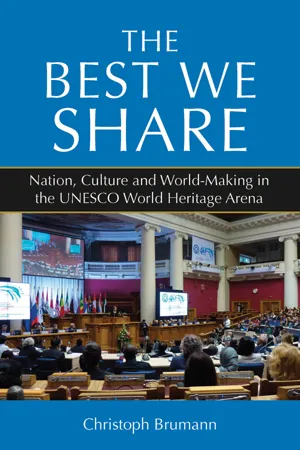
The Best We Share
Nation, Culture and World-Making in the UNESCO World Heritage Arena
- 316 pages
- English
- ePUB (mobile friendly)
- Available on iOS & Android
eBook - ePub
The Best We Share
Nation, Culture and World-Making in the UNESCO World Heritage Arena
About this book
Trusted by 375,005 students
Access to over 1.5 million titles for a fair monthly price.
Study more efficiently using our study tools.
Information
Chapter 1
A DAY IN THE LIFE OF THE UNESCO WORLD HERITAGE COMMITTEE

Saint Petersburg on Sunday, 1 July 2012. After little sleep and a hurried breakfast with a Kenyan delegate, I board a small shuttle bus arranged by the organizers, which takes us to the conference venue across the Neva River. Our large hotel has conserved its socialist heritage rather well in terms of Spartan rooms and intransigent staff. Although by no means cheap, it is still one of the least costly options, so on the bus ride I am surrounded by participants from the not quite so affluent countries such as Cuba, Chile and Slovakia; the Saudi Arabian delegate may just have booked too late for the posher places. On the short ride, I joke with the Kenyan delegate about his own possible inscription on the World Heritage List, given that so much is listed these days, and chat with a South Korean university professor about the lunchtime event her delegation organized yesterday. Participants have dressed formally, with my own suit and tie not standing out.
The driver drops us off at the Tauride Palace, which usually houses the meetings of the members of the Commonwealth of Independent States (CIS). Passing by the registration tent, we enter the grandiose classicist building through an airport-style security check with metal detectors. The tables lining the walkway to the large foyer are filled with promotional materials about World Heritage sites and candidates, and there are also the TV screens where the Japanese private station TBS Tokyo shows its acclaimed World Heritage documentaries. Special desks have been set up for such purposes as booking excursions and arranging return flights. There is no coffee yet in the foyer, so I walk up the stairs to the meeting hall where the pews are slowly filling up. I chat with Japanese participants about the upcoming fortieth anniversary celebration of the Convention, which they will organize in the autumn in Kyoto. Delegates of the International Council of Monuments and Sites (ICOMOS) complain to me about the new style of decision-making that ignores their expert advice. I install myself in the back rows reserved to ordinary, nonstate observers. On my notebook computer and with the Wifi access offered by the organizers, I see that the deliberate destructions of World Heritage properties in Timbuktu, Mali, which Islamist insurgents have been committing for several days now, are dominating global news headlines. World Heritage is clearly in the limelight.
The Morning Session
Shortly past 10AM and despite the troubling news, chairperson Eleonora Mitrofanova – the Russian Federation’s ‘Permanent Delegate’ (i.e. ambassador) to UNESCO – opens the morning session of the seventh day of the thirty-sixth World Heritage Committee session to routine business. This is the examination of this year’s nominations to the World Heritage List and, continuing with the cultural properties from the previous day, she calls up agenda item 36 COM 8B.37, ‘Schwetzingen: A Prince Elector’s Summer Residence’, a candidate submitted by Germany. As is usual when cultural heritage is concerned, she first hands over to ICOMOS whose representative is also seated on the podium facing the semi-circular pews rising in front of them. Supported by a PowerPoint presentation, this retired French professor of technical history takes a couple of minutes to summarize the evaluation, which has been online for six weeks. He reiterates that the nominated property lacks ‘outstanding universal value’ or ‘OUV’, the precondition for World Heritage listing. Instead, it does not distinguish itself from many other Baroque palaces and parks, so that ICOMOS advises rejection. As everyone is aware, adopting this verdict would seal the fate of the candidate by precluding submission of a revised nomination file in the future. Most states therefore quietly withdraw such bids ahead of the session, thereby avoiding a binding decision. But Germany has already done so in 2009 when Schwetzingen was up the first time and was also deemed unworthy by ICOMOS. Therefore, since extensive revisions of the nomination file have not improved the judgment, the delegation is determined to put up a fight.
Once the presentation is finished, the chair opens the debate, inviting the twenty-one Committee member delegations in the first rows to make their comments. To her right, the Director of the World Heritage Centre (the Convention secretariat) – an Indian nature conservation expert – assists her in giving the floor to the delegations in the order in which they raise their state name plates, turning them from horizontal to vertical in the groove of a small wooden block on their desks. The chair always calls up the state name, not that of the individual. The delegates then speak into their microphones for up to three minutes, using one of the two official working languages of English and French or the other languages for which treaty states have volunteered to sponsor interpretation (this time Russian, Spanish and Arabic). At the entrance, the several hundred participants in the hall have been equipped with small broadcasting devices with headphones for this purpose.
Colombia speaks first, followed by France, and soon the delegates find themselves embroiled in contention: Germany – itself on the Committee – complains that the ICOMOS evaluation, in addition to missing the full significance of the palace theatre, passes over the eighteenth-century mosque in the palace gardens, the oldest in Western Europe. The ICOMOS expert objects that this is just a small and unremarkable structure reflective of the Orientalist leanings of the time. Yet Qatar, Algeria and the United Arab Emirates declare themselves impressed by this symbol of religious tolerance and even propose immediate World Heritage inscription, a rather extreme turnaround; it looks as if the Germans have asked them for their support. In contrast, Switzerland, France and Senegal are sceptical, insisting on the difference to a real, functioning mosque, and this clearly upsets the German ambassador. Nobody brings up Timbuktu, where a World Heritage-listed mosque in continued usage is being mutilated while the Committee speaks. The Indian ambassador suggests ‘deferring’ consideration of the Schwetzingen property, the one of four customary decision options that allows for the resubmission of a substantially revised nomination file no sooner than two years from now. With other delegations voicing support, a compromise seems in sight. But then, the Swiss ambassador loses his patience and calls for a vote. After some confused back and forth, the legal advisor – a UNESCO official on the podium that the chair consults over procedural matters – clarifies that the Swiss demand is for a vote on the original draft decision, which is the provisional decision text drafted by ICOMOS and the World Heritage Centre that was put online ahead of the session.
The German ambassador hastens to declare that her delegation would be quite happy with the suggested deferral, but this does not prevent the Committee from sinking into rare depths of confusion for the better part of an hour, with participants forgetting their most basic procedural routines. For one thing, the Swiss proposal diverges from the usual practice to vote not on the decision text proper, but on proposed amendments to it. As a two-thirds majority is required for decisions regarding World Heritage inscription or noninscription, this ends up turning the numerical advantage against the strict line Switzerland has been demanding, a fact of which the delegation appears mysteriously unaware. When others point out the breach of usual practice, the legal advisor insists that no amendments to the draft decision have been received from the Committee members, and the usual recipient of such submissions, the rapporteur – a diplomat from member state Mexico, also on the podium, who is tasked with recording the decisions – does not interfere. However, the decision text on the big screens in the hall has an edit marked in blue that foresees inscription for Schwetzingen and gives the aforementioned Arab states as supporters. It is common practice for the typists working in the back of the podium to add such edits in track-changes mode while the Committee is speaking, grasping the delegates’ intent even without special prodding. But nobody points out the obvious, namely that these edits are usually treated as amendments by the Committee. And if considered an amendment, the inscription proposal by the Arab states would have to be voted on first, as this is the decision option most removed from the original draft text, which foresaw noninscription. However, unlike almost everyone in the room, the legal advisor cannot see the screen from her seat, as she later tells me.
It is strange to see that many speakers sense that something is unusual, with incredulous laughter rising at times, while nobody manages to put their finger on what exactly is wrong. The chair as the person best placed to do so – as she can speak any time, not just when her turn in the queue comes up – is confused too. She reminds herself belatedly that substantive debate must end after the Swiss call for a vote, forgetting that the motion must first be supported by a second delegation, only to then let the debate continue the very next moment; she leaves some delegates perplexed about exactly on what they are voting; and she claims that after the noninscription of Schwetzingen fails to receive the required two-thirds majority (unusually, no count of the show of hands is announced), the other decision options must be voted too, just to again drop that (incorrect) idea the very next moment. Several times, confused delegates, often signalling a point of order by forming a T with the state name plate and their arm, weigh in, usually only for interventions that reveal their own puzzlement. In the end and after having regained her signature self-assurance, the chair convinces the Committee that the deferral option is now their consensus, dropping her gavel to mark adoption when no objections are raised. The decision thus returns to India’s much earlier suggestion and had Germany withdrawn the bid entirely, the practical consequences (major revisions before resubmission) would have been the same. Small wonder then that the chair declares her intention to avoid further such ‘difficult and unpleasant situations’.
It is only now that the chair suspends the discussion of nominations and hands over to the Malian Minister of Culture who reads out an emotional – and, in the end, tearful – statement, in which she reports fresh destructions in Timbuktu, denounces them as running counter to the spirit of Islam, laments her country’s plight, pleads for everyone’s support, given that such tragedies could happen everywhere and closes with: ‘God help Mali!’ Long applause follows and the Senegalese ambassador, chair of the Group of Islamic Cooperation within UNESCO, confirms their solidarity. The chair then suggests that she express the grief felt by everyone in the hall rather than having more interventions on the matter, given that ‘we have a lot of work ahead’. Somewhat piqued by the chair’s suspicion that she might wish to return to Schwetzingen, the German ambassador calls for a moment of silence. ‘We have to interrupt our work for this one minute’, she insists and the chair obliges, with the hall rising for the brief gesture. It is difficult to say what is more strange – a minute of silence honouring lost heritage rather than lost lives (casualties have not been reported) or the fact that the Committee does not have more than a moment for a World Heritage property under attack while it speaks, with the world watching the destructions on YouTube and the perpetrators giving UNESCO interference as one of their reasons for their actions.
‘Street fighting!’ is a Dutch delegate’s comment on the Schwetzingen scuffle when I leave the room for a quick coffee in the foyer. I return to more orderly proceedings. For the ‘Vineyard Landscape of Piedmont: Langhe-Roero and Monferrato’ presented by Italy, which is up next, ICOMOS misses clear selection criteria and overall coherence among the nine spatially discrete components of this so-called ‘serial’ property, proposing a deferral decision. No sustained attempts to amend it are made, indicating Italy’s commitment not to lobby for ‘upgrades’ of Advisory Body judgments, and the deferral is adopted in just 20 minutes’ time, not the 90 minutes it took for Schwetzingen. Next, the chair announces several reshuffles of the agenda to accommodate key participants’ flight bookings – a new trend of recent sessions – and moves to the ‘Mining Sites of Wallonia’, Belgium, another serial candidate site. For the first time today, ICOMOS supports inscription of what is also a revised nomination from deferral two years earlier. Citing time pressure, the South African vice-chair – briefly pitching in for Mitrofanova – suggests moving to the decision right away and since he sees no objections, he declares the property inscribed on the World Heritage List and congratulates Belgium. From the rows of the observer States Parties not currently on the Committee, a Belgian delegate offers kudos to the Committee, ICOMOS and the nomination team, emphasizes the importance of coal for Belgian history, and hopes to share the sites and Belgian multiculturalism with visitors from all over the world. All this is expected content in the acceptance speech, for which the concerned states have two minutes. Proceedings move on while delegates walk over to the Belgian delegation to congratulate them in person.
For the ‘Decorated Farmhouses of Hälsingland’, a Swedish nomination of a series of seven such structures and likewise a revised earlier bid, ICOMOS misses a joint management body, a more extensive ‘buffer zone’ around one of the houses and better fire protection. It recommends ‘referral’, meaning minor revisions with possible resubmission already by next year, but the Swedes assert that the issues have been resolved in the meantime, with Switzerland and Estonia backing them up. South Africa proposes immediate inscription and in the absence of objections, this is what the chair adopts, to more applause. In his acceptance speech, the Swedish delegate mentions that the residents of six of the houses are sitting next to him. One cannot help wondering whether these would have travelled to Saint Petersburg only to see just another postponement – the Swedish delegation must have counted on the Committee overruling ICOMOS. Yet much as this has become a common occurrence in recent sessions, the Swedes are usually strongly opposed to this practice, as are Switzerland and Estonia, whom they must have asked for their support. This means that even the paragons of virtue within the Committee remain aware of their national advantage.
Obliging a further request for accelerated treatment, the chair turns to ‘Rio de Janeiro, Carioca Landscapes between the Mountain and the Sea’ (Brazil). This is yet another revised nomination, for a cultural landscape embedded in a megacity. Coming just months after the UNESCO General Conference adopted the ‘Recommendation on the Historic Urban Landscape’, it is a kind of test case for a new approach to urban heritage. However, the Rio property only includes hills, green areas, parks and beaches such as the Corvocado peak with the famous Christ the Redeemer statue, the Copacabana beach and the Sugar Loaf. There is hardly a built structure included – the actual urban fabric of Rio is declared the buffer zone of the nominated components, even though these only become connected through this buffer zone and, of course, take their name from the city. The wish to have the World Heritage title with no conservation strings attached is obvious, practical as this will be in an urban environment preparing for the upcoming FIFA World Cup and Summer Olympics. Accordingly, ICOMOS bases its referral recommendation on the missing specifications as to how the buffer zone will be monitored and protected. Yet when the debate opens, it is the other Committee members from the same UNESCO ‘electoral group’ – Latin America and the Caribbean – which rush to Brazil’s support, with Mexico waxing lyrical about how the property embodies the future course of the World Heritage Convention and the symbiotic dialogue between a city and its surrounding landscape. A Colombian delegate makes an attempt to hasten the decision, but the chair, having been assured that the Brazilian Minister of Culture can stay a bit longer, interrupts proceedings for lunch.
A World Heritage Centre official takes over to make the usual announcement of the meetings and events during the break – the working group on the budget of the Convention, a meeting of African ministers of culture (meaning that a sufficient number have travelled to Saint Petersburg) and an information event about one of the Centre’s ‘Thematic Initiatives’, the one for prehistoric sites. The chair closes almost exactly on time at 1 PM, and after sorting their belongings and the session documents piling up on their desks, the delegates slowly file out of the hall, most of them engrossed in conversation.
The Lunch Break
After brief exchanges with the legal advisor and a Swiss representative – both of them confident of having made no mistakes – I run into the Dutch delegate again, who shares my impression that the Swiss ‘shot themselves in the foot’, as he puts it. Crossing the foyer and walking out into the courtyard, I enter a large white tent, one of several places to partake of the lunch buffet. Russia spares no expenses to host us in style and all participants – not just the state representatives – are offered free lunches and invited to splendid receptions. The last one was just the night before, in the garden of the Peter and Paul Fortress on the banks of the Neva, complete with a sumptuous dinner buffet, freely flowing drinks, top-class ballet and somewhat more debatable pop performances, social dancing and shuttle bus services to the location and then back to our hotels. All this comes with endless sunshine on top, now that the famous ‘White Nights’ have just ended. It is rumoured that the whole session costs Russia to the tune of €10 million or even more, exceeding the annual budget of the World Heritage Fund.
A delegate in the line tells another how cumbersome the confidential negotiations about the old city of Jerusalem are, with Israel and the United States sitting in one room and Jordan and Palestine in the other. As one of the agreed mediators, he is on his knees all the time, he jokes, but a settlement is in sight. With my plate filled, I join several ICOMOS representatives at one of the large round tables. The mosque in the Schwetzingen park was just a last straw, one of them claims, and played hardly any role in the submitted nomination file. They update me about the current state of affairs of an ambitious candidacy of Le Corbusier buildings – twice referred already, but still up for resubmission in a future session – and how the French claim unquestioned leadership in the multinational bid, down to the use of their language rather than English. I also cannot resist walking up to the Swiss ambassador I know from an interview and ask him if his call for a vote was wisely put. He claims that demanding and then losing the vote was strategic, with the deferral decision his real objective. But wasn’t the Committee heading there anyway, I wonder; he throws up his hands with a flourish and turns away. A blunder it was, I cannot help thinking, but who could possibly stay alert for days on end?
The Afternoon Session
I am back at my seat when the session resumes shortly after 3 PM with further discussion of the Rio property. More Committee member support for World Heritage inscription follows. While nominating states may only respond to specific questions asked by Committee members and may not engage in advocacy, a young Brazilian diplomat ventures into a long eulogy, which the chair interrupts only in the seventh minute, reminding everyone that two is the maximum for non-Committee states. The rapporteur says she has already received an amendment for immediate inscription from Colombia this morning, a detail that lays bare how minds were made up already before the debate opened. So in the absence of objections, Rio is declared World Heritage, with the ‘Statement of OUV’ adopted only provisionally, since ICOMOS has had no time yet to talk this mandatory text through with the Brazilian delegation. But they have drafted one, as they do whenever they propose a referral, an option that usually presupposes the presence of OUV. The Brazilian Minister of Culture in her acceptance speech and Colombia and India, which unusually request the floor another time, all stress the pioneer character of this urban site.
The pattern of the Committee ‘upgrading’ recommended decisions continues through the next agenda items. For the ‘Russian Kremlins’, ICOMOS misses a satisfactory comparative analysis: it is neither clear how the three kremlins included in that serial property have been chosen nor how they relate to those four kremlins that, as part of other World Heritage properties encompassing larger areas, such as in Moscow and Kazan, are already on the List. Problems of authenticity for reconstructed sections come on top so that the recommendation is for outright rejection, just as with Schwetzingen. Estonia, Colombia and Switzerland are on ICOMOS’s side, but the other Committee members put forth counter-arguments, some of them rather tangential: ICOMOS only requested additional information once, not twice as with other candidates; ICOMOS assesses authenticity in t...
Table of contents
- Cover
- Title Page
- Copyright Page
- Contents
- List of Illustrations
- Acknowledgements
- Introduction
- Chapter 1. A Day in the Life of the UNESCO World Heritage Committee
- Chapter 2. The Promise of World Heritage
- Chapter 3. Fulfilling the Promise
- Chapter 4. Rebellion and Peace
- Chapter 5. The Nation State
- Chapter 6. Procedures
- Chapter 7. Concepts
- Chapter 8. Global North and South
- Conclusion. Utopian Remnants and the Logic of Growth
- References
- Index
Frequently asked questions
Yes, you can cancel anytime from the Subscription tab in your account settings on the Perlego website. Your subscription will stay active until the end of your current billing period. Learn how to cancel your subscription
No, books cannot be downloaded as external files, such as PDFs, for use outside of Perlego. However, you can download books within the Perlego app for offline reading on mobile or tablet. Learn how to download books offline
Perlego offers two plans: Essential and Complete
- Essential is ideal for learners and professionals who enjoy exploring a wide range of subjects. Access the Essential Library with 800,000+ trusted titles and best-sellers across business, personal growth, and the humanities. Includes unlimited reading time and Standard Read Aloud voice.
- Complete: Perfect for advanced learners and researchers needing full, unrestricted access. Unlock 1.5M+ books across hundreds of subjects, including academic and specialized titles. The Complete Plan also includes advanced features like Premium Read Aloud and Research Assistant.
We are an online textbook subscription service, where you can get access to an entire online library for less than the price of a single book per month. With over 1.5 million books across 990+ topics, we’ve got you covered! Learn about our mission
Look out for the read-aloud symbol on your next book to see if you can listen to it. The read-aloud tool reads text aloud for you, highlighting the text as it is being read. You can pause it, speed it up and slow it down. Learn more about Read Aloud
Yes! You can use the Perlego app on both iOS and Android devices to read anytime, anywhere — even offline. Perfect for commutes or when you’re on the go.
Please note we cannot support devices running on iOS 13 and Android 7 or earlier. Learn more about using the app
Please note we cannot support devices running on iOS 13 and Android 7 or earlier. Learn more about using the app
Yes, you can access The Best We Share by Christoph Brumann in PDF and/or ePUB format, as well as other popular books in Art & Études des musées. We have over 1.5 million books available in our catalogue for you to explore.