The insular Pacific is a region saturated with great cultural diversity and poignant memories of colonial and Christian intrusion. Considering authenticity and authorship in the area, this book looks at how these ideas have manifested themselves in Pacific peoples and cultures. Through six rich complementary case studies, a theoretical introduction, and a critical afterword, this volume explores authenticity and authorship as "traveling concepts." The book reveals diverse and surprising outcomes which shed light on how Pacific identity has changed from the past to the present.
eBook - ePub
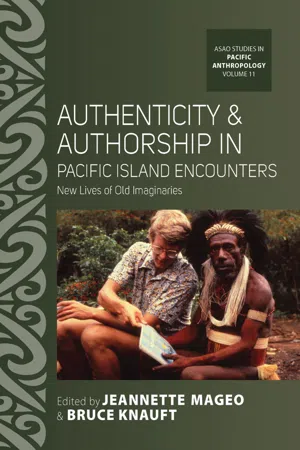
Authenticity and Authorship in Pacific Island Encounters
New Lives of Old Imaginaries
- 246 pages
- English
- ePUB (mobile friendly)
- Available on iOS & Android
eBook - ePub
Authenticity and Authorship in Pacific Island Encounters
New Lives of Old Imaginaries
About this book
Trusted by 375,005 students
Access to over 1.5 million titles for a fair monthly price.
Study more efficiently using our study tools.
Information
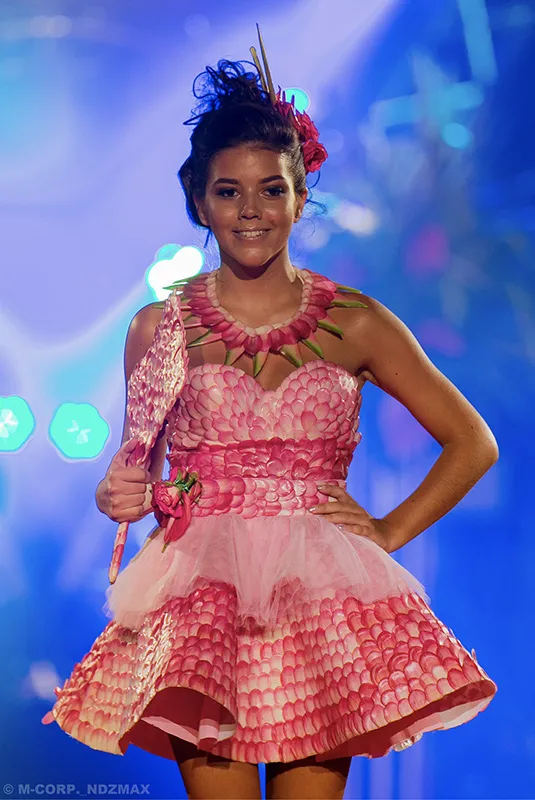
Figure 1.1. In the 2017 Miss Puna‘auia contest, Mareva Domby wears a dress created by Myrna Taae, composed of the petals of pink ‘ōpuhi flowers. Photograph by NDZ Max; courtesy of the Miss Puna‘auia Organization.

Tenues Végétales in Beauty Contests of French Polynesia
Authenticity on Islanders’ Own Terms
JOYCE D. HAMMOND
Introduction
During 2013 research in French Polynesia, I decided to watch the Miss Tahiti contest on television. Conforming to a common use of the name Tahiti to refer to all of the Society Islands or even to French Polynesia as a whole, the contest is popularly understood as a competition for young women with Mā‘ohi (Indigenous) ancestry.1 I had never attended the competition or seen a televised recording of it, but I thought it would simply mirror a Miss America or Miss USA beauty pageant. Although there were many elements paralleling those in well-known beauty contests—a swimsuit segment,2 an evening gown portion, and the final crowning of the Miss—I was taken by surprise when the candidates appeared in one passage in couture-style dresses made from local flowers. The garments, created with such flowers as orchids, bougainvillea, hibiscus, and an endemic variety of gardenia, were stunning. Later, I was to learn that tenues végétales, the French term used by islanders for all fashionable attire made from many different island materials, had become a regular feature of the Miss Tahiti contest at the beginning of the twenty-first century. Their appearance in numerous beauty contests held in French Polynesia intrigued me, and four years later, in 2017, I returned to Tahiti for six months to learn more about tenues végétales, their place in beauty contests, and what they mean to those who make them, wear them, and see them. During my stay, I had many conversations and interviews with a wide variety of people: pageant organizers and judges, contest participants, stylists, people who go to beauty contests and those who do not. I attended several competitions on the island of Tahiti where most contests are held,3 viewed television and video coverage of past contests, and examined newspaper accounts of tenues végétales in former competitions. I learned that the elaborate garments are made from a wide variety of local natural materials, the choice often influenced by contest themes. Flowers, leaves, ferns, inner and outer bark of trees, pearls, feathers, shells, seeds, and seed pods are included in many contemporary beauty contests of French Polynesia, particularly in the Society Islands.4 I also learned about the significance of the garments to creators, contestants, and viewers.
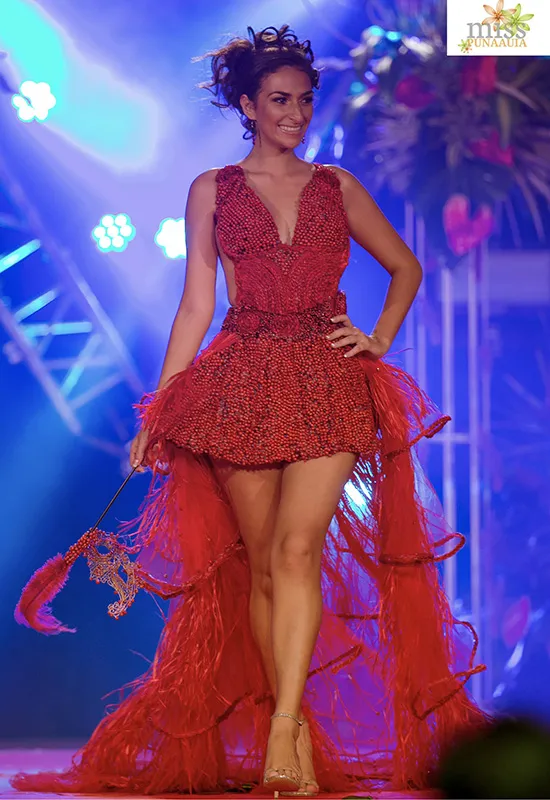
Figure 1.2. In the 2017 Miss Puna‘auia contest, Vaite Fernandez Estall wears a creation by Manuarii Teauroa composed of red pitipiti‘ō seeds, red-dyed more, and a red-dyed chicken feather. Photograph by NDZ Max; courtesy of the Miss Puna‘auia Organization.
In this chapter, I examine tenues végétales as authentic expressions of Polynesian identities of the twenty-first century, drawing upon definitions of authenticity by scholars such as Chambers (2010), Gubrium and Holstein (2009), and Waterson (2011) who emphasize the agency of people defining authenticity for themselves. In contradiction to still widely held Western definitions of authenticity that link the concept to long-established and unchanging practices, I argue that the authenticity of tenues végétales emanates from the agency of islanders to make and to wear the garments as self-defined articulations of Polynesian distinctiveness. The innovative, couture-style apparel of tenues végétales foregrounds islanders’ creativity, skills, and knowledge; features a wide assortment of island resources; and presents recontextualized global fashion styles modified to suit islanders’ tastes and goals to perform sartorial expressions of contemporary French Polynesian islanders’ identities. The creation and display of tenues végétales affirm islanders’ values and pride in their ethnic identities, and, at the same time, highlight their imaginative selection and inventive use of borrowed ideas.
Whose Authenticity?
Prior to my 2017 research, I searched for recent scholarship on tenues végétales. In contrast to an extensive scholarship on Pacific Islanders’ adoption and adaptation of Western cloth and clothing styles to embrace social innovations and, in some cases, to resist outsiders’ hegemonic power (Arthur 2006; Bolton 2003; Colchester 2003; Hammond 1986; Herda 2011; Küchler and Eimke 2009; Küchler and Were 2009; O’Hanlon 2005), the only research I found that mentioned tenues végétales was Schuft and Massiera’s 2012 article. The authors examine sport and beauty contests of Tahiti and include brief comments about the tenues végétales segment in beauty contests (referring to them as “vegetal dresses”). They claim that the garments are a re-appropriation of Western stereotypes of islander authenticity created for economic gain in tourism marketing. Further, they declare the attire to be “symbols of pre-missionary traditions” (2012: 111).5 Evoking touristic imaginaries of the “true” and “authentic,” Schuft and Massiera suggest that in the Miss Tahiti contest (and by extension, other beauty contests in French Polynesia), islanders are deliberately creating a false authenticity to sell to tourists.6
I disagree: tenues végétales are examples of islanders’ agency to create and to proudly express a contemporary Polynesian identity, an identity that combines celebration for a legacy of island life with a cosmopolitan knowledge and sophistication that islanders accrue through their life experiences and interactions with people from abroad. Although I discuss the legitimacy of tenues végétales as authentic to islanders primarily in terms of how the creation and display of the garments communicate islander values and contemporary self-concepts, I first contest the idea that the tenues végétales are a tourism marketing strategy. Tahiti Tourisme staff in the French Polynesian capital of Pape‘ete told me that they do not actively promote the Miss Tahiti contest.7 Buried within a lengthy events calendar on the Tahiti Tourisme website, the Miss Tahiti contest appears only as an entry of a few lines, but when Tahiti Tourisme materials feature island women on websites, brochures, etc., the young women appear in two-piece dance costumes, swimsuits, or pāreu (wrap-around cloth “sarongs”). Moreover, despite the fact that the Miss Tahiti pageant has been, in Schuft and Massiera’s words, “diffused locally and internationally” through social media such as YouTube (2012: 110), very few tourists attend Miss Tahiti or other beauty contests in French Polynesia; almost all competition attendees are friends and family members of the participants or other local people.8
Owing to their assumption that tenues végétales are meant to evoke Western preconceived notions of authentic islanders, Schuft and Massiera never consider that the garments are distinctive, contemporary statements of cultural identity made on islanders’ own terms, deriving from similar motivations of Pacific Islanders to adopt and adapt Western cloth and clothing. While some attire may incorporate materials and techniques that Mā‘ohi ancestors used for fashioning a wide variety of things,9 especially in the context of certain contests’ themes, the garments, often compared by locals to the haute couture of European fashion runways, are not “symbols of pre-missionary traditions.” Rather, as Kaeppler has observed about Polynesian and Micronesian fashion, “Fashions change from within and as intercultural dialogues with neighbors and colonizers . . . Today, high fashion takes us back to traditional materials combined with globalized style” (2008: 133–34).10
Nonetheless, Schuft and Massiera’s claim that islanders use tenues végétales as a re-appropriated Western touristic stereotype is revealing: it betrays a popular Western definition of authenticity as cultural ideas, practices, and products original to a society, free of influence from other people, and passed down virtually unchanged through multiple generations (cf. Mageo and Knauft Introduction; Shiner 1994; Sperlich 2006). Compounding this problem is the fact that Westerners’ perceptions and imaginative understandings of non-Westerners’ lifeways contributed to an erroneous conclusion: change to what was conceived as the pure and originary suggested Indigenous peoples and their altered practices were inauthentic. However, Western definitions of authenticity, based largely on philosophical, artistic, and moral pronouncements, are increasingly critiqued, fracturing these definitions (Golomb 1995; Theodossopoulos 2013; Wang 1999). Some scholars, therefore, now advocate recognizing authenticity as what a group of people themselves identify as true to their realities and aspirations.
Chambers, for example, argues “for a definition of authenticity that is determined primarily by a people’s ability to choose for themselves those elements of stability and change that make their lives meaningful” (2010: 5). Like Chambers, Waterson grounds her definition of authenticity in the truths of a people’s experience; she defines authenticity as “an ingenious response to a particular ecology and way of life” (2011: 79). Gubrium and Holstein view authenticity as “centered on its in situ social construction, as operating in practice and in relation to local relevancies” (2009: 123), and Arthur states, “When an indigenous culture adopts and incorporates a western item, it is culturally authentic by virtue of its cultural embeddedness” (2011: 103). All four perspectives include recognition of the active decision-making that allows people to determine what is relevant to their lives and to incorporate change as they see fit. Kaeppler, who has decades of experience working with Pacific Islanders, also emphasizes people’s agency in a statement about tradition, the latter often equated with authenticity: “I feel that tradition is a continuous process—constantly adding and subtracting ideas and practices, constantly changing, constantly recycling bits and pieces of ideas and practices into new traditions” (2004: 294).
People in many societies incorporate new ideas and material culture without feelings of contradiction or a belief that they are undermining who they know themselves to be. Many societies’ beauty contests pointedly combine symbols of local ethnicity with borrowed aspects of global expression (Cohen, Wilk, Stoeltje 1996; Besnier 2011; Kozol 2005; Schackt 2005; Wilk 1995; Yano 2006). In the words of renowned tenue végétale creator Maruia Holozet:
Polynesia contains enormous treasures in the sense of its vegetation, in the sense of what one can create with it. And that, in fact, everything, everything that we have today, one could say that our ancestors gave it to us. But today, with life—how shall I say it—with modern life, we have brought what they handed down to us up into the present. Because, back in that time, they made simple things, because their lives were simple. But today, life has evolved, so our way of creating has also evolved. (Holozet, pers. comm., 15 May 2017; translation by the author)
Sahlins (1999: ix) calls the process of selectively combining elements from the past and the present (especially in modified borrowings from other people), “indigenized modernity.” Other scholars such as Newell (2010), Salmond (2009), and Thomas (1991) point out that Pacific Islanders have always selectively borrowed elements of Western culture and combined those with cultural practices, aesthetics, and concepts chosen from islander history.11 From the beginning of encounters with Europeans, Mā‘ohi often wore outfits that combined elements of their Indigenous clothing with Western attire. Spanish observations made on the island of Tahiti in 1774, for example, include descriptions of various Mā‘ohi warriors wearing breastplates decorated with dogs’ hair, pearl shell, and sharks’ teeth; towering wickerwork helmets; and thick white barkcloth turbans. Many of the same men also “proudly displayed shreds of European clothing—the arm of a jacket, the leg of some trousers or a dirty, torn shirt” (Salmond 2009: 341).
Writing about the Tahiti of the 1820s and 1830s when missionaries and merchant ships were prevalent, D’Alleva recounts that islanders frequently wore elements of clothing from both cultural repertoires “in the complex and sometimes uneasy imbrication of European clothing and decorated Tahitian bark cloth clothing” (2005: 47). She asserts that “the hybrid wardrobes of the Tahitian elite, as designed and worn, have much to tell us about the ways that they negotiated new and old forms of political and social power at this time” (2005: 47). D’Alleva’s summary of ways Mā‘ohi combined Western and Indigenous clothing “to assert political power, social status, religion, wealth, artistic skill, taste, connection with the present and connection with the past” (2005: 47) clearly reveals the authenticity of Mā‘ohi choices.
Some Westerners, such as the French naval captain Bernard who wrote in 1840 of Queen Pōmare’s use of both barkcloth and Western dress for different purposes, reacted in positiv...
Table of contents
- Cover
- Title Page
- Copyright Page
- Contents
- List of Figures
- Introduction. On Authoring and Authenticity
- Chapter 1. Tenues Végétales in Beauty Contests of French Polynesia: Authenticity on Islanders’ Own Terms
- Chapter 2. American Colonial Mimicry: Cultural Identity Fantasies and Being “Authentic” in Samoa
- Chapter 3. Critical Reflections across Four Decades of Work with Gebusi: Authorship, Authenticity, Anthropology
- Chapter 4. Recovering Authenticity: Garamut (Slit-Drums) among Kayan People, Madang Province, Papua New Guinea
- Chapter 5. The Flying Fox and the Sentiment of Being: On the Authenticity of a Papua New Guinea Rawa Tradition
- Chapter 6. Digital Storytelling in the Pacific and “Ethnographic Orientalism”
- Afterword. Authoring and Authenticity: Reflections on Traveling Concepts in Oceania
- Index
Frequently asked questions
Yes, you can cancel anytime from the Subscription tab in your account settings on the Perlego website. Your subscription will stay active until the end of your current billing period. Learn how to cancel your subscription
No, books cannot be downloaded as external files, such as PDFs, for use outside of Perlego. However, you can download books within the Perlego app for offline reading on mobile or tablet. Learn how to download books offline
Perlego offers two plans: Essential and Complete
- Essential is ideal for learners and professionals who enjoy exploring a wide range of subjects. Access the Essential Library with 800,000+ trusted titles and best-sellers across business, personal growth, and the humanities. Includes unlimited reading time and Standard Read Aloud voice.
- Complete: Perfect for advanced learners and researchers needing full, unrestricted access. Unlock 1.5M+ books across hundreds of subjects, including academic and specialized titles. The Complete Plan also includes advanced features like Premium Read Aloud and Research Assistant.
We are an online textbook subscription service, where you can get access to an entire online library for less than the price of a single book per month. With over 1.5 million books across 990+ topics, we’ve got you covered! Learn about our mission
Look out for the read-aloud symbol on your next book to see if you can listen to it. The read-aloud tool reads text aloud for you, highlighting the text as it is being read. You can pause it, speed it up and slow it down. Learn more about Read Aloud
Yes! You can use the Perlego app on both iOS and Android devices to read anytime, anywhere — even offline. Perfect for commutes or when you’re on the go.
Please note we cannot support devices running on iOS 13 and Android 7 or earlier. Learn more about using the app
Please note we cannot support devices running on iOS 13 and Android 7 or earlier. Learn more about using the app
Yes, you can access Authenticity and Authorship in Pacific Island Encounters by Jeannette Mageo, Bruce Knauft, Jeannette Mageo,Bruce Knauft in PDF and/or ePUB format, as well as other popular books in Social Sciences & Cultural & Social Anthropology. We have over 1.5 million books available in our catalogue for you to explore.