Guiding the reader through the development of sex education in Poland, Agnieszka Ko?cia?ska looks at how it has changed from the 19th century to the present day. The book compares how sex was described in school textbooks, including those scrapped by the communists for fear of offending religious sentiments, and explores how the Catholic church retained its power in Poland under various regimes. The book also identifies the women and men who changed the way sex was written about in the country, and how they established the field of Polish sex education.
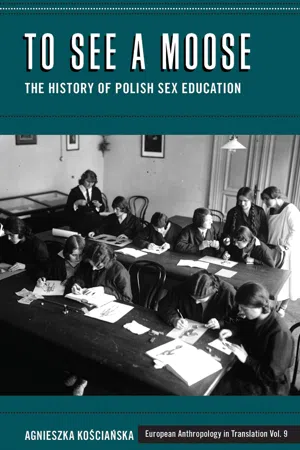
- 354 pages
- English
- ePUB (mobile friendly)
- Available on iOS & Android
eBook - ePub
About this book
Trusted by 375,005 students
Access to over 1.5 million titles for a fair monthly price.
Study more efficiently using our study tools.
Information
PART I
Behind and Beyond the School Gates
Chapter 1
Poland Bids Farewell to the Stork
The First Class and the First Handbook
At the very beginning of the twentieth century, Wacław Jezierski, a biology teacher based in Warsaw, announced: ‘The fairy tale about the stork should vanish and never be allowed to return’ (1906: 293). His approach to this issue was full of gravity and very scientific: ‘Biological process can be divided into two categories: some processes are directed at preserving a given individual’s life (food ingestion, digestion, assimilation, dissimilation, secretion, etc.), and others at the preservation of a species’ existence (reproduction)’ (1906: 291). The significance of all these processes is fully reflected in the latter category: ‘From a morphological perspective, this differentiation of processes corresponds to the differentiation of the organism into ontogenetic (somatic) and reproductive dimensions’ (1906: 291). It is on reproduction that the future depends: ‘the ontogenetic dimension expires along with the individual’s death, while the reproductive dimension (the reproductive cells) can become a new organism and live on, thus ensuring the continued survival of the species’ (1906: 291). The author concludes that biology, being a life science, has ‘as an object of enquiry both the lives of individuals and the life of species, hence both the former and latter should always be treated as such when teaching biology’ (1906: 291).
Jezierski had decided to address the issue of reprodution because in high schools it was being passed over ‘in resolute silence, with children being taught the natural sciences using sexless anatomical models’ (1906: 291). The author explains the practical ramifications of this:
When I began my teaching career almost ten years ago, I learned from more senior biology teachers that in boys’ schools alone, it was permissible to explain the construction and functions of kidneys without mentioning the bladder or urinary tract, while in girls’ schools, sweat glands were to be described as excretory organs while the ‘others’ were only to be pointed out and the most appropriate term for the anal orifice was ‘the gastrointestinal tract’s other opening’. (1906: 291–92)
This oversensitivity was extended to species other than humans. As an additional precaution, there was no discussion of the reproduction of animals, especially ‘higher’ ones.
Jezierski regarded these guidelines as not fit for purpose from the very beginning. However, the approach he decided to take was evolutionary rather than revolutionary. With every passing year, he expanded ‘the scope of his biology lectures’ (1906: 292) until finally – as he writes in 1906 – ‘a few years ago’ at the Merchants’ Club’s Trade School in Warsaw, ‘for the first time in our country, as far as I know, high school pupils heard about the human reproductive organs and reproduction’ (1906: 292). The historian Jolanta Sikorska-Kulesza (2004: 37) worked out that that class must have taken place before 1904.
After this successful start, Jezierski did not rest on his laurels. In 1904, he began explaining the facts of life to schoolgirls, ‘doing this in consultation with female tutors and (almost always) the girls’ parents’ (Jezierski 1906: 292). Eventually, he managed to persuade a number of naturalists affiliated to the Warsaw Educational Society to vote through a resolution calling for the universal introduction of this content to biology teaching. Needless to say, Jezierski’s activism provoked outrage in some circles. Yet he remained indefatigable, continuing to teach and advise others how to do so: ‘The issue of the reproduction of organisms is probably best broached for the first time during a botany course and then – in zoology – most useful at this stage, as would always be expected, are observation and experimentation’ (1906: 292). He was not suggesting here that young people should furtively observe their parents or explore their own bodies. Instead, he proposed ‘pollinating and fertilising seed plants and fertilising fish spawn using “milk” in dishes to obtain young fish, observing chicken embryos, as far as opportunity allows, in their eggs, etc.’ (1906: 292). Next, he argued, ‘in anatomy and human physiology courses, a few lectures should be devoted to the description of (mainly internal) organs and the human embryo development process’ (1906: 292–93). He advised that the greatest seriousness, naturalness and candidness should be maintained: ‘then (as I know from experience), there is no way that that sense of modesty, so valuable to everyone, will be encroached upon’ (1906: 293).
Jezierski bolstered his argument by citing examples from other countries, in particular Germany, pointing out that in other parts of the world, high school pupils were receiving lectures on ‘comparative embryology’ and ‘sexually transmitted diseases’ (1906: 293). He also referred to a meeting of Berlin’s School Hygiene Association in 1905, at which it was emphasized that by discussing the facts of life with schoolchildren, they were only responding to what parents, doctors and clerics were demanding. Such discussions should be the responsibility of schools because ‘parents are often afraid to discuss the facts of life with their children and in the majority of cases, they are not in fact suitably prepared for this’ (1906: 293). It was biology teachers who were best qualified to do this. Besides, ‘discussing the facts of life with a large group of youngsters at their school should be regarded as preferable to discussing the facts of life with separate individuals’ (1906: 293).
A start should be made as early as possible and parents needed to be involved (and educated accordingly): ‘A mother should explain to her six-year-old child, while still at kindergarten, what pregnancy, motherhood and fatherhood are; suitable guidance could be provided by booklets written for this purpose’ (1906: 293).
According to this model, four years later – when the child was ten years old – the biology teacher would roll into action. He would discuss ‘the origins of plant and animal organisms’ (1906: 293–94). Over the following classes, educators would focus on the development of animal embryos (at this juncture, observing ‘chicken development’ (1906: 294) would be helpful). ‘In the upper grades, biology teachers, doctors and clerics should finally discuss sexual issues with young people’ (1906: 294). Jezierski cites as an authority the medical officer of health, Dr O. Rosenthal, who argued that ‘the sense of mystery in which sexual issues are shrouded has a stimulating effect on young people, thereby laying the ground for onanism, which is physically and spiritually debilitating and alters the organism’s immunity to infectious diseases’ (Jezierski 1906: 204). And that’s not all: ‘A similar effect is caused by filthy books, images and magazines, some theatrical events, extended periods of sitting at work, school or home, improper clothing, sleeping on feather quilts, alcohol, an overly lavish meal before going to bed, lack of due care when cleaning the body, the communal living of several families in one cramped apartment, etc.’ (1906: 294). Therefore, what was really needed was (for adults) to talk and explain the facts of life and (for adolescents) to take regular exercise and wash.
How did Jezierski’s efforts correspond to the knowledge young people of his time actually possessed of those sensitive issues? It turns out that young people felt little compulsion to believe in the stork because they were pretty well acquainted with sexual issues. Just as Jezierski was setting off on his adventure with sex education for schools, Marian Falski (1906a, 1906b) – an educator and author of the famous Elementarz (Primer), which was used to teach basic literacy skills throughout the twentieth century – conducted a survey on the lives of young men. The questionnaire he used contained eighty-eight questions covering issues relating to school and mental and physical development. It also included questions about sex that explored physical development issues. The survey was carried out in the 1903–4 school year. Most of the respondents were pupils aged between sixteen and nineteen, and totalled ninety-seven people. They were asked about their interests, the novels and newspapers they had read, religion, politics and how long they slept for (1906a: 781). The average age at which pupils had had the facts of life explained to them was eleven and a half. The main source of this knowledge was friends (fifty-three of the surveyed pupils), while twenty-one boys had worked things out on their own and seventeen had learned everything from servants. A total of 24 per cent of the respondents masturbated (relatively few, when compared to the research Izabela Moszczeńska was conducting among university students at the same time, over half of whom confessed to masturbating). Seventeen of those who masturbated gave the time when they were initiated into this practice: in one respondent’s case, this happened when he was seven years old, two began as ten year olds, five a year later, three when they were twelve, one when he was thirteen, three when they were fourteen, one when he was fifteen and two when they were seventeen. This behaviour had been encouraged by what they had read or a ‘smutty drawing’. Some had been taught by friends or they began – a category in its own right – ‘under the influence of a corrupted boy’ (1906b: 871). Only one research participant decided to share his reflections:
You would be well advised to take notice of the development of onanism among young pupils because over the last three years, as a senior student in the pupil’s dormitories, I had to deal with a whole series of young onanists and despite many remarks made to the middle school doctor, I was unable to secure any assistance. Over the last two years, I managed to cure 3 of the little tykes, though my methods were barbaric, as I beat them, but effective. (1906b: 871)
Young people had deeply ingrained convictions at the time about the harmfulness of masturbation. This is also confirmed by the numbers. While only twenty-three boys admitted to having masturbated at all, only four wrote that they were still doing it, but were trying to stop, though that was proving to be difficult. One confessed that ‘he is so drawn to it that sometimes he cannot stop’ (1906b: 871). Those who had abandoned this form of pleasure claimed that this had happened because ‘they had discovered or understood … the negative consequences’ (1906b: 871) or for religious reasons. One ‘started to copulate’ instead, while another one stopped ‘because it goes against nature’ and one more ‘thanks to his strong resolve’ (1906b: 872). They had learned about the harmfulness of such practices from books and, in only one case, from a priest who ‘described during confession the terrible consequences of onanism and gave some advice on how to avoid it’ (1906b: 872).
Forty-two (or 43 per cent) of the research participants had begun their sex lives. If this result is compared – as Falski did – with those of the surveys conducted among University of Warsaw students (15.33 per cent were still ‘innocent’) or the University of Technology (32.14 per cent were ‘innocent’) a few years earlier by Kowalski and Moszczeńska, respectively, 43 per cent may appear to be a modest amount (Falski 1906b: 872). But the investigated students were older. Falski’s pupils were usually beginning to have sex from the ages of fourteen to seventeen, while Moszczeńska’s students were starting between seventeen and nineteen. Clearly, as Falski concludes, the average age of sexual initiation was decreasing.
Falski was also interested in how his respondents came to have sex for the first time. He asked the following question: ‘at what age and under what circumstances (in the company of/at the instigation of friends, being intoxicated, etc.) [did you] have sex for the first time?’ (1906b: 874). Not everyone answered so the replies do not add up to forty-two: five were intoxicated; ten were persuaded (by friends, prostitutes or servants); five were in the company of friends; five acted of their own accord (in this case, one of the boys added ‘out of curiosity’). Only one replied ‘out of love’ and also pointed out that this had happened – according to the wording of Falski’s footnote – ‘With a mature woman, under the best ethical conditions’ (1906b: 874). Another one wanted to unlearn to masturbate in this way.
The survey results also make clear how often the pupils were having sex: seven once or twice a month, three once or twice a week and the remainder, let’s say, once in a blue moon (1906b: 874–75). From today’s perspective, the prevalence of paid sex is extremely noticeable. Fourteen boys visited brothels, one utilized the services of a ‘streetwalker’ and three confessed that ‘it depends’ (1906b: 975). Fewer than half relied on ‘free love’. Thirteen of the boys had contracted venereal diseases, mainly gonorrhoea, though in seven cases, this did not interfere with them continuing to have sex (1906b: 876).
Interestingly, Falski not only asked about the reasons for having sex, but also about the causes of abstinence. He gave the option to indicate more than one response. Eighteen boys indicated ‘ethical principles’, fourteen were afraid of contracting diseases, five had no desire to have sex and the same amount cited religious grounds, four felt shame and two disgust (one of these probably added to the comments section: ‘under the circumstances in which young people have sex, people are no different from animals’), two had not had any opportunity, one lacked the means and one more selected ‘good books’ (1906b: 876–77).
When Jezierski – no doubt horrified by the findings of Falski’s research and that of others – was crusading for sex education classes, others were writing textbooks. In all likelihood, the most complete – and certainly most progressive – lecture on this subject was given by Dr Walenty Łukasz Miklaszewski (1906a, 1906b), a physician, researcher and popularizer of healthy living, as well as the author of novels, plays and travel literature. He appealed to different age groups by producing versions for young adolescents and for young adults.
He begins with the words ‘My friends!’ and makes light work of the hypocrisy and prudishness of grown-ups – the parents and educators:
The mistakes made by teachers of the old school were: that they were afraid to explain the facts of life, thinking it would debauch [their charges]; that they considered moral edification to be improving morals and teaching formulas, such as proverbs, fairy tales and completely incomprehensible catechisms; finally, that they not only concealed the truth the young mind demanded, but attempted to stop it, using lies, threats, shaming and similar methods, from noticing, reflecting and thinking. Let parents and tutors of children and young people therefore reconcile themselves to the fact that the Fourth Commandment: ‘Honour thy mother and thy father’ has not in itself assured them the status of children’s true friends, because that friendship has had to be earned through always telling the truth, through attending to the child’s spirituality and through working to elevate it to the heights of recognition and love of the grand laws of nature. (1906a: 883)
Of course, children should love their parents because, as the author writes, ‘they have ensured that you have food, somewhere to live, clothing, entertainment, that you finish your schools, earn your school leaving certificates and privileges and that you do not want for anything and can live in prosperity’ (1906a: 883), yet it is often difficult to obtain advice from them and difficult to befriend them: ‘only the exceptional among you can love them because you do not need to seek out, apart from them, wise and devoted friends who can be turned to, whenever you have doubts, for clarification, advice and guidance’ (1906a: 883).
Miklaszewski offers to act as an intermediary in this enterprise: ‘Oh yes, you need a true friend who would lead you out of this labyrinth along Ariadne’s thread. And this is the friend I want to be for you, recalling that a few decades ago, I was wandering the same barren trails, exposed every now and again to dangers’ (1906a: 884).
The author is building a bridge of understanding between an adult (himself) and the young. He evokes the feelings he had as an adolescent. Curiosity and terror predominated. It is during this period that young people uncover gender differences. These differences aid procreation, but do not justify discrimination. Miklaszewski was an indefatigable defender of equality. He argued that male domination arose from upbringing and culture, and was of social origin rather than being innate: ‘Not so long ago, you called a barking quadruped a dog and a neighing one – a horse, because the names bitch, mare and nag were not familiar to you and more often than not regarded as indecent. And in the human world, you did not compare men to women as you regarded every person as equal’ (1906a: 885). He exclaimed: ‘Oh, remember for the rest of your lives this period of innate, independent, untainted thinking! Remember, because for you as well, the moment may come when you forget the inherent truth that sex is only the personal characteristic of an individual and does not grant him rights and privileges or deny them to him’ (1906a: 885).
Gender difference and its laws and privileges are sustained by culture, personified, as it were, by capitalists wishing to sell women ‘trinkets and baubles, and especially various artifices falsifying reality (whiteners, blackeners, rouges, singeing, coiffing)’ (1906a: 895). He continues:
This extraordinary attention to external beauty, which is expanding through societies more terrifyingly than the bubonic plague is pitifully evident throughout their lives. The girl, having forgotten that the sources of her allure are her freshness and health, succumbs to the influence of industrialists who personally profit by constantly changing fashions and convincing gullible creatures that they need to be able to please others. Or have these fears of ‘losing one’s looks’ and ‘not being special any more’ not perchance been artificially transplanted from inanimate objects to you living beings? Is this lowering of your dignity not all the more potent in that it is to inanimate objects, despite them not changing their appearance, that man is becoming attached, and it is only you who need to transform yourselves to provide constantly fresh stimulation for a man? (1906a: 895–96)
Miklaszewski was not suggesting here that sensuality should be completely renounced; in fact, he distances himself from the position ‘that noblest is the love that renounces external beauty’ (1906a: 894). However, a lack of moderation ‘brings about pitiful consequences: the woman neglects her spiritu...
Table of contents
- Cover
- Title Page
- Copyright Page
- Contents
- Foreword
- Preface to the English Edition
- Acknowledgements
- Introduction. Puberty and Politics
- Part I. Behind and Beyond the School Gates
- Part II. The View from the Pulpit
- Part III. Country Matters
- Conclusion. A Culture of Emancipation, a Culture of Dialogue
- References
- Index
Frequently asked questions
Yes, you can cancel anytime from the Subscription tab in your account settings on the Perlego website. Your subscription will stay active until the end of your current billing period. Learn how to cancel your subscription
No, books cannot be downloaded as external files, such as PDFs, for use outside of Perlego. However, you can download books within the Perlego app for offline reading on mobile or tablet. Learn how to download books offline
Perlego offers two plans: Essential and Complete
- Essential is ideal for learners and professionals who enjoy exploring a wide range of subjects. Access the Essential Library with 800,000+ trusted titles and best-sellers across business, personal growth, and the humanities. Includes unlimited reading time and Standard Read Aloud voice.
- Complete: Perfect for advanced learners and researchers needing full, unrestricted access. Unlock 1.5M+ books across hundreds of subjects, including academic and specialized titles. The Complete Plan also includes advanced features like Premium Read Aloud and Research Assistant.
We are an online textbook subscription service, where you can get access to an entire online library for less than the price of a single book per month. With over 1.5 million books across 990+ topics, we’ve got you covered! Learn about our mission
Look out for the read-aloud symbol on your next book to see if you can listen to it. The read-aloud tool reads text aloud for you, highlighting the text as it is being read. You can pause it, speed it up and slow it down. Learn more about Read Aloud
Yes! You can use the Perlego app on both iOS and Android devices to read anytime, anywhere — even offline. Perfect for commutes or when you’re on the go.
Please note we cannot support devices running on iOS 13 and Android 7 or earlier. Learn more about using the app
Please note we cannot support devices running on iOS 13 and Android 7 or earlier. Learn more about using the app
Yes, you can access To See a Moose by Agnieszka Kościańska in PDF and/or ePUB format, as well as other popular books in Social Sciences & European History. We have over 1.5 million books available in our catalogue for you to explore.