Literary allegory has deep roots in early reading and interpretation of Scripture and classical epic and myth. In this substantial study, Mindele Treip presents an overview of the history and theory of allegorical exegesis upon Scripture, poetry, and especially the epic from antiquity to the seventeenth and early eighteenth centuries, with close focus on the Renaissance and on the triangular literary relationship of Tasso, Spenser, and Milton.
Exploring the different ways in which the term allegory has been understood, Treip finds significant continuities-within-differences in a wide range of critical writings, including texts of postclassical, patristic and rabbinical writers, medieval writers, notably Dante, Renaissance theorists such as Coluccio Salutati, Bacon, Sidney, John Harrington and rhetoricians and mythographers, and the neoclassical critics of Italy, England and France, including Le Bossu.
In particular, she traces the evolving theories on allegory and the epic of Torquato Tasso through a wide spectrum of his major discourses, shorter tracts and letters, giving full translations. Treip argues that Milton wrote, as in part did Spenser, within the definitive framework of the mixed historical-allegorical epic erected by Tasso, and she shows Spenser's and Milton's epics as significantly shaped by Tasso's formulations, as well as by his allegorical structures and images in the Gerusalemme liberata.
In the last part of her study Treip addresses the complex problematics of reading Paradise Lost as both a consciously Reformation poem and one written within the older epic allegorical tradition, and she also illustrates Milton's innovative use of biblical "Accommodation" theory so as to create a variety of radical allegorical metaphors in his poem.
This study brings together a wide range of critical issues—the Homeric-Virgilian tradition of allegorical reading of epic; early Renaissance theory of all poetry as "translation" or allegorical metaphor; midrashic linguistic techniques in the representation of the Word; Milton's God; neoclassical strictures on Milton's allegory and allegory in general—all of these are brought together in new and comprehensive perspective.
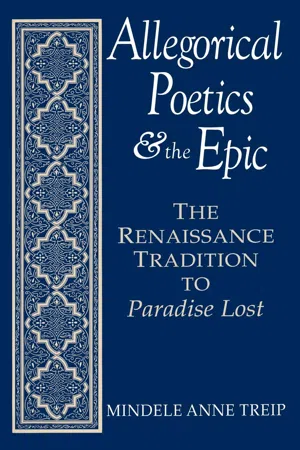
eBook - ePub
Allegorical Poetics and the Epic
The Renaissance Tradition to Paradise Lost
- 392 pages
- English
- ePUB (mobile friendly)
- Available on iOS & Android
eBook - ePub
About this book
Information
Publisher
The University Press of KentuckyYear
2021Print ISBN
9780813160344
9780813118314
eBook ISBN
9780813185668
PART I

Theory of Allegory in Poetry and Epic from Antiquity to the Renaissance

ONE

Antiquity to the Middle Ages
Late Classical Interpreters and Their Successors
Certain tensions or oppositions may be perceived to recur throughout the history of allegory. Even though in allegorism no more than in other literary modes can the distinction between “content” and “form” sustain itself for long, one broad opposition which we shall find recurring historically is that between “allegory” conceived as meaning (hidden thought) and allegory defined as a feature of rhetoric, usually a brief rhetorical trope. For Aristotle and Quintilian allegoria is a rhetorical figure (sometimes defined as permutatio or inversio), or a trope which works by saying one thing while meaning another—the ordinary definition in the Oxford English Dictionary still.1 This definition avoids problems by omitting specific reference to the possible length of the figure or the nature of the transposed content or meaning. Sometimes allegory in this view means something like our present understanding of “riddle”; however, aenigma in the ancient understanding of allegory is more obscure than “riddle”, which is only one form of allegory.2 But a prevailing degree of obscurity seems to characterize allegory and to distinguish it from irony or sarcasm, which are clearer in intention.
That the quality of obscurity is important to the understanding of the allegorical trope is evident in rhetorical definitions of it from classical times to the Renaissance. It is apparent in the classical connection of allegory with “riddling”, or the medieval or Renaissance stress on the “veil” of allegory, the “dark” conceit—all these, as we shall see, both link the figure of allegoria to, yet distinguish it from, metaphor. The emphasis on obscurity is also evident in the use of favoured literary devices, as in the European allegorical tradition of enigmatical images or structures such as dreams, dream-visions, disguises, emblems (pictorialized conceits), the bizarre in narrative sequence or other elements, riddling pageant or masque displays, and so forth. A good example is the pageant in the Divina commedia near the end of the Purgatorio (cantos 29-31): the “triumph of Beatrice” unrolls in time, seen as a visual enigma, only partially explained and not understood, in fact “riddling” the doctrine of the second coming of Christ expected throughout history.3 An aesthetic based on enigma or riddle is also evident behind many modern critical attempts to systematize understanding of allegorical methodology, especially in Spenser.4 More generally, the classical rhetorical orientation evinces itself in the present critical tendency to identify allegory with some particular formal technique. This insistence on allegory as a formal device and riddling trope is, as we shall later see, confuted by Torquato Tasso, who takes pains to distinguish his own evolving profounder use of epic allegory from such limited rhetorical definitions as that of Aristotle—which nonetheless caused him much unease, given the authority of Aristotle in the sixteenth century.5
On the other side stands a tradition from classical into early Christian times, and evolving from rabbinical into patristic exegesis, which defines allegory in terms of meaning or meanings ascribed to or discovered in a text, without (it has been supposed until quite recently) regard to considerations of literary form. In these traditions of exegesis on classical legend, or for that matter on scriptural text (more often the Old Testament), allegory is used as a mode of investigative analysis or critical interpretation. As is well known, such exegesis provided the origins of the science of literary criticism. The object of the exegete is to discover in a work some received, unified body of philosophical or religious doctrine. In certain developments such allegoresis is closely linked to Platonic or Neoplatonic ethical or religious systems, elsewhere to Stoic thought of a metaphysical-scientific cast. Such readings use as their “texts” or scriptures classical myths, notably pre-Homeric or Homeric, often extracted from longer epic narratives. Several fictive incidents in one poem or from several poems may be put together, or seen as belonging together, in the interests of supporting a coherent larger system; alternatively, one convenient episode may be intensively analysed.6
Illustrative of one strand of such early allegoresis is, for example, the Commentary, according to wider or narrower scientific principles, of Macrobius (A.D. C4-5) on the [Somnium Scipionis] Dream of Scipio.7 In the same vein, exactly, are later works by Renaissance mythographers, such as Natalis Comes’ Mythologiae or George Sandys’ Ovid, with their rich variety of “natural” (scientific-biological-geographic) as well as ethical readings of Ovidian, Homeric or other myths. The tradition is best represented in English, perhaps, by Bacon’s innovative work [De sapientia veterum] Of the Wisdom of the Ancients (1609). (These works will be considered later.) Famous “setpieces” of such moralized readings of myths according to Platonic or later Neoplatonic ethics (often cohabiting with other kinds of readings, for example cosmological or natural-scientific) may be found in such early commentaries as that of Porphyry (A.D. c. 232-305) on the Cave of the Nymphs in Homer;8 again, Fulgentius’ (A.D. c. 467-532) treatments of seventy-five myths in Mitologiarum libri tres;9 and (picking up the vein) on into the systematic dictionaries of the Renaissance humanist mythographers. In the Ovide Moralisé, Christianized readings of myths provide a highly specialized religious development of intermittent exegesis on myth.10 It has been thought that such classical or Christian readings developed on a Platonic-transcendental model: they reach for truths which may be shadowed by but exist outside of the texts being read.11 On a more comprehensive philosophical plane, one may cite such later allegorists as the Italian Neoplatonists, Giovanni Boccaccio, Marsilio Ficino and others,12 who deploy the whole classical pantheon, Platonic myths and pastiches of Platonic treatises in order to project in veiled form entire cosmological and religious thought systems.
While such Renaissance developments in allegoresis reveal an effort to achieve intellectual synthesis and coherence within their allegorical extrapolations, it has too often been assumed (though in certain cases it may be true) that all such treatments of myth show little evidence of sensitivity to the original materials as literature, no great regard for the literary integrity or even for the intellectual coherence of the texts which they employ. Allegorical readings are taken as being concerned with the extraction of certain favoured or received meanings out of the texts, as not seeking to align the extrapolated readings with the coherent narrative line of the original myths—indeed, as flagrantly violating the literal models, and as not having any regard to any formal qualities in the works concerned. They are examples of “imposed” allegory: of meaning or meanings arbitrarily imposed on the unfortunate texts. Their concern is said to be extra-literary and only with the authenticity of the hidden meanings they educe, that being based entirely on the weight of traditional interpretation supporting these. Such alleged disregard of the integrity of the original texts is seen as later perpetuated by a whole line of Renaissance commentaries on vernacular epic, chiefly Ariosto’s, the sporadic or episodic nature of which was to cause Tasso much vexation.
There is increasing evidence that the above views represent a radical oversimplification. That early interpreters felt, not without reason, that there were elements in their texts which supported their own religious or cosmological interpretations has become clearer. And that their forms of exegesis constantly adapted or invented literary forms and paraliterary linguistic resources analogous to those of the text being interpreted is also becoming apparent. In the same way that the science of biblical interpretation, or of literary interpretation at least until very recently, required that the overall system of meaning educed from the text be governed by conditions and internal correspondences within that text, so early comprehensive literary allegoresis almost perforce developed systems of explanation correspondent with the internal organization of the texts being studied. Only fairly recently has it been understood how important a contribution to literary allegory and especially to the later European epic tradition was made in particular by the allegorical interpreters of Homeric and Virgilian epic—that is, via their continuous expositions of extended narrative.
As Félix Buffière and Jean Pépin, and, more recently, Robert Lamberton have shown,13 a mode of analysis which took cognizance of literary factors in the texts under consideration in actuality developed from earliest times. The impulse was, certainly, to extrapolate from the old stories, first Homeric or pre-Homeric, then Virgilian, ethical and religious principles originally conceived according to ancient thought systems, later developed on Neoplatonic and Christian lines. But the myths were not necessarily treated in total isolation from their original literary context. Rather, a serious effort might be made, for example, to correlate a certain proposed desirable sequence of ethical development, or a spectrum or hierarchy of perceived virtues, with the developmental framework of the original narrative. One such early interpreter is Fulgentius, whose Expositio Vergilianae continentiae depicts the twelve Books of the Aeneid as a picture of the natural sequence and growth in wisdom of human life.14 In the twelfth century Bernard de Silvestre (Bernardus Silvestris) followed a similar “progress” pattern and distinctively Neoplatonic ethic and aesthetic in interpreting the events of the Aeneid as an allegory of the moral life of man.15 Later follow parallel expositions of Virgil by the Italian humanists, by Boccaccio, Jodocus Badius and especially Cristoforo Landino;16 while Coluccio Salutati performs for both Virgil and the Hercules legends a similar service.17
The contents of all of these expositions run in parallel. The myths or epics are found to portray a steady moral and spiritual development, as traced in the hero, through phases demarcated by distinct phases of the narrative, toward a finally achieved “heroic” wisdom and virtue. These increasingly elaborate allegorical expositions would seem to mark a new departure and to lay the foundations for a designedly allegorical epic literature, the spiritual “progresses” of Dante, Tasso, Spenser, Milton. They do not lift interesting bits out of the original text or indulge in a variety of interesting but dissociated interpretative forays into the text, but attempt instead to link even disjunct episodes in it and certainly the main thread of the epic fable with a coherent, complex, ethical developmental system. Thus the sequence of “interpretation” recreates or transposes the original literary pattern or structure onto the allegorical critique. In finding their inspiration in the congruence between the developmental allegory and the developing narration, these more disciplined interpretations, however fanciful portions of them may sometimes appear, represent an advance in the practice of literary allegoresis, one in which interpretation itself is seen to be acquiring the characteristics of literary narrative. The foregoing remarks represent a more radical perspective than that which would see allegorical literature as arising only later, from the “wedding of ancient works (themselves with some allegorical content) and recent [i.e. later] Platonizing allegorical commentary to produce a new kind of deliberately allegorical poetry” in medieval times.18 In the earliest exegeses on epic, the margin of difference between allegorical interpretation and allegorical literature has already narrowed.
Rabbinical Interpretation
If early Neoplatonist allegorical reading of myth shows more regard for the narrative integrity of the text than has sometimes been thought, it has, again until recently, often been alleged that in their over-concern with extrapolated meanings, transcendental or otherwise, the parallel traditions of early rabbinic and early patristic reading of Scripture did not do so. This view has recently been forcefully challenged by what one might call the New School of biblical-literary criticsm.19 For the classical or post-classical, the early Christian and the rabbinical traditions of interpretation of their respective scriptures share much common ground. Earlier or medieval rabbinic traditions of Old Testament interpretation (referred to under the general term of midrash), like those on their part of the early Fathers who were close in time, or later of Neoplatonist exegetes on epic, were sometimes homiletic in intention, designed to educe a whole religious way of morals, thought and life from the sacred texts.20 The particular schemata which the Jewish exegetes followed, including that of cross-matching texts from different parts of the canon and narratively expanding these into glosses upon each other, or creating multiple, sometimes imaginative commentaries on the texts,21 were not by them regarded as a wrenching of the text or divergence from it, but on the contrary as a rediscovery or sometimes a reconstruction of the original experiences of faith recorded in Scripture.22
Through their various genres or literary forms, midrashic readings provided a philosophic basis for allegorical reading, a way of making the text of Scripture personal, a mode of meaningful appropriation, in intention not dissimilar to certain forms of later Protestant reading.23 The Bible then as now was understood to be not a homogeneous text but a “self-glossing book” or collection of self-referential texts. By such midrashic methods of commentary, more, not less, order was found in it; as Gerald L. Bruns has said: “As the Rabbis, Augustine, and Luther knew, the Bible, despite its textual heterogeneity, can be read as a self-glossing book. One learns to study it by following the ways in which one portion of the text illuminates another. . . . the parts a...
Table of contents
- Cover
- Half title
- Title
- Copyright
- Dedication
- Contents
- Preface
- Acknowledgements
- Part I. Theory of Allegory in Poetry and Epic from Antiquity to the Renaissance
- Part 2. Theory of the Allegorical Epic from Tasso, Spenser and the Neoclassicals to Milton
- Part 3. “Real or Allegoric”: Representation in Paradise Lost
- Appendix A. Bibliographical Essay on Tasso
- Appendix B. “Idea”
- Appendix C. Tasso and Spenser
- Appendix D. The Literal Level and the “Literal Commentators”
- Appendix E. “Accommodation” and Figuration in Paradise Lost
- Appendix F. Typological Criticism
- Notes
- List of Works Cited
- Index
Trusted by 375,005 students
Access to over 1.5 million titles for a fair monthly price.
Study more efficiently using our study tools.
Frequently asked questions
Yes, you can cancel anytime from the Subscription tab in your account settings on the Perlego website. Your subscription will stay active until the end of your current billing period. Learn how to cancel your subscription
No, books cannot be downloaded as external files, such as PDFs, for use outside of Perlego. However, you can download books within the Perlego app for offline reading on mobile or tablet. Learn how to download books offline
Perlego offers two plans: Essential and Complete
- Essential is ideal for learners and professionals who enjoy exploring a wide range of subjects. Access the Essential Library with 800,000+ trusted titles and best-sellers across business, personal growth, and the humanities. Includes unlimited reading time and Standard Read Aloud voice.
- Complete: Perfect for advanced learners and researchers needing full, unrestricted access. Unlock 1.5M+ books across hundreds of subjects, including academic and specialized titles. The Complete Plan also includes advanced features like Premium Read Aloud and Research Assistant.
We are an online textbook subscription service, where you can get access to an entire online library for less than the price of a single book per month. With over 1.5 million books across 990+ topics, we’ve got you covered! Learn about our mission
Look out for the read-aloud symbol on your next book to see if you can listen to it. The read-aloud tool reads text aloud for you, highlighting the text as it is being read. You can pause it, speed it up and slow it down. Learn more about Read Aloud
Yes! You can use the Perlego app on both iOS and Android devices to read anytime, anywhere — even offline. Perfect for commutes or when you’re on the go.
Please note we cannot support devices running on iOS 13 and Android 7 or earlier. Learn more about using the app
Please note we cannot support devices running on iOS 13 and Android 7 or earlier. Learn more about using the app
Yes, you can access Allegorical Poetics and the Epic by Mindele Anne Treip in PDF and/or ePUB format, as well as other popular books in Literature & European Poetry. We have over 1.5 million books available in our catalogue for you to explore.