eBook - ePub
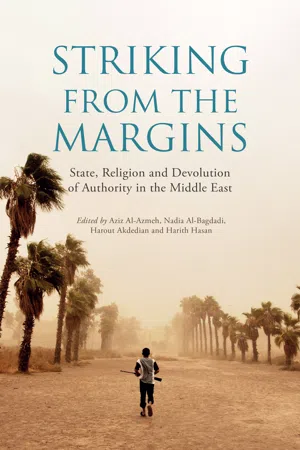
Striking From The Margins
State, Religion and Devolution of Authority in the Middle East
- 352 pages
- English
- ePUB (mobile friendly)
- Available on iOS & Android
eBook - ePub
Striking From The Margins
State, Religion and Devolution of Authority in the Middle East
About this book
Since the collapse of the Soviet Union, the Arab world has undergone a series of radical transformations. One of the most significant is the resurgence of activist and puritanical forms of religion presenting as viable alternatives to existing social, cultural and political practices. The rise in sectarianism and violence in the name of religion has left scholars searching for adequate conceptual tools that might generate a clearer insight into these interconnected conflicts. In Striking from the Margins, leading authorities in their field propose new analytical frameworks to facilitate greater understanding of the fragmentation and devolution of the state in the Arab world. Challenging the revival of well-worn theories in cultural and post-colonial studies, they provide novel contributions on issues ranging from military formations, political violence in urban and rural settings, transregional war economies, the crystallisation of sect-based authorities and the restructuring of tribal networks. Placing much-needed emphasis on the re-emergence of religion, this timely and vital volume offers a new, critical approach to the study of the volatile and evolving cultural, social and political landscapes of the Middle East.
Information
PART I
POLITICAL ECONOMIES & TURMOIL IN THE MENA REGION
CHAPTER ONE
ARAB CIVIL WARS
AGGREGATE MODELS & INDIVIDUAL CASES
Stathis N. Kalyvas
THIS CHAPTER EXPLORES THE CAUSES of the major civil wars in the Arab world during the post–Second World War period, as a means of evaluating and rethinking what is arguably the dominant research paradigm in the field of civil war studies: the comparative/quantitative study of civil war onset. This exercise rests on two pillars.
The first consists of probing the empirical findings of aggregate models of civil war onset against the record of individual civil wars in a particular world region. That is, rather than evaluate these models based simply on their ability to explain global variation in both civil war and domestic peace, as per standard practice, the goal here is to juxtapose them to what we actually know about each case separately. Put differently, by examining the record of the nineteen major Arab civil wars (as coded by the datasets used by these models), I hope to explore their explanatory capacity and identify and highlight potential blind spots and misinterpretations.1
Second, and flowing from the previous point, I propose to systematize this practice as an alternative means of minimizing the gap between available credible individual causal narratives of these civil wars and the theoretical accounts derived from these models. Thus, I am pointing to the utility of a middle-range type of analysis located above the level of case studies but below the structural and transhistorical level of aggregate models, something that might be described as ‘qualitative aggregate theorizing’. This approach exploits the dialectical interaction between aggregate theorizing, on the one hand, and case-based evidence embedded in a specific historical and regional context, on the other.
I begin with a brief discussion of the three dominant aggregate models of civil war onset: the Fearon/Laitin (FL),2 the Collier/Hoeffler (CH)3 and the Cederman/Gleditsch/Buhaug (CGB)4 models. I then compare their key intuitions and findings against capsule-case studies of the major civil wars of the Arab world. I conclude with a brief discussion of an alternative analytical pathway.
A BRIEF HISTORY OF AGGREGATE MODELS OF CIVIL WAR ONSET
Drawing from the quantitative study of interstate war, inspired by the Correlates of War (COW) programme that was initiated during the 1960s, and aiming to discover the deeper laws of war through the aggregation of the universe of cases, the quantitative study of civil war onset took off in the early 1990s on the back of three trends. First, comparative political scientists with a long interest in the study of ethnicity, such as David Laitin, were captivated by the flare-up of ethnic violence in Eastern Europe after the collapse of the Soviet Union. Second, political scientists specializing in the study of international security, like Barry Posen, sought to export insights from the study of interstate war, like the security dilemma, to the study of ethnic conflict. Third, development economists, like Paul Collier, thought that understanding the causes and dynamics of domestic conflict would allow them to crack open the problem of stalled economic development, particularly in Sub-Saharan Africa. More than twenty years later, what have we learned from these models?
I begin from the two early efforts by Fearon and Laitin (FL) and Collier and Hoeffler (CH). Both appeared in print in the early 2000s (2003 and 2004 respectively), although various versions began circulating and were discussed widely at the end of the 1990s. In their influential and highly cited 2003 APSR paper ‘Ethnicity, insurgency, and civil war’ (at almost 8,000 citations, this is the most cited APSR article), Fearon and Laitin conduct a comparative analysis of civil war onset to find what distinguishes country/years with civil war onsets from those without.5 Their main findings are negative: their analysis falsifies the claims that (a) civil wars proliferated rapidly with the end of the Cold War and that (b) the root cause of many or most of these civil wars has to do with ethnic and religious conflicts. Instead they argue that the prevalence of civil in the late 1990s was the result of a steady accumulation of protracted conflicts since the 1950s and 1960s rather than a sudden change associated with a new, post–Cold War international system and that more ethnically or religiously diverse countries have been no more likely to experience significant civil wars. On the positive side, they argue that civil war is a function of the feasibility of insurgency or rural guerrilla warfare, a form of warfare that can be harnessed to serve diverse political agendas. In turn, the feasibility of insurgency is a function of state weakness and ‘rough terrain’. Lastly, poverty, political instability and large populations are also found to be statistically associated with the likelihood of civil war onset globally.
FL measured ethnicity using the then commonly employed ethnolinguistic fractionalization (ELF) index based on data from a Soviet atlas, which gives the probability that two randomly drawn individuals in a country are from different ethnolinguistic groups; they also used a measure of the share of population belonging to the largest ethnic group constructed from the CIA Factbook and other sources, the number of distinct languages spoken by groups exceeding 1% of the country’s population and a measure of religious fractionalization also from the CIA Factbook and other sources. Additional variables included various measures of democracy, economic inequality and indicators measuring religious or linguistic discrimination. As for the warfare dimension, they included proxies for the relative weakness or strength of the insurgents, including a lower per capita income, percentage of young males6 and male secondary schooling, and a measure of the proportion of the country that is ‘mountainous’. Lastly, control variables included regimes mixing democratic with autocratic features (‘anocracies’), a large population, a territorial base separated from the state’s centre by water or distance, foreign governments or diasporas willing to supply weapons, money or training, land supporting the production of high value, low-weight goods such as coca, opium, diamonds and other contraband, which can be used to finance an insurgency, states whose revenues derive primarily from oil exports and the incidence of prior war.
Their findings suggested that per capita income is strongly significant in both a statistical and a substantive sense: $1,000 less in per capita income is associated with 41% greater annual odds of civil war onset, on average. In contrast, they found that the estimates for the effect of ethnic and religious fractionalization are substantively and statistically insignificant; equally insignificant are the estimates for democracy and civil liberties, though anocracies are more prone to civil war, linguistic and religious discrimination, economic inequality, trade openness and the proportion of primary commodity exports (this last one directly contradicting CH). In contrast, population size and oil production tend to be positively correlated with civil war risk. Interestingly for the purposes of this chapter, oil production is not an indirect indicator of the Middle East or Majority Muslim religious affiliation: when dummy variables for the MENA region or the percentage of Muslims are added in, they turn out to be insignificant. Foreign support for rebels or governments turns out to be one of the least well measured items as data were lacking. Using the number of civil wars ongoing in neighbouring countries in the previous year as a possible proxy did not turn out a significant result and a proxy for government support is membership in the Soviet bloc prior to 1991. To summarize, the analysis was pitched primarily on the basis of a non-finding (‘ethnicity does not cause civil war’) and pointed to two key conditions (poverty and rough terrain) facilitating the initiation of guerrilla warfare via a state’s limited capacity to project power across its territory.
Collier and Hoeffler’s paper circulated and eventually appeared at about the same time as Fearon and Laitin’s, although in a less prestigious venue, Oxford Economic Papers. Nevertheless, as it was backed by the World Bank and was the first ambitious empirical foray of economists in the world of conflict, it garnered equally outsized attention (over 8,000 citations). Like FL, this paper initially was pitched negatively as the true, scientifically validated alternative to the conventional wisdom that saw civil wars as the epitome of grievance, casting them instead as a reflection of greed.
Although analysing a smaller cross-section of civil wars (covering the period between 1960 and 1999), its results are largely similar. CH also find weak or null effects for variables measuring grievances, such as (demographic) ethnic and religious diversity and polarization, political repression and exclusion, and inequality, with the exception of ethnic dominance (i.e. the demographic preponderance of a single ethnic/sectarian group). They stressed, instead, opportunity variables that ‘could proxy’ for the viability of rebellion, with an emphasis on ‘lootable resources’ which allow financing of a rebel army. These include primary commodity exports, income, low (male) school enrolments, but also the presence of ethnic diasporas. Unlike FL, they found that primary commodity exports are highly significant predictors of civil war, as are per capita income, population size, diasporas and a short time since the last war. Interestingly for my focus here, population dispersion was found to be associated with a high likelihood of civil war and population concentration with a low probability. They interpreted these findings as showing that opportunities trump grievances and, in turn, that opportunities channel ‘greed’, the willingness to loot natural resources to both finance the war and gain from it. However, they qualified this last point (made stronger in earlier versions) by suggesting that opportunities may be distinguishable from criminal intent. Furthermore, unlike earlier versions, they also recognized that the payoffs of rebellion were not exclusively tied to the ultimate capture of the state and that conflict was not an exclusive source of cost...
Table of contents
- Cover
- Title
- Copyright
- Contents
- Introduction
- Part One | Political Economies & Turmoil in the Mena Region
- Part Two | Reconfiguring Religion & the Local
- Part Three | Jihadi Formations
- Part Four | Beyond Locality
- Conclusion
- About the Contributors
- Index
Trusted by 375,005 students
Access to over 1.5 million titles for a fair monthly price.
Study more efficiently using our study tools.
Frequently asked questions
Yes, you can cancel anytime from the Subscription tab in your account settings on the Perlego website. Your subscription will stay active until the end of your current billing period. Learn how to cancel your subscription
No, books cannot be downloaded as external files, such as PDFs, for use outside of Perlego. However, you can download books within the Perlego app for offline reading on mobile or tablet. Learn how to download books offline
Perlego offers two plans: Essential and Complete
- Essential is ideal for learners and professionals who enjoy exploring a wide range of subjects. Access the Essential Library with 800,000+ trusted titles and best-sellers across business, personal growth, and the humanities. Includes unlimited reading time and Standard Read Aloud voice.
- Complete: Perfect for advanced learners and researchers needing full, unrestricted access. Unlock 1.5M+ books across hundreds of subjects, including academic and specialized titles. The Complete Plan also includes advanced features like Premium Read Aloud and Research Assistant.
We are an online textbook subscription service, where you can get access to an entire online library for less than the price of a single book per month. With over 1.5 million books across 990+ topics, we’ve got you covered! Learn about our mission
Look out for the read-aloud symbol on your next book to see if you can listen to it. The read-aloud tool reads text aloud for you, highlighting the text as it is being read. You can pause it, speed it up and slow it down. Learn more about Read Aloud
Yes! You can use the Perlego app on both iOS and Android devices to read anytime, anywhere — even offline. Perfect for commutes or when you’re on the go.
Please note we cannot support devices running on iOS 13 and Android 7 or earlier. Learn more about using the app
Please note we cannot support devices running on iOS 13 and Android 7 or earlier. Learn more about using the app
Yes, you can access Striking From The Margins by Aziz Al-Azmeh,Nadia Al-Bagdadi,Harith Hasan,Harout Akdedian in PDF and/or ePUB format, as well as other popular books in Politics & International Relations & Middle Eastern Politics. We have over 1.5 million books available in our catalogue for you to explore.