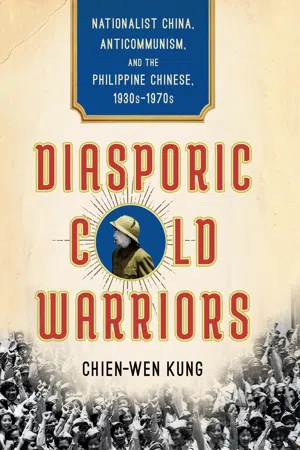
In Diasporic Cold Warriors, Chien-Wen Kung explains how the Chinese Nationalist Party (Kuomintang) sowed the seeds of anticommunism among the Philippine Chinese with the active participation of the Philippine state.
From the 1950s to the 1970s, Philippine Chinese were Southeast Asia's most exemplary Cold Warriors among overseas Chinese. During these decades, no Chinese community in the region was more vigilant in identifying and rooting out suspected communists from within its midst; none was as committed to mobilizing against the People's Republic of China as the one in the former US colony. Ironically, for all the fears of overseas Chinese communities' ties to the PRC at the time, the example of the Philippines shows that the "China" that intervened the most extensively in any Southeast Asian Chinese society during the Cold War was the Republic of China on Taiwan.
For the first time, Kung tells the story of the Philippine Chinese as pro-Taiwan, anticommunist partisans, tracing their evolving relationship with the KMT and successive Philippine governments over the mid-twentieth century. Throughout, he argues for a networked and transnational understanding of the ROC-KMT party-state and demonstrates that Taipei exercised a form of nonterritorial sovereignty over the Philippine Chinese with Manila's participation and consent. Challenging depoliticized narratives of cultural integration, he also contends that, because of the KMT, Chinese identity formation and practices of belonging in the Philippines were deeply infused with Cold War ideology.
Drawing on archival research and fieldwork in Taiwan, the Philippines, the United States, and China, Diasporic Cold Warriors reimagines the histories of the ROC, the KMT, and the Philippine Chinese, connecting them to the broader canvas of the Cold War and postcolonial nation-building in East and Southeast Asia.
CHAPTER 1The KMT, Chinese Society, and Chinese Communism in the Philippines before 1942
On March 2, 1947, the Kuomintang’s (KMT) general branch in the Philippines officially reopened, having been destroyed during World War II. Of those who addressed the twelve hundred in attendance for the reopening ceremony at the party’s headquarters on Benavidez Street in Manila’s Chinatown, three are especially significant. The first was the Chinese consul Chen Chih-ping, who presided over the ceremony. Chen, who later became the Republic of China’s (ROC) first ambassador to the Southeast Asian nation, stressed that the KMT and the Chinese diaspora were inseparable, describing the latter as “vanguard troops” (xianfeng budui) of the former and exhorting those present to preserve the party’s glorious history and “carry forward [Sun Yat-sen’s Three Principles of the People] into the world” (hongyang yu shijie). The second speaker of note was sixty-one-year-old Ong Chuan Seng (see figure 1.1). The founder and principal of Chiang Kai-shek High School (Zhongzheng Zhongxue, or CKSHS) in Manila, Ong was also a member of the Central Executive Committee (Zhongyang Zhixing Weiyuanhui, or CEC), the KMT’s highest decision-making organ, in Nanjing. Ong recalled being present at the founding of the general branch on October 11, 1921, exactly a decade and a day after the start of the Xinhai Revolution, which overthrew China’s last imperial dynasty, the Qing. Looking backward, Ong traced the history of the Philippine KMT to early twentieth-century anti-Qing groups in the archipelago and to precursors of the party such as the Revive China Society (Xingzhonghui) and the Revolutionary Alliance (Tongmenghui). Reflecting on his present, he described the party’s nation-building project, following the ratification of a new constitution in late 1946, as entering its third and final stage, that of creating a constitutional government. The third person of importance, although not physically present, was Chiang Kai-shek, who spoke to the audience through “instructions” (xunci) that he had written to commemorate the occasion. In it, he reminded the attendees of their responsibilities to the Chinese nation and urged them to “collectively encourage loyalty” (tong li zhongcheng).1
FIGURE1.1. A bust of Ong Chuan Seng at Chiang Kai-shek College. Author’s photograph.
This ceremony challenges Sinologists’ mainland-centered understandings of the pre-1949 KMT by emphasizing how the party represented itself diasporically and was linked to overseas Chinese societies through the institutions and individuals that formed its transnational networks. CKSHS, the CEC, the ROC Consulate, and the party’s general branch constituted just a few of the many organizational ties between the party-state and the Philippine Chinese. Each of the three individuals in question linked the KMT-ROC party-state in China to the party and its constituents overseas by crossing borders—in Chiang’s case, figuratively—to be in the Philippines. As the leader who had overseen China’s victory against Japan in the war, Chiang personified an imagined Chinese nation that extended beyond China’s borders and that Chinese everywhere were supposed to owe their loyalties to. Chen Chih-ping, in his capacity as an official diplomatic representative of the ROC, articulated China’s solicitude for the overseas Chinese—a key pillar of its foreign policy.2 As both a local school principal and one of only several overseas Chinese members of the CEC, Ong Chuan Seng symbolically straddled China and the Philippines—the center and its periphery. A founder of the Philippine KMT, Ong, like Chiang, embodied the ties between the party’s prewar history and the postwar scene. His speech joined these temporal segments to each other in a stagist, teleological narrative, driven by the KMT, that he believed was culminating in the realization of Sun Yat-sen’s vision of a democratic China.
In the same historical spirit of this ceremony and to set the stage for the rest of the book, this chapter examines how the KMT established itself in the Philippines from the late 1920s to the eve of the Japanese occupation, the Philippines as a setting for overseas Chinese history, and the clash between the KMT and the Chinese left in the country. Throughout the prewar period, despite the KMT-ROC party-state’s increasingly institutionalized efforts at diasporic mobilization after 1927, the party’s position in Philippine-Chinese society was less secure than it became after World War II. US colonialism, it is true, facilitated the emergence of a Chinese capitalist class that was largely unsympathetic to communism; excluded from the islands Chinese laborers who might have formed a critical proletarian mass for left-wing mobilization; permitted the KMT to operate openly; and suppressed communism until the late 1930s. Some of these factors propelled the KMT’s ascent after 1945. But unlike in the 1950s, Chinese communism in the Philippines grew during the 1930s in partnership with the Filipino left and in spite of seemingly unfavorable structural conditions. The KMT faced financial difficulties and was generally unpopular among members of the Chinese community’s de facto governing body, the Philippine Chinese General Chamber of Commerce in Manila (Feilübin Minlila Zhonghua Shanghui). Internal factionalism bedeviled the party from the 1930s onward, even during the Second Sino-Japanese War (or the War of Resistance, as it was known in China), supposedly the high-water mark of overseas Chinese nationalism. In December 1941, with Japan poised to invade and occupy the archipelago, it is difficult to say which of these two Chinese factions held the upper hand.
KMT Networks beyond China, 1894–1930s
The political organization that we describe as the KMT emerged in the first half of the twentieth century by embedding itself in a landscape of Chinese mobility that extended across and beyond a globalizing, modernizing China. It began as a decentralized, heterogeneous aggregate of anti-Qing societies held together by a small group of committed revolutionaries and was transformed after 1927 into a bureaucratized, hierarchical network that radiated outward from the Nationalist capital in Nanjing. Similar to chambers of commerce in the early twentieth-century lower Yangtze delta region, the overseas KMT developed into what the historian Zhongping Chen calls an “associational network,” within which interpersonal and institutional relations were intertwined with each other and with broader socioeconomic and political forces.3 Yet, while the KMT in some ways resembled existing kinship and commercial networks, it is irreducible to and differed from them in other ways. As the examples of Ong Chuan Seng and other Hokkiens whom we will encounter suggest, native-place migration routes underlay the itineraries of many nationalists who moved between China and the Philippines. However, the KMT’s ecumene was not a closed space and could accommodate those not from the typical Philippine-Chinese home villages in Jinjiang and other counties in Quanzhou. Both the party’s networks and migration networks joined the overseas Chinese to China. But if the former linked emigrants’ villages and places of sojourn through real and imagined ancestral relations, party branches abroad connected these emigrants to each other and to their imagined counterparts in China by perpetuating an ideology that supposedly transcended native place. The party did not contribute to migration as what Adam McKeown calls “a viable economic strategy and stable system for the circulation of goods, people, information, and profit,” but rather leveraged existing migration patterns to network the Chinese national revolution.4
In official and semiofficial narratives of the KMT’s history such as Ong’s, the party traces its origins to Sun Yat-sen’s founding of the Xingzhonghui in Honolulu on November 24, 1894. Eleven years later, after twice trying and failing to overthrow the Qing, Sun merged the Xingzhonghui and other anti-Qing organizations into the Tongmenghui. In accordance with its constitution, five Tongmenghui branches were established in China and four overseas: in Nanyang (Singapore), Europe (Belgium), the Americas (San Francisco), and Hawai‘i (Honolulu).5 Each of these branches was responsible for revolutionary activities in a particular world region. In Southeast Asia, with guidance from Singapore, Tongmenghui branches were created in Siam, Burma, and the Dutch East Indies in the years leading up to the fall of the Qing dynasty in 1911. In that year, just a few months before the revolution, the Philippine branch was founded at the initiative of a Hong Kong Tongmenghui member.6 The first KMT was constituted from these branches, in and beyond China, and from several smaller revolutionary parties, to contest the republic’s first national elections in 1912. A year later, however, Sun was again forced to seek refuge overseas when the ROC’s first president, Yuan Shikai, banned the KMT. Sun’s newest political party, the Chinese Revolutionary Party (Zhongguo Geming Dang, or CRP), was born in Tokyo and of his disillusionment with democracy and KMT members’ ill discipline and disunity. Henceforth, Sun required that all CRP members swear oaths of secrecy, fully devote themselves to the revolutionary cause, and obey him unquestioningly.7 The CRP was reorganized into the second KMT after the May Fourth Movement in 1919, but it remained unable to operate openly in China.
In these early years of the KMT, there was no bureaucratic mechanism to ensure coherence between party branches in China and those overseas. In lieu of a fixed, institutionalized center and overseas branches, there was the itinerant leadership of Sun Yat-sen, his ever-changing coterie of loyalists, and their interpersonal, transnational webs of political friendship. Wang Jingwei, for example, was instrumental in organizing the Tongmenghui in Siam in 1908.8 In the Philippines, the establishment of the CRP there owed much to Ong Chuan Seng, a Tongmenghui member whom Sun sent to the islands after the KMT’s failure to overthrow Yuan in 1913.9
Refounded in 1919, the KMT was reorganized again in 1923, this time with support from the Comintern, into a Leninist vanguard party, becoming the senior partner in an anti-imperialist united front with the Chinese Communist Party (CCP). This was a vital juncture in the history of the KMT’s efforts at overseas mobilization and at ensuring that, to quote one of its main slogans, “the party was present wherever there were large numbers of overseas Chinese.”10 Now based in Canton (Guangzhou), Sun laid down detailed regulations for the establishment and functioning of party branches abroad. These included requiring general branches (zongzhibu) in large or capital cities to “accept an executive appointed by the Canton party headquarters to carry out party duties or resolutions.” On paper, zongzhibu also had jurisdiction over lower-level party branches (zhibu), subbranches (fenbu), and sub-subbranches (qufenbu) in smaller towns with a Chinese presence.11 In January 1924, forty overseas representatives attended the KMT’s First National Party Congress in Canton, right after which the party created the Overseas Department (Haiwaibu), which Sun chaired, to provide centralized direction to zongzhibu abroad.12 Overseas party branches proliferated as the KMT mobilized the diaspora against warlordism. By June 1925, the party’s overseas membership was estimated at 43,612 and its reach had expanded beyond East Asia, the United States, Canada, and continental Europe to include Cuba, Mexico, Australia, India, South Africa, and England.13 By the Second National Party Congress in 1926, zongzhibu and around three hundred zhibu and fenbu had been established in every Southeast Asian country.14
The KMT and CCP’s successful Northern Expedition and subsequent split in 1927 ushered in a new organizational and ideological phase in the KMT’s diasporic project; it is from this point on that distinctions between the KMT as a political movement and the ROC as the government become blurred because of the former’s incorporation into the latter. As part of its anticommunist purge and drive toward administrative centralization, the CEC instructed all overseas branches to reorganize themselves and reregister their members in 1928.15 After qufenbu were abolished, the three tiers of the party and its collective leadership overseas were restructured, as table 1.1 illustrates.16
In 1932, Sun’s Overseas Department was renamed the Overseas Party Affairs Committee (Haiwai Dangwu Weiyuanhui, or OPAC). Subordinate to the CEC, it was responsible for organizing and expanding the party abroad, disseminating information through party newspapers, disciplining and indoctrinating members, working with the CEC’s Organization and Propaganda Committees on propaganda plans, coordinating between party branches and consulates, and protecting overseas Chinese from discrimination.17 State agencies such as the Ministry of Foreign Affairs ...
Table of contents
Acknowledgments
List of Abbreviations
Note on Translation and Romanization
Map of Southern Fujian and Taiwan
Map of the Philippines
Map of Manila
Introduction
1. The KMT, Chinese Society, and Chinese Communism in the Philippines before 1942
2. A “Period of Bloody Struggle”
3. Practicing Anticommunism
4. Anticommunism in Question
5. Networking Ideology
6. Experiencing the Nation
7. Dissent and Its Discontents
Conclusion
Notes
Glossary of Selected Chinese Names
Bibliography
Index
Trusted by 375,005 students
Access to over 1.5 million titles for a fair monthly price.
Study more efficiently using our study tools.
Frequently asked questions
Yes, you can cancel anytime from the Subscription tab in your account settings on the Perlego website. Your subscription will stay active until the end of your current billing period. Learn how to cancel your subscription
No, books cannot be downloaded as external files, such as PDFs, for use outside of Perlego. However, you can download books within the Perlego app for offline reading on mobile or tablet. Learn how to download books offline
Perlego offers two plans: Essential and Complete
Essential is ideal for learners and professionals who enjoy exploring a wide range of subjects. Access the Essential Library with 800,000+ trusted titles and best-sellers across business, personal growth, and the humanities. Includes unlimited reading time and Standard Read Aloud voice.
Complete: Perfect for advanced learners and researchers needing full, unrestricted access. Unlock 1.5M+ books across hundreds of subjects, including academic and specialized titles. The Complete Plan also includes advanced features like Premium Read Aloud and Research Assistant.
Both plans are available with monthly, semester, or annual billing cycles.
We are an online textbook subscription service, where you can get access to an entire online library for less than the price of a single book per month. With over 1.5 million books across 990+ topics, we’ve got you covered! Learn about our mission
Look out for the read-aloud symbol on your next book to see if you can listen to it. The read-aloud tool reads text aloud for you, highlighting the text as it is being read. You can pause it, speed it up and slow it down. Learn more about Read Aloud
Yes! You can use the Perlego app on both iOS and Android devices to read anytime, anywhere — even offline. Perfect for commutes or when you’re on the go. Please note we cannot support devices running on iOS 13 and Android 7 or earlier. Learn more about using the app
Yes, you can access Diasporic Cold Warriors by Chien-Wen Kung in PDF and/or ePUB format, as well as other popular books in History & 20th Century History. We have over 1.5 million books available in our catalogue for you to explore.