- 250 pages
- English
- ePUB (mobile friendly)
- Available on iOS & Android
eBook - ePub
About this book
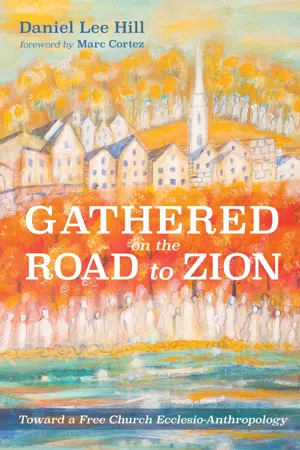
Churches are filled with human beings. It is as a community of human creatures that the church gathers together on Sunday mornings to worship the triune God, and it is as a community of creatures that its members participate in the church's liturgical life. However, merely noting that the church and human beings are related to one another leaves the nature of this relationship unresolved and undefined. And this raises an important question: How should the doctrine of the church inform our understanding of what it means to be human? This project is an exercise in ecclesio-anthropology, albeit from a Free Church perspective. In it Daniel Lee Hill seeks to discover how the nature, practices, mission, and telos of the church robustly inform our understanding of the human creature.
Information
Topic
Theology & ReligionSubtopic
Christian Theology1
Introduction
Churches are filled with human beings, or at least they ought to be. It is as a community of human creatures that the church gathers together on Sunday mornings to worship the Triune God. It is as a community of human creatures that the church celebrates baptism, receives the Lord’s Supper, and hears the preached word. And it is human creatures that disperse from these gatherings back out into the world, fueled with an indefatigable hope, as witnesses to the redemptive work accomplished in Christ. It is enough to make one wonder: Does our life together as the body of Christ meaningfully contribute to our understanding of what it means to be human?
Merely knowing that the church is filled with human beings leaves the relationship between the ecclesial community and the human creatures who comprise it unresolved. While modern theology has demonstrated increased interest in theological anthropology as a distinct locus of theological inquiry,1 articulating the relationship between these two loci remains an area ripe for theological exploration. In emphasizing the significance of the church as, hypothetically, the realm in which the ideal human community is realized, or the place where humanity is properly formed, an important anthropological query is raised: How should ecclesiology inform anthropology? Ecclesio-anthropology is a way of relating two theological loci, ecclesiology and anthropology, in order to understand how the former grants unique and significant insight into the latter.2 More specifically, it asks the question, how do the nature, practices, mission, and telos of the church robustly inform our understanding of humanity? But even the posing of this question presupposes two others: Why think that ecclesiology might inform anthropology and not the other way around? Is ecclesio-anthropology exclusive, or are other approaches to theological anthropology legitimate? While I will return to each of these questions in my conclusion, it seems in undertaking such a project I may need help along the way. For that reason, I have chosen to work with three interlocutors, Hans Urs von Balthasar, Stanley Hauerwas, and John Zizioulas, in order to learn how to do ecclesio-anthropology before making my own attempt.
So what, then, is the church? And, to appropriate a phrase from Alasdair MacIntyre, whose church and which ecclesiology?3 If we assume ecclesiology should in fact inform theological anthropology in unique ways, it stands to reason that different ecclesiologies will result in different anthropologies. Therefore, since this project seeks to articulate the manner in which ecclesiology should inform anthropology, it is important to identify which ecclesiological commitments are at work.
The goal of this project will be to develop a Free Church ecclesio-anthropology. While the Free Church is not typically understood as distinctive in its Christology or soteriology, it does present unique points of emphasis in its ecclesiology. With its traditional emphasis on congregationalism, the freedom of the church from state or provincial governance, voluntary adult membership, and the priesthood of all believers, Free Church ecclesiologies contain a broad range of commitments that have clear anthropological significance. I will seek to articulate these implications through the construction of a Free Church ecclesio-anthropology. However, before moving forward this introductory chapter must provide four important resources. First, I will offer a more expansive explanation of what is meant by the term “ecclesio-anthropology.” Second, I will articulate an understanding of the expression “Free Church,” highlighting central characteristics and points of emphasis within the movement. Third, I will give an overview of how contemporary scholars are connecting the two loci and identify why I have chosen Zizioulas, Balthasar, and Hauerwas as my interlocutors. Finally, I will close this chapter by providing a map of the work that lies ahead.
Toward a Preliminary Definition of Ecclesio-Anthropology
My first task is to provide greater clarity regarding what I intend to communicate with the term “ecclesio-anthropology.” While greater precision must await this project’s final chapters, a preliminary description will help provide context for my use of the term as we move forward. At minimum, an ecclesio-anthropology connects the two loci of ecclesiology and anthropology, arguing that the nature, mission, practices, and telos of the church play a distinctive and constitutive role in shaping anthropology. To a certain extent, the boundaries between these four categories overlap and are semi-permeable. Still, in this section I will briefly address each in turn and provide a preliminary description. Since my interlocutors use the concepts of nature, mission, practice, and telos in unique ways, this initial description will need to be broad enough in scope to incorporate their various differences. I will then revisit some of these categories in chapter 5.
The Nature and Identity of the Church
First, the church is a community whose origin and existence are predicated upon divine action. To inquire into the church’s nature or identity is to ask about its whatness. Here, I am not necessitating a certain ontological or metaphysical approach to ecclesiology. Instead, I am asking the following questions: Who or what is this community? How did it come to be? And what organizes its life together? As will be demonstrated below, some of my interlocutors will answer these questions with strong metaphysical commitments while others will prefer an approach that avoids metaphysical concerns altogether, adopting a more pragmatic approach to ecclesial life. In either case, my interlocutors seem to agree that there is something about the church that distinguishes it from other communities and that inclusion into the ecclesial community entails a fundamental change in how we relate to God, to one another, and tothe world. This seems to imply that the very nature of this community significantly changes our understanding of the identity of its members.
The Mission of the Church
Second, the church is created for a specific purpose and is given a unique mission that participates in the larger missio Dei.4 By mission, I am referring to the “being-sent-ness” of the church into the world for a particular task as they await the return of their Lord ...
Table of contents
- Title Page
- Acknowledgments
- Abbreviations
- Foreword
- Chapter 1: Introduction
- Chapter 2: The Ecclesio-Anthropology of John Zizioulas
- Chapter 3: The Ecclesio-Anthropology of Hans Urs von Balthasar
- Chapter 4: The Ecclesio-Anthropology of Stanley Hauerwas
- Chapter 5: Zizioulas, Balthasar, and Hauerwas in Dialogue
- Chapter 6: Gathered Under the Rule of Christ
- Chapter 7: Conclusion
- Bibliography
Trusted by 375,005 students
Access to over 1.5 million titles for a fair monthly price.
Study more efficiently using our study tools.
Frequently asked questions
Yes, you can cancel anytime from the Subscription tab in your account settings on the Perlego website. Your subscription will stay active until the end of your current billing period. Learn how to cancel your subscription
No, books cannot be downloaded as external files, such as PDFs, for use outside of Perlego. However, you can download books within the Perlego app for offline reading on mobile or tablet. Learn how to download books offline
Perlego offers two plans: Essential and Complete
- Essential is ideal for learners and professionals who enjoy exploring a wide range of subjects. Access the Essential Library with 800,000+ trusted titles and best-sellers across business, personal growth, and the humanities. Includes unlimited reading time and Standard Read Aloud voice.
- Complete: Perfect for advanced learners and researchers needing full, unrestricted access. Unlock 1.5M+ books across hundreds of subjects, including academic and specialized titles. The Complete Plan also includes advanced features like Premium Read Aloud and Research Assistant.
We are an online textbook subscription service, where you can get access to an entire online library for less than the price of a single book per month. With over 1.5 million books across 990+ topics, we’ve got you covered! Learn about our mission
Look out for the read-aloud symbol on your next book to see if you can listen to it. The read-aloud tool reads text aloud for you, highlighting the text as it is being read. You can pause it, speed it up and slow it down. Learn more about Read Aloud
Yes! You can use the Perlego app on both iOS and Android devices to read anytime, anywhere — even offline. Perfect for commutes or when you’re on the go.
Please note we cannot support devices running on iOS 13 and Android 7 or earlier. Learn more about using the app
Please note we cannot support devices running on iOS 13 and Android 7 or earlier. Learn more about using the app
Yes, you can access Gathered on the Road to Zion by Daniel Lee Hill in PDF and/or ePUB format, as well as other popular books in Theology & Religion & Christian Theology. We have over 1.5 million books available in our catalogue for you to explore.