- English
- ePUB (mobile friendly)
- Available on iOS & Android
eBook - ePub
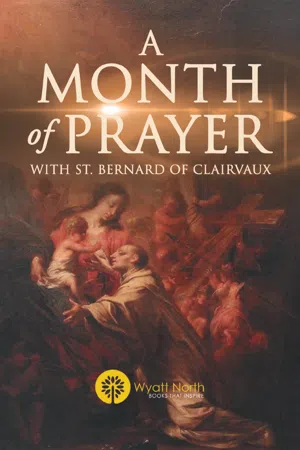
A Month of Prayer with St. Bernard of Clairvaux
About this book
Bernard of Clairvaux (1090-1153) was a Burgundian abbot who was credited with the revitalization of the Benedictine order through the nascent Order of the Cistercians. He lived during the time of schism, when the head of the church was in contention. Benedict was chosen to help decide between the claims on the papacy - ultimately siding with Pope Innocent II rather than the Antipope Anacletus II. Benedict played a significant role in unifying the church and protecting its unity against the threat that this dispute signified.
Information
Topic
Theology & ReligionSubtopic
Christian Denominations Day 1
God is love. If we are going to ask why it is important that we love God, the answer must start with God’s nature and character. This is the insight that St. Bernard gave in his book, On Loving God, and we would do well to consider it. Often, we hear people say things like, “I couldn’t love a God who allows bad things to happen,” and other similar sentiments. However, God is love. We love because He first loved us. The cross is sufficient to demonstrate the basis of our love of God. It’s there that we should look, not within the contingencies of our lives, if we are to love God properly.
Meditations from St. Bernard
You want me to tell you why God is to be loved and how much. I answer, the reason for loving God is God Himself; and the measure of love due to Him is immeasurable love. Is this plain? Doubtless, to a thoughtful man; but I am debtor to the unwise also. A word to the wise is sufficient; but I must consider simple folk too. Therefore, I set myself joyfully to explain more in detail what is meant above.
We are to love God for Himself, because of a twofold reason; nothing is more reasonable, nothing more profitable. When one asks, Why should I love God? he may mean, What is lovely in God? or What shall I gain by loving God? In either case, the same sufficient cause of love exists, namely, God Himself.
And first, of His title to our love. Could any title be greater than this, that He gave Himself for us unworthy wretches? And being God, what better gift could He offer than Himself? Hence, if one seeks for God’s claim upon our love here is the chiefest: Because He first loved us (I John 4.19).
Ought He not to be loved in return, when we think who loved, whom He loved, and how much He loved? For who is He that loved? The same of whom every spirit testifies: ‘Thou art my God: my goods are nothing unto Thee’ (Ps. 16.2, Vulg.). And is not His love that wonderful charity which ‘seeketh not her own’? (I Cor.13.5). But for whom was such unutterable love made manifest? The apostle tells us: ‘When we were enemies, we were reconciled to God by the death of His Son’ (Rom. 5.10). So it was God who loved us, loved us freely, and loved us while yet we were enemies. And how great was this love of His? St. John answers: ‘God so loved the world that He gave His only-begotten Son, that whosoever believeth in Him should not perish, but have everlasting life’ (John 3.16). St. Paul adds: ‘He spared not His own Son, but delivered Him up for us all’ (Rom. 8.32); and the Son says of Himself, ‘Greater love hath no man than this, that a man lay down his life for his friends’ (John 15.13).
St. Bernard of Clairvaux. On Loving God, Ch. 1.
Additional Biblical Reflections: Deuteronomy 6:5; John 14:21; Galatians 2:20.
Prayer
Lord, your love for us is greater than we can possibly comprehend. Yet, so often, the love we have for you pales in comparison to the love you demonstrated for us on the cross. Lord, grant us hearts that conform to the image of your Son so that we might love you as you love us. Amen.
Day 2
Even besides the cross, the Love of God is abundant and evident to believers and unbelievers alike. Despite our lack of gratitude, God continues to grant earthly blessings like food, sunlight, and food even to those who blaspheme His name. As such, life in creation testifies to our basis of love for God on several levels. If we do not see cause to love God, it is on account of the hardness of our hearts, not on account of any lack of graciousness on God’s part.
Meditations from St. Bernard
Those who admit the truth of what I have said know, I am sure, why we are bound to love God. But if unbelievers will not grant it, their ingratitude is at once confounded by His innumerable benefits, lavished on our race, and plainly discerned by the senses. Who is it that gives food to all flesh, light to every eye, air to all that breathe? It would be foolish to begin a catalogue, since I have just called them innumerable: but I name, as notable instances, food, sunlight and air; not because they are God’s best gifts, but because they are essential to bodily life. Man must seek in his own higher nature for the highest gifts; and these are dignity, wisdom and virtue. By dignity I mean free-will, whereby he not only excels all other earthly creatures, but has dominion over them. Wisdom is the power whereby he recognizes this dignity, and perceives also that it is no accomplishment of his own. And virtue impels man to seek eagerly for Him who is man’s Source, and to lay fast hold on Him when He has been found.
Now, these three best gifts have each a twofold character. Dignity appears not only as the prerogative of human nature, but also as the cause of that fear and dread of man which is upon every beast of the earth. Wisdom perceives this distinction, but owns that though in us, it is, like all good qualities, not of us. And lastly, virtue moves us to search eagerly for an Author, and, when we have found Him, teaches us to cling to Him yet more eagerly. Consider too that dignity without wisdom is nothing worth; and wisdom is harmful without virtue, as this argument following shows: There is no glory in having a gift without knowing it. But to know only that you have it, without knowing that it ...
Table of contents
- Introduction
- Day 1
- Day 2
- Day 3
- Day 4
- Day 5
- Day 6
- Day 7
- Day 8
- Day 9
- Day 10
- Day 11
- Day 12
- Day 13
- Day 14
- Day 15
- Day 16
- Day 17
- Day 18
- Day 19
- Day 20
- Day 21
- Day 22
- Day 23
- Day 24
- Day 25
- Day 26
- Day 27
- Day 28
- Day 29
- Day 30
Trusted by 375,005 students
Access to over 1.5 million titles for a fair monthly price.
Study more efficiently using our study tools.
Frequently asked questions
Yes, you can cancel anytime from the Subscription tab in your account settings on the Perlego website. Your subscription will stay active until the end of your current billing period. Learn how to cancel your subscription
No, books cannot be downloaded as external files, such as PDFs, for use outside of Perlego. However, you can download books within the Perlego app for offline reading on mobile or tablet. Learn how to download books offline
Perlego offers two plans: Essential and Complete
- Essential is ideal for learners and professionals who enjoy exploring a wide range of subjects. Access the Essential Library with 800,000+ trusted titles and best-sellers across business, personal growth, and the humanities. Includes unlimited reading time and Standard Read Aloud voice.
- Complete: Perfect for advanced learners and researchers needing full, unrestricted access. Unlock 1.5M+ books across hundreds of subjects, including academic and specialized titles. The Complete Plan also includes advanced features like Premium Read Aloud and Research Assistant.
We are an online textbook subscription service, where you can get access to an entire online library for less than the price of a single book per month. With over 1.5 million books across 990+ topics, we’ve got you covered! Learn about our mission
Look out for the read-aloud symbol on your next book to see if you can listen to it. The read-aloud tool reads text aloud for you, highlighting the text as it is being read. You can pause it, speed it up and slow it down. Learn more about Read Aloud
Yes! You can use the Perlego app on both iOS and Android devices to read anytime, anywhere — even offline. Perfect for commutes or when you’re on the go.
Please note we cannot support devices running on iOS 13 and Android 7 or earlier. Learn more about using the app
Please note we cannot support devices running on iOS 13 and Android 7 or earlier. Learn more about using the app
Yes, you can access A Month of Prayer with St. Bernard of Clairvaux by Wyatt North in PDF and/or ePUB format, as well as other popular books in Theology & Religion & Christian Denominations. We have over 1.5 million books available in our catalogue for you to explore.