The book of Psalms served as Israel's songbook. The apostle Paul, in his letters to the Ephesians and Colossians, wrote of the importance and use of the psalms in our worship. It is also a part of the rule of faith and practice in the church today. The psalms are God's inspired hymnbook. Paul's admonition to the church concerning the psalms is to teach and admonish one another in psalms. The book of Psalms in the Hebrew text is called Book of Praises. The Greek word psalmoi means "songs sung with musical instruments." The psalms are sacred music at its best. They reveal much about their writers, the times, the people, and above all, the glories of Jehovah and the coming Messiah.It is generally believed that Ezra gathered these 150 psalms together into one book during the fifth century before Christ. The actual dates of their writing cover a period of almost 1000 years. David is often referred to as the psalmist, having written 73 of the psalms. Forty-six are anonymous as to the human writer. Various writers including Moses, Asaph, Solomon, Heman, and the sons of Korah wrote the remaining 31.The book of Psalms has long been a favorite among the Lord's people. The writers of the New Testament made 283 direct quotes from the Old Testament and 116 of these are from the Psalms. The Psalms are an excellent source book for the saints of God. There seems to be a related song for every situation we may face in everyday life.The Messianic Psalms span the years of time from the birth of the Messiah, His earthly ministry, and His glorious return at the second coming. May the Lord richly bless the reader as they prayerfully study this wonderful portion of God's Word.
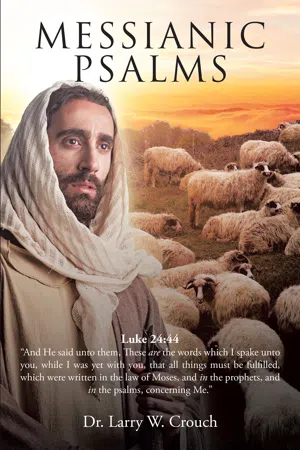
- 244 pages
- English
- ePUB (mobile friendly)
- Available on iOS & Android
eBook - ePub
Messianic Psalms
About this book
Information
Topic
Theology & ReligionSubtopic
ReligionThe Messiah’s Deity Psalm 110:1–3; Matthew 22:41–45; Acts 2:34–35
A Psalm of David. The LORD said unto my Lord, Sit thou at My right hand, until I make Thine enemies Thy footstool. The LORD shall send the rod of Thy strength out of Zion: rule Thou in the midst of Thine enemies. Thy people shall be willing in the day of Thy power, in the beauties of holiness from the womb of the morning: Thou hast the dew of Thy youth.
—Psalm 110:1–3
While the Pharisees were gathered together, Jesus asked them, Saying, What think ye of Christ? Whose son is He? They say unto him, The Son of David. He saith unto them, How then doth David in spirit call Him Lord, saying, The LORD said unto my Lord, Sit thou on My right hand, till I make Thine enemies Thy footstool? If David then call Him Lord, how is He His son? And no man was able to answer Him a word, neither durst any man from that day forth ask Him any more questions.
—Matthew 22:41–46
Introduction
- No question should arise as to the writer of this awe-inspiring psalm.
- Jesus attested to the fact that it was written by King David. The Lord quoted from this psalm to silence His critics.
- Jesus challenged His critics to explain that since the Messiah was to be David’s son, why did David in Spirit call Him Lord?
- Some critics attempt to fly in the face of Jesus Himself. To escape finding Jesus as the Messiah in these verses, they read the title, “Psalm of (or concerning) David.” “A” is left out.
- They attempt to make it about David rather than by David.
- A careful and honest reader of Scripture will see little of David here except as the writer.
- David is not the subject but the Messiah, Jesus Christ.
- How blind are some modern so-called wise men, even with the light shining brightly upon the Scriptures!
- The Spirit, who spoke by the “man after God’s on heart,” will grant us the spiritual sight to see the wondrous truths of this marvelous psalm.
- Every statement and word has infinity of truth and meaning.
- This psalm was likely written on the occasion when David brought the Ark of the Covenant up to Jerusalem.
- On that day David put aside his royal robes and wore the linen ephod of the priestly garment. And David danced before the LORD with all his might; and David was girded with a linen ephod. (2 Samuel 6:14)
- A linen ephod was also worn by Aaron the high priest. And these are the garments which they shall make; a breastplate, and an ephod, and a robe, and a broidered coat, a mitre, and a girdle: and they shall make holy garments for Aaron thy brother, and his sons, that he may minister unto Me in the priest’s office. And they shall take gold, and blue, and purple, and scarlet, and fine linen. And they shall make the ephod of gold, of blue, and of purple, of scarlet, and fine twined linen, with cunning work. (Exodus 28:4–6)
- A line ephod was also by the prophet Samuel. But Samuel ministered before the LORD, being a child, girded with a linen ephod. (1 Samuel 2:18)
- On that day David put aside his royal robes and wore the linen ephod of the priestly garment.
- This foresees the day when Jesus will fulfill all three offices as:
- Prophet: And He shall send Jesus Christ, which before was preached unto you: Whom the heaven must receive until the times of restitution of all things, which God hath spoken by the mouth of all His holy prophets since the world began. For Moses truly said unto the fathers, A prophet shall the Lord your God raise up unto you of your brethren, like unto me; Him shall ye hear in all things whatsoever He shall say unto you. (Acts 3:20–22)
- Priest: Seeing then that we have a Great High Priest, that is passed into the heavens, Jesus the Son of God, let us hold fast our profession. (Hebrews 4:14)
- King: That thou keep this commandment without spot, unrebukeable, until the appearing of our Lord Jesus Christ: Which in His times he shall show, who is the blessed and only Potentate, the King of kings, and Lord of lords; Who only hath immortality, dwelling in the light which no man can approach unto; whom no man hath seen, nor can see: to Whom be honour and power everlasting. Amen. (1 Timothy 6:14, 15)
- Prophet:
- The psalm is clearly Messianic. It is referred to eleven times in the New Testament more than any other psalm, emphasizing its importance in Messianic prophecy (Matt. 22:44; Mark 12:36; Luke 20:42, 43; Acts 2:34, 35; Hebrews 1:3, 10:12, 13; 1 Corinthians 15:25; Romans 11:26, 27; Hebrew 5:6, 6:20, 7:21). Great importance with regard to today’s sermon.
- In Matthew 22:41–46 to confound the Herodians’ biased political question, the Sadducees’ tricky religious question, and the Pharisees’ testing moral question. Jesus turned their questions back on them, quoting Psalm 110:1.
- In Acts 2:34, 35 to convict those who heard Peter’s message charging that they had murdered the Messiah. Three thousand were convicted and led to repentance.
- In Hebrews 1:13 to confirm that Jesus, the Christ, is superior to the angels of heaven.
I. The Messiah’s Position
The LORD said unto my Lord, Sit thou at My right hand, until I make Thine enemies Thy footstool. (Psalm 110:1)
- David is in the middle of the conversation. On one side he sees the Lord, Jehovah, and on the other the Lord, Adonai.
- Jehovah, the self-existent One, is speaking to Adonai, David’s Lord, and the Messiah who is Christ the Lord. ...
Table of contents
- The Messiah’s Deity Psalm 110:1–3; Matthew 22:41–45; Acts 2:34–35
- The Messiah—God’s Son! Psalm 8:1–9; Hebrews 2:6–11
- The Messiah—Eternal Lord and Creator Psalm 102:25–28; Hebrews 1:10–12
- The Messiah—The Living Stone Psalm 118:21–23; 1 Peter 2:8
- The Messiah—Ruler over All Psalm 2:1–12; Acts 4:25–28
- The Messiah—The Good Shepherd Psalm 23:1–6; Hebrews 13:20; John 10
- The Messiah—The Great High Priest Psalm 110:4; Hebrews 5:6, 6:20, 7:21
- The Messiah—Betrayed Psalm 41:9; John 13:18–19
- The Messiah—Obedient Unto Death Psalm 40:1–17; Hebrews 10:5–17
- The Messiah—Crucifixion Psalm 22:1–18; Matthew 27:35–46
- The Messiah’s Resurrection Psalm 16:1–11; Acts 2:25–31, 15:13–17
- The Messiah’s Ascension Psalm 68:1–35; Ephesians 4:7–16
- The Messiah—Things Touching the King Psalm 45:1–8; Matthew 3:16–17; Hebrews 1:8–9
- Her Royal Majesty Psalm 45:9–17; 2 Corinthians 11:2
- The Messiah—Crown Him King Psalm 72:1–11; Revelation 5:5–10
- The Messiah—King of Kings Psalm 89:1–52; 1 Timothy 6:15; Revelation 19:16
Trusted by 375,005 students
Access to over 1.5 million titles for a fair monthly price.
Study more efficiently using our study tools.
Frequently asked questions
Yes, you can cancel anytime from the Subscription tab in your account settings on the Perlego website. Your subscription will stay active until the end of your current billing period. Learn how to cancel your subscription
No, books cannot be downloaded as external files, such as PDFs, for use outside of Perlego. However, you can download books within the Perlego app for offline reading on mobile or tablet. Learn how to download books offline
Perlego offers two plans: Essential and Complete
- Essential is ideal for learners and professionals who enjoy exploring a wide range of subjects. Access the Essential Library with 800,000+ trusted titles and best-sellers across business, personal growth, and the humanities. Includes unlimited reading time and Standard Read Aloud voice.
- Complete: Perfect for advanced learners and researchers needing full, unrestricted access. Unlock 1.5M+ books across hundreds of subjects, including academic and specialized titles. The Complete Plan also includes advanced features like Premium Read Aloud and Research Assistant.
We are an online textbook subscription service, where you can get access to an entire online library for less than the price of a single book per month. With over 1.5 million books across 990+ topics, we’ve got you covered! Learn about our mission
Look out for the read-aloud symbol on your next book to see if you can listen to it. The read-aloud tool reads text aloud for you, highlighting the text as it is being read. You can pause it, speed it up and slow it down. Learn more about Read Aloud
Yes! You can use the Perlego app on both iOS and Android devices to read anytime, anywhere — even offline. Perfect for commutes or when you’re on the go.
Please note we cannot support devices running on iOS 13 and Android 7 or earlier. Learn more about using the app
Please note we cannot support devices running on iOS 13 and Android 7 or earlier. Learn more about using the app
Yes, you can access Messianic Psalms by Dr. Larry W. Crouch in PDF and/or ePUB format, as well as other popular books in Theology & Religion & Religion. We have over 1.5 million books available in our catalogue for you to explore.