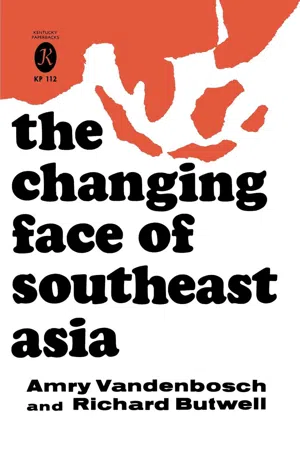
Southeast Asia, whose alienation might tilt the balance of power in favor of the Communist bloc, has become the focus of American foreign policy. Amry Vandenbosch and Richard Butwell here trace the development of the eight nations which comprise Southeast Asia and appraise their current role in international affairs.
Although led to adopt state forms similar to those of the departing colonial powers, each nation traditionally had quite different political systems. It is the authors' thesis that their historical patterns of political and social behavior are re-emerging and that the chief differences among the national political systems and related ways of life can largely be explained in these terms. They feel that the main changes in Southeast Asia in the past two decades reflect the peculiar wedding of such historical considerations and the worldwide forces of democracy, communism, and economic development.
Southeast Asia, the authors hold, can be viewed as a single collective political entity, for no country is free from direct or indirect influence from its neighbors and this interaction is increasing in quantity and intensity. The pattern of political development, the authors assert, is much colored by national variations of common occurrences, but paradoxically Southeast Asia has never meant more in terms of an interdependent unit historically than it does today.
- 448 pages
- English
- ePUB (mobile friendly)
- Available on iOS & Android
eBook - ePub
The Changing Face of Southeast Asia
About this book
Information
CHAPTER 1
SOUTHEAST ASIA
Politics of a New Era
Politics of a New Era
MODERN POLITICAL SYSTEMS are the primary means for attempting to solve problems of a public character, with the control of government the chief goal of the competitors for power. The purpose of this pursuit of power is influence over such policies as are formulated by government and subsequently administered by various of its agencies. Those interests which seek to influence public decision-making and policy execution in areas of their concern hope either to obtain or increase advantages for themselves or to prevent undesirable action.
At least two such types of political systems exist side by side in contemporary Southeast Asia. One of these systems embraces all of Southeast Asia. This is by no means a centralized system after the fashion of the more integrated nation-states, but then neither is that of the world as a whole—which few would deny is today an increasingly interdependent political system, the diversity of its constituent parts notwithstanding. A political system Southeast Asia also surely is, with highly developed competing national (and other) interests striving to influence decisions of importance to the whole area, such as the region’s commitment (or noncommitment) in worldwide political controversies and the extent of state economic activity in the area at large.
Each of the Southeast Asian lands has at the same time its own national political system—some of these, most conspicuously Laos, far from fully integrated. In Vietnam’s case, there are both North and South political systems of clearly distinguishable character as well as the larger Vietnamese political system within which the Communist and non-Communist portions of the divided and wartorn country interact. The difficulties attending a decision on Laotian neutralization in 1961-1962 clearly attest to the frequent autonomy of such national political processes. The great powers, including both the United States and Communist China, had reached a meeting of the political minds, however unpalatable to various of them in different ways. But for more than a year the world waited for the Laotians to reach comparable agreement among themselves. There may not be a real Laotian nation in fact, but there is a Laotian political process identical with the geographical extent of the so-called nation of Laos.
The countries of Southeast Asia, collectively forming a political system, are distinguished by several common characteristics. They are certainly subject to some of the same influences, and there are, of course, “rules of the game,” which, though rarely articulated as such, are fairly widely understood (even as they are undergoing change). On the other hand, it should be noted that some extremely important political events within particular countries have failed to influence in any apparent respect the way in which neighboring countries behaved—for example, Burma’s army coup of 1962. Singapore’s race riots of mid-1964, however, clearly encouraged Indonesian boldness in pursuit of the policy of “confrontation”—even to the point of apparent encouragement by the Djakarta government of a second outbreak between Malays and Chinese after the first seemingly spontaneous clashes.
The most conspicuous—and important—characteristic of Southeast Asia as a political system is the interaction, which is increasing in both quantity and intensity, among its parts. A quarter of a century ago, what happened in the Philippines was not of major immediate importance to Indonesia, although of long-range importance more than was generally realized at the time. Indonesian nationalism, for example, was unquestionably stimulated by the greater maturity of Filipino nationalism and the fact that the Americans had set a timetable for Philippine independence. But today Indonesia far more decisively influences the Philippines than either state had previously influenced the other. The most obvious area is foreign policy. But, domestically, such influence is also considerable and of both a positive and a negative sort—that is, the Philippines is encouraged to do some things and not to do others because of Indonesia’s nearby presence and its particular behavior. Indonesian economic failures have not moved the Philippines to imitate Djakarta’s example in this policy area, but Indonesian emphasis on the results of the change from foreign to indigenous control of government has had an influence on Filipino attitudes toward remaining American economic interests and, even more profoundly, on the style and intensity of Philippine nationalism (with all that this means in terms of domestic and foreign policy-making).
THE INFLUENCE OF GEOGRAPHY
There are many factors which help to make Southeast Asia an internally interacting political system. One of these is geography. Southeast Asia is set off physically from other areas of human habitation. High mountains divide the area from China and India to the north, except for the northeast coastal region of Vietnam, and oceans form natural boundaries to the east, south, and west. This is not to say that Southeast Asia is forced by physical circumstances to be wholly internally oriented. As a matter of fact, the region is much involved in major aspects of worldwide international relations both economically and politically. North Vietnam, for example, is a communist country caught in the controversy between Moscow and Peking. At the same time, however, North Vietnam itself looks to the south and the west—not only in the direction of South Vietnam, against which it has waged a guerrilla-style war since the late 1950s, but also towards Laos and Cambodia and even Thailand (and perhaps beyond). What happens in North Vietnam, not to mention Vietnam as a whole, clearly influences the behavior of the other states of Southeast Asia—in part because the region is a distinct and interrelated geographical whole, making it virtually impossible for any country within the area to isolate itself from the other parts politically.
Location is a major geographical influence on political behavior throughout Southeast Asia, even when that behavior differs dramatically from country to country in response to the same stimuli. Strategically situated on the main sea route between India and China (from which the term “Indochina” stems), Southeast Asia is much influenced by fear of its big and immediate neighbor, China—internally in such areas as freedom of movement and speech as well as in foreign policy decisions involving such alternatives as alignment or nonalignment. The ease of access to Southeast Asia provided by the very waters which separate the region from its neighbors on three sides is a constant threat to the area as witnessed by its recent history of prolonged external subjection.
One consequence of the circumstance of physical fragmentation is the fact that Southeast Asia’s several states are the weaker both because of their size and their continuous concern over relations with their neighbors within the area: Malaysia in reply to Indonesia’s policy of confrontation, Thailand in response to Cambodia’s accommodation to Peking, and South Vietnam concerning supply routes into its territory from North Vietnam through Laos. The largest country in Southeast Asia is Indonesia, which occupies 750,000 square miles and has a population of about 103 million persons. Burma is the second biggest state territorially but with a total land area much smaller than Indonesia’s (more than 260,000 square miles), the Philippines the country with the second largest population (30 million). The other countries are even smaller. Although Southeast Asia as a whole exceeds 1.7 million square miles inhabited by more than 225 million persons, there are three times as many people in China as in all the Southeast Asian countries combined. And China’s land area is twice as great as that of the eleven lands which are its southern neighbors.
PRE-WESTERN ATTITUDES AND INSTITUTIONS
Southeast Asia also derives some unity from the fact of near regionwide penetration of Indian cultural influences in the era before the coming of the European. The age of Indianization of most of the pre-Western Southeast Asian kingdoms (except Vietnam) is evident in the architectural majesty of Angkor in Cambodia, Borobudur in Indonesia, and Pagan in Burma as well as in religion, language, clothing, and some surviving political attitudes and institutions. Most important among the latter is the continuing impact of the assumed basic nature of politics and the relationship between ruler and ruled in pre-Western times—that is, the status-oriented conception of political roles and the related gap between leaders and led.
The gulf between leaders and led was also a characteristic of colonial times. Although nationalists have alleged that the Europeans interrupted traditionally democratic practices, there is much just plain nonsense in their claims. If anything, the colonial powers seemed more concerned with the lot of their subjects than most of the pre-European monarchs, sultans or chieftains. And they established representative institutions which, however modest and grudgingly offered, exceeded the accomplishments of their indigenous predecessors. The tradition of autocracy has deep roots in Southeast Asia, and these roots have never been killed, although some autocratic political institutions have been replaced or modified. Among the primary social institutions the family, for example, is the source of authoritarian attitudes throughout Southeast Asia, no less in the ostensibly democratic Philippine Republic than in fiercely dictatorial soldier-run Burma.
No less alive is the influence of mysticism in politics, another legacy of the pre-Western period. Long-time Indonesian President Sukarno, Cambodian Chief of State Prince Norodom Sihanouk, and former Burmese Premier U Nu were probably never regarded by most of their countrymen as leaders whose chief function it was to reconcile the competing interests in their societies and to emerge with fairly reasonable answers to public problems—answers that made sense in terms of means-ends relationships. Leaders are regarded throughout most of Southeast Asia as possessing powers that cannot be defined wholly, if even largely, in terms of conventional political skills and support. Exceptions are few, differences in degree many. U Nu was considered by his countrymen to be both a God-king of the traditional Hindu sort and a Buddha-in-the-process-of-becoming (probably in the final cycle of rebirth). Even the Philippines cannot escape description of its politicians in such terms: President Ferdinand E. Marcos, a much decorated World War II hero, was depicted in a popular 1965 campaign biography as possessed of magic powers of survival.
The expressive dimension of politics is clearly more important in all the countries of Southeast Asia than the modern problem-solution or policy aspect. Indonesia’s Sukarno and Burma’s Nu proclaimed policies for years with only limited attention to their execution. Likewise, in the Philippines it is customary for the Congress to pass laws for which implementing funds are never expected by anyone to be appropriated. It is as if the political leaders were able to accomplish great things only by lifting their hands and saying, “Let it be done!” This is not to ignore the progress registered in many areas by contemporary Southeast Asian governments, particularly Malaysia, Singapore, the Philippines, and Thailand (and Indonesia, to an amazing extent, in the field of education). It is just that there is a widely prevalent attitude, a holdover of the pre-Western era, that does not relate ends to means in problem solution and which gives a singular unity and mutual understanding to the several national parts of the broader Southeast Asian political process.
THE COLONIAL LEGACY
Another major influence shaping the regional political process results from the period of Western colonial domination, which greatly varied in duration and intensity among the countries, even influencing independent Thailand. Both the benefits and the problems of colonialism have survived withdrawal of the former imperial powers. Economically, the West left the Southeast Asian countries with largely “colonial economies”; that is, the economies are based on the production of raw materials and the extraction of minerals for shipment to other countries with price and other circumstances which are difficult to control partly because of differences in the character of agricultural and manufacturing activities.
The growth of cities is an important legacy of the Western era or, in the case of Thailand (and Bangkok), of indigenous adoption of key facets of Western life. The new elites which today govern the several Southeast Asian countries are mainly urban-based, a major consequence born of forces set in motion by the European presence. Since independence the Southeast Asian governments have probably never been more dissimilar than they are today, ranging from the largely successful Filipino and Malaysian experiments with democracy to the communist and military dictatorships respectively of North Vietnam and Burma. But are the real political processes of these lands as different as their governmental structures seem to suggest? Probably not. The urban-based few rule in Southeast Asia—no less in the Philippines than Burma (though in a different fashion).
Such urban elite rule, differing more in form than in the reality of government by the few, is a characteristic of all the Southeast Asian countries. In varying degrees, political decisions are made in not dissimilar ways from country to country. On many issues, indeed, the various elites must consider the response of elites in adjacent countries as much as mass opinion in their own lands. At the same time, however, these elites—as in the case of the colonial elites before them—are sowing the seeds of their own destruction, whether they realize it or not. They are extending education to the many, for example, at a pace unparalleled in the history of Southeast Asia. This, too, is a consequence of the past Western association, none of the Southeast Asian lands having had higher institutions of learning before the European era and some of them hardly any schools at all. It also reflects a continuing self-image of inferiority in comparison with foreigners that can only be corrected by intensive education.
ANTICOLONIALISM AND NATIONALISM
This attitude of inferiority, possibly most pronounced where least acknowledged, cannot be divorced from the ideological premise most accepted by the leaders of all the Southeast Asian countries—whether democratic or communist, soldier or civilian, Moslem or Buddhist—that colonalism was a grave evil and must be ended in all its manifestations. Anticolonialism is the most important ideological common denominator of the outlook of the several Southeast Asian ruling elites, though not probably the only such common denominator. This anticolonialism may express itself in different ways on many occasions, but on others it does not.
There is every reason to believe, accordingly, that the North Vietnamese political leadership wishes to minimize Chinese influence over its country as much as possible—just as Filipinos are growing increasingly restive over persisting American obstacles to development of national economic autonomy. The world has called this urge for independence nationalism, one of the most potent political forces in all the Southeast Asian countries today. Whether it sufficiently unites the peoples of these lands, on the other hand, is another matter. It is also open to question whether what is called nationalism is always nationalism. That is to say, there are interests in Southeast Asia today, conservative as well as communist (and military as much as economic), that seek to use nationalism as a justification for the satisfaction of their more narrow aspirations.
Nationalism came into being, in major measure, in response to the Western colonial presence and to an outside world to which the European imperial powers largely introduced most of Southeast Asia. Whereas European nationalism sought to explain, justify and perpetuate an increasingly well established state of existence, Southeast Asian nationalism represents an attempt to find answers to questions of individual and group identity that are claimed to restrict the countries of the area from fulfilling many of their proclaimed objectives. Hence, there is a “Burmese Way to Socialism”—which is not that basically different from the search for a “true Filipino personality” or for governing arrangements reflective of an “Indonesian soul.”
Such nationalism divides. But this may not be its most important characteristic from the vantage point of attempting to understand present-day Southeast Asia. It may well be that national integration is a necessary prerequisite or, at the very least, a required contemporary occurrence of broader regional integration. The fact is that the European colonial powers inadequately integrated the territories over which they ruled in Southeast Asia for varying periods of time. More rabid nationalist elements charge that they held back national integration, which is a false claim. Indonesia is what it is today, territorially and politically, because the Dutch hastened the integration of the Indonesian peoples to a far greater extent than any other single factor in their history. But the task, a gigantic one, was never completed. Such imperfect integration characterizes even the Philippines, perhaps the most unified of the Southeast Asian countries as a result of the length and intensity of the common government and policies of its imperial rulers (both Spanish and American but particularly the former).
The integrative needs of today are not wholly of an ethnopolitical character, though these are very important (most especially in the case of Burma). Economic integration also is an imperative. Economic development in the still very recent past was not primarily in terms of national needs. Moreover, tasks formerly performed by aliens in the interest of aliens, whether Western or Asian, must now be performed by nationals or in conformity with national goals. Equally important, military establishments have been formed which are designed to defend national needs and goals rather than to protect, for example, a “life-line” from formerly imperial Britain to erstwhile dominion Australia via ex-colony Singapore.
Such nationalism does not mean that there is not a functioning political system among the country-units of contemporary Southeast Asia. A political system is still a political system, even though divided into component parts.
COMMON PROBLEMS
Still another factor linking the several countries of Southeast Asia is the sim...
Table of contents
- Cover
- Title
- Copyright
- Preface
- Contents
- 1. Southeast Asia: Politics of a New Era
- 2. Indonesia: Protracted Revolution
- 3. Malaysia: Crisis of Confrontation
- 4. The Philippines: Doubting Democracy
- 5. Vietnam: Cork in the Bottle?
- 6. Laos: Captive of Conflict
- 7. Cambodia: Land of Strange Politics
- 8. Burma: From Buddha to Mars
- 9. Thailand: Soldiers in the Saddle
- 10. International Relations of Southeast Asia
- 11. American Policy in Southeast Asia
- 12. Change in the Making
- Bibliographical Note
- Index
Trusted by 375,005 students
Access to over 1.5 million titles for a fair monthly price.
Study more efficiently using our study tools.
Frequently asked questions
Yes, you can cancel anytime from the Subscription tab in your account settings on the Perlego website. Your subscription will stay active until the end of your current billing period. Learn how to cancel your subscription
No, books cannot be downloaded as external files, such as PDFs, for use outside of Perlego. However, you can download books within the Perlego app for offline reading on mobile or tablet. Learn how to download books offline
Perlego offers two plans: Essential and Complete
- Essential is ideal for learners and professionals who enjoy exploring a wide range of subjects. Access the Essential Library with 800,000+ trusted titles and best-sellers across business, personal growth, and the humanities. Includes unlimited reading time and Standard Read Aloud voice.
- Complete: Perfect for advanced learners and researchers needing full, unrestricted access. Unlock 1.5M+ books across hundreds of subjects, including academic and specialized titles. The Complete Plan also includes advanced features like Premium Read Aloud and Research Assistant.
We are an online textbook subscription service, where you can get access to an entire online library for less than the price of a single book per month. With over 1.5 million books across 990+ topics, we’ve got you covered! Learn about our mission
Look out for the read-aloud symbol on your next book to see if you can listen to it. The read-aloud tool reads text aloud for you, highlighting the text as it is being read. You can pause it, speed it up and slow it down. Learn more about Read Aloud
Yes! You can use the Perlego app on both iOS and Android devices to read anytime, anywhere — even offline. Perfect for commutes or when you’re on the go.
Please note we cannot support devices running on iOS 13 and Android 7 or earlier. Learn more about using the app
Please note we cannot support devices running on iOS 13 and Android 7 or earlier. Learn more about using the app
Yes, you can access The Changing Face of Southeast Asia by Amry Vandenbosch,Richard Butwell in PDF and/or ePUB format, as well as other popular books in Politics & International Relations & Vietnam War. We have over 1.5 million books available in our catalogue for you to explore.