In the wake of the global financial crisis, water services have come under renewed neoliberal assault across Europe. At the same time, the struggle against water privatization has continued to pick up pace; from the re-municipalization of water in Grenoble in 2000, to the United Nations declaration of water as a human right in 2010.
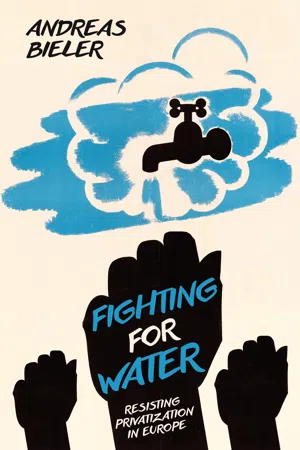
In Fighting for Water, Andreas Bieler draws on years of extensive fieldwork to dissect the underlying dynamics of the struggle for public water in Europe. By analysing the successful referendum against water privatization in Italy, the European Citizens' Initiative on 'Water and Sanitation are a Human Right', the struggles against water privatization in Greece and water charges in Ireland, Bieler shows why water has been a fruitful arena for resistance against neoliberal restructuring.
- 288 pages
- English
- ePUB (mobile friendly)
- Available on iOS & Android
eBook - ePub
Chapter 1
RESISTING WATER PRIVATIZATION: AN INTRODUCTION
Introduction
Water is a fundamental human need. We cannot survive without access to drinkable water. As COVID-19 has revealed, access to water is also essential for a healthy life. Washing our hands regularly is key to overcoming the pandemic. At the same time, capital uses water to expand profit-making into ever-new avenues. Local communities are rarely consulted and their needs hardly taken into account. The global financial crisis of 2007/2008 has intensified capitalist pressures towards the privatization of public services. In this ongoing neo-liberal attack, a global infrastructure market for profitable investment by private capital is being created. Water services infrastructure is no exception in this respect. And yet, from the Cochabamba water war in Bolivia in 2000 to the United Nations (UN) declaration of water as a human right in 2010, from the re-municipalization of water in Grenoble in 2000 to the re-municipalization of water in Paris in 2010 and Berlin in 2013, the struggle against water privatization has picked up pace. Between 2000 and 2015, there were 235 cases of water re-municipalization in thirty-seven countries affecting 100 million people worldwide (Kishimoto, Lobina and Petitjean 2015). This book is about resistance to capital’s expropriation of water resources.
Water privatization has also been part of restructuring in the European Union (EU) before and in response to the global financial and closely related Eurozone crises. In Greece, Ireland and Portugal, for example, the Eurozone crisis has been used for the imposition of water privatization in exchange for bailout agreements. Nevertheless, in Europe too water is the area where resistance against capitalist exploitation has been most successful. When privatization of water started in some towns in central Italy in the late 1990s and early 2000s, consumers were almost immediately hit by drastic increases in water charges of over 100 per cent. In response, resistance started to emerge around local water committees. When they encountered water activists from Latin America and other parts of the world at the first Alternative World Water Summit in Florence/Italy in 2003, Italian activists realized that their local struggles are part of a wider pattern. They moved towards establishing the Italian Forum of Water Movements at the national level in 2006 as the next step. The Forum provided the organizational basis for the successful mobilization in the referendum on water privatization in 2011, when Italian citizens rejected water privatization by a large majority. In turn, the success of the Italian water movement in the 2011 referendum encouraged the European Federation of Public Service Unions (EPSU) to organize the first European Citizens’ Initiative (ECI) ‘Water and Sanitation are a Human Right’ in 2012. Once the ECI had been approved by the European Commission on 10 May 2012, the collection of signatures started and between May 2012 and September 2013 close to 1.9 million signatures were collected across the EU and formally submitted to the Commission. When water activists from the Greek city of Thessaloniki followed the hearing of the ECI outcome in the European Parliament (EP) via video link in 2014, these activists decided that they too would organize a referendum in their city in support of public water. The rejection of privatization was overwhelming. On 18 May 2014, 98 per cent of participating citizens voted in favour of keeping water in public hands. Ireland came rather late to the struggles over water in the EU. During the ECI, for example, Ireland had not been one of those countries, in which the required number of signatures had been collected. It was only in 2014, when the Irish government established a national water company and started to roll out a programme of installing water meters – perceived by many as the first steps towards privatization – that activists mobilized. Large demonstrations, a non-payment campaign of water charges and civil disobedience in the active blocking of the installation of water meters proved to be a powerful set of strategies, which ultimately led to the suspension of water charges in 2016. In short, through a detailed investigation of the Italian referendum on water privatization in 2011, via the ECI on ‘Water and Sanitation are a Human Right’ in 2012 and 2013 to the ongoing struggles against water privatization in Greece as well as the fight against the introduction of water charges in Ireland between 2014 and 2016, this book will analyse why water has been an area for successful resistance against intensified capitalist exploitation in Europe. A focus on the agency of resistance around broad alliances of trade unions, social movements as well as environmental and development groups will be placed within the wider structuring conditions of global capitalism in the twenty-first century.
The comparative analysis in this book does not follow a standard positivist, comparative research strategy, which identifies clearly self-contained, distinguishable units to be externally compared with each other. Case studies have not been selected according to a most-similar or most-different strategy. The goal is not to identify any law-like, causal relationships in an ‘objective reality’ (Ward 2010: 479–80). It is accepted that ‘cases cannot be abstracted from their time/space location, via an experimental logic which juxtaposes cases “externally”, in order to generalize from observed patterns’ (McMichael 2000: 672). Hence, although I focus on struggles in Greece, Ireland and Italy, this is not on the basis of a ‘methodological nationalism’, which understands national borders as sealing off distinctive units. Instead, I pursue a related or incorporated comparison, which argues that ‘what are typically seen as bounded “units of analysis” are often more usefully understood as vantage points from which to try to begin to grasp the coming together and interconnections of what (at least initially) appear as key processes’ (Hart 2018: 389). Rather than regarding individual cases as separate, they are recognized as co-constitutive. Throughout the book, we will see how the struggle in one location has had implications on struggles in other places. As already mentioned, the success in the Italian referendum gave EPSU the confidence to move ahead with the ECI. Italian activists, in turn, participated in collecting signatures for the ECI and were also present as international monitors during the referendum in Thessaloniki in May 2014. Thus, following the methodological strategy of an incorporated comparison this book demonstrates how the proposed sale of public water and sanitation services is not simply a set of nationally tailored policies. Instead, privatization policies are understood as spatial and temporal components of broader dynamics of neo-liberal, capitalist restructuring within crisis conditions inside the global political economy. In short, while specific struggles over national trajectories of development are compared with each other, they are at all times embedded and internally related within the wider struggles contesting the possible privatization of essential public services as part of the ‘historically integrated process’ of global capitalist restructuring (Morton 2013a: 245).
The incorporated comparison adopted in this book is ‘a singular form, analysing variation in or across space within a world-historical conjuncture …; [the case studies] are comparable precisely because they are competitively combined, and therefore redefined, in an historical conjuncture with unpredictable outcomes’ (McMichael 1990: 389). While global neo-liberal developments shape policies in different national contexts, which are compared with each other in the way they co-constitute each other as well as the overall system, the global political economy itself is in a process of changing. ‘In effect, the “whole” emerges via comparative analysis of “parts” as moments in a self-forming whole’ (McMichael 1990: 386; see also McMichael 2000: 671). Hence, while each case in a way responds to similar pressures within the overall system, and here especially capital searching for profitable investment opportunities on the back of neo-liberal restructuring, the overall system is not a pre-given, fixed totality. Rather, it shapes and equally is being shaped by the various individual cases of struggle. It is this co-constitution of the various parts as well as the whole through its parts (Hart 2018: 378), which implies that transformation of the whole is possible in the first place. Italian, Greek and Irish struggles have clearly been shaped by developments at the European level, while struggles against water privatization in the EU were affected by national level struggles in turn, all shaping and being shaped by neo-liberal restructuring within the global political economy.
Neo-liberal economics, first experimented with in Pinochet’s Chile in the early 1970s before it was implemented in the UK by Thatcher and the United States by Reagan during the 1980s, gained a hegemonic status at the global level during the 1990s, underpinning the so-called Washington consensus. Neo-liberalism consists of a set of policies, including deregulation and liberalization of the economy, the privatization of national companies, the marketization of public services delivery as well as an attack on workers’ rights and the power of trade unions, through which the state unleashes market forces. However, neo-liberal economics is more than just specific policies. It has also been the hegemonic project of transnational capital to secure the continuation of accumulation and re-assert its power over labour against the background of economic recession as well as rising workers and trade union militancy during the 1970s (Harvey 2006b).
Individual case studies offer vantage points of assessing and looking into wider general developments. Unsurprisingly, the cases selected for this book are not the only possible ones. An alternative or additional case could have been, for example, the struggle over re-municipalizing water services in Berlin. This too would have offered an interesting vantage point to understand ongoing contestation of capitalist expropriation of water. Ultimately, the case studies were selected due to the way they directly impacted on each other, as will be revealed throughout the book. Moreover, the Berlin case is still an integral part of struggles analysed in this book. Activists from the Berlin Water Table (Berliner Wassertisch) were active members of the ECI struggles and they continue to be members of the European Water Movement (EWM), which is concerned with struggles over water at the local, national and European level. Ongoing contestations in Spain and here in particular Catalonia, where there is an intensive struggle to wrest control of water services from the Suez subsidiary Agbar group, could have been chosen as another vantage point. Again, Spanish activists have been involved at the European level and contributed significantly to the knowledge of how water can be managed differently. I will at least consider the latter aspect more closely in the final chapter of this book, when I discuss the experiences of the Water Observatory in Terrassa. In short, the case studies of this book are not exhaustive of all current water struggles in Europe. Nevertheless, as a combination they provide clear insights into ongoing struggles against capitalist expropriation co-constituting each other across different levels and, thereby, constituting the overall system. Methodologically, the research for this book is partly based on a set of sixty-one semi-structured interviews with water activists in the three countries and across the EU between 2014 and 2020. Interviewees include activists from local citizens’ committees, established and rank-and-file trade unions, environmental and development NGOs as well as a number of academic-activists, who were themselves involved in the struggles reflecting and writing about them at the same time. Overall, in addition to official communications by the various organizations involved and relevant secondary literature, this interview material provides a rich texture of the various dynamics underpinning water struggles in Europe.1
In its relentless search for higher profits, capital expropriates water in a number of ways. First, as part of the globalized system of food production, water is often diverted from local use towards large agribusiness companies. These moments of ‘land grabbing’ by large corporations or states through their sovereign wealth funds are ultimately a form of water grabbing, as this agricultural land would be worthless without access to the water necessary for growing crops. In turn, however, this focus on the production of export cash crops, often enforced by international organizations such as the IMF, the World Bank and the WTO, implies that enormous amounts of water are taken away from local populations. For example, ‘flower production for the USA and Europe in vulnerable areas of Kenya and the Andean mountains of Colombia and Ecuador profoundly affects the quantity and quality of local community water sources, as well as overall livelihood conditions’ (Boelens, Vos and Perreault 2018: 8). Second, extractive industries including mining projects as well as hydrocarbon industries such as fracking, tar sands and the exploration for oil are a significant burden on drinking water resources. ‘In 2014, the Inter-American Human Rights Commission investigated 22 large-scale Canadian mining projects in nine Latin American countries, concluding that they all caused profound environmental impacts, contaminating rivers, displacing people, impoverishing communities, and dispossessing water rights’ (Boelens, Vos and Perrault 2018: 9). Third, large dam constructions for the generation of energy as well as the increasing use of rivers as part of hydropower development put heavy pressure on local water supply (Nilsen 2010). The Mekong River in Asia, for example, with its enormous fish variety and rich agricultural soil on its banks, sustaining millions of people’s livelihood, is under threat from numerous dam projects (Khidhir 2019; Peter 2019). In Europe, the unspoilt rivers of the Balkans have become a target for investors in small hydropower plants, endangering local eco-systems (Interview No.52; Interview No.56).
Fourth, ‘bottled water is one of the world’s top businesses even in countries where water stress is acute. The global market is valued at about 250 billion USD, and it’s only expected to grow’ (Pacheco-Vega 2020: 113; see also Barlow 2019: 17–18). This industry, which also includes the production of other beverages relying on access to water, is a key example of how capitalism draws on water as a ‘cheap’ resource in order to make profit. Recent developments in California indicate the political nature of water shortages. ‘During the drought, bottled water companies were extracting groundwater to sell water to other places while residents had water restrictions, creating considerable controversy’ (Sultana 2018: 486). Finally, there is the privatization of water and sanitary services, which has increasingly become a focus for profitable private investment. The provision of certain public services such as education and health, water and energy, is the responsibility of the state in industrialized, developed countries. It is this state responsibility, with profits guaranteed by the state and state bailouts ensured should anything go wrong, which makes the privatization of services like water such an attractive investment opportunity for capital. At times, when the global economy is in crisis, investing in services provision promises large profits, when any other investment opportunities have dried up. In sum, all these different processes are aptly referred to as ‘water grabbing’, a process in which water resources are appropriated by capital to expand accumulation to the detriment of local communities (Veldwisch, Franco and Mehta 2018: 62). Thus, water grabbing ‘is a form of accumulation by dispossession; water is no longer a public good but rather a commodity, shifting risk from private investors to the public, whilst profits move in the opposite direction’ (Moore 2018: 4).
All these forms of water grabbing have resulted in moments of resistance. This book will analyse resistance to the privatization of water and sanitary services. While this push for privatization has been a global phenomenon, this book will focus on ongoing struggles in Europe. In doing so, however, these struggles are always understood as being nested within broader global dynamics in line with the research strategy of incorporated comparison.
Conceptualizing water struggles
The management and distribution of drinking water is often described as a technical problem, which requires a rational solution. See, for example, the UN Water Report 2012 in this respect (UN 2013). Nevertheless, this ‘diverts the attention from the deeply uneven political, social and economic power relations and conflicts that ultimately choreograph access to, distribution and management of water’ (Swyngedouw 2013: 826). Water shortages or scarcity are not natural phenomena due to environmental characteristics, but the outcome of political struggles (Loftus 2009: 953). In other words, ‘the global water problem is neither one of physical water scarcity nor of excessive demographic development. It is primarily the fusion of the dynamics of water with the power of money in highly uneven ways’ (Swyngedouw 2013: 828). This book adopts this ‘political ecology’ insight and, therefore, focuses on struggle, when it comes to water privatization. However, accepting that water management and distribution is a matter of political struggle waged by actors with uneven access to power resources does not tell us how the analysis of these struggles should be conceptualized, who the agents are and in what way they relate to the wider structures. In this section, I will discuss how we can conceptualize struggles over water privatization. I will argue that only a historical materialist approach allows us to comprehend the historical specificity of capitalism within which these struggles are placed.
Within sociology and political science, the analysis of social movements has gained significant attention in recent years in the wake of increasing contestations of globalization. Hence, I will first provide a critical engagement with this set of approaches. Subsequently, I will introduce a Marxist approach to social movements. Only a historical materialist approach, I will argue, allows us to understand why it is that capitalism is driven by this relentless pressure towards continuing outward expansion. This book will therefore deal closely with the structuring conditions of the capitalist social relations of production, which ensure that capitalism is such a dynamic, but ultimately also destructive economic-political system for human beings and nature alike. This focus on structure, however, does not imply that agency is overlooked. On the contrary, this book is about the multiple social class forces, which have refused to accept the imposition of intensified exploitation. It is analysed in detail how these social class forces are internally related to the structuring conditions of capitalism through a focus on class struggle. Instead of privileging ‘class’ as an analytical category over other categories, class struggle is, thereby, conceptualized in a way, which acknowledges the multiple forms of oppression in a capitalist social formation, including patriarchal structures as well as the ongoing expropriation of nature, which are part and parcel of capitalist accumulation.
Liberal social movement studies
Social movements and civil society more generally have been widely studied by liberal approaches in view of increasing levels of inequality against the background of globalization. In line with Karl Polanyi’s (1957) ideas about a double movement, in which a period of laissez-faire is followed by a period of regulation, liberal scholars discuss the possibility of establishing global governance institutions, which can ensure a more just distribution of increasing wealth, resulting from neo-liberal restructuring at the global level (e.g. Held and McGrew 2002: 135–6; Held et al. 1999: 449–52). There are, however, a number of problems associated with this. First, these scholars understand civil society as some kind of progressive force (Buttigieg 1995: 5). Nevertheless, civil society also includes pro-globalization forces such as business associations, which are often a driving force behind global restructuring. Of course,
the oppressed, the marginalized, and the voiceless are indeed important elements of civil society, and they merit special attention precisely because they are generally overlooked, even though they are in the majority; but to regard them as tantamount to civil society can only result in a false understanding of the complex dynamics of power relations within, among, and across states.
(Buttigieg 2005: 35)
Second, liberal analyses overlook the crucial importance of the capitalist social relations of production around the private ownership or control of the means of production and wage labour. As a result, different organizations have different levels of structural power available, with business organizations in times of transnational production networks being more powerful than trade unions, for example (Bieler 2011: 165–70). Hence, ‘civil society is not some kind of benign or neutral zone where different elements of society operate and compete freely and on equal terms, regardless of who holds a predominance of power in go...
Table of contents
- Cover
- Halftitle Page
- Title Page
- Contents
- Note about the Author
- List of Abbreviations
- Acknowledgements
- Preface
- CHAPTER 1 RESISTING WATER PRIVATIZATION: AN INTRODUCTION
- CHAPTER 2 CAPITALISM’S RELENTLESS THIRST FOR ACCUMULATION
- CHAPTER 3 MOBILIZING FROM BELOW: VICTORY IN THE ITALIAN WATER REFERENDUM
- CHAPTER 4 WATER IS A HUMAN RIGHT: THE FIRST EUROPEAN CITIZENS’ INITIATIVE OVER PUBLIC WATER
- CHAPTER 5 CONTESTING THE TROIKA: RESISTANCE IN GREECE AGAINST IMPOSED WATER PRIVATIZATION
- CHAPTER 6 ‘WE WILL STRIKE, WE WILL FIGHT, WATER IS A HUMAN RIGHT’: THE IRISH PEOPLE RISE UP
- CHAPTER 7 TRANSFORMING CAPITALISM TOWARDS THE COMMONS?
- Bibliography
- Index
- Imprint
Trusted by 375,005 students
Access to over 1.5 million titles for a fair monthly price.
Study more efficiently using our study tools.
Frequently asked questions
Yes, you can cancel anytime from the Subscription tab in your account settings on the Perlego website. Your subscription will stay active until the end of your current billing period. Learn how to cancel your subscription
No, books cannot be downloaded as external files, such as PDFs, for use outside of Perlego. However, you can download books within the Perlego app for offline reading on mobile or tablet. Learn how to download books offline
Perlego offers two plans: Essential and Complete
- Essential is ideal for learners and professionals who enjoy exploring a wide range of subjects. Access the Essential Library with 800,000+ trusted titles and best-sellers across business, personal growth, and the humanities. Includes unlimited reading time and Standard Read Aloud voice.
- Complete: Perfect for advanced learners and researchers needing full, unrestricted access. Unlock 1.5M+ books across hundreds of subjects, including academic and specialized titles. The Complete Plan also includes advanced features like Premium Read Aloud and Research Assistant.
We are an online textbook subscription service, where you can get access to an entire online library for less than the price of a single book per month. With over 1.5 million books across 990+ topics, we’ve got you covered! Learn about our mission
Look out for the read-aloud symbol on your next book to see if you can listen to it. The read-aloud tool reads text aloud for you, highlighting the text as it is being read. You can pause it, speed it up and slow it down. Learn more about Read Aloud
Yes! You can use the Perlego app on both iOS and Android devices to read anytime, anywhere — even offline. Perfect for commutes or when you’re on the go.
Please note we cannot support devices running on iOS 13 and Android 7 or earlier. Learn more about using the app
Please note we cannot support devices running on iOS 13 and Android 7 or earlier. Learn more about using the app
Yes, you can access Fighting for Water by Andreas Bieler in PDF and/or ePUB format, as well as other popular books in Business & Business General. We have over 1.5 million books available in our catalogue for you to explore.