eBook - ePub
When a State Turns on its Citizens
60 years of Institutionalised Violence in Zimbabwe
- 144 pages
- English
- ePUB (mobile friendly)
- Available on iOS & Android
eBook - ePub
When a State Turns on its Citizens
60 years of Institutionalised Violence in Zimbabwe
About this book
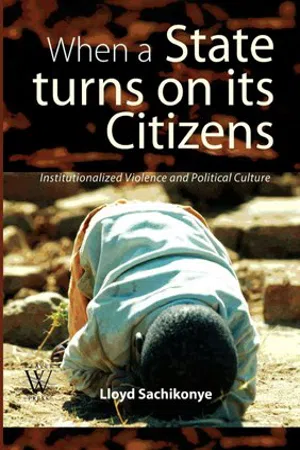
Lloyd Sachikonye traces the roots of Zimbabwe's contemporary violence to the actions of the Rhodesian armed forces, and the inter-party conflicts that occurred during the liberation war. His focus, however, is the period since 2000, which has seen state-sponsored violence erupting in election campaigns and throughout the programme of fast-track land reform. The consequences of this violence run wide and deep. Aside from inflicting trauma and fear on its victims, the impunity enjoyed by its perpetrators has helped to mould a culture within which personal freedoms and dreams are strangled. At a broader social level, it is responsible - both directly and indirectly - for millions of Zimbabweans voting with their feet and heading for the diaspora. Such a migration 'cannot simply be explained in terms of the search for greener economic pastures. Escape from authoritarianism, violence, trauma and fear is a large factor behind the exodus'. Sachikonye concludes that any future quest for justice and reconciliation will depend on the country facing up to the truth about the violence and hatred that have infected its past and present.
Information
Chapter 1
Background, History and Patterns of Political Violence

Introduction
In March 2007, the world was shocked by the scenes of brutality seared into swollen faces and battered heads as well as broken limbs of Zimbabwean opposition politicians and civil society leaders. They had been extensively beaten and tortured by state security forces and denied medical treatment for several days. The gruesome treatment that they received from the state was punishment for attempting to hold a public prayer meeting. Six months earlier, in September 2006, harrowing torture had been applied to trade unionists who were exercising their right to protest against the regime’s economic policies. Even more shocking was the retributive violence, largely orchestrated by state security forces, against opposition and civil society activists in April-June 2008. State-organized violence against opponents of ZANU-PF has been a central instrument in the perpetuation of its tenure and hence its systematic deployment during election campaigns since independence. But violence as a method of political competition, and for seeking and maintaining power, has deep roots in Zimbabwean politics. The practice and culture of violence were established more than 50 years ago. By the time a split occurred in the nationalist movement in 1963 – the formation of the Zimbabwe African National Union (ZANU) as a splinter party from the Zimbabwe African Peoples Union (ZAPU) – violence was already frequently used in political contest.
Half a Century of Political Violence
To trace the roots of political violence to the period 1960-63 is not to provide any excuse for its subsequent use, or its refinement under both the Smith and Mugabe regimes. It is an attempt to understand why and how violence has been a method of choice of regimes in power to maintain their grip on power. It is also to explore why counter-violence has been a preferred option by groups or forces (such as nationalist/liberation movements and some opposition parties) aspiring to power. Clearly there were certain dividends from the deployment of violence. The colonial state itself was a major source of violence.Violence was a major prop for the institutions that the colonial state created (Interview with N.U., February 2010). It deployed this violence against nationalist organizations such as the National Democratic Party (NDP) and the Zimbabwe African People’s Union (ZAPU). The growth of militant and mass nationalism in colonial Zimbabwe was a response to a shift to uncompromising white supremacy under the successive leaderships of Edgar Whitehead, Winston Field and Ian Smith. The eclipse in 1958 of the moderate Garfield Todd government which was sympathetic to African nationalism heralded a pronounced shift to this white extremism that was hostile to African nationalist aspirations.
Detentions of nationalist leaders and banning of their parties became common methods of the white minority regime to contain nationalism. Violence was deployed through beatings, use of dogs in controlling gatherings, forceful arrests and shootings. Nationalists mounted resistance to this violence. As one historian recalled:
party leaders ordered their members to mount resistance against provocative police operations. The response was solid and proved beyond any doubt that the leaders were far from being a coterie of malcontents with no base among the people... (Bhebe, 1989:74).
Marches and demonstrations against the colonial regime were common. So too were strikes and riots. Some of the strikes were quelled with ferocity. At Wankie, in 1954, miners were tear-gassed while pressing for better working conditions. In Harare, during a riot in October 1960, seven Africans were shot dead while 70 received gunshot wounds. Earlier in July 1960, Bulawayo was rocked by riots and protests against the colonial state. These were termed the zhii riots in which youth played a leading role. However, this violence as expressed through riots often slipped out of the control of nationalists, and degenerated into widespread lawlessness. Troops were deployed in the townships in 1960 and in the countryside to stem the spiralling violence (Ranger, 1995). The NDP itself was banned in 1961. And this was just the beginning of half a century of political violence.
Political Violence in the Nationalist Movement
An outstanding feature of African nationalism in Zimbabwe was not just its confrontation with white minority nationalism through violence. There was also a great deal of violence between the nationalist parties themselves. Instead of expending their energies and other resources against the white minority state, ZAPU and ZANU in 1963 and 1964 engaged in a bitter violent contest for the political high ground. Each of the two parties sought to position itself for power in negotiations with the British imperial state and the white minority state. The stakes were clearly high. This study will not attempt to delve into events and factors surrounding the fissure in the nationalist movement in 1963. It was a fissure that resulted in the split of ZAPU with the splinter wing calling itself ZANU. Some analysts have explained the split in terms of the ethnic factor but the power dynamics should not be underestimated; for instance, prominent Shona politicians remained in the leadership of ZAPU despite the presumption that it was a predominantly Ndebele party.
Inter-party violence reared its ugly head for the first time in the clashes between ZAPU under Joshua Nkomo and ZANU led by Ndabaningi Sithole. It was a contest conducted with ferocity in both urban townships and rural areas. Interestingly, there has been considerable writing about this inter-party violence (Nyagumbo, 1980; Ellert, 1989; Sithole, 1999; Nkomo, 1999; Tekere, 2007). Most of the writing has been in the form of empirical accounts without analytical reflections on the precedents and consequences of that form of violence. Given the viciousness and wide reach of inter-party violence, questions should have been asked as to whether the violence was a manifestation of latent aggression built into the colonial system. In other words, humiliation and belligerence amongst the colonized was destructively used against fellow nationalists instead of directed at the colonial state and its agents. In addition, it could have been questioned whether and in what ways the colonial state itself abetted the inter-party clashes to its advantage.
Nevertheless, these accounts that exist are illuminating. Amongst nationalists, Maurice Nyagumbo spent the longest period in political detention experiencing violence in its various manifestations during the process. He wrote that some ZAPU leaders in 1963:
went to Mabvuku, Harare and Mufakose where they mobilised youth, who were all brought to Highfield and given the task of stoning the houses of those they called ‘dissidents’ who no longer wanted Nkomo’s leadership. This started a black chapter of our history in this country. Our opponents, Nkomo and his followers, were dedicated to the elimination of every one of us and those who supported us... (Nyagumbo, 1980:179).
Nyagumbo added that throughout the year 1963-64 the destruction of houses and property and the molestation of ZANU members continued. He narrated how he was an object of the violence himself:
at my house in Highfield, I was awoken by pieces of asbestos falling on my bed from the roof. I then saw those thugs were trying to get into my room through the window but the whole roof had been torn by stones...(Ibid., 183).
Rural areas were not spared the violence. Nyagumbo’s house and other property were burnt in 1964. In Murehwa, thugs rampaged through villages demanding money for ‘umdala’ (a reference to Nkomo) (Ibid.). It was alleged that those who could not afford the required money had their houses burnt down and property destroyed. Nyagumbo concludes his account of inter-party violence by narrating a horrendous ordeal experienced by one chief in the Rusape district:
Some thugs went to headman Nedewedzo’s village, remaining on a hill opposite until late at night. When the old man had gone to sleep, these people went to the house and tied the only door with a piece of wire from outside and set the house alight. Although he struggled with the door and shouted for help, by the time the neighbours came the place had already burnt down and the old man was dead... (Ibid., 184).
Of course, Nyagumbo’s account is partisan and attributed the blame for the inter-party violence to ZAPU’s thugs. There was also violence committed by ZANU’s thugs against ZAPU about which he was reticent. Even so, Nyagumbo acknowledges the prominent role played by ZANU youth leaders in inter-party violence. As he recounts: ‘both Enos Chikowore and Nyamupingidza boasted that they could make it impossible for Chikerema and Nkomo to remain in Harare for one hour’ (Ibid.). The two were key ZANU youth leaders who directed violence against ZAPU leaders and supporters.
Equally prominent in anti-ZAPU violence was Edgar Tekere who was active not only in Highfield but also in Gweru. In his autobiography, he recounted that:
...the Zanu Youth Wing went to Masvingo to mobilise support for the Party in that town. In effect, we were fighting a war with Zapu and, as Zanu was unable to operate in either Harare or Bulawayo, the Gweru structure was effectively fighting for the whole party. We would dispatch teams to the other cities, particularly at weekends, to fight battles. Zapu would go into hiding when they heard we were coming... (Tekere, 2007:54).
These recollections underscore the muscular and aggressive approach taken to mobilization and political competition by ZANU’s leadership. In his own account of inter-party violence, Joshua Nkomo is more restrained but perhaps predictably lays the blame on ZANU. Blaming it for the split in the nationalist movement, he charged that:
Zanu was determined to make its mark by fair means or foul. Among my own supporters, there was real anger at the Zanu leadership’s betrayal of national solidarity. On each side there was violence against the other, leading in particular to a campaign of petrol bombing in the townships that caused real distress. The government was obviously delighted at this split among its enemies, and did its best to foster confusion (Nkomo, 2001:101).
While the hand of the colonial government could not be ruled out, the predominant responsibility for the inter-party violence lay with the two parties. Conspicuous by its absence was any effort by the leaderships of the two parties to dissuade and stop the violence amongst their members. In retrospect, this was a grave error of omission and ambivalence amongst such leaders as Joshua Nkomo, Ndabaningi Sithole and Robert Mugabe. The culture and resurgence of inter-party violence in future would haunt them. As a perceptive study of this era of nationalism has argued, particular nationalist leaders and parties made decisions to accept the use of political violence to attain political control of township populations (Scarnecchia, 2008). Obtaining such control:
became an integral part of nationalist strategy in the 1960s as large sums of international financial support were resting on the claims of competing groups to greater grassroots support. Violence became the most ‘efficient’ short-term means of creating support even if its long-term effects were disastrous... (Ibid., 2).
Clearly, before UDI in 1965 and intensification of rule by a state of emergency, inter-party violence was a significant diversion of energies from the anti-colonial struggle to fratricidal infighting within the nationalist movement. However, the experience of that violence and trauma does not appear to have been explored in depth in most literature. It left, however, a permanent stamp on Zimbabwe’s evolving political culture. More than 50 years later, the burning of houses and property of political opponents continues. Indeed, there has been intensification in inter-party violence in the form of torture, abductions, extra-judicial killings, eviction from property as well as use of food as a political weapon. The major additional element is the central role played by the state in the orchestrating of this violence. But this is to anticipate. Let us explore other forms and patterns of political violence prior to independence.
Ramifications of Violence in a Liberation War
We should distinguish between the different forms of violence executed from the 1960s onwards. In addition to inter-party violence, there was violence consciously aimed at colonial state institutions and personnel. Then there was guerrilla violence by soldiers who became known as ‘freedom fighters’ aimed at colonial regime security forces but also at white civilians. Each of these types of violence had its own distinctive logic and objective. This will be explored in greater detail in Chapter 2, but here we will provide an outline of liberation war-related violence. The first phase of guerrilla warfare in the early 1960s mainly involved sabotage. Undertaken by nationalist groups known as Zhanda, the overall strategy of sabotage was to cause maximum disruption to the economy and sow fear amongst whites. Tactics employed by Zhanda militants included the use of petrol bombs and arson against state institutions, factories, shops, council halls, dip tanks and schools (Ellert, 1989). Other forms of sabotage were fence-cutting, telephone-wire cutting, destruction of white farm crops and livestock as well as murder (Ibid.). The Zhanda campaign proved effective but it might have made a greater impact on the regime if it had been backed by sustained guerrilla incursions. The regime was able to contain the situation through increased surveillance and repression in both urban and rural areas.
The second phase in guerrilla violence was heralded by the operations of nationalist guerrillas trained in China. In July 1964, a ZANU group known as the Crocodile Gang under the leadership of William Ndangana organized acts of sabotage and violence. Their operations culminated in the murder of a white farmer called P.J. Oberholzer in the Nyanyadzi district of Manicaland. Later, other farm-related attacks included the killing of J.H. Viljoen in the Chegutu district in Mashonaland West. In September 1964, a ZAPU guerrilla group attacked a ranch at Kezi in Matabeleland South.
These guerrilla skirmishes reached a climax in April 1966 near Chinhoyi in Mashonaland West when there was a prolonged clash between ZANU guerrillas and regime security forces. So fierce was the clash, which included aerial bombardment, that it later became known as the Battle of Chinhoyi. A major feature of these incursions and clashes was that nationalist guerrillas enjoyed considerable local support in rural areas (such as Nyanyadzi, Zvimba and Chegutu) in which they operated. In 1967 and 1968, there were even larger sustained clashes between ZAPU guerrillas and regime forces. A combined ZAPU-African National Congress (ANC) force inflicted significant casualties on regime forces. It is noteworthy that the leading veterans of what became known as the Wankie Campaign were Dumiso Dabengwa of ZAPU and Chris Hani of the ANC (Dabengwa, 1995; Smith and Tromp, 2009). However, like the earlier sabotage campaign of 1963-65, the regime successfully contained the guerrilla attacks.
However, with the third phase of guerrilla advances in 1972, the situation changed significantly. The balance of strength, especially firepower as well as grassroots support, changed irretrievably from 1972 onwards. It is not our intention to provide a narrative account of the liberation war itself from 1972 to 1979. It is sufficient to state that it was a vicious war in which many combatants from guerrilla and regime forces were killed and injured but also in which thousands of civilians lost their lives, property and livelihoods.
How significant were the forms, dynamics and patterns of violence in this phase of the liberation war? Let us briefly consider the following types of violence:
• Colonial regime violence including torture and collective punishment,
• Guerrilla coercion an...
Table of contents
- Cover Page
- Title Page
- Copyright Page
- Dedication
- Acknowledgements
- About the Author
- Contents
- Tables and Boxes
- Acronyms
- Preface
- Chapter 1: Background, History and Patterns of Political Violence
- Chapter 2: Political Violence and the Scramble for Resources
- Chapter 3: Systemic Violence and the 2008 Election
- Chapter 4: Violence and Political Culture
- Chapter 5: Wider Impact of Political Violence on Society
- Conclusion and Afterword
- Bibliography
- Appendix 1: A Note on Methodology
Trusted by 375,005 students
Access to over 1.5 million titles for a fair monthly price.
Study more efficiently using our study tools.
Frequently asked questions
Yes, you can cancel anytime from the Subscription tab in your account settings on the Perlego website. Your subscription will stay active until the end of your current billing period. Learn how to cancel your subscription
No, books cannot be downloaded as external files, such as PDFs, for use outside of Perlego. However, you can download books within the Perlego app for offline reading on mobile or tablet. Learn how to download books offline
Perlego offers two plans: Essential and Complete
- Essential is ideal for learners and professionals who enjoy exploring a wide range of subjects. Access the Essential Library with 800,000+ trusted titles and best-sellers across business, personal growth, and the humanities. Includes unlimited reading time and Standard Read Aloud voice.
- Complete: Perfect for advanced learners and researchers needing full, unrestricted access. Unlock 1.5M+ books across hundreds of subjects, including academic and specialized titles. The Complete Plan also includes advanced features like Premium Read Aloud and Research Assistant.
We are an online textbook subscription service, where you can get access to an entire online library for less than the price of a single book per month. With over 1.5 million books across 990+ topics, we’ve got you covered! Learn about our mission
Look out for the read-aloud symbol on your next book to see if you can listen to it. The read-aloud tool reads text aloud for you, highlighting the text as it is being read. You can pause it, speed it up and slow it down. Learn more about Read Aloud
Yes! You can use the Perlego app on both iOS and Android devices to read anytime, anywhere — even offline. Perfect for commutes or when you’re on the go.
Please note we cannot support devices running on iOS 13 and Android 7 or earlier. Learn more about using the app
Please note we cannot support devices running on iOS 13 and Android 7 or earlier. Learn more about using the app
Yes, you can access When a State Turns on its Citizens by Lloyd Sachikonye in PDF and/or ePUB format, as well as other popular books in Política y relaciones internacionales & Historia africana. We have over 1.5 million books available in our catalogue for you to explore.