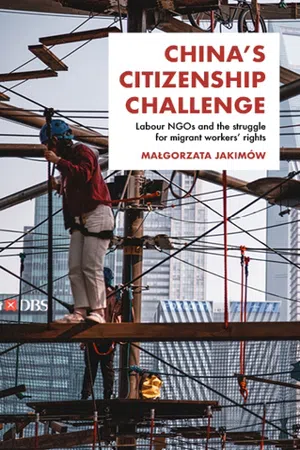
China's citizenship challenge tells a story of how labour NGOs contest migrant workers' citizenship marginalisation in China. The book argues that in order to effectively address problems faced by migrant workers, these NGOs must undertake 'citizenship challenge': the transformation of migrant workers' social and political participation in public life, the broadening of their access to labour and other rights, and the reinvention of their relationship to the city.
By framing the NGOs' activism in terms of citizenship rather than class struggle, this book offers a valuable contribution to the field of labour movement studies in China. The monograph also proves exceptionally timely in the context of the state's repression of these organisations in recent years, which, as the book explores, were largely driven by their citizenship-altering activism.
eBook - ePub
China's citizenship challenge
Labour NGOs and the struggle for migrant workers' rights
- 322 pages
- English
- ePUB (mobile friendly)
- Available on iOS & Android
eBook - ePub
China's citizenship challenge
Labour NGOs and the struggle for migrant workers' rights
About this book
Information
Structural citizenship
1
Migrant workers’ citizenship, the hukou system and local state policies: a genealogical enquiry
The story of citizenship is closely linked to the story of urbanisation: the story of how urban life imposed a different perspective of time and space which forged national consciousness, of how communities transformed from tight, familial networks to self-governing bodies of individuals, of how technology, the mainstream urban cultures and city images shaped urbanites’ identity. From Greek polis, to the emergence of medieval cities to the multicultural, global cities of nowadays, city has been central to the shaping of citizenship. Yet, in this story of how urbanisation formed citizens, there is rarely a chapter authored by those who live in the shadows of the city. They are the ones who are given their voice only once they rise, change and move, and once they become fully urban, as if their own experience of what came before is irrelevant. In the Chinese context, these marginal experiences are the experiences of rural migrant workers. Suspended in the world of in-between – not yet fully urban, but already delinked from their rural home – migrant workers are at the forefront of shaping new forms of urban belonging and citizenship in China.
This chapter presents a genealogical enquiry into how rural migrant workers have played such an important role in the shaping of citizenship in China. As discussed in the introduction, in China, the story of migrant workers’ citizenship has been predominantly told in relation to the hukou system and the suzhi discourse. Yet in order to fully grasp the role of migrant workers in citizenship formulation and contestation, it is necessary to go beyond these two aspects, and look at how both discursive and legal aspects of structural citizenship have been shaped in China. The first section presents the role of the rural–urban divide in the formation of the concept of citizenship in China and in the relationship between citizenship discourse and regime. I propose here that the mechanism which unifies both, citizenship discourse and regime, is the spatio-temporal ‘othering’ imaginary introduced with the onset of Western-influenced modernisation. This mechanism hierarchically identifies urban, modern and Han residents as ‘proper’ citizens, while excluding migrant workers and peasants as those who are of a ‘worse sort’ and need to be ‘turned into citizens’ (shiminhua). The citizenship regime, with its cornerstone in the Maoist version of the hukou system, was both a consequence of this modernist vision of citizenship, and a driving force behind its contemporary entrenchment. The second section looks at how citizenship has been shaped in relation not only to the rural–urban divide, but also state–society relations. I reflect here on how the concept of citizenship has been shaped at the crossroads of Western and Confucian traditions, and how this tension, in turn, was translated into citizenship education in post-Maoist China, which promoted the paternalistic, state-obedient ideal of citizenship. The final section discusses how the combined forces of the hierarchical rural–urban imaginary, the hukou system and the prescribed citizenship practices of obedience and passivity have interplayed with local state policies in urban China. I analyse three cities in particular – Shenzhen, Beijing and Hangzhou – as these are the locations of the majority of NGOs in this study, and three key endpoints of migration. I discuss the variegated municipal policies of these three locations towards both migrant workers and NGOs. This discussion allows exploration of local particularities of state approach to the political, social and material position of migrant workers in urban China.
Migrant workers’ role in the historical formation of citizenship in China
In order to grasp adequately the extent to which structural citizenship affects migrant workers’ position in China, the hierarchical character of structural citizenship in China should be traced beyond hukou and suzhi debates, and positioned within the wider context of how citizenship has been forged in modernity. The rural–urban divide has played a crucial role in the process of the modern shaping of citizenship in China, since long before the Maoist-type hukou system was introduced. Indeed, it owes much to the way Western experience of modernity filtered into China through semi-colonial encounters with the West. Mayfair Yang (2011) argues that with the appropriation of Western theories in China at the turn of the twentieth century, the Chinese modern elites started seeing anything non-modern as ‘backward’ and ‘shameful’. Such ‘Orientalist’ self-perception in both the state's and intellectuals’ self-image as Chinese in relationship to the West, as well as their approach to the many groups within China, became intertwined with the modern development of citizenship in China.1
One important theory which underlay this conceptualisation of citizenship is Max Weber's assertion that citizenship is necessarily an urban (and Occidental) phenomenon (Weber, 1963: 1228; Weber, 1930). This theory, in its original European context, was both a response to urbanisation as the engine of modernisation, and an attempt to disentangle a complex relationship between citizenship and the city. While it was the nineteenth-century condition of industrialisation that especially forcefully created the perception of peasants (and impoverished migrants to the city) as ‘savages’ and non-citizens (Weber, 1976: 3), a close link between cities and citizenship is recurrent in the history of Europe. Engin Isin (2002) shows how the city, as the space around which citizenship was initially formed in ancient Greece, has been continuously reappropriated throughout history. Even when citizenship became equated with nationality and belonging to the state rather than the city, the characteristics of urban citizenship were retained in the characteristics of state citizenship (Isin, 2009: 374–375). This ‘Weberian’ understanding of citizenship as necessarily urban has also become a cornerstone of the contemporary understanding of citizenship in China after its contact with the West.2 This was the decisive impact which influenced the treatment of peasants, and later migrant workers, in China, long before the introduction of the hukou system.
In China, before contact with the colonial powers in the nineteenth century, the relationship between city and countryside was strikingly different. Under the early Qing empire, it was based on balanced economic and cultural exchanges between rural and urban, whereby rural life and identities were seen not as inferior, but rather as ideal: the microcosms of the empire (Oakes and Schein, 2006: 4; Duara, 2000: 15). This equilibrium started to shift after the first Opium War in 1840, and the change was further embedded in the Republican era (1912–1949), when the rapid growth of coastal cities gave rise to new urban elites located in the colonial enclaves, which envisioned the character of Chinese cities as ‘global’, and ‘urban’ as modern, in contrast to rural China and to the rural migrants to the city (Yeh, 1997).
Ironically, this modernist tendency continued during Communism. Officially, the Communists strived to renounce anything that they associated with the ‘bourgeois’ capitalist class of the Republican era, including urban merchants and semi-colonised urban culture (Whyte and Parish, 1984: 10–16; Yeh, 1997: 378). The rejection of the Republican Chinese urban values opened a way to ‘ruralise’ city culture and organisation. For instance, with the gradual introduction of ‘work units’ (danwei) in the cities after 1949, the entire life-work of an individual or a collective was organised around a particular walled-off, urban, village-like community (Dutton, 1992: 231–232). However, even though the ‘rural’ was the new ideal to be re-enacted in the ‘revolutionary’ cities, the Maoist understanding of the ‘rural’ had little to do with Imperial China's conception of the ‘rural’ as the microcosm of the empire. Instead of family- or clan-centred identities, the Communists sought to remake both the city and the countryside into a new society (see Mao, 1940), where the old ‘feudal’ organisation of rural life was to be replaced by classless social relations, a process which peaked in the years of the Cultural Revolution (Cohen, 1993: 152–154). The hukou system, established in the late 1950s, was to aid this project by enabling strict monitoring of the ideological education of the peasantry, at the same time limiting movement of the population. By limiting people's movement, the system ensured a steady flow of produce from the countryside to the growing urban areas, ensuring that urban Chinese lived in the comfort of welfare provisions guaranteed by their danwei. In the meantime, despite the Maoist rhetoric, peasants continued to be seen as a ‘feudal’ and ‘backward’ part of society, which needed to be remade into a new class in order to lead the revolution (Cohen, 1993: 156).
Subsequently, after the ‘opening to the world reforms’ (kaifang gaige), the narratives of development and progress became even more pronounced, while peasant identities experienced a...
Table of contents
- Cover
- Half-title page
- Title page
- Copyright page
- Contents
- List of figures
- Acknowledgements
- List of abbreviations
- Introduction: Labour non-governmental organisations (NGOs) and the citizenship challenge
- Part I Structural citizenship
- Part II Civic organising
- Part III Labour
- Part IV Space
- Conclusion: Citizenship challenge, social inequality and the insecure state
- Appendices
- References
- Index
Trusted by 375,005 students
Access to over 1.5 million titles for a fair monthly price.
Study more efficiently using our study tools.
Frequently asked questions
Yes, you can cancel anytime from the Subscription tab in your account settings on the Perlego website. Your subscription will stay active until the end of your current billing period. Learn how to cancel your subscription
No, books cannot be downloaded as external files, such as PDFs, for use outside of Perlego. However, you can download books within the Perlego app for offline reading on mobile or tablet. Learn how to download books offline
Perlego offers two plans: Essential and Complete
- Essential is ideal for learners and professionals who enjoy exploring a wide range of subjects. Access the Essential Library with 800,000+ trusted titles and best-sellers across business, personal growth, and the humanities. Includes unlimited reading time and Standard Read Aloud voice.
- Complete: Perfect for advanced learners and researchers needing full, unrestricted access. Unlock 1.5M+ books across hundreds of subjects, including academic and specialized titles. The Complete Plan also includes advanced features like Premium Read Aloud and Research Assistant.
We are an online textbook subscription service, where you can get access to an entire online library for less than the price of a single book per month. With over 1.5 million books across 990+ topics, we’ve got you covered! Learn about our mission
Look out for the read-aloud symbol on your next book to see if you can listen to it. The read-aloud tool reads text aloud for you, highlighting the text as it is being read. You can pause it, speed it up and slow it down. Learn more about Read Aloud
Yes! You can use the Perlego app on both iOS and Android devices to read anytime, anywhere — even offline. Perfect for commutes or when you’re on the go.
Please note we cannot support devices running on iOS 13 and Android 7 or earlier. Learn more about using the app
Please note we cannot support devices running on iOS 13 and Android 7 or earlier. Learn more about using the app
Yes, you can access China's citizenship challenge by Malgorzata Jakimów in PDF and/or ePUB format, as well as other popular books in Politics & International Relations & Housing & Urban Development Law. We have over 1.5 million books available in our catalogue for you to explore.