eBook - PDF
Statistics on the Table
The History of Statistical Concepts and Methods
- 503 pages
- English
- PDF
- Available on iOS & Android
eBook - PDF
About this book
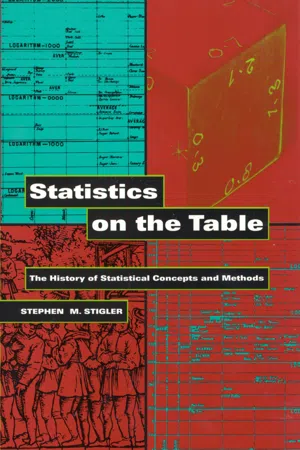
This lively collection of essays examines in witty detail the history of some of the concepts involved in bringing statistical argument "to the table," and some of the pitfalls that have been encountered. The topics range from seventeenth-century medicine and the circulation of blood, to the cause of the Great Depression and the effect of the California gold discoveries of 1848 upon price levels, to the determinations of the shape of the Earth and the speed of light, to the meter of Virgil's poetry and the prediction of the Second Coming of Christ. The title essay tells how the statistician Karl Pearson came to issue the challenge to put "statistics on the table" to the economists Marshall, Keynes, and Pigou in 1911. The 1911 dispute involved the effect of parental alcoholism upon children, but the challenge is general and timeless: important arguments require evidence, and quantitative evidence requires statistical evaluation. Some essays examine deep and subtle statistical ideas such as the aggregation and regression paradoxes; others tell of the origin of the Average Man and the evaluation of fingerprints as a forerunner of the use of DNA in forensic science. Several of the essays are entirely nontechnical; all examine statistical ideas with an ironic eye for their essence and what their history can tell us about current disputes.
Information
Publisher
Harvard University PressYear
2002Print ISBN
9780674009790
9780674836013
eBook ISBN
9780674267602
Table of contents
- Cover
- Title Page
- Copyright
- Dedication
- Contents
- Acknowledgments
- Introduction
- Part I. Statistics and Social Science
- Part II. Galtonian Ideas
- Part III. Some Seventeenth-Century Explorers
- Part IV. Questions of Discovery
- Part V. Questions of Standards
- References
- Credits
- Index
Trusted by 375,005 students
Access to over 1.5 million titles for a fair monthly price.
Study more efficiently using our study tools.
Frequently asked questions
Yes, you can cancel anytime from the Subscription tab in your account settings on the Perlego website. Your subscription will stay active until the end of your current billing period. Learn how to cancel your subscription
No, books cannot be downloaded as external files, such as PDFs, for use outside of Perlego. However, you can download books within the Perlego app for offline reading on mobile or tablet. Learn how to download books offline
Perlego offers two plans: Essential and Complete
- Essential is ideal for learners and professionals who enjoy exploring a wide range of subjects. Access the Essential Library with 800,000+ trusted titles and best-sellers across business, personal growth, and the humanities. Includes unlimited reading time and Standard Read Aloud voice.
- Complete: Perfect for advanced learners and researchers needing full, unrestricted access. Unlock 1.5M+ books across hundreds of subjects, including academic and specialized titles. The Complete Plan also includes advanced features like Premium Read Aloud and Research Assistant.
We are an online textbook subscription service, where you can get access to an entire online library for less than the price of a single book per month. With over 1.5 million books across 990+ topics, we’ve got you covered! Learn about our mission
Look out for the read-aloud symbol on your next book to see if you can listen to it. The read-aloud tool reads text aloud for you, highlighting the text as it is being read. You can pause it, speed it up and slow it down. Learn more about Read Aloud
Yes! You can use the Perlego app on both iOS and Android devices to read anytime, anywhere — even offline. Perfect for commutes or when you’re on the go.
Please note we cannot support devices running on iOS 13 and Android 7 or earlier. Learn more about using the app
Please note we cannot support devices running on iOS 13 and Android 7 or earlier. Learn more about using the app
Yes, you can access Statistics on the Table by Stephen M. Stigler in PDF and/or ePUB format, as well as other popular books in Mathematics & Probability & Statistics. We have over 1.5 million books available in our catalogue for you to explore.