Genomic Sequence Analysis for Exon Prediction Using Adaptive Signal Processing Algorithms
eBook - ePub

Genomic Sequence Analysis for Exon Prediction Using Adaptive Signal Processing Algorithms

  1. 192 pages
  2. English
  3. ePUB (mobile friendly)
  4. Available on iOS & Android
eBook - ePub

Genomic Sequence Analysis for Exon Prediction Using Adaptive Signal Processing Algorithms

About this book

This book addresses the issue of improving the accuracy in exon prediction in DNA sequences using various adaptive techniques based on different performance measures that are crucial in disease diagnosis and therapy. First, the authors present an overview of genomics engineering, structure of DNA sequence and its building blocks, genetic information flow in a cell, gene prediction along with its significance, and various types of gene prediction methods, followed by a review of literature starting with the biological background of genomic sequence analysis. Next, they cover various theoretical considerations of adaptive filtering techniques used for DNA analysis, with an introduction to adaptive filtering, properties of adaptive algorithms, and the need for development of adaptive exon predictors (AEPs) and structure of AEP used for DNA analysis. Then, they extend the approach of least mean squares (LMS) algorithm and its sign-based realizations with normalization factor for DNA analysis. They also present the normalized logarithmic-based realizations of least mean logarithmic squares (LMLS) and least logarithmic absolute difference (LLAD) adaptive algorithms that include normalized LMLS (NLMLS) algorithm, normalized LLAD (NLLAD) algorithm, and their signed variants. This book ends with an overview of the goals achieved and highlights the primary achievements using all proposed techniques. This book is intended to provide rigorous use of adaptive signal processing algorithms for genetic engineering, biomedical engineering, and bioinformatics and is useful for undergraduate and postgraduate students. This will also serve as a practical guide for Ph.D. students and researchers and will provide a number of research directions for further work.

Features

  • Presents an overview of genomics engineering, structure of DNA sequence and its building blocks, genetic information flow in a cell, gene prediction along with its significance, and various types of gene prediction methods
  • Covers various theoretical considerations of adaptive filtering techniques used for DNA analysis, introduction to adaptive filtering, properties of adaptive algorithms, need for development of adaptive exon predictors (AEPs), and structure of AEP used for DNA analysis
  • Extends the approach of LMS algorithm and its sign-based realizations with normalization factor for DNA analysis
  • Presents the normalized logarithmic-based realizations of LMLS and LLAD adaptive algorithms that include normalized LMLS (NLMLS) algorithm, normalized LLAD (NLLAD) algorithm, and their signed variants
  • Provides an overview of the goals achieved and highlights the primary achievements using all proposed techniques

Dr. Md. Zia Ur Rahman is a professor in the Department of Electronics and Communication Engineering at Koneru Lakshmaiah Educational Foundation (K. L. University), Guntur, India. His current research interests include adaptive signal processing, biomedical signal processing, genetic engineering, medical imaging, array signal processing, medical telemetry, and nanophotonics.

Dr. Srinivasareddy Putluri is currently a Software Engineer at Tata Consultancy Services Ltd., Hyderabad. He received his Ph.D. degree (Genomic Signal Processing using Adaptive Signal Processing algorithms) from the Department of Electronics and Communication Engineering at Koneru Lakshmaiah Educational Foundation (K. L. University), Guntur, India. His research interests include genomic signal processing and adaptive signal processing. He has published 15 research papers in various journals and proceedings. He is currently a reviewer of publishers like the IEEE Access and IGI.
Tools to learn more effectively

Saving Books

Saving Books

Keyword Search

Keyword Search

Annotating Text

Annotating Text

Listen to it instead

Listen to it instead

Information

Publisher
CRC Press
Year
2021
eBook ISBN
9781000375220

1 Introduction

1.1 Genomics Engineering

In the past few decades, engineering in genomics has become a vigorous area of study that has attracted massive attention from the digital signal processing (DSP) research community. Some of its primary goals are analysis of deoxyribonucleic acid (DNA) sequences, protein structure modeling, locating exon segments in gene sequences, and finding correlations between various gene expression profiles. Genomic sequence analysis can be classified into two well-researched areas: DNA sequence analysis and microarray analysis. Signal processing in genomics is a novel field of research that combines DSP methods for a superior gene data analysis [1]. This book discourses a substantial challenging issue, namely, exon prediction in the DNA sequences of Homo sapiens in the area of genome sequence analysis. With the recent completion of numerous very large-scale genomic sequencing projects (e.g. human, Caenorhabditis elegans) and the need for a future scope of learning about different novel gene sequences, this issue is considered on major real significance. This issue arises primarily as the nature of genes in a genome is not continuous. Eukaryotic genes are further categorized into coding regions termed as exons and also other sections named as introns. Moreover, both these sections comprise the major part of a genome. The exon sections occupy only 3% of the human DNA.
The narrow accuracy of the various available data-driven software programs for gene prediction such as AUGUSTUS [2], FGENESH [3], GeneID [4], GeneMark.hmm [5], Genie [6], GENSCAN [7], HMM-gene [8], MORGAN [9], and MZEF [10] is an indication for improvement in the accuracy of gene prediction. The effectiveness of different gene finding programs is presented in Ref. [11]; also the use of Bayesian gene prediction, as illustrated in Ref. [12], has been put forward to use non-traditional methods, and thus this area is worth to investigate further. This can be dealt thru inspecting the roles of specific DSP procedures and developing different novel adaptive techniques towards improving the effectiveness of algorithms for exon identification. DSP-based techniques remain prominent as genomic data do not need any training, unlike prevailing data-driven methods.

1.2 DNA Sequence Structure

The key info that is essential for building and also maintaining an organism’s structure is present in a complex molecule known as DNA. It is comprised of genetic codes formed with four nucleotide bases: adenine (A), cytosine (C), guanine (G), and thymine (T). Phosphates along with sugar molecules are linked to every base, and all these are combined to form a nucleotide. The need for analyzing using DSP methods remains crucial due to diverse behaviors exhibited by DNA signals in different ‘amplitudes’ and ‘times’ (i.e. the base pair domain).
Converting these alphabetic bases to distinct numeric sequences aids new beneficial applications of DSP to solve diverse issues connected to DNA like gene identification. DSP elucidates this task with an improved accuracy and also less complexity [13]. This work is highly cross-disciplinary in nature while basic subject matter is biological and final results obtained are of biological interest, techniques from other fields like DSP are greatly used.
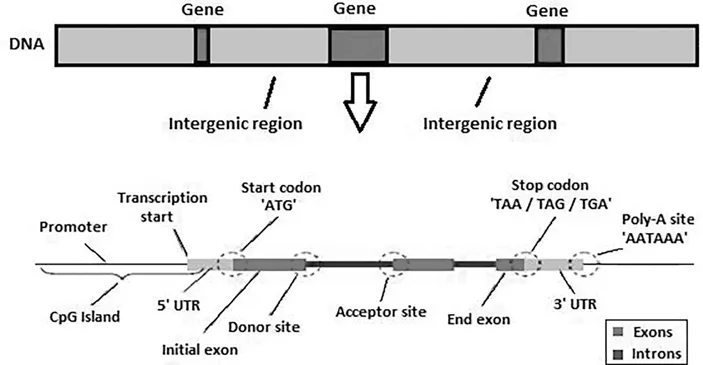
The precise prediction of exon/intron sections, splice sites of acceptor/donor, additional segments, and also genetic signals of DNA with genic and intergenic sections is depicted in Figure 1.1. These positions relevant to 5′ and 3′ end points were accustomed in linking exon segments present on two sides of introns termed as splicing. A novel ailment-free computation method is presented in Ref. [14] for calculating the distance between a pair of sequences. In this work, the roles of DSP techniques in locating exon segments of genomic sequences are examined, and novel adaptive exon predictor (AEP)-based methods are developed for this purpose. Prevalent DSP techniques for exon prediction remain less accurate due to their lone dependency on period-3 identification, and they are also not good in terms of exon locating ability, computational complexities, and convergence behavior.
images
FIGURE 1.1 DNA with genic and intergenic regions.
In this book, several methods of DNA symbolic-to-numeric representation for extraction of exon segments are reviewed and a Voss binary representation for conversion of alphabetic DNA to binary notation is also presented. The existing least mean squares (LMS) and new AEP-based techniques are then evaluated using real gene datasets taken from NCBI gene databank using various performance metrics computed at nucleotide level. We believe that the proposed novel DSP-based adaptive techniques are effective in gene identification, and also their ensuing AEPs offer improved gene prediction accuracy, better convergence performance, and considerably lower computational complexity than that offered by the existing LMS methods.

1.3 Motivation for the Work

As observed thru different findings and an extensive survey of literature, exon prediction remains as a crucial step in disease diagnosis. Almost one in six deaths in the world is due to cancer, and thus, cancer has become the second most common cause of death. As per WHO statistics, cardiovascular and dreadful diseases like cancer are leading causes of death worldwide. Non-communicable diseases (NCDs), such as cardiovascular diseases (17.9 million), cancers (around 9 million), respiratory diseases (3.9 million), and diabetes (1.6 million), kill 41 million individuals every year worldwide.
As per World Cancer Report 2014, 8...

Table of contents

  1. Cover
  2. Half Title
  3. Title Page
  4. Copyright Page
  5. Table of Contents
  6. Authors
  7. Chapter 1 Introduction
  8. Chapter 2 Literature Review
  9. Chapter 3 Sign LMS Based Realization of Adaptive Filtering Techniques for Exon Prediction
  10. Chapter 4 Normalization-Based Realization of Adaptive Filtering Techniques for Exon Prediction
  11. Chapter 5 Logarithmic-Based Realization of Adaptive Filtering Techniques for Exon Prediction
  12. Chapter 6 Conclusion and Future Perspective
  13. References
  14. Index

Frequently asked questions

Yes, you can cancel anytime from the Subscription tab in your account settings on the Perlego website. Your subscription will stay active until the end of your current billing period. Learn how to cancel your subscription
No, books cannot be downloaded as external files, such as PDFs, for use outside of Perlego. However, you can download books within the Perlego app for offline reading on mobile or tablet. Learn how to download books offline
Perlego offers two plans: Essential and Complete
  • Essential is ideal for learners and professionals who enjoy exploring a wide range of subjects. Access the Essential Library with 800,000+ trusted titles and best-sellers across business, personal growth, and the humanities. Includes unlimited reading time and Standard Read Aloud voice.
  • Complete: Perfect for advanced learners and researchers needing full, unrestricted access. Unlock 1.4M+ books across hundreds of subjects, including academic and specialized titles. The Complete Plan also includes advanced features like Premium Read Aloud and Research Assistant.
Both plans are available with monthly, semester, or annual billing cycles.
We are an online textbook subscription service, where you can get access to an entire online library for less than the price of a single book per month. With over 1 million books across 990+ topics, we’ve got you covered! Learn about our mission
Look out for the read-aloud symbol on your next book to see if you can listen to it. The read-aloud tool reads text aloud for you, highlighting the text as it is being read. You can pause it, speed it up and slow it down. Learn more about Read Aloud
Yes! You can use the Perlego app on both iOS and Android devices to read anytime, anywhere — even offline. Perfect for commutes or when you’re on the go.
Please note we cannot support devices running on iOS 13 and Android 7 or earlier. Learn more about using the app
Yes, you can access Genomic Sequence Analysis for Exon Prediction Using Adaptive Signal Processing Algorithms by Md. Zia Ur Rahman,Srinivasareddy Putluri in PDF and/or ePUB format, as well as other popular books in Mathematics & Biotechnology. We have over one million books available in our catalogue for you to explore.