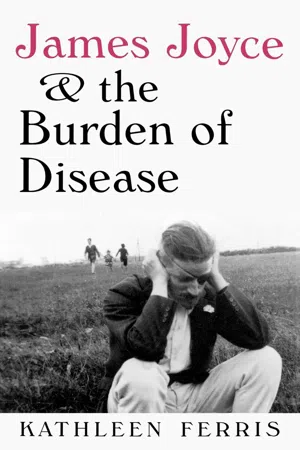
James Joyce's near blindness, his peculiar gait, and his death from perforated ulcers are commonplace knowledge to most of his readers. But until now, most Joyce scholars have not recognized that these symptoms point to a diagnosis of syphilis. Kathleen Ferris traces Joyce's medical history as described in his correspondence, in the diaries of his brother Stanislaus, and in the memoirs of his acquaintances, to show that many of his symptoms match those of tabes dorsalis, a form of neurosyphilis which, untreated, eventually leads to paralysis.
Combining literary analysis and medical detection, Ferris builds a convincing case that this dread disease is the subject of much of Joyce's autobiographical writing. Many of this characters, most notably Stephen Dedalus and Leopold Bloom, exhibit the same symptoms as their creator: stiffness of gait, digestive problems, hallucinations, and impaired vision. Ferris also demonstrates that the themes of sin, guilt, and retribution so prevalent in Joyce's works are almost certainly a consequence of his having contracted venereal disease as a young man while frequenting the brothels of Dublin and Paris. By tracing the images, puns, and metaphors in Ulysses and Finnegans Wake, and by demonstrating their relationship to Joyce's experiences, Ferris shows the extent to which, for Joyce, art did indeed mirror life.
- 184 pages
- English
- ePUB (mobile friendly)
- Available on iOS & Android
eBook - ePub
James Joyce and the Burden of Disease
About this book
Information
Publisher
The University Press of KentuckyYear
2021Print ISBN
9780813126647
9780813118932
eBook ISBN
9780813184531
1
The Creative Daemon
For the creative artist, the act of writing frequently is the result of an inner compulsion, the fulfillment of a need. Sometimes the creative impulse stems from a desire to communicate to others whatever special insights the author has gained through the process of living, to share one’s world view. Writing can also be a means of communicating with the hidden, unconscious part of oneself, or it can be an act of catharsis. As we have noted, for Joyce, writing was a way of ordering experience to try to make sense out of life. It was also an act of purgation. In him, the creative urge seems to be rooted in sin and guilt; throughout his writings we find these motifs resonating.
In an essay he wrote on Oscar Wilde in 1909, five years after he and Nora departed for the continent, Joyce emphasizes the importance of sin in the art and life of that writer, in words that echo some of his own themes:
Here we touch the pulse of Wilde’s art—sin. He deceived himself into believing that he was the bearer of good news of neo-paganism to an enslaved people. His own distinctive qualities, the qualities, perhaps, of his race—keenness, generosity, and a sexless intellect—he placed at the service of a theory of beauty which, according to him, was to bring back the Golden Age and the joy of the world’s youth. But if some truth adheres to his subjective interpretations of Aristotle,. . . at its very base is the truth inherent in the soul of Catholicism: that man cannot reach the divine heart except through that sense of separation and loss called sin. (Critical Writings 204-5)
We could attribute Joyce’s preoccupation with sin to his religious upbringing, but to explain this concern solely in terms of his Roman Catholic background would be a case of oversimplification; certainly many other Irish Catholic write—Padraic Colum, Frank O’Connor, Patrick Kavanagh, Austin Clarke, to name only a few—have managed to escape the degree of obsession with sin and guilt that permeates Joyce’s works. The trait seems a personal one with him, not to be dismissed as merely part of a cultural phenomenon. Many critics have commented upon the theme of guilt in Joyce’s writings, as did Darcy O’Brien in The Conscience of Joyce in 1968, but heretofore scholars have not fully explored the source of this personal preoccupation.
In order to locate the mainsprings of Joyce’s creativity, it is helpful to look beyond existing biographical constructs of the artist to his own words, where the patterns of his thought are to be found in the metaphors he used in reference to himself. Frequently what he says through indirection is more revealing than what is stated more bluntly. In his works, both published and unpublished, we find a number of recurrent images and figures of speech that he used to describe himself.
From earliest childhood, Joyce seems to have identified with Satan, the Arch-Sinner. At first, the feelings he attached to this self-image were not altogether negative. Early in his life especially, he enjoyed playing the bad boy. According to his brother Stanislaus, when he was a young child, Joyce directed the children of the family nursery in a dramatization of the fall of Adam and Eve, reserving for himself the role of serpent (MBK 27). Joyce’s childhood playmate, Eileen Vance Harris, tells a similar story, that “Jimmie had his own way of punishing his small brothers and sisters when they displeased him. He had a red stocking cap and a little red wheelbarrow. The offending child was made to lie on the ground, the wheelbarrow was put over him, and Jimmie donned the red cap. Now he was the Devil and made sounds to indicate that the offender under the wheelbarrow was being burned in Hell” (Ellmann Collection, Tulsa).
As a young man, Joyce again assumed a diabolic role, this time of a lofty Miltonic Satan, in a satiric broadside, “The Holy Office,” fired at his fellow writers just before he left Ireland to reside permanently on the European continent:
Where they have crouched and crawled and prayed
I stand, the self-doomed, unafraid, Unfellowed,
friendless and alone.
(Portable JJ 659)
Stephen Dedalus strikes a similar pose when like Lucifer he declares: “Nonserviam” (Portrait 239; Ulysses 15.4228). References to Milton’s Satan and to Paradise Lost also occur in Finnegans Wake (Schork).
Toward the end of his life, when writing a children’s story for his grandson Stephen, a story about the devil and a cat, Joyce once more identified himself with Satan in the postscript appended to his letter: “The devil mostly speaks a language of his own called Bellsybabble which he makes up himself as he goes along but when he is very angry he can speak quite bad French very well though some who have heard him say he has a strong Dublin accent” (Ltrs. I: 388).
Joyce’s early Satanic posturings were perhaps merely the expression of an overactive imagination or of youthful arrogance; however, the consistency of his use of diabolic imagery in reference to himself suggests a deeply instilled sense of his own sinfulness, a self-image that was to have a profound effect on his life and art. Though with the passage of time, the proud, “self-doomed” Satan deteriorated into a babbling old devil, he remained among the company of the damned.
Perhaps one reason Joyce maintained this view of himself as sinner is that he identified with his scalawag father, upon whose death he wrote to Harriet Shaw Weaver, “I was very fond of him always, being a sinner myself, and even liked his faults” (Ltrs. I: 312). He also liked and identified with historical and literary sinners, filling his works with mythic outcasts. The figure of Cain seems particularly to have captured his imagination. In 1928 he sent to an American composer in Paris, George Anthiel, a copy of Byron’s drama Cain, suggesting that he use it as a libretto for an opera. The “Circe” episode of Ulysses, which he also wanted Anthiel to set to music, has Leopold Bloom branded with the letter C, the mark of Cain, and in Finnegans Wake Finn MacCool is told, “Just press this cold brand against your brow for a mow. Cainfully! The sinus the curse” (374.32). Many of the Biblical references in Ulysses are to great sinners: Stephen quotes not only Lucifer, but also Esau, King Ahab, and the Prodigal Son; Lynch is referred to as Judas; and Bloom is called the Antichrist and the Wandering Jew.
Frequently in private correspondence, Joyce’s allusions to sin are made in jest, such as, “Writing in English is the most ingenious torture ever devised for sins committed in previous lives,” and “Is not this adding a new horror to eternal punishment?” and “O dear me! What sins did I commit in my last incarnation to be in this hole?” (Ltrs. I: 120; III: 79; II: 88). In moments of dejection, however, his self-denigration knew no limits. To his benefactress, Harriet Shaw Weaver, he refers to “the dark side of my despicable character,” and to his wife, he says, “Take away your children from me to save them from the curse of my presence. Let me sink back into the mire I came from . . . . It is wrong for you to live with a vile beast like me or to allow your children to be touched by my hands” (Ltrs. I: 167; II: 265).
In this last example is another recurrent image by which Joyce conveys the idea of his own sinfulness, the metaphor of physical filth to represent spiritual corruption. In “The Holy Office,” he satirically describes the cathartic role of the poet by portraying himself in the function of a sewer:
That they may drem their dreamy dreams
I carry off their filthy streams.
For I can do those things for them
Through which I lost my diadem,
Those things for which Grandmother Church
Left me severely in the lurch.
Thus I relieve their timid arses,
Perform my office of Katharsis.
(Portable JJ 658)
References to physical filth continue in his depiction of literary characters. In Portrait of the Artist as a Young Man, when young Stephen Dedalus is pushed into an open sewage ditch by an older boy and consequently becomes very ill, the action prefigures Stephen’s later fall in a Dublin brothel, into the “foul swamp of sin” (114). The first fall, which results in disease, is probably not biographical, for Joyce’s brother Stanislaus remembers that Jim was in perfect health during his years at Clongowes Wood College (MBK 41); the second, as Stanislaus’s diaries show, undoubtedly is. In Ulysses, Leopold Bloom is described as “that vigilant wanderer, soiled by the dust of travel and combat and stained by the mire of an indelible dishonour,” and Stephen is called “the unclean bard” because, like Joyce, he refuses to bathe (14.1217-18; 1.475). In Finnegans Wake the washerwomen at the Ford refer to HCE as “duddurty devil” (196.15), and Justius tells Shem, “You will need all the elements in the river to clean you over it all and a fortifine popespriestpower bull of attender to booth” (188.5). Stanislaus recalls Joyce’s hygiene as a university student: “During a parlour game called ‘Confession,’ when asked what was his pet aversion, he answered promptly ‘Soap and water,’ and I believe it was the truth” (MBK 123). One possible explanation of this behavior is given by psychologist Theodor Reik: “Analytic observation shows . . . that neglect of cleanliness, dirt itself, becomes an unconscious sign of a feeling of guilt” (345). In Ulysses, Stephen too makes a correlation between dirt and guilt: “They wash and tub and scrub. Agenbite of inwit. Conscience. Yet here’s a spot” (1.481-82).
Yet Joyce had not always been a hydrophobe. J.F. Byrne, who had known him from boyhood, recalls: “Joyce was . . . a good swimmer, and during the summer months in the late 90’s he frequented the Bull Wall, at the southwest side, where he swam or sat sunning on the rocks, attired, like all the boys and young men at that place, in nothing at all” (176). By his later years, Joyce had acquired an avid dislike for public bathing. Jacques Mercanton recalls that he watched bathers “with horror” and “with his usual dread” (Potts 216, 236). Writing to his son Giorgio, who was vacationing at a seaside resort, Joyce explained his refusal to swim: “I should take a bath too but I am too proud. Or perhaps I have too much respect for the water” (Ltrs. III: 361). Joyce’s words imply that his own dirt would contaminate the ocean.
In Christian cultures, sexual sins are traditionally associated with the notion of filth, perhaps because since the late fifteenth century, promiscuity has been known to lead to disease. In his writing Joyce repeatedly juxtaposes images of dirt and sexually transmitted infections. In Giacomo Joyce, an autobiographical vignette written in Trieste c. 1914, we see the image of “the cesspool of the court of slobbering James” with “the pox-fouled wenches and young wives that, gaily yielding to their ravishers, clip and clip again” (9). In the “Epilogue to Ibsen’s Ghosts” that Joyce wrote in 1932, the ghost of Captain Alving (who during his lifetime had infected his wife and child with syphilis) compares himself to a “lewd knight in dirty linen” (Yale). Stephen’s guilt and repentance for his sins in Portrait of the Artist are expressed in terms of mire, excrement, corruption, foulness, infection. His confession is described thus: “His sins trickled from his lips, one by one, trickled in shameful drops from his soul festering and oozing like a sore, a squalid stream of vice. The last sins oozed forth, sluggish, filthy” (144). The old priest warns Stephen in the confessional of the physical as well as the spiritual consequences of his actions: “You are very young, my child, he said, and let me implore of you to give up that sin. It is a terrible sin. It kills the body and it kills the soul” (144-45). The priest is clearly warning the boy against the dangers of venereal infection. As Allan M. Brandt has noted, victims of venereal disease think of themselves as filthy, or contaminated, or poisoned. He quotes one sufferer of herpes as saying, “You never think you’re clean enough” (181). Thus the images of filth which Joyce chose to describe his characters and himself convey associations both psychological and physical. They are an especially good example of the manner in which he uses imagery and allusion to create allegorical representations of his own life. As we shall see, Stephen Dedalus’s fall into the sewage ditch and the life-threatening illness that resulted are symbolic of Joyce’s own fall into the “foul swamp of sin” in brothels and of his consequent illness.
In Roman Catholicism, sin is washed away by the waters of Baptism, by the Blood of the Lamb, by the priest washing his hands before the consecration of the host, by annointing the senses of the dying person with holy oil, and by the sacrament of Confession. In Finnegans Wake, Joyce associates the ideas of washing and the need for confession. Justius suggests that unclean Shem say a “homely little confiteor about things” (188.4), and the old washerwomen, trying to scour the dirt and stain of sin out of the laundry of HCE and ALP, paraphrase the opening words of the penitent in the confessional, “Baptise me, father, for she has sinned!” (204.36) As Father William T. Noon has noted, Joyce ends Finnegans Wake with a pun on the words “wash-up” and “worship” (130).
The same reasoning which lies behind Joyce’s explanation to his son, that neither pride alone, nor aversion to water, but a deep sense of his own uncleanness kept him from bathing, lies behind Stephen Dedalus’s refusal to worship:
Devotion had gone by the board. What did it avail to pray when he knew that his soul lusted after its own destruction? A certain pride, a certain awe, withheld him from offering to God even one prayer at night though he knew it was in God’s power to take away his life while he slept and hurl his soul hellward ere he could beg for mercy. His pride in his own sin, his loveless awe of God, told him that his offence was too grievous to be atoned for in whole or in part by a false homage to the Allseeing and Allknowing. (Portrait 103-4)
The refusal to worship, like the refusal to wash-up, comes from a sense of unworthiness. Perhaps Joyce, like Stephen, became estranged from God not because of lack of faith, but from a sense that his offence against God was “too grievous to be atoned for.”
According to his own words, his rebellion against the church was not intellectual but emotional. He explained to his fiancée, Nora Barnacle: “Six years ago I left the Catholic Church, hating it most fervently. I found it impossible for me to remain in it on account of the impulses of my nature . . . . I cannot enter the social order except as a vagabond” (Ltrs. II: 48). Many years later, in discussing his religious crisis with the writer Padraic Colum, Joyce said, “Mind you, it was not a question of belief. It was a question of celibacy. I knew I could not live the life of a celibate” (Our Friend James Joyce 205-6).
For Joyce, as for Stephen, the...
Table of contents
- Cover
- Half title
- Title
- Copyright
- Contents
- List of Illustrations
- Acknowledgments
- Prologue
- 1 The Creative Daemon
- 2 The Wandering Jew in Ulysses
- 3 Epics of the Body
- 4 An Insectfable
- Epilogue: Dear mysterre Shame’s Voice
- Chronology of Joyce’s Medical History
- Notes
- Bibliography
- Index
Trusted by 375,005 students
Access to over 1.5 million titles for a fair monthly price.
Study more efficiently using our study tools.
Frequently asked questions
Yes, you can cancel anytime from the Subscription tab in your account settings on the Perlego website. Your subscription will stay active until the end of your current billing period. Learn how to cancel your subscription
No, books cannot be downloaded as external files, such as PDFs, for use outside of Perlego. However, you can download books within the Perlego app for offline reading on mobile or tablet. Learn how to download books offline
Perlego offers two plans: Essential and Complete
- Essential is ideal for learners and professionals who enjoy exploring a wide range of subjects. Access the Essential Library with 800,000+ trusted titles and best-sellers across business, personal growth, and the humanities. Includes unlimited reading time and Standard Read Aloud voice.
- Complete: Perfect for advanced learners and researchers needing full, unrestricted access. Unlock 1.5M+ books across hundreds of subjects, including academic and specialized titles. The Complete Plan also includes advanced features like Premium Read Aloud and Research Assistant.
We are an online textbook subscription service, where you can get access to an entire online library for less than the price of a single book per month. With over 1.5 million books across 990+ topics, we’ve got you covered! Learn about our mission
Look out for the read-aloud symbol on your next book to see if you can listen to it. The read-aloud tool reads text aloud for you, highlighting the text as it is being read. You can pause it, speed it up and slow it down. Learn more about Read Aloud
Yes! You can use the Perlego app on both iOS and Android devices to read anytime, anywhere — even offline. Perfect for commutes or when you’re on the go.
Please note we cannot support devices running on iOS 13 and Android 7 or earlier. Learn more about using the app
Please note we cannot support devices running on iOS 13 and Android 7 or earlier. Learn more about using the app
Yes, you can access James Joyce and the Burden of Disease by Kathleen Ferris in PDF and/or ePUB format, as well as other popular books in Literature & Literary Biographies. We have over 1.5 million books available in our catalogue for you to explore.