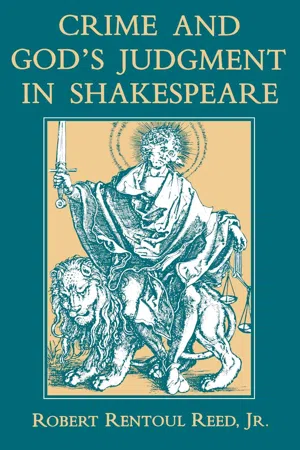
Divine retribution, Robert Reed argues, is a principal driving force in Shakespeare's English history plays and three of his major tragedies. Reed finds evidence of the playwright's growing ingenuity and maturing skill in his treatment of the crime of political homicide, its impact on events, and God's judgment on the criminal.
Reed's analysis focuses upon Tudor concepts that he shows were familiar to all Elizabethans—the biblical principle of inherited guilt, the doctrine that God is the fountainhead of retribution, with man merely His instrument, and the view that conscience serves a fundamentally divine function—and he urges us to look at Shakespeare within the context of his time, avoiding the too-frequent tendency of twentieth-century critics to force a modern world view on the plays.
Heaven's power of vengeance provides an essential unifying theme to the plays of the two historical tetralogies, Julius Caesar, Hamlet, and Macbeth. By analyzing these plays in the light of values held by Shakespeare's contemporaries, Reed has made a substantial contribution toward clarifying our understanding of the plays and of Elizabethan England.
- 232 pages
- English
- ePUB (mobile friendly)
- Available on iOS & Android
eBook - ePub
Crime and God's Judgment in Shakespeare
About this book
Information
NOTES

INTRODUCTION
1. David L. Frey, The First Tetralogy: Shakespeare’s Scrutiny of the Tudor Myth (The Hague and Paris, 1976), p. 10.
2. All quotations from Shakespeare’s plays in my introduction (and throughout) are from Peter Alexander, ed., Shakespeare: The Complete Works (New York, 1952).
3. Michael Quinn, “Providence in Shakespeare’s Yorkist Plays,” Shakespeare Quarterly, 10 (1959), p. 50.
4. Ibid.
5. Wilbur Sanders, The Dramatist and the Received Idea (Cambridge, 1968), p. 94.
6. Moody E. Prior, The Drama of Power: Studies in Shakespeare’s History Plays (Evanston, Ill., 1973), p. 49.
7. See Lloyd Berry, “Introduction,” The Geneva Bible (1560), facs. (Madison, Wisc., 1969), for an estimate of the number of editions printed between 1560 (first edition) and 1603. Until 1575, editions were printed in Geneva and were shipped to England. From 1575 to 1618, the Bodley Press in England issued “at least one new edition of the Geneva Bible . . . each year” (p. 14).
8. Several Elizabethan writers stress the principle that the magistrate (whether the king, the local or itinerant judge, or the hangman) was responsible principally to God. Among them, John Norden wrote: “God himselfe . . . will revenge it [a violation against authority], and the magistrate hath power from him to punish it” (The Mirror of Honor [London, 1597], p. 39). Edward Coke, attorney general of England during the last decade of Elizabeth’s reign, was to state categorically in his Institutes: “Revenge belongeth [only] to the magistrate, who is Gods lieutenant” (The Third Part of the Institutes of the Laws of England, written ca. 1620-1630 [London, 1797], p. 157). Mary B. Mroz, whose study of late medieval and Renaissance principles of God’s judgment upon human transgression is unusual in its thoroughness, sums up the Elizabethan view of the God/ magistrate relationship: “Public magistrates . . . are recognized as the foremost human agents of divine vengeance” (Divine Vengeance [Washington, D.C., 1941], p. 48).
9. Regarding God’s right and willingness to abrogate the divine right of an intractable king and to sanction his removal from office, see R.R. Reed, Jr., Richard II: From Mask to Prophet (University Park, Pa., 1968), pp. 22-31, especially pp. 26-30.
10. A.L. French, “The World of Richard III,” Shakespeare Studies, 4 (1968), p. 36.
11. Sanders, p. 107.
12. French, p. 37.
13. Fictitious.
14. Sanders, p. 93.
15. William Perkins, A Discourse of Conscience (1596), ed. Thomas F. Merrill (Nieuwkoop, Netherlands, 1966), p. 10.
16. Timothy Bright, A Treatise of Melancholie (1586), reprint ed. (New York, 1940), p. 185.
ONE: Shakespeare’s Eight-Part Epic
1. Henry A. Kelly, Divine Providence in the England of Shakespeare’s Histories (Cambridge, Mass., 1970), p. 39.
2. Kelly, p. 40, quoted from The Chronicles of John Hardyng (ca. 1465), ed. Sir Henry Ellis (London, 1812), p. 18. Kelly modernizes the spelling of all old texts. In a passage referring specifically to the Lancastrian curse of inherited guilt and its origin, Hardyng has written:
For when Henry the fourth first was cround,
Many a wyseman sayd full commenly,
The third heyre shuld not ioyse, but be uncround,
And deposed of all regalitie.
[Hardyng, p. 18]
3. Kelly, pp. 40-41. Quoted from John de Waurin, Recueil des chroniques/... de la Grant Bretaigne (ca. 1447), ed. Sir William Hardy and Edward Hardy, 5 vols. (1-4: London, 1884; 5:London, 1891), 2:393-94.
4. Kelly, p. 50. Quoted from A Political Retrospect, ed. Thomas Wright in Political Poems (London, 1861), pp. 267-69. The ancient author of this piece on the third heir is anonymous.
5. All biblical quotations are from the Geneva Bible (1560), the most widely circulated version in Elizabethan England. Between 1560 and 1611, it appeared in more than one hundred editions.
6. Kelly, p. 96. Quoted and translated from Polydore Vergil, Anglica historia (Basel, 1534), pp. 514-15.
7. Kelly, p. 126.
8. Edward Hall, The Union of The Two Noble and Illustre Famelies of Lancastre & Yorke (1548), reprint (London, 1809), p. 35. Quoted, the spelling having been modernized, by Kelly, p. 115.
9. Kelly, p. 117.
10. Ibid., p. 137.
11. Hall, pp. 245-48; see, in particular, pp. 246-47. For a shorter version, with spelling modernized, see Kelly, pp. 121-24.
12. Raphael Holinshed, Chronicles of England, Scotland, and Ireland, 2nd ed. (London, 1587), reprint ed., 6 vols. (London, 1808), 3:325. Quoted and spelling modernized by Kelly, p. 152.
13. Holinshed, 2:869.
14. Ibid., 3:24.
15. Kelly, p. 143.
16. John Donne, The Sermons of John Donne, ed. George R. Potter and Evelyn M. Simpson, 9 vols. (Berkeley, 1957), 3:284.
17. Hall, p. 292.
18. Holinshed, 3:448 (misnumbered 478).
19. Robert B. Pierce, Shakespeare...
Table of contents
- Cover
- Half title
- Title
- Copyright
- Contents
- Introduction
- One: The Structure of Shakespeare’s Eight-Part Epic
- Two: The Justice of God: Medieval and Renaissance
- Three: Thomas of Gloucester: The Sword of Retribution
- Four: Richard II and the Delay of Providence
- FIVE: The Later Gloucesters: Humphrey and Richard
- Six: Prince Hamlet and the Double Mission
- Seven: Macbeth, the Devil, and God
- Conclusion
- Notes
- Index
Trusted by 375,005 students
Access to over 1.5 million titles for a fair monthly price.
Study more efficiently using our study tools.
Frequently asked questions
Yes, you can cancel anytime from the Subscription tab in your account settings on the Perlego website. Your subscription will stay active until the end of your current billing period. Learn how to cancel your subscription
No, books cannot be downloaded as external files, such as PDFs, for use outside of Perlego. However, you can download books within the Perlego app for offline reading on mobile or tablet. Learn how to download books offline
Perlego offers two plans: Essential and Complete
- Essential is ideal for learners and professionals who enjoy exploring a wide range of subjects. Access the Essential Library with 800,000+ trusted titles and best-sellers across business, personal growth, and the humanities. Includes unlimited reading time and Standard Read Aloud voice.
- Complete: Perfect for advanced learners and researchers needing full, unrestricted access. Unlock 1.5M+ books across hundreds of subjects, including academic and specialized titles. The Complete Plan also includes advanced features like Premium Read Aloud and Research Assistant.
We are an online textbook subscription service, where you can get access to an entire online library for less than the price of a single book per month. With over 1.5 million books across 990+ topics, we’ve got you covered! Learn about our mission
Look out for the read-aloud symbol on your next book to see if you can listen to it. The read-aloud tool reads text aloud for you, highlighting the text as it is being read. You can pause it, speed it up and slow it down. Learn more about Read Aloud
Yes! You can use the Perlego app on both iOS and Android devices to read anytime, anywhere — even offline. Perfect for commutes or when you’re on the go.
Please note we cannot support devices running on iOS 13 and Android 7 or earlier. Learn more about using the app
Please note we cannot support devices running on iOS 13 and Android 7 or earlier. Learn more about using the app
Yes, you can access Crime and God's Judgment in Shakespeare by Robert Rentoul ReedJr.,Robert Rentoul Reed Jr. in PDF and/or ePUB format, as well as other popular books in Literature & English Literary Criticism. We have over 1.5 million books available in our catalogue for you to explore.